Content
- 16th Finance Commission & Urban Grants
- Why are Tribals Protesting in Maharashtra?
- IIT Council & Adaptive JEE
- DAY-NRLM at Crossroads (2026–31 Cycle)
- Mountain Gorilla Conservation & One Health Model
- 16th Finance Commission on Exit Clauses
16th Finance Commission & Urban Grants
Fiscal Federal Context
- 16th Finance Commission (FC) report tabled in Lok Sabha sets tax devolution and local body grants framework, signalling stronger fiscal recognition of urbanisation, municipal finance needs, and decentralised service delivery.
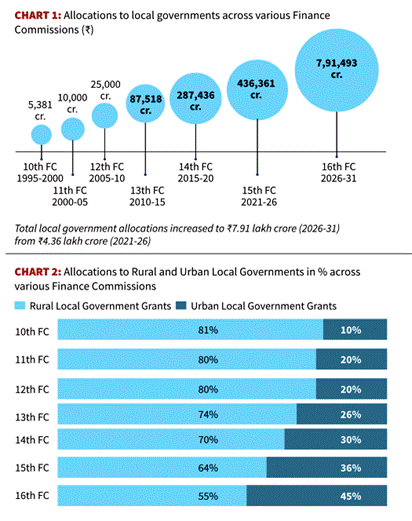
- Commission recommended ₹3.5 lakh crore for Urban Local Governments (ULGs) over five years, reflecting unprecedented scale-up in urban fiscal support amid rapid urbanisation and infrastructure stress.
Relevance
GS II — Polity & Governance
- Finance Commission (Article 280), fiscal federalism, Centre–State–ULB relations.
- Urban governance, decentralisation, and municipal finance reforms.
GS III — Economy
- Urban infrastructure financing, municipal bonds, property tax reforms.
- Public expenditure quality and local fiscal capacity.
Background — Finance Commission & Urbanisation
Role of Finance Commission
- Finance Commission, under Article 280, recommends vertical and horizontal devolution, including grants to local bodies to strengthen fiscal capacity and cooperative federalism.
- Urban grants aim to improve first-mile infrastructure, service delivery, and municipal governance in water, sanitation, mobility, and local public goods.
Urbanisation Context
- India’s urban population projected near 40% by 2036, increasing pressure on urban infrastructure, housing, and services, necessitating stronger municipal finances.
Key Recommendations — 16th FC
Quantum of Allocation
- Recommended ₹3.5 lakh crore to ULGs for five years, roughly matching Centre’s share in centrally sponsored urban schemes over previous 13 years combined (Janaagraha analysis).
- Marks 230% increase over 15th FC allocation of ₹1.5 lakh crore (2021–26), signalling major fiscal shift toward urban governance.
Share in Local Body Grants
- ULGs’ share in total local government grants raised to 45% from 36% earlier, indicating prioritisation of urban governance alongside Panchayati Raj Institutions.
Urbanisation Premium Grant
- Introduced ₹10,000 crore urbanisation premium grant to incentivise planned rural–urban transition, supporting emerging towns facing demographic and economic transformation pressures.
Grant Design & Structure
Basic vs Tied Grants
- Over 60% grants categorised as basic grants; tied components target core services like water supply and sanitation, ensuring minimum service standards.
- Untied grants allow location-specific spending flexibility, excluding salary and establishment costs, promoting local prioritisation and accountability.
State-wise Trends
Distribution Patterns
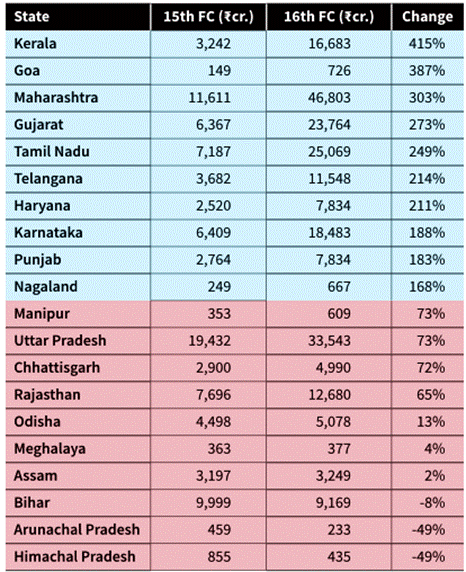
- Kerala recorded >400% increase in allocation, reflecting demographic and urban governance indicators; suggests performance-sensitive distribution.
- Himachal Pradesh saw ~50% decline, possibly linked to lower urbanisation levels or revised formula weights.
Economic & Governance Significance
Strengthening Municipal Capacity
- Enhanced grants can reduce ULG dependence on State transfers, enabling better own-source revenue leverage, creditworthiness, and municipal bond potential.
- Supports decentralised delivery of public goods, improving urban productivity, livability, and economic competitiveness.
Urban Transition Support
- Urbanisation premium recognises migration-driven town growth, helping finance infrastructure in peri-urban and census towns lacking formal governance capacity.
Data & Evidence
Key Figures
- ₹3.5 lakh crore recommended for ULGs.
- 230% rise from previous cycle.
- 45% share of local body grants to ULGs.
- ₹10,000 crore urbanisation premium.
- >60% basic grants structure.
Challenges & Concerns
Implementation Risks
- Weak municipal capacity, staffing gaps, and planning deficits may limit effective utilisation of larger grants.
- Persistent low property tax collection efficiency constrains fiscal sustainability despite higher transfers.
- Risk of grant dependency without parallel reforms in revenue mobilisation and governance.
Way Forward
Reform Priorities
- Link grants with municipal finance reforms, digital property tax systems, and user-charge rationalisation.
- Strengthen urban planning, GIS-based asset mapping, and participatory budgeting.
- Encourage municipal bonds and credit ratings for large cities.
Why are tribals protesting in Maharashtra?
Why in News ?
Immediate Context
- Thousands of tribals from Palghar and Nashik undertook long marches in January 2026 demanding land titles, irrigation support, and livelihood security, over pending forest rights.
- Protests gained traction as both districts have high tribal populations and long-standing grievances over land ownership recognition and welfare access.
Relevance
GS II — Polity & Social Justice
- FRA 2006, PESA 1996, Fifth Schedule — tribal rights and governance.
- Welfare delivery, land rights, and inclusion of STs.
GS III — Environment
- Forest governance, conservation vs livelihood debate.
- Community-based natural resource management.
Background — Tribal Land & Forest Rights
Constitutional Foundation
- Fifth Schedule mandates protection of tribal land and self-governance in Scheduled Areas, recognising historical injustice and need for cultural–economic safeguards.
- Article 244 provides administrative framework for Scheduled Areas, while PESA Act 1996 empowers Gram Sabhas over natural resource management.
Forest Rights Act (FRA), 2006
- FRA recognises Individual Forest Rights (IFR), Community Forest Rights (CFR), and habitat rights of Scheduled Tribes and Other Traditional Forest Dwellers.
- Objective is to correct historical injustice caused by colonial forest laws that alienated tribals from customary lands.
Core Issues Behind Protests
Land Title Concerns
- Tribals allege that titles issued contain incorrect formats, joint listings, or partial land recognition, restricting access to credit, schemes, and legal security.
- Many cultivators received titles for only fraction of land actually tilled, creating livelihood uncertainty.
High Rejection Rates
- Over 45% FRA claims rejected in Maharashtra, raising concerns about verification processes and interpretation standards.
- Out of 3,80,966 disposed claims, only 2,08,335 titles granted while 1,72,631 rejected, indicating significant exclusion.
Digitisation & Record Gaps
- Digitisation of land records reportedly caused mismatches between ground reality and official data, leading to claim denials and procedural delays.
Livelihood & Development Demands
Irrigation & Agriculture
- Protestors demand small dams and river-linking to divert west-flowing rivers for irrigating drought-prone eastern belts, enabling multi-cropping and income stability.
- Irrigation seen as critical for reducing dependence on rain-fed farming and seasonal migration.
Employment & Education
- Secure land rights linked to eligibility for institutional loans, schemes, and education benefits, making FRA implementation central to socio-economic mobility.
Governance & Policy Dimension
Implementation Deficit
- FRA implementation varies across States due to bureaucratic caution, forest department resistance, and differing interpretations of eligibility criteria.
- Gap exists between legal recognition and ground-level enforcement.
Ideological Tension
- Ecologist Madhav Gadgil noted tension between fortress conservation model and FRA’s community-based conservation vision.
- Debate framed as “conservation versus forest rights” reflects policy mindset conflict.
IIT Council & Adaptive JEE
Immediate Context
- IIT Council recommended exploring adaptive testing for JEE-Advanced to create a “better and less stressful assessment,” marking potential shift from uniform linear exams to technology-driven evaluation.
- Proposal includes a two-year transition (2026–2028) with optional adaptive mock tests from 2026 for calibration and familiarity.
Relevance
GS II — Governance & Education
- Education reforms, exam governance, transparency.
- Article 14 and equality in public examinations.
GS III — Science & Tech
- AI/data-driven testing, digital governance.
- EdTech and assessment reforms.
Background — Competitive Exams in India
Linear Examination Model
- Traditional exams use identical question papers for all candidates, ranking based on correct responses, often encouraging rote learning and coaching-oriented test-cracking strategies.
- High-stakes nature means even marginal score differences shape career trajectories, intensifying exam pressure.
Need for Reform
- Concerns over exam stress, memorisation culture, and inequitable assessment of conceptual ability have pushed policymakers toward assessment reforms focusing on aptitude and reasoning.
What is Adaptive Testing?
Concept & Mechanism
- Adaptive testing uses Item Response Theory (IRT) where computer algorithms select questions based on candidate performance, dynamically adjusting difficulty after each response.
- Test usually begins with medium-difficulty items; correct answers lead to harder questions, incorrect ones to easier items, refining ability estimates iteratively.
Assessment Logic
- Goal is precise ability measurement using fewer but better-targeted questions, reducing fatigue while improving psychometric accuracy.
- Candidates may face different questions yet remain comparable on a common ability scale.
Advantages of Adaptive Testing
Pedagogical Gains
- Rewards conceptual clarity since only strong candidates progress to high-difficulty, high-weightage questions, discouraging superficial preparation strategies.
- Reduces random guessing and score inflation, improving validity of merit ranking.
Efficiency & Fairness
- Shorter tests with equal reliability lower candidate stress and logistical burdens.
- Fairness embedded in design as difficulty adapts to individual performance rather than post-test normalisation.
- Widely used globally for over 25 years in exams like GRE and GMAT.
Legal & Constitutional Concerns
Equality Debate
- Under Article 14, equality often equated with identical question papers; adaptive testing’s varied questions may face judicial scrutiny.
- Fairness must be demonstrated through transparent scaling and scientific validation.
Algorithmic Transparency
- Algorithm opacity could trigger bias or discrimination claims unless supported by equity audits and disclosures.
- Robust grievance redressal needed to reduce litigation risk.
Operational Challenges
Infrastructure Risks
- Requires reliable digital infrastructure, especially in tier-2/3 cities, as glitches could be challenged as maladministration.
- Data centre reliability, secure proctoring, and incident handling must exceed current standards.
Question Bank Development
- Needs large, calibrated item banks with difficulty indexing, syllabus coverage, and leakage-proof pretesting—technically and administratively demanding.
Transition Strategy
Phased Rollout
- Proposed two-year transition includes optional adaptive mock tests to familiarise students and refine item calibration.
- Gradual implementation helps build stakeholder trust and reduce resistance.
Learning from Global Practice
- GRE and GMAT experiences show acceptance improves with transparency, technical documentation, and consistent communication.
Broader Significance
Education Reform Lens
- Reflects shift toward competency-based assessment aligned with NEP 2020 emphasis on critical thinking over rote learning.
- Signals growing role of data science and AI in public examinations.
Safeguards
- Establish independent psychometric audits and publish methodology summaries.
- Ensure multilingual interface parity and accessibility.
- Strengthen legal frameworks and grievance mechanisms before full adoption.
DAY-NRLM at Crossroads (2026–31 Cycle)
Current Context
- DAY-NRLM is due for appraisal for the 2026–27 to 2030–31 cycle, prompting review of strategy to deepen women’s livelihoods, enterprise growth, and institutional sustainability.
- Programme recognised for mobilising women-led collectives and financial inclusion, but next phase demands institutional strengthening and market integration.
Relevance
GS II — Social Justice
- SHGs, women empowerment, poverty alleviation.
- DBT delivery and grassroots institutions.
GS III — Economy
- Financial inclusion, rural entrepreneurship, microfinance.
- Livelihood diversification and credit systems.
Background — DAY-NRLM
What is DAY-NRLM?
- Deendayal Antyodaya Yojana–NRLM, under Ministry of Rural Development, aims to reduce rural poverty through SHG-based mobilisation, financial inclusion, and livelihood promotion of poor households, especially women.
- Focuses on social mobilisation, capacity building, credit access, and enterprise promotion using community institutions.
Institutional Architecture
- Built on three-tier structure: Self-Help Groups (SHGs) → Village Organisations (VOs) → Cluster-Level Federations (CLFs) ensuring decentralised, community-driven governance.
Scale & Achievements
Mobilisation & Financial Inclusion
- Around 10 crore households mobilised into 91 lakh SHGs, federated into 5.35 lakh VOs and 33,558 CLFs, making it one of world’s largest women-led networks.
- SHGs mobilised ₹11 lakh crore bank credit with only ~1.7% NPA, indicating strong credit discipline.
Women’s Economic Gains
- Lakhpati Didis exceed 2 crore, reflecting income enhancement and enterprise success among rural women.
- SHG participation linked to higher financial literacy and asset ownership.
Political & Social Empowerment
- Women’s collectives increasingly influence local governance and DBT delivery, with States using SHG networks for schemes like Ladli Laxmi, Maiya Samman, Ladki Bahin.
Core Concerns
Weakening Autonomy of CLFs
- CLFs reportedly becoming subservient to government functionaries, limiting independent decision-making and diluting community ownership model.
- Contradicts original vision of self-managed community institutions.
Idle Funds & Accountability
- Community institutions hold large capitalisation funds (reported ₹56.69 lakh crore), creating risks of idle funds and misuse without robust audits.
- Need for social and statutory audits to ensure transparency.
Credit Constraints
- SHG members seek higher credit for scaling enterprises but lack individual credit histories and CIBIL scores, limiting access to formal loans.
Financial & Institutional Gaps
Uniform Loan Products
- Standardised loan tenures and rates ignore diversity in livelihoods, reducing financial efficiency and suitability for varied enterprises.
- Community-led credit decisions could improve outcomes.
Limited Financing Models
- Heavy reliance on debt financing; limited use of equity, venture capital, and blended finance restricts enterprise scaling.
Need for Convergence
Siloed Implementation
- Livelihood schemes across departments operate in silos, reducing cumulative impact and causing duplication.
- Convergence often officer-driven and unsustainable.
Institutional Solution
- Proposed Convergence Cell at NITI Aayog could streamline multi-ministry coordination and resource optimisation.
Market Linkage Deficit
Marketing Barriers
- Weak branding, packaging, pricing, and logistics limit SHG product competitiveness in markets.
- Absence of dedicated marketing vertical reduces visibility and scale.
Proposed Solutions
- Dedicated national marketing vertical and State-level professional agencies could improve market access.
- Select CLFs as logistics hubs for aggregation and distribution.
Way Forward
Institutional Reforms
- Revitalise CLFs as community-owned institutions with autonomy and professional support.
- Strengthen audit systems and financial governance.
Financial Deepening
- Develop customised financial products, generate CIBIL scores, and partner with SIDBI, NBFCs, and neobanks.
Livelihood Planning
- Use Village Prosperity and Resilience Plans (VPRP) for annual livelihood planning and enterprise targeting.
Broader Significance
Inclusive Growth Lens
- DAY-NRLM supports SDGs on poverty reduction, gender equality, and decent work, making it central to inclusive rural transformation.
- Strengthened SHG ecosystems can drive rural entrepreneurship and local economic multipliers.
Mountain Gorilla
Current Event
- Global attention on Uganda’s mountain gorilla conservation due to recognition of Dr. Gladys Kalema-Zikusoka’s One Health model linking wildlife health, community health, and conservation success.
- Her decades-long work through Conservation Through Public Health (CTPH) is highlighted as a model for integrating conservation with livelihoods and disease prevention in biodiversity-rich developing countries.
Relevance
GS III — Environment
- Biodiversity conservation, flagship species, eco-tourism.
- One Health approach (human–animal–ecosystem link).
GS II — Governance
- Community participation in conservation.
- Public health–environment interface.
Why is it in News?
Policy & Conservation Relevance
- Uganda’s mountain gorilla recovery showcases how community-based conservation, eco-tourism, and public health integration can revive critically endangered species even after political instability and poaching-driven collapse.
- Growing global focus on One Health, zoonotic disease risks, and human-wildlife coexistence makes Uganda’s gorilla model relevant for biodiversity policy and conservation governance debates.

Mountain Gorillas
Species Basics
- Mountain gorilla (Gorilla beringei beringei) is a critically endangered great ape found only in Central Africa’s Bwindi and Virunga forests at elevations of 2,200–4,300 metres.
- Global population approximately ~1,000 individuals, making them among the rarest primates, with slow recovery due to low reproduction and high sensitivity to disturbance.
Ecology & Behaviour
- Occupy dense montane and bamboo forests; primarily herbivorous, feeding on leaves, shoots, and stems, playing ecological roles in seed dispersal and forest regeneration.
- Long birth interval of 4–5 years limits rapid population growth, increasing vulnerability to poaching, habitat loss, and disease.
Threats
- Major threats include habitat encroachment, poaching, civil conflict spillovers, and human-borne respiratory diseases due to close genetic similarity with humans.
- Historical poaching reduced Virunga population from 400–500 (1960s) to ~260–290 during political turmoil in the 1970s–80s.
Conservation Significance
- Gorilla tourism generates revenue and incentives for protection, similar to tiger tourism in India, linking conservation with local livelihoods.
- Considered a flagship species for biodiversity conservation, eco-tourism, and One Health approaches.
16th Finance Commission on Exit Clauses
Core Update
- The 16th Finance Commission (FC) has recommended “exit clauses” for cash transfer and subsidy schemes, urging States to avoid open-ended, unconditional freebies that strain fiscal sustainability and crowd out development spending.
- Comes amid a sharp rise in State-level Direct Benefit Transfers (DBTs) and subsidy schemes, especially ahead of elections, raising concerns about long-term fiscal health.
Relevance
GS II — Polity & Governance
- Fiscal federalism, welfare governance, subsidy design.
- Role of Finance Commission in fiscal discipline.
GS III — Economy
- Freebies vs welfare debate, fiscal sustainability.
- FRBM, quality of public expenditure.
Why is it in News?
Fiscal Concern
- Several States have significantly increased cash transfer and subsidy outlays (2023–26 BE period), prompting the FC to caution against fiscally unsustainable welfare expansion without sunset or review mechanisms.
- The recommendation revives the debate on “freebies vs welfare”, fiscal discipline, and responsible public expenditure under competitive populism.
Background — Finance Commission
Constitutional Role
- Article 280 mandates the Finance Commission to recommend tax devolution and grants-in-aid, and increasingly to advise on fiscal sustainability and macro-stability.
- Though advisory, FC recommendations strongly influence Centre–State fiscal relations and budget priorities.
Key Observations of the 16th FC
Rise in Subsidy Burden
- States like Jharkhand, Odisha, and Madhya Pradesh have expanded DBTs and subsidies sharply, with some recording double-digit growth in cash support schemes.
- Such schemes risk creating structural revenue burdens rather than temporary social protection.
Exit Clause Logic
- FC suggests schemes should include sunset clauses, periodic reviews, and outcome evaluation, ensuring they do not become permanent entitlements without fiscal space.
- Aims to shift focus from consumption subsidies to capital and human development spending.
Economic Significance
Fiscal Sustainability
- Rising revenue expenditure on transfers reduces fiscal room for capex, infrastructure, and growth-enhancing investments, potentially weakening long-term State finances.
- Persistent freebies can increase debt–GSDP ratios and interest burdens.
Welfare Efficiency
- Well-designed welfare improves equity, but unconditional transfers without targeting or exit strategy may reduce efficiency and distort incentives.
Governance Dimension
Populism vs Responsibility
- Competitive populism among States risks a race-to-the-bottom fiscal strategy, undermining cooperative federalism and macroeconomic stability.
- FC stresses evidence-based welfare design, not politically driven expansion.
Way Forward
Reform Directions
- Introduce sunset clauses and beneficiary targeting.
- Link DBTs to human capital outcomes (health, education, skills).
- Strengthen fiscal responsibility frameworks at State level.