
Content
- India–Malaysia Strategic Partnership
- Thwaites Glacier (“Doomsday Glacier”)
- Biotechnology and Green Growth
- AI Agents, “SaaSpocalypse” and Market Panic
- Traditional Delicacies as Next “Makhana Moment”
India–Malaysia Strategic Partnership
Why in News ?
Recent Bilateral Developments
- India and Malaysia signed 11 agreements in 2026 covering defence, semiconductors, energy, and digital cooperation, signalling diversification of ties beyond traditional trade toward high-technology and security sectors.
- Both sides promoted local currency trade settlement (₹–Ringgit) amid global de-dollarisation trends, aiming to reduce forex risk and transaction costs in a bilateral trade relationship already exceeding US$20 billion annually.
Relevance
GS 2 (International Relations)
- India–ASEAN relations, Act East Policy
- Bilateral diplomacy, UNSC reforms
- Indo-Pacific strategy, maritime cooperation
- De-dollarisation and currency diplomacy
GS 3 (Economy & Security)
- Semiconductor supply chains and tech sovereignty
- Defence cooperation and maritime security
- Energy and digital economy partnerships
Basics & Core Keywords
Strategic Partnership
- A strategic partnership involves sustained cooperation in defence, technology, and diplomacy; India–Malaysia upgraded ties in 2015 to Enhanced Strategic Partnership, institutionalising annual dialogues and sectoral cooperation.
Local Currency Trade
- Local currency settlement reduces dollar dependence; India already has similar arrangements with UAE and Sri Lanka, reflecting RBI’s push for rupee internationalisation in over 18 partner countries.
Semiconductor Cooperation
- Semiconductor collaboration aligns with India’s US$10 billion Semiconductor Mission (2021) and Malaysia’s established role in global chip assembly, where it handles ~13% of global testing and packaging.
Indo-Pacific
- Indo-Pacific region carries 60% of global GDP and 50% of global trade, making India–Malaysia maritime cooperation strategically significant for sea-lane security.
Historical & Civilisational Links
Maritime & Cultural Ties
- Historical Chola-era trade and migration built links; today ~2 million people of Indian origin live in Malaysia, forming one of the largest Indian diasporas in Southeast Asia.
Diaspora Diplomacy
- Indian diaspora contributes significantly to Malaysia’s services and political sectors, strengthening soft power and business bridges.
Political & Diplomatic Dimension
UNSC Support
- Malaysia reiterated support for India’s permanent UNSC membership, adding to backing from major ASEAN partners and strengthening India’s G4 reform narrative.
High-Level Engagement
- PM-level visits and CEO Forums facilitate business deals; Malaysia ranks among India’s top 15 trading partners globally.
Economic Dimension
Trade & Investment
- Bilateral trade crossed US$20–25 billion range in recent years, with palm oil, petroleum products, electronics, and machinery dominating baskets.
Currency Diversification
- Use of rupee–ringgit trade can lower hedging costs by 2–3% in transaction value, benefiting SMEs and stabilising trade flows.
Supply Chain Resilience
- Semiconductor and electronics cooperation reduces overdependence on East Asian hubs, critical after global chip shortages (2020–22).
Security & Defence Dimension
Counter-Terrorism
- Both countries cooperate via intelligence sharing under ASEAN-led frameworks; Southeast Asia remains vulnerable to extremist networks like Jemaah Islamiyah, necessitating coordination.
Maritime Security
- Malacca Strait handles ~25% of global trade, making India–Malaysia maritime cooperation vital for anti-piracy and SLOC security.
Defence Engagement
- India conducts defence training and capacity-building with ASEAN states, including Malaysia, under ADMM-Plus mechanisms.
Technology & Innovation Dimension
Digital & AI Cooperation
- India’s digital economy projected to reach US$1 trillion by 2030, making tech partnerships attractive for Malaysia’s innovation ecosystem.
Health & Food Security
- Joint agri-tech and pharma cooperation aligns with India’s role as “pharmacy of the world,” supplying vaccines and generics globally.
Geopolitical Significance
Act East Policy
- Malaysia is a key ASEAN economy; ASEAN–India trade stands around US$110 billion, making Malaysia important for regional integration.
China Factor
- China is ASEAN’s largest trade partner (>US$900 billion ASEAN–China trade), pushing India to strengthen bilateral ties for strategic balance.
Indo-Pacific Stability
- Both endorse a rules-based maritime order, aligning with UNCLOS norms and freedom of navigation.
Challenges
Trade Imbalance
- India often runs deficit due to palm oil imports; Malaysia is among India’s top palm oil suppliers.
Geopolitical Sensitivities
- ASEAN centrality requires India to avoid bloc politics while expanding influence.
Implementation Gap
- Past MoUs show slow execution due to regulatory and financing delays.
Way Forward
Institutional Dialogue
- Annual reviews and sectoral working groups can track implementation.
Tech Skill Ecosystem
- Joint semiconductor skill hubs and R&D centres support long-term collaboration.
Maritime Cooperation
- Expand HADR and joint naval exercises to secure sea lanes.
Value Addition
- Malaysia is India’s 3rd largest trading partner in ASEAN (after Singapore & Indonesia).
- FDI from Malaysia to India ≈ US$1.2–1.5B cumulative, mainly in infrastructure & construction.
- Over 60 Indian companies operate in Malaysia, including in IT, pharma, and manufacturing.
- India imports ~6–7 million tonnes of palm oil annually, Malaysia among top two suppliers.
- ASEAN accounts for ~11% of India’s total global trade.
- Indian Ocean carries 80% of global oil trade, highlighting maritime cooperation relevance.
Thwaites Glacier (“Doomsday Glacier”)
Why in News ?
Recent Scientific Concern
- Recent field studies and satellite observations show accelerated thinning, grounding-line retreat, and ice-shelf fracturing, raising fears of irreversible instability and renewed focus on Antarctica’s contribution to future global sea-level rise.
Relevance
GS 1 (Geography) — Core
- Glaciers, cryosphere, sea-level rise
- Physical geography of Antarctica
- Climate–ocean interactions
GS 3 (Environment) — Core
- Climate change impacts
- Global warming and sea-level rise
- Coastal vulnerability and disaster risk
Basics & Core Keywords
What is a Glacier ?
- A glacier is a long-lasting mass of compressed snow and ice flowing under gravity, acting as a freshwater reservoir and climate indicator, sensitive to temperature, snowfall, and oceanic conditions.
What is Thwaites Glacier ?
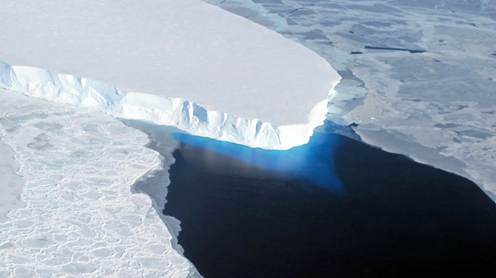
- Thwaites Glacier is a massive outlet glacier in West Antarctica draining into the Amundsen Sea, comparable in area to a large country, and critically important for global sea-level regulation.
Why “Doomsday Glacier” ?
- Nicknamed “Doomsday Glacier” because potential collapse could trigger substantial sea-level rise and destabilise neighbouring ice basins, amplifying global coastal risks far beyond Antarctica.
Physical Geography & Glaciology
Marine Ice Sheet Setting
- Thwaites rests on bedrock sloping downward inland below sea level, a configuration called marine ice-sheet instability, making retreat self-reinforcing once warm water reaches grounding zones.
Grounding Line
- The grounding line is where glacier ice detaches from bedrock and begins floating; its inland retreat indicates weakening structural stability and greater vulnerability to ocean-driven melting.
Ice Shelf Buttressing
- Thwaites’ floating ice shelf acts as a buttress, slowing inland ice flow; thinning or breakup reduces resistance, allowing faster glacier discharge into the ocean.
Climate & Ocean Interactions
Ocean-Driven Melting
- Relatively warm Circumpolar Deep Water intrudes beneath the ice shelf, melting it from below, thinning critical support structures and accelerating grounding-line retreat.
Atmospheric Warming
- Rising air temperatures influence surface melt and ice dynamics, though ocean heat currently plays the dominant role in destabilising West Antarctic outlet glaciers.
Data & Evidence
Current Contribution
- Thwaites alone contributes roughly 4% of present global sea-level rise, making it one of the single largest glacial contributors worldwide.
Potential Sea-Level Rise
- Complete collapse over centuries could raise global mean sea level by ~0.5 metre, while also destabilising adjacent West Antarctic ice, adding several additional metres over longer timescales.
Observed Changes
- Satellite records show rapid thinning, faster ice flow, and grounding-line retreat over recent decades, indicating ongoing dynamic imbalance rather than stable conditions.
Global Implications
Coastal Vulnerability
- Even modest sea-level rise increases coastal flooding, erosion, salinisation, and storm-surge damage, threatening megacities, ports, and delta regions globally.
Small Island States
- Low-lying island nations face existential risks, with higher adaptation costs, displacement pressures, and loss of freshwater lenses due to saltwater intrusion.
Economic Impact
- Sea-level rise raises costs for coastal infrastructure, insurance, disaster management, and climate adaptation, affecting both developed and developing economies.
Governance & Policy Dimension
Climate Mitigation Link
- Thwaites’ fate is strongly tied to global warming trajectories, making deep emissions cuts under Paris Agreement central to slowing long-term ice-sheet loss.
Scientific Cooperation
- International collaborations like large Antarctic research missions improve modelling, monitoring, and early-warning capacity for ice-sheet instability.
Challenges & Uncertainties
Timescale Uncertainty
- Exact timelines for major retreat remain uncertain, complicating policy planning, but risk-based approaches justify early adaptation and mitigation investments.
Complex Ice Dynamics
- Ice–ocean interactions, subglacial topography, and feedback loops create modelling challenges, requiring continuous observation and refinement.
Way Forward
Rapid Emission Reductions
- Limiting warming to well below 2°C reduces long-term Antarctic mass loss risks and associated sea-level rise.
Coastal Adaptation
- Strengthen coastal zoning, resilient infrastructure, mangrove restoration, and managed retreat strategies to reduce vulnerability.
Polar Research Investment
- Expand satellite monitoring, ocean sensors, and ice-penetrating radar to improve predictive capability.
Value Addition
- Antarctica stores ~70% of the world’s freshwater.
- Antarctic Ice Sheet holds enough ice to raise sea level by ~58 metres if fully melted.
- Global mean sea level already rose ~20 cm since 1900 (IPCC).
- Sea level is rising at ~3.3 mm/year currently, double the 20th-century rate.
- Mumbai, Kolkata, Chennai among top 20 global cities at coastal flood risk by 2050 (C40/World Bank studies).
- India has 7,500 km coastline, making it highly vulnerable.
Biotechnology and Green Growth
Why in News ?
Biotech for Sustainable Future
- Experts in a national webinar highlighted biotechnology’s role in enabling green growth, zero-waste processes, and sustainable industry, aligning with India’s expanding bioeconomy and sustainability goals.
Relevance
GS 3 (Science & Tech + Economy + Environment)
- Bioeconomy and green growth
- Industrial biotech and sustainability
- Agri-biotech and food security
- Innovation-led growth and startups
Basics & Core Keywords
Biotechnology
- Biotechnology applies biological systems, organisms, or derivatives to develop products and processes in health, agriculture, environment, and industry, integrating biology with technology for societal and economic benefits.
Green Growth
- Green growth refers to economic development that reduces environmental risks, promotes resource efficiency, and ensures sustainability while maintaining GDP growth and employment generation.
Bioeconomy
- Bioeconomy includes economic activities using renewable biological resources to produce food, materials, and energy, reducing fossil-fuel dependence and supporting circular economy transitions.
Data & Evidence
India’s Bioeconomy Growth
- India’s bioeconomy expanded from ~US$10 billion (2014) to ~US$165 billion (2024), a 16-fold rise, making it among the fastest-growing bioeconomies globally.
2030 Target
- India targets US$300 billion bioeconomy by 2030, driven by biopharma, bio-agriculture, industrial biotech, and bio-services sectors.
Sectoral Contribution
- Major drivers include biopharma, agriculture biotech, industrial biotech, and IT-enabled bio-services, collectively supporting innovation-led growth.
Environmental Dimension
Zero-Waste & Circularity
- Industrial biotechnology supports zero-waste manufacturing, bioremediation, and biodegradable materials, lowering pollution and landfill burdens.
Climate Link
- Bio-based fuels and materials reduce carbon footprint and support net-zero transitions, complementing renewable energy policies.
Economic Dimension
Employment & Skills
- Biotechnology generates high-skill jobs in genomics, microbial technology, bioinformatics, and process engineering, supporting knowledge-economy growth.
Innovation Economy
- Start-ups and R&D in biotech attract investments, patents, and global partnerships, strengthening India’s innovation ecosystem.
Social Dimension
Health & Food Security
- Biotech advances vaccines, diagnostics, fortified crops, and precision agriculture, improving public health and nutrition security.
Rural Development
- Agri-biotech supports climate-resilient crops and bio-inputs, enhancing farmer incomes and sustainable rural livelihoods.
Governance & Policy Dimension
Policy Support
- India’s biotechnology push aligns with BioE3 (Biotechnology for Economy, Environment, Employment) and national sustainability missions.
Skill Development
- Focus on biotech education and training builds human capital for future bio-industries.
Technology Dimension
Core Skills
- High demand for expertise in gene editing, microbial culture, fermentation tech, and data analytics for biotech innovation.
Industry 5.0 Link
- Biotechnology integrates with AI, automation, and data science in Industry 5.0, enabling precision and efficiency.
Challenges
Regulatory Hurdles
- Biosafety regulations, ethical concerns, and approval delays can slow innovation.
Funding Gaps
- High R&D costs and long gestation periods deter private investment.
Skill Mismatch
- Rapid sector growth demands continuous upskilling.
Way Forward
R&D Investment
- Increase public–private biotech R&D funding and translational research support.
Startup Ecosystem
- Strengthen incubators, venture funding, and industry–academia linkages.
Sustainable Integration
- Promote bio-based alternatives in mainstream industries.
AI Agents, “SaaSpocalypse” and Market Panic: Structural Shift or Overreaction?
Why in News ?
Claude Plugins Shock Markets
- Anthropic released 11 open-source plugins (Jan 30) for Claude Cowork enabling autonomous legal, finance, and compliance workflows, triggering fears of AI replacing software and labour, and causing sharp global tech stock sell-offs.
Relevance
GS 3 (Science & Tech)
- AI disruption and automation
- Agentic AI and future of work
- Digital economy transformation
GS 3 (Economy — Core)
- IT sector vulnerability
- Employment and reskilling
- Business model shifts
Basics & Core Keywords
Agentic AI
- Agentic AI refers to AI systems that autonomously execute multi-step tasks, coordinate workflows, and make operational decisions with minimal human input, moving beyond chatbots to digital co-workers in enterprises.
SaaS (Software as a Service)
- SaaS is a cloud-based software model charging per-user subscriptions; revenues depend on human “seats,” making it vulnerable if AI reduces human workforce dependence.
SaaSpocalypse
- SaaSpocalypse, coined by Jefferies Group, describes fear that AI agents may replace traditional software usage itself, not merely enhance productivity, undermining seat-based revenue models.
Human-in-the-Loop (HITL)
- HITL involves human oversight in AI decisions for validation, exception handling, ethics, and governance, especially in regulated sectors like finance, defence, and healthcare.
Data & Evidence: Market Reaction
Global Sell-off
- Nearly $285 billion market cap erased globally after announcement, showing sensitivity of tech valuations to AI disruption narratives.
U.S. Software Impact
- Goldman Sachs software basket fell 6% (Feb 3); Thomson Reuters plunged 15.8%, LegalZoom 19.7%, RELX 14%, reflecting direct threat to legal/knowledge software.
Indian Market Impact
- Nifty IT fell 5.87% in one day, wiping out nearly ₹2 lakh crore, steepest fall since March 2020; Infosys and TCS fell >7%.
Technological Significance
From Assistive to Autonomous
- Shift from AI assistants to autonomous agents marks transition from productivity tool to workflow executor, threatening service-based business models.
Bloomberg GPT Benchmark
- BloombergGPT (50B parameters, 363B tokens) proved domain-specific AI can outperform general models in finance, setting precedent for vertical AI disruption.
GitHub Coding Evidence
- Studies show ~4% of public GitHub commits authored by Claude Code, projected to reach 20% by year-end, indicating rapid AI penetration in coding.
Economic & Business Model Impact
Headcount Model at Risk
- India’s outsourcing relies on billing per employee; if one agent replaces teams, pricing models face structural repricing.
Corporate Signals
- Salesforce paused hiring engineers/lawyers citing AI productivity; Goldman Sachs deploying AI for compliance and onboarding tasks.
Capital Expenditure Paradox
- Contradiction noted by BofA: AI cannot both reduce capex and simultaneously replace all software; suggests overreaction.
Employment Dimension
Jobs at Risk
- Entry-level testing, maintenance, and compliance roles most vulnerable as they involve repetitive rule-based tasks.
Reskilling Imperative
- Demand rising for AI architects, governance specialists, and HITL supervisors rather than traditional coders.
Quantitative Signal
- TCS reportedly reduced workforce by ~11,000, and some firms cut fresher hiring from 80% to near zero in certain teams.
Comparative Insight: DeepSeek Moment
DeepSeek Precedent
- DeepSeek (Jan 2025) triggered Nvidia’s $589B single-day loss, yet stock recovered 58% within a year, showing panic cycles in AI markets.
Expert’s View
- Bank of America and Gartner termed sell-off “overblown,” arguing enterprises won’t discard existing software investments quickly.
Strategic Implications for India
Need for Pivot
- Shift from labour arbitrage to AI deployment partnerships combining domain expertise with platforms.
Competitive Advantage
- Indian firms possess deep domain knowledge in BFSI and healthcare, enabling HITL governance and AI integration services.
Investment Signals
- TCS–TPG committed $2B for AI data centres; Wipro allocated $1B for AI360, showing gradual adaptation.
Challenges
Speed Gap
- Global firms integrating AI faster than Indian IT transition pace.
Revenue Model Risk
- Seat-based billing vulnerable to automation.
Skill Gap
- Large-scale reskilling required for AI system design.
Way Forward
AI Governance & HITL
- Build HITL centres for regulated sectors ensuring compliance and trust.
Reskilling at Scale
- Train engineers in AI architecture and domain analytics.
Platform Partnerships
- Collaborate with leading AI firms rather than compete at foundation-model level.
Traditional Delicacies as Next “Makhana Moment”
Why in News ?
Cultural Visibility → Market Opportunity
- National spotlight on Chhattisgarh’s thethri and khurmi during a student interaction with the Prime Minister signals how cultural visibility can trigger market demand, branding, and value-chain development for regional foods.
Relevance
GS 3 (Economy )
- Food processing and value addition
- Rural livelihoods and SHGs
- ODOP, PMFME, GI economy
GS 1 (Culture )
- Intangible cultural heritage
- Food culture and identity
Basics & Core Keywords
Traditional Delicacies
- Region-specific foods using local ingredients and customary methods; they encode ecological knowledge, seasonality, and community practices, forming part of intangible cultural heritage and local identity.
“Makhana Moment”
- Makhana (fox nuts) evolved from a local snack to a national superfood through branding, GI support, and organised value chains; similar pathway can scale other regional foods.
Value Addition
- Value addition involves processing, branding, packaging, and quality certification that increase product price and farmer/producer income beyond raw commodity sales.
Case Focus: Thethri
- Made from besan (gram flour) and spices, deep-fried for low moisture and longer shelf life, enabling storage, transport, and small-scale commercialisation across regional markets.
Cultural Embedment
- Linked to Diwali and harvest festivities, thethri carries ritual value, aiding storytelling-based branding and festival-driven demand spikes.
Case Focus: Khurmi
- Prepared from jaggery, wheat flour, and semolina; jaggery adds iron and minerals, positioning khurmi as a traditional, less-refined sweet alternative to processed confectionery.
Rural Suitability
- Simple ingredients and techniques allow SHGs and home enterprises to produce at scale with low capital, supporting decentralised rural industries.
Economic Angle: From Snack to Sector
Rural Livelihoods
- Scaling traditional snacks through SHGs/FPOs can generate non-farm rural income, especially for women; India has 80+ lakh SHGs linked to livelihoods missions.
Domestic Market Potential
- India’s packaged snacks market exceeds $15–20 billion, growing with urban demand for ethnic and healthier options; regional products can capture niche segments.
Export Possibility
- Ethnic foods ride diaspora demand; processed food exports from India cross $40 billion annually, indicating room for branded traditional snacks.
“Next Makhana” Pathway
GI & Branding
- GI tagging and state branding (like Bihar makhana) can signal authenticity, prevent imitation, and command price premiums for thethri/khurmi.
Processing & Standards
- FSSAI-compliant units, standardised recipes, and hygienic packaging extend shelf life and enable retail/e-commerce entry.
Cluster Development
- ODOP (One District One Product) and PMFME schemes can build clusters for traditional foods, linking credit, training, and marketing.
Nutrition & Sustainability
Clean-Label Advantage
- Traditional snacks use short ingredient lists (besan, jaggery, grains), aligning with clean-label trends and reduced ultra-processed consumption.
Local Sourcing
- Using local grains/pulses reduces transport emissions and supports circular local economies.
Governance & Policy Linkages
Scheme Convergence
- Converge PMFME, NRLM, ODOP, and GI promotion for end-to-end support from production to branding.
Tourism Link
- Culinary trails and state festivals can anchor food tourism, boosting regional economies.
Challenges
Quality Consistency
- Variability in taste and hygiene can limit scale; requires training and SOPs.
Commercial Dilution
- Over-sweetening, additives, or ingredient substitution may erode authenticity and nutrition.
Market Access
- Small producers face logistics and retail entry barriers without aggregator platforms.
Way Forward
Brand-Build-Scale
- Create state-backed brands, storytelling labels, and influencer marketing to build recognition.
Digital Commerce
- Use ONDC and e-commerce for pan-India reach with small-batch producers.
Capacity Building
- Train SHGs in food safety, packaging, and financial literacy for sustainable scaling.
Value Addition
Rural Economy
- India has 80+ lakh SHGs, many engaged in food processing.
- Food processing contributes ~13% of manufacturing GVA.
Market Size
- Indian packaged snacks market: US$15–20B and growing.
- Processed food exports: US$40B+ annually.
GI & Branding Impact
- GI-tagged products often see 20–40% price premium.
- India has 500+ GI tags, many food-related.
Tourism Link
- Culinary tourism is a growing niche within India’s US$200B+ tourism economy.


