
Content
- India Growth Outlook Revised to 6.6% (FY27)
- Gaganyaan Mission – Safe Re-entry & Recovery Mechanism
- Climate Change & Public Health in India
- Artemis II Mission – Re-entry & Lunar Exploration Milestone
- IUCN Red List Update: Emperor Penguins & Fur Seals Endangered
- Vulture Mortality near Dudhwa Tiger Reserve
- India–Egypt Joint Exercise CYCLONE-IV
India Growth Outlook Revised to 6.6% (FY27)
Why in news ?
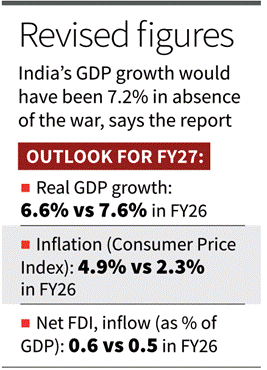
- World Bank revised India’s FY27 GDP growth to 6.6% (from 7.2%).
- Downgrade linked to West Asia conflict impacting global energy supply and domestic economic activity.
Relevance
GS III (Economy)
- Growth dynamics, macroeconomic stability, external sector vulnerability (oil shocks).
- Role of private investment, consumption, and reforms in sustaining growth.
GS II (Governance)
- Fiscal management, subsidy burden, and policy response to external shocks.
Practice Question
Q1.“External shocks, rather than domestic structural weaknesses, are increasingly shaping India’s growth trajectory.”Analyse with reference to recent GDP revisions. (250 words)
Key data & projections
- India GDP growth (FY27): 6.6% (revised) vs earlier 7.2%.
- South Asia growth (2026): 6.3%, down from 7% (2025).
- Downgrade assumes continued disruption in oil & gas supply till end-2026.
Reasons for downgrade
External shocks
- West Asia conflict affecting global oil and gas supply chains.
- Rising energy prices increase import bill and inflationary pressures.
Impact on domestic economy
- Higher energy costs reduce household consumption and disposable income.
- Government faces fiscal pressure due to subsidies and expenditure adjustments.
- Industrial activity impacted due to higher input costs and supply disruptions.
Underlying strengths of Indian economy
- Strong growth momentum in FY26 (Q4 performance).
- Ongoing pro-growth reforms in infrastructure, manufacturing, and digital economy.
- Large domestic market supports consumption-driven growth model.
Economic implications
Consumption slowdown
- Rising fuel and inflation pressures reduce real purchasing power.
- Weakens demand-led sectors like FMCG, transport, and services.
Investment & industrial output
- Costlier energy affects manufacturing competitiveness and profit margins.
- Private investment sentiment may weaken amid global uncertainty.
Fiscal & external sector pressure
- Higher oil prices widen current account deficit (CAD).
- Increased subsidy burden strains fiscal balance.
Structural insights
- India remains vulnerable to external energy shocks due to import dependence.
- Growth resilience depends on domestic demand, diversification, and reforms.
- Highlights need for energy transition and economic diversification.
Way forward
- Promote private sector-led growth through ease of doing business and investment incentives.
- Accelerate energy diversification (renewables, green hydrogen) to reduce oil dependency.
- Strengthen domestic manufacturing (Make in India) to reduce import vulnerabilities.
- Maintain macroeconomic stability through prudent fiscal and monetary policies.
- Enhance export competitiveness and global value chain integration.
Prelims pointers
- World Bank India Development Update assesses macroeconomic outlook.
- GDP growth influenced by external shocks like oil prices and geopolitical conflicts.
- Current Account Deficit (CAD) widens with rising import bills.
Gaganyaan Mission – Safe Re-entry & Recovery Mechanism
Why in News?
- Discussion on safe return of astronauts in Gaganyaan highlights critical technologies for re-entry, deceleration, and recovery.
- India preparing for its first human spaceflight, making re-entry systems a key technological milestone.
Relevance
GS III (Science & Tech)
- Human spaceflight, re-entry physics, thermal protection systems.
Practice Question
Q1. Explain the challenges of atmospheric re-entry in human spaceflight and how Gaganyaan ensures crew safety. (250 words)
Re-entry dynamics
- Crew module enters Earth’s atmosphere at very high speeds, generating intense heat and friction (“fireball phase”).
- Atmospheric drag acts as primary braking force, dissipating most kinetic energy.
- Controlled descent trajectory ensures precision landing within designated recovery zone.
Multi-stage deceleration system
Aerobraking phase
- Initial slowdown occurs due to interaction with Earth’s atmosphere, reducing velocity significantly.
- Requires heat shield protection to withstand extreme temperatures.
Parachute deployment
- Series of parachutes deployed sequentially to reduce speed further.
- Ensures controlled descent to safe landing velocity before splashdown.
Final landing phase
- Module lands in sea (splashdown) rather than land to minimise impact forces.
- Designed to maintain structural stability and crew safety upon impact.
Why parachutes alone are insufficient ?
- Parachutes cannot handle extremely high initial speeds of re-entry.
- Require prior velocity reduction through atmospheric drag.
- Large parachutes increase weight and design complexity, limiting feasibility.
Challenges in safe landing
- High re-entry speed and thermal stress require advanced heat shield materials.
- Small trajectory deviations can lead to large landing errors (hundreds of kilometres).
- Atmospheric conditions (winds, density variations) affect descent accuracy.
Recovery mechanism
Naval recovery operations
- Indian Navy plays key role in retrieving crew module after splashdown.
- Deployment of ships, aircraft, and tracking systems for precise location identification.
Tracking & localisation
- Use of GPS, communication systems, and electronic beacons to locate module.
- Visual tracking aids used in low-visibility conditions.
Crew extraction
- Recovery teams secure module and safely extract astronauts using specialised equipment.
- Immediate medical support provided post-recovery.
Significance
Technological advancement
- Demonstrates India’s capability in human spaceflight technologies, including re-entry systems and life-support.
- Strengthens ISRO’s expertise in precision navigation and recovery systems.
Strategic dimension
- Positions India among elite nations (USA, Russia, China) with human spaceflight capability.
- Enhances India’s role in global space exploration and collaborations.
Scientific & economic benefits
- Enables research in microgravity, human physiology, and space medicine.
- Boosts space economy, innovation ecosystem, and private sector participation.
Challenges
- Ensuring crew safety under extreme conditions of re-entry and landing.
- High cost and complexity of human-rated space missions.
- Need for precision coordination between ISRO and defence forces (Navy).
Way forward
- Strengthen testing of crew escape systems, heat shields, and parachute technologies.
- Enhance real-time tracking and recovery coordination mechanisms.
- Expand collaboration with global space agencies for human spaceflight best practices.
- Integrate private sector and advanced materials research for future missions.
Prelims pointers
- Gaganyaan: India’s first human spaceflight mission by ISRO.
- Landing method: Splashdown in sea with parachute-assisted descent.
- Indian Navy responsible for recovery operations.
- Re-entry involves aerobraking + heat shield protection.
Climate Change & Public Health in India
Why in News ?
- Report “Under the Weather: India’s Climate-Health Intersections and Pathways to Resilience” highlights climate change as a major public health threat in India.
- Nearly 40% of districts identified as high-risk from extreme weather events, signalling systemic health vulnerability.
Relevance
GS Paper III (Environment)
- Climate change as health-risk multiplier.
GS Paper II (Social Sector)
- Public health infrastructure & vulnerability.
Practice Question
Q1. “Climate change is no longer just an environmental issue but a public health emergency.”Examine in the Indian context. (250 words)
Changing disease landscape
Vector-borne diseases expansion
- Changing temperature and rainfall patterns expanding dengue and malaria into new geographies.
- Previously unaffected areas like Shimla, Jammu & Kashmir, Himalayan foothills now reporting cases.
- Urban centres like Pune emerging as dengue hotspots.
Rise in non-communicable diseases
- Heat exposure linked to higher cardiovascular mortality and heatstroke cases.
- Air pollution (PM2.5) associated with respiratory diseases, asthma, and chronic illnesses.
- Climate change increases overall disease burden and healthcare demand.
Impact on vulnerable groups
- Infants and children more susceptible to heat stress, dehydration, and respiratory illnesses.
- Women face increased risks:
- 16% higher odds of preterm birth during heatwaves
- Increased gestational hypertension and pre-eclampsia due to pollution
- Rural populations and informal workers disproportionately affected due to exposure and weak safety nets.
Impact of extreme weather events
- Floods trigger water-borne diseases like cholera and hepatitis.
- Heatwaves cause dehydration, heatstroke, and cardiovascular stress.
- Extreme events disrupt healthcare delivery systems (hospitals, supply chains, access roads).
Economic & livelihood impacts
- Climate change leads to loss of income, rising healthcare costs, and reduced productivity.
- India lost ~160 billion labour hours (2021) due to heat exposure, affecting economic output.
- Creates cycle of vulnerability—health shocks → income loss → reduced resilience.
Institutional & policy response
- National Action Plan on Climate Change and Human Health (NAPCCHH) integrates health into climate policy.
- State-level climate action plans focus on local adaptation strategies.
- Heat Action Plans implemented in multiple cities for early warning and preparedness.
Significance
- Recognises climate change as public health crisis, not just environmental issue.
- Highlights need for inter-sectoral convergence (health, environment, disaster management).
- Aligns with SDG-3 (Health) and SDG-13 (Climate Action).
Challenges
- Lack of granular, district-level data linking climate events with health outcomes.
- Funding imbalance: more focus on mitigation than adaptation in health sector.
- Weak public awareness and behavioural preparedness.
- Fragmented data systems and institutional coordination gaps.
Way forward
- Develop climate-resilient healthcare infrastructure, especially in vulnerable districts.
- Strengthen local data systems and surveillance for targeted interventions.
- Integrate health into all climate policies (Health-in-All-Policies approach).
- Increase investment in adaptation measures, including early warning systems and public health preparedness.
- Promote community awareness and behavioural change strategies for climate resilience.
- Enhance collaboration between government, civil society, and private sector.
Prelims pointers
- NAPCCHH: integrates climate change with public health planning in India.
- Heat Action Plans: include early warning, preparedness, and response strategies.
- PM2.5: fine particulate matter causing respiratory and cardiovascular diseases.
- Climate change leads to range expansion of vector-borne diseases.
Artemis II Mission – Re-entry & Lunar Exploration Milestone
Why in News?
- Crew of Artemis II preparing for high-speed atmospheric re-entry (“fireball” phase) after historic crewed mission around the Moon.
- Marks first human flight to lunar far side since Apollo era, signalling revival of deep-space human exploration.
Relevance
GS III (Science & Tech)
- Deep-space missions, lunar exploration & re-entry technologies.
GS II (IR)
- Space geopolitics & international collaboration.
Practice Question
Q1. Discuss the significance of Artemis II mission in the context of global space exploration and deep-space technologies. (250 words)
Key mission highlights
- Crew: 4 astronauts (USA + Canada), marking international collaboration in human spaceflight.
- Achieved record distance of ~252,000 miles from Earth, surpassing Apollo 13 record by ~4,000 miles.
- Duration: ~10-day mission, including lunar flyby of far side of Moon.
Re-entry phase (critical stage)
- Spacecraft enters atmosphere at ~38,000 mph (~61,000 km/h), generating extreme heat due to friction.
- Orion’s advanced heat shield tested under high thermal and mechanical stress.
- Successful re-entry crucial for crew safety and validation of deep-space mission capability.
Technological significance
- Validates Orion crew capsule for long-duration space missions beyond low-Earth orbit.
- Demonstrates capability for deep-space navigation, communication, and life-support systems.
- Provides data for future missions involving crew transfer, docking, and lunar landings.
Artemis programme roadmap
- Artemis II: Crewed lunar flyby (testing phase).
- Artemis III: Planned human landing on Moon using landers.
- Artemis IV (target ~2028): Expanded lunar missions and infrastructure development.
- Long-term goal: Permanent lunar presence + stepping stone for Mars missions.
Strategic significance
Space geopolitics
- Artemis programme reflects renewed global space race, particularly with China’s lunar ambitions.
- Strengthens leadership of USA-led coalition in space exploration.
International collaboration
- Inclusion of Canadian astronaut highlights multilateral cooperation in space missions.
- Aligns with broader frameworks like Artemis Accords for peaceful space use.
Scientific advancement
- Enables study of lunar geology, far-side environment, and deep-space conditions.
- Provides critical inputs for astrobiology and planetary science research.
Challenges
- High-risk nature of re-entry and deep-space missions, requiring precision engineering.
- Massive financial costs of multi-billion-dollar Artemis programme.
- Technical complexities in sustained lunar habitation and resource utilisation.
- Competition with other space powers may intensify strategic rivalries in space domain.
Way forward
- Strengthen international collaboration frameworks for sustainable and peaceful space exploration.
- Focus on cost-efficient technologies and reusable systems to reduce mission expenses.
- Develop lunar infrastructure (habitats, energy systems, logistics) for long-term presence.
- Enhance integration of private sector (SpaceX, commercial partners) in mission execution.
Prelims pointers
- Artemis Programme aims to return humans to Moon and enable Mars missions.
- Orion spacecraft: crew capsule designed for deep-space missions.
- Re-entry involves extreme heating due to atmospheric friction.
- Artemis missions follow Apollo programme (last crewed Moon mission: 1972).
IUCN Red List Update: Emperor Penguins & Fur Seals Endangered
Why in News ?
- Emperor Penguin and Antarctic Fur Seal uplisted to “Endangered” in International Union for Conservation of Nature Red List (2026).
- Highlights accelerating climate change impacts in Antarctica, including sea-ice loss, food scarcity, and disease outbreaks.
Relevance
GS III (Environment & Biodiversity)
- Climate change impact on polar ecosystems & species extinction.
Practice Question
Q1. “Polar ecosystems act as early warning systems for global climate change.”Discuss in light of recent IUCN Red List updates. (250 words)
Key findings & data
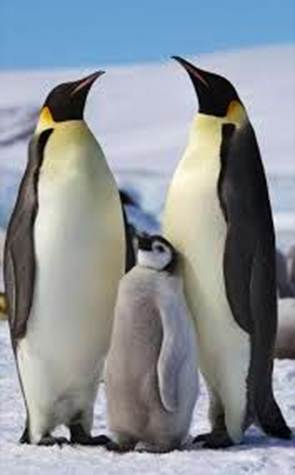
Emperor penguins
- Status changed from Near Threatened → Endangered.
- Population declined by ~10% (2009–2018), equivalent to 20,000+ adult penguins.
- Projections indicate ~50% population decline by 2080s due to climate change.
Antarctic fur seals
- Status changed from Least Concern → Endangered.
- Population dropped from ~21.8 lakh (1999) to ~9.44 lakh (2025) → >50% decline.
- Decline linked to reduced krill availability and changing marine ecosystem dynamics.
Southern elephant seals
- Status downgraded to “Vulnerable” due to disease pressures.
- Bird flu (H5N1) caused >90% mortality of pups in some colonies.
- Disease impacted 4 out of 5 major subpopulations, indicating widespread vulnerability.
Drivers of decline
Climate change impacts
- Sea-ice loss since 2016 disrupts breeding habitat of emperor penguins dependent on stable “fast ice”.
- Rising ocean temperatures push krill to deeper waters, reducing food availability for predators.
- Antarctic ecosystems highly sensitive to temperature and ice variability.
Food chain disruption
- Krill decline affects entire food web including penguins, seals, and whales.
- Increased competition with recovering whale populations further reduces food access.
Disease emergence
- Spread of Highly Pathogenic Avian Influenza (H5N1 clade 2.3.4.4b) affecting 485 bird species and 48 mammal species globally.
- Polar species more vulnerable due to low prior exposure to pathogens and dense colony living.
Ecological significance
- Emperor penguins act as sentinel species, indicating health of polar ecosystems and climate stability.
- Antarctic marine ecosystem is critical for global carbon cycles and biodiversity balance.
- Decline signals broader ecosystem degradation and climate tipping points.
Global implications
- Reflects climate-driven extinction crisis, especially in polar regions warming faster than global average.
- Demonstrates interaction of multiple stressors: climate change + food scarcity + disease.
- Raises concerns for global biodiversity targets (Kunming-Montreal Global Biodiversity Framework).
Challenges
- Difficulty in monitoring remote polar ecosystems and translating local events into population trends.
- Limited global progress in reducing greenhouse gas emissions despite scientific warnings.
- Weak integration of climate science with conservation policy frameworks.
- Increasing unpredictability due to compounding ecological stressors.
Way forward
- Accelerate global decarbonisation efforts to limit temperature rise and preserve polar ecosystems.
- Strengthen climate-informed conservation planning using satellite data and predictive modelling.
- Protect krill fisheries and Antarctic marine food chains through stricter international regulation.
- Enhance disease surveillance systems in wildlife, especially in sensitive polar regions.
- Expand funding and capacity for IUCN Red List assessments and biodiversity monitoring.
Prelims pointers
- International Union for Conservation of Nature Red List categories: LC, NT, VU, EN, CR.
- Emperor Penguin depends on fast ice for breeding and moulting.
- Krill is keystone species in Antarctic marine ecosystem.
- H5N1 Avian Influenza affects both birds and mammals; increasing zoonotic concern.
Vulture Mortality near Dudhwa Tiger Reserve
Why in News ?
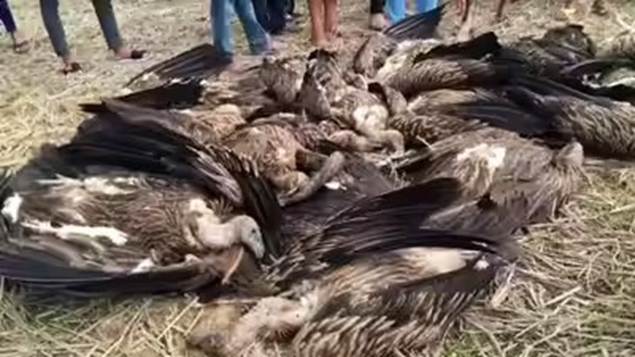
- 25 Himalayan Griffon vultures found dead in Lakhimpur Kheri (UP) near Dudhwa Tiger Reserve.
- Incident suspected to be secondary poisoning, raising concerns about wildlife safety and human-wildlife interactions.
Relevance
GS III (Environment)
- Biodiversity conservation, food chain toxicity, human-wildlife interface.
Practice Question
Q1. Analyse the causes and ecological implications of vulture mortality inIndia. Suggest conservation measures. (250 words)
Key facts & ecological context
- Species: Himalayan Griffon (Gyps himalayensis) classified as “Near Threatened” (IUCN Red List).
- Location: Buffer zone of Dudhwa Tiger Reserve, indicating human-wildlife interface vulnerability.
- Scale: 25 deaths + 6 affected birds, reflecting mass mortality event.
Cause of deaths
- Primary trigger: Consumption of carcasses of poisoned animals (likely stray dogs).
- Mechanism: Toxic substances (pesticides/chemicals) enter food chain → bioaccumulation → rapid collapse of scavengers.
- Classified as secondary poisoning, a major threat to scavenger bird populations globally.
Ecological significance of vultures
- Vultures act as natural scavengers, ensuring rapid disposal of carcasses and disease control.
- Prevent spread of zoonotic diseases like anthrax and rabies by eliminating decaying organic matter.
- Decline in vulture populations historically linked to increase in feral dog population and public health risks.
Broader conservation concerns
- India has already faced vulture crisis due to Diclofenac (NSAID toxicity), causing massive population decline in Gyps species.
- Secondary poisoning from pesticides and intentional baiting is emerging as a new major threat.
- Weak regulation and misuse of agrochemicals and toxic substances exacerbate wildlife mortality.
Governance & institutional response
- Forest Department initiated post-mortem and forensic testing, samples sent to Indian Veterinary Research Institute.
- Formation of expert panel for investigation and cause determination.
- Planned awareness campaigns for local communities to prevent use of harmful substances.
Challenges
- Unregulated pesticide use and easy availability of toxic chemicals in rural areas.
- Lack of awareness among local communities regarding ecological consequences.
- Weak monitoring in buffer zones where human-wildlife interaction is high.
- Absence of rapid response systems to detect and prevent poisoning incidents.
Way forward
- Strict regulation and monitoring of toxic chemicals and pesticides, especially near protected areas.
- Promote community awareness programmes on ecological role of vultures and risks of poisoning.
- Strengthen wildlife forensic and surveillance mechanisms for early detection of mass mortality events.
- Encourage safe carcass disposal practices and alternatives to poisoning for animal control.
- Integrate vulture conservation into broader biodiversity and public health strategies.
Prelims pointers
- Himalayan Griffon (Gyps himalayensis): scavenger bird, Near Threatened (IUCN).
- Diclofenac toxicity: major cause of vulture decline in India; banned for veterinary use.
- Secondary poisoning: occurs when predators/scavengers consume poisoned prey.
- IVRI Bareilly: premier institute for veterinary research and toxicology analysis.
India–Egypt Joint Exercise CYCLONE-IV
Why in News ?
- Indian Army contingent has departed for Egypt to participate in 4th edition of Joint Special Forces Exercise CYCLONE-IV (April 2026).
- Reflects deepening India–Egypt defence cooperation and expanding strategic engagement in West Asia/North Africa region.
Relevance
GS II (IR)
- Defence diplomacy, India–Egypt strategic relations.
GS III (Security)
- Counter-terrorism, special forces cooperation.
Practice Question
Q1. “Defence cooperation is emerging as a key pillar of India’s engagement with West Asia and North Africa.”Discuss with reference to India–Egypt relations. (250 words)
Key features of the exercise
- Conducted at Anshas (Egypt) from 09–17 April 2026, involving 25 Indian Special Forces personnel.
- Focus on special operations tactics, techniques, and procedures (TTPs) in realistic combat scenarios.
- Emphasises joint mission planning, counter-terror operations, and high-intensity tactical drills.
Strategic significance
Defence cooperation dimension
- Strengthens bilateral military relations through regular joint exercises and professional exchanges.
- Builds mutual trust, operational familiarity, and coordinated response capability in security challenges.
Interoperability & capacity building
- Enhances ability of forces to operate together in multinational or coalition environments.
- Facilitates exchange of best practices, combat techniques, and operational doctrines.
Geostrategic importance
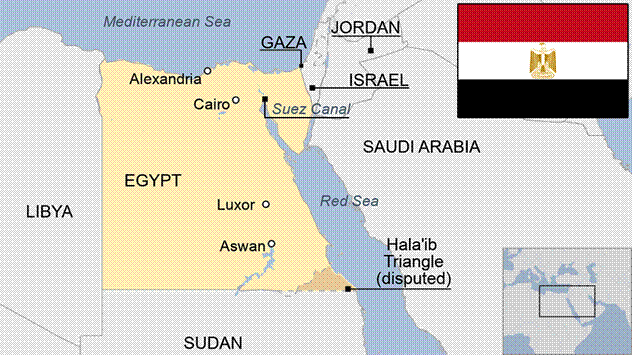
- Egypt’s location near Suez Canal and Red Sea makes it critical for global trade and maritime security.
- Strengthens India’s strategic footprint in West Asia and North Africa (WANA region).
Counter-terrorism relevance
- Special forces cooperation improves readiness against terrorism, insurgency, and unconventional threats.
- Useful for tackling challenges in desert warfare zones and transnational security threats.
Defence diplomacy role
- Joint exercises act as tools of military diplomacy, complementing political and economic ties.
- Promote people-to-people contact between armed forces, enhancing cultural understanding and trust.
- Support India’s vision of being a net security provider and responsible global security partner.
Broader India–Egypt relations
- India and Egypt share historical ties since Non-Aligned Movement (NAM) era and strategic convergence in global forums.
- Growing cooperation in defence, trade, energy, and counter-terrorism domains.
- Recent engagements indicate shift toward strategic partnership with security cooperation at core.
Challenges & concerns
- Bilateral exercises remain limited in scale and frequency compared to India’s engagements with major powers.
- Need for deeper integration in defence technology, intelligence sharing, and joint production.
- Regional instability in West Asia/North Africa may constrain long-term defence collaboration.
Way forward
- Expand scope of exercises to include tri-service participation and advanced warfare domains (cyber, space).
- Enhance cooperation in defence manufacturing, joint training institutions, and intelligence sharing.
- Align defence ties with maritime security and Indo-Pacific–West Asia connectivity strategies.
- Institutionalise regular engagements for long-term strategic partnership and regional stability cooperation.
Prelims pointers
- Exercise CYCLONE: India–Egypt joint special forces exercise, conducted alternately in both countries.
- Focus: desert warfare, counter-terrorism, and special operations training.
- Egypt located near Suez Canal, critical chokepoint for global trade routes.
- Indian contingent: Special Forces units (~25 personnel).


