
Content
- Centre mandates label for photorealistic AI content
- What explains SpaceX and Blue Origin stepping up their moon plans?
- Global warming and pollution are stripping vibrant colours from nature
- Get the rocket ready
- For first time, Indians invest more in gold ETFs than equity MFs
- Soot at sight: Black carbon spewing from marine traffic ensnares the Arctic
Centre mandates label for photorealistic AI content
Source : The Hindu
Why is it in News?
Recent Regulatory Update
- Union Government notified IT (Intermediary Guidelines & Digital Media Ethics Code) Amendment Rules, 2026, mandating prominent labelling of photo-realistic AI content and 2–3 hour takedown timelines for unlawful content.
- Rules effective 20 February 2026, significantly tightening platform obligations amid rising AI deepfakes, misinformation, and non-consensual synthetic media, especially affecting elections, women’s safety, and public order.
Relevance
- GS 2 (Polity & Governance ):
IT Act, intermediary liability, safe harbour, free speech vs regulation, privacy rights, digital governance, regulatory role of executive, global tech regulation comparisons. - GS 3 (S&T / Internal Security ):
AI governance, misinformation, cybersecurity, influence operations, tech policy, platform accountability.
Practice Question
- “Regulating AI-generated content requires balancing free speech, privacy, and platform accountability.” Examine in context of India’s intermediary liability framework. (250 words)
Basics & Conceptual Foundation
What are Intermediary Rules?
- IT Rules issued under Information Technology Act, 2000 (Section 79) define due diligence obligations of intermediaries, covering content moderation, grievance redressal, and safe harbour protection.
- Intermediaries include social media platforms, search engines, and hosting providers, which act as conduits for user-generated content rather than traditional publishers.
What is Synthetic / AI-Generated Content?
- Defined as audio, visual, or audiovisual content artificially created or modified using computational techniques to appear real, authentic, or indistinguishable from actual persons or events.
- Includes deepfakes, AI-generated nudity, voice cloning, and event manipulation, raising concerns over consent, privacy, misinformation, and reputational harm.
Key Provisions of Amendment
Mandatory Labelling
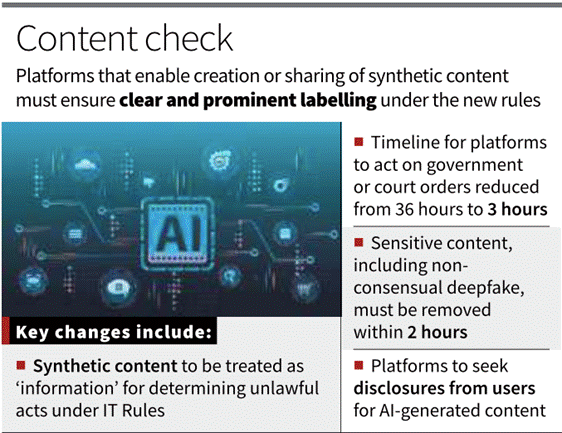
- Platforms must prominently label photo-realistic AI-generated content, ensuring users can distinguish synthetic media from real content, improving transparency and informed digital consumption.
- Carve-out provided for routine smartphone touch-ups and basic editing, preventing over-regulation of everyday digital photography and casual content enhancement.
Takedown Timelines
- Court or government-declared illegal content: removal within 3 hours, compared to earlier 24–36 hours, marking drastic acceleration in compliance expectations.
- Non-consensual nudity and deepfakes: removal within 2 hours, prioritising victim protection, especially women and minors, against reputational and psychological harm.
Safe Harbour Link
- Non-compliance may lead to loss of safe harbour under Section 79, exposing platforms to direct liability for user content, significantly increasing legal and financial risks.
Constitutional / Legal Dimension
Rights Involved
- Balances Article 19(1)(a) free speech with reasonable restrictions under Article 19(2) relating to defamation, public order, and decency.
- Protects Article 21 right to privacy and dignity, especially against deepfake-based harassment and identity misuse.
Judicial Context
- Supreme Court in Shreya Singhal v. Union of India (2015) upheld safe harbour but required takedowns based on court or government orders, shaping intermediary liability framework.
Governance / Administrative Dimension
Platform Accountability
- Moves from self-regulation to co-regulatory oversight, making platforms proactive gatekeepers against AI-driven harms.
- Requires robust AI detection tools, human moderation, and grievance systems, raising operational compliance costs.
Digital Governance Trend
- Reflects global shift toward regulating Big Tech; similar efforts seen in EU Digital Services Act and AI regulations.
Social / Ethical Dimension
Citizen Protection
- Deepfakes disproportionately target women, celebrities, and political figures, leading to harassment, blackmail, and misinformation.
- Labelling promotes media literacy and informed consumption, reducing viral spread of manipulated content.
Ethical AI Use
- Encourages responsible AI deployment, consent-based content creation, and accountability for misuse.
Security Dimension
Information Integrity
- Deepfakes can influence elections, communal harmony, and national security, making rapid takedowns critical for information integrity.
- Globally, misinformation campaigns increasingly use synthetic media for influence operations.
Data & Evidence
Global Trends
- Deepfake incidents globally have increased multiple-fold since 2019, with finance, politics, and entertainment most affected sectors (industry cybersecurity reports).
- India among largest social media markets, making it highly vulnerable to AI-driven misinformation scale effects.
Challenges / Criticisms
Implementation Concerns
- Detecting AI-generated content accurately remains technologically complex; false positives may affect legitimate satire, art, and journalism.
- Very short timelines may pressure platforms toward over-censorship to avoid liability.
Federal & Legal Risks
- Broad “government order” powers may raise concerns of executive overreach and chilling effects on speech.
Way Forward
Regulatory Improvements
- Develop clear SOPs and appeal mechanisms to protect legitimate speech while tackling harms.
- Invest in AI watermarking, provenance tools, and detection technologies.
Capacity Building
- Promote digital literacy campaigns, especially among youth, to recognise manipulated media.
- Encourage global cooperation on AI governance norms and cross-border enforcement.
What explains SpaceX and Blue Origin stepping up their moon plans?
Source : The Hindu
Why is it in News?
Recent Shift by Major Space Firms
- SpaceX and Blue Origin have pivoted focus to lunar missions, prioritising Moon over Mars, aligning with NASA’s Artemis programme, geopolitical competition with China, and nearer-term technological and commercial milestones.
- SpaceX reportedly targets uncrewed lunar landing by 2027, while Blue Origin paused suborbital tourism for two years to accelerate human-rated lunar lander development for NASA.
Relevance
- GS 3 (S&T ):
Space technology, private sector role, commercialisation of space, dual-use tech, innovation ecosystems.
Practice Question
- Private space companies are reshaping global space exploration. Analyse opportunities and risks for states. (250 words)
Basics & Conceptual Foundation
New Space vs Old Space
- “New Space” refers to private-sector-led space activity driven by commercial models, reusable rockets, and innovation, contrasting with state-dominated “Old Space” programmes of Cold War era.
- Private firms now handle launch services, satellite deployment, crewed missions, and lunar landers, reducing costs and increasing frequency of missions.
Moon vs Mars — Technical Differences
- Moon is ~384,400 km away, reachable in 3–7 days, enabling near-real-time communication and frequent launch windows (≈3/month).
- Mars missions require 26-month launch windows, months-long travel, and higher fuel costs, making risk, delay, and capital exposure significantly larger.
Global Space Governance Framework
Legal Regime
- Governed by Outer Space Treaty 1967, which bars national appropriation, mandates peaceful use, and holds states responsible for private actors’ space activities.
- Artemis Accords (2020 onwards) promote norms on lunar exploration, resource utilisation, and transparency, led by the U.S. with multiple partner countries.
Strategic & Geopolitical Dimension
Moon as Geopolitical Arena
- Renewed lunar race reflects U.S.–China competition; China’s Chang’e missions and ILRS plans aim for permanent lunar presence by 2030s.
- Lunar capability now seen as marker of technological leadership, strategic signalling, and prestige, similar to Cold War space race symbolism.
NASA’s Moon-First Priority
- NASA’s Artemis programme targets sustainable lunar presence, Gateway station, and eventual Mars pathway, making Moon a stepping-stone for deep-space missions.
- Congressional oversight and funding pressures push NASA to prioritise achievable lunar milestones over distant Mars timelines.
Economic Dimension
Commercial Incentives
- Lunar missions attract government contracts, international partnerships, and technology funding, offering clearer revenue pathways than speculative Mars colonisation.
- Global space economy valued at $450+ billion (OECD estimates), expected to exceed $1 trillion by 2040, driven by private participation.
Investor & Market Logic
- SpaceX’s potential IPO increases scrutiny on deliverables; investors prefer near-term milestones and predictable contracts like Artemis-linked missions.
- Lunar missions provide faster learning cycles and technology validation, improving commercial credibility.
Science & Technology Dimension
Technology Maturation
- Moon missions help mature life-support systems, ISRU (in-situ resource utilisation), radiation shielding, and reusable launch systems required for deeper space travel.
- Lunar environment serves as testbed for Mars technologies, reducing risk for future interplanetary missions.
Governance / Policy Dimension
Public–Private Partnerships
- NASA increasingly relies on commercial contracts, reducing state expenditure and leveraging private innovation under fixed-price models.
- Private firms must meet human-rating standards and safety norms, increasing regulatory oversight.
Social & Ethical Dimension
Ethical Questions
- Space colonisation raises concerns over space environmental protection, equitable access, and commercial exploitation of extraterrestrial resources.
- Debate continues over whether lunar resources are global commons or commercial assets.
Security Dimension
Dual-Use Concerns
- Space technologies have civil–military overlap, including navigation, surveillance, and communications, making lunar presence strategically sensitive.
- Militarisation risks increase as great powers expand cislunar capabilities.
Challenges / Criticisms
Technological & Financial Risks
- Human-rated deep-space missions remain high-risk; failures damage investor confidence and national prestige.
- High capital costs and uncertain returns challenge long-term sustainability.
Governance Gaps
- International law unclear on space mining, property rights, and liability, risking future disputes.
Way Forward
Strengthening Global Norms
- Update global space governance for resource use, debris management, and conflict prevention.
- Promote multilateral cooperation in lunar exploration.
Indian Relevance
- India’s Chandrayaan programme and Artemis partnerships position it as emerging lunar stakeholder.
- Encourage private sector under IN-SPACe reforms to join global lunar economy.
Global warming and pollution are stripping vibrant colours from nature
Source : The Hindu
Why is it in News?
Emerging Scientific Evidence
- Recent studies report oceans turning greener, forests browning earlier, insects and birds altering pigmentation, and widespread coral bleaching, linking colour changes directly to climate warming, pollution, and habitat disturbance.
- Indian coral bleaching events (2025) reported in Gulf of Mannar, Palk Bay, Lakshadweep, Andaman & Nicobar, Gulf of Kachchh, highlighting regional vulnerability and ecosystem stress.
Relevance
- GS 3 (Environment ):
Climate change impacts, biodiversity loss, coral bleaching, ecosystem stress indicators, pollution impacts.
Practice Question
- How does climate change-induced ecological discolouration reflect deeper biodiversity stress? Discuss with examples. (250 words)
Basics & Conceptual Foundation
What is Ecological Discolouration?
- Ecological discolouration refers to observable changes in colour of ecosystems or organisms driven by climate change, pollution, and land-use change affecting pigments, species composition, and ecological interactions.
- Colours in nature serve camouflage, mate attraction, UV protection, and thermoregulation, hence pigment shifts indicate deeper ecological and evolutionary stress responses.
Scientific Basis
Role of Pigments
- Melanin pigments (eumelanin: dark shades; pheomelanin: yellow-red hues) regulate heat absorption, UV protection, and coloration; reduced melanin leads to lighter bodies in warmer climates.
- Carotenoids in plants create red-yellow-orange hues attracting pollinators; pollution and urbanisation reduce carotenoid production, indirectly affecting pollination and food webs.
Ecogeographical Rules
- Bogert’s Rule: cold-blooded animals darker in cold regions, lighter in warm regions for thermoregulation.
- Gloger’s Rule: warm-blooded animals darker in humid, warm areas and lighter in dry, cold regions due to microbial resistance and camouflage needs.
Evidence & Case Studies
Terrestrial Ecosystems
- Amazon deforestation linked to loss of brightly coloured butterflies, with camouflaged species dominating disturbed habitats, indicating biodiversity simplification.
- 2024 Ecology & Evolution study: ladybirds and dragonflies in Northern Hemisphere becoming lighter due to frequent heatwaves.
- Molecular Ecology 2024: brown morph tawny owls increasing in Europe due to milder winters and UV protection benefits.
Urbanisation Effects
- Study on 547 Chinese bird species (2024) found urban birds darker and duller; heavy metals like lead bind with melanin, darkening plumage.
- Urban plants show reduced carotenoid pigments and altered UV patterns, lowering attractiveness to pollinators.
Marine Ecosystems
- Coral bleaching occurs when heat-stressed corals expel zooxanthellae algae, turning white and risking starvation and disease.
- Algal blooms driven by warming and nutrient runoff make oceans greener, reduce sunlight penetration, and create hypoxic conditions harming marine life.
Environmental & Ecological Implications
Biodiversity Impacts
- Colour change alters predator-prey dynamics, mating success, and species interactions, potentially reducing reproductive success and accelerating biodiversity loss.
- Coral reef degradation threatens ecosystems supporting ~25% of marine species, despite covering <1% of ocean floor.
Ecosystem Functioning
- Loss of colourful pollinator-attracting signals may disrupt plant–pollinator networks, affecting food security and ecosystem stability.
Social & Economic Relevance
Livelihoods
- Coral reef decline affects fisheries, tourism, and coastal protection, impacting millions dependent on reef ecosystems.
- FAO estimates ~500 million people globally depend on coral reefs for food, income, and storm protection.
Challenges
Research Limitations
- Major knowledge gaps in tropical and southern hemisphere regions, limiting global trend assessments.
- Colour change often subtle and long-term, requiring large-scale longitudinal monitoring.
Way Forward
Conservation & Climate Action
- Reduce GHG emissions to meet Paris Agreement targets, limiting warming and ecological stress.
- Preserve microhabitats (shade, vegetation cover) aiding thermoregulation for species.
- Strengthen coral reef protection via coastal regulation, pollution control, and stress monitoring.
Research & Monitoring
- Expand field and lab-based pigment and biodiversity monitoring across climatic zones.
- Integrate colour indicators into ecosystem health assessments.
Get the rocket ready
Source : The Hindu
Why is it in News?
Artemis II Testing Update
- NASA recently detected a hydrogen leak during a wet dress rehearsal of Artemis II mission, highlighting importance of pre-launch testing in ensuring crew safety and mission reliability in human spaceflight.
- Artemis II is NASA’s first crewed lunar mission since Apollo era, making testing milestones globally significant for space governance and human deep-space exploration.
Relevance
- GS 3 (S&T ):
Cryogenic technology, human spaceflight safety, mission reliability, aerospace engineering basics.
Practice Question
- Human spaceflight demands near-zero failure tolerance. Discuss the role of pre-launch testing in ensuring mission reliability. (250 words)
Basics & Conceptual Foundation
What is a Dress Rehearsal in Rocketry?
- A dress rehearsal is a full-system simulation of launch-day procedures, validating coordination among hardware, software, personnel, timelines, and safety protocols before committing to actual launch.
- It integrates vehicle systems, ground systems, mission control, and safety agencies to ensure seamless operational readiness and risk mitigation.
Types of Dress Rehearsals
Dry Dress Rehearsal
- Conducted without loading cryogenic propellants, focusing on countdown procedures, communications checks, sensor simulations, and decision-making chains among launch control and engineering teams.
- Helps identify procedural or logical errors without fuel-related hazards, reducing cost and safety risks during early-stage testing.
Wet Dress Rehearsal
- Involves actual fueling with cryogenic propellants like liquid oxygen (LOX) and liquid hydrogen (LH2), closely replicating real launch-day conditions.
- Teams cool propellant lines, fill tanks, pressurise systems, monitor leaks, and run countdown near ignition point before safely draining propellants.
- Only wet rehearsals reveal cryogenic-specific issues such as seal contraction, material stress, and hydrogen leakage.
Scientific & Technical Dimension
Cryogenic Propellants
- Cryogenic fuels stored at extremely low temperatures (LH2 at −253°C, LOX at −183°C) offer high efficiency but require advanced insulation and handling.
- Boil-off losses and thermal stresses demand precise monitoring, making rehearsal crucial.
Hydrogen Challenges
- Hydrogen molecules are extremely small, making them prone to leakage through tiny seal imperfections, posing fire and explosion risks.
- Hydrogen leaks historically contributed to major launch delays and accidents in global space programmes.
Strategic & Governance Dimension
Human Spaceflight Safety
- Crewed missions require stringent safety margins, and rehearsals reduce probability of catastrophic failures, protecting astronauts and national prestige.
- NASA follows “test-as-you-fly” principle—systems tested under real conditions before human use.
International Relevance
- Artemis programme shapes global lunar governance under Artemis Accords, making successful missions diplomatically and strategically important.
Economic Dimension
Cost Considerations
- Launch failures can cost hundreds of millions of dollars, making preventive testing economically justified.
- Artemis programme estimated in tens of billions of dollars, requiring high reliability.
Environmental & Safety Dimension
Risk Management
- Cryogenic propellant spills can cause fire hazards and local environmental risks, requiring controlled procedures.
- Spaceports maintain strict safety perimeters and environmental compliance.
Challenges
Technical Complexity
- Multiple subsystems must synchronise perfectly; minor valve or seal issues can delay missions.
- Weather sensitivity adds unpredictability to fueling operations.
Way Forward
Technological Improvements
- Develop advanced seal materials and leak-detection sensors.
- Increase automation and AI-based diagnostics for real-time anomaly detection.
Indian Context
- ISRO’s Gaganyaan programme similarly emphasises abort tests and integrated rehearsals for crew safety.
- Building indigenous cryogenic expertise strengthens strategic autonomy.
For first time, Indians invest more in gold ETFs than equity MFs
Source : The Indian Express
Why is it in News?
Historic Investment Shift
- For the first time, gold ETF inflows exceeded equity mutual fund inflows in January 2026, reflecting investor shift toward safe-haven assets amid global uncertainty and high gold prices.
- AMFI data shows gold ETF inflows at ~₹24,040 crore (Jan 2026), more than doubling from December and marking an all-time monthly high.
Relevance
- GS 3 (Economy ):
Financial markets, investor behaviour, safe-haven assets, capital markets, household savings patterns, macro-financial stability.
Practice Question
- Why do investors shift toward gold during uncertainty? Analyse macroeconomic implications. (250 words)
Basics & Conceptual Foundation
What are Gold ETFs?
- Gold ETFs are exchange-traded funds backed by physical gold, allowing investors exposure to gold prices without holding physical bullion, reducing storage and purity risks.
- Each unit typically represents ~1 gram of gold (varies by fund) and trades like a stock on exchanges, offering liquidity and price transparency.
Equity Mutual Funds
- Equity MFs invest primarily in stocks and equity-linked instruments, aiming for long-term capital appreciation but carrying higher volatility linked to market performance.
Data & Evidence
Recent Trends
- Gold ETF AUM reached ~₹1.84 lakh crore, while silver ETFs also saw rising inflows (~₹9,463 crore), reflecting strong precious metal demand.
- Equity MF inflows fell to ~₹24,029 crore in January, down ~14% from December, indicating cooling equity sentiment.
- SIP inflows changed marginally to ~₹31,002 crore, while number of SIP accounts rose to ~10.29 crore, showing continued retail participation.
Economic Dimension
Safe-Haven Behaviour
- Gold traditionally acts as inflation hedge and safe-haven during currency weakness, geopolitical tensions, and market corrections.
- Global central banks have been net buyers of gold since 2022, supporting prices and investor confidence.
Portfolio Diversification
- Financial planners recommend 5–10% portfolio allocation to gold for diversification and risk hedging against equity volatility.
Global & Macro Context
International Factors
- Weakening US dollar, geopolitical risks, and trade uncertainties increase gold’s appeal globally.
- FPI outflows from Indian equities (~$4 billion in Jan) coincided with higher domestic gold investment.
Governance / Regulatory Dimension
Role of SEBI & AMFI
- SEBI regulates ETFs and MFs, ensuring disclosure, transparency, and investor protection.
- AMFI publishes industry flow data, guiding market sentiment analysis.
Social Dimension
Cultural Preference
- Gold holds cultural and financial significance in India, historically used as store of value and inflation hedge, especially among households.
- Financialisation via ETFs shifts demand from physical gold to digital formats, reducing import-related distortions.
Environmental Dimension
Gold Mining Concerns
- Gold mining associated with deforestation, mercury use, and high carbon footprint, making recycled and financial gold relatively sustainable options.
Challenges / Risks
Over-Reliance on Gold
- Excessive shift to gold may reduce capital available for productive investment in equities and corporate growth.
- Gold generates no productive yield, unlike equities that support economic expansion.
Way Forward
Balanced Asset Allocation
- Promote financial literacy on diversification, avoiding herd behaviour in asset classes.
- Encourage long-term SIP-based equity investing for wealth creation.
- Deepen gold monetisation and digital gold frameworks to reduce imports.
Soot at sight: Black carbon spewing from marine traffic ensnares the Arctic
Source : The Indian Express
Why is it in News?
Rising Concern over Arctic Shipping Emissions
- Reports highlight black carbon emissions from marine traffic accelerating Arctic warming, while global regulation remains weak due to geopolitical and commercial interests.
- Debate intensified after proposals at the International Maritime Organization (IMO) to regulate heavy fuel oil and black carbon emissions in polar waters.
Relevance
- GS 1 (Geography ):
Arctic geography, cryosphere, albedo effect, polar regions. - GS 3 (Environment ):
Climate change, SLCPs, pollution, shipping emissions, climate feedback loops.
Practice Question
- Explain how black carbon emissions accelerate Arctic warming. Why is this globally significant? (250 words)
Basics & Conceptual Foundation
What is Black Carbon?
- Black carbon is a short-lived climate pollutant (SLCP) formed from incomplete combustion of fossil fuels, biofuels, and biomass, strongly absorbing solar radiation and warming the atmosphere.
- Unlike CO₂, black carbon remains in the atmosphere for days to weeks, but has disproportionately high warming potential.
Why is Black Carbon Dangerous in the Arctic?
- When deposited on snow and ice, black carbon reduces albedo (reflectivity), causing surfaces to absorb more heat and melt faster.
- Arctic warming is occurring ~4 times faster than global average (Arctic amplification), making it highly sensitive to such pollutants.
Scientific Dimension
Albedo Effect
- Fresh snow reflects 80–90% of sunlight, but black carbon darkens surfaces, significantly increasing heat absorption and accelerating glacier and sea-ice melt.
Climate Feedback Loops
- Ice loss exposes darker ocean water, further reducing albedo and amplifying warming—creating a positive feedback cycle.
Shipping & Emissions
Marine Fuel Issue
- Ships often use Heavy Fuel Oil (HFO), a residual fuel high in sulphur and particulate emissions, producing significant black carbon.
- Arctic shipping has increased as sea ice retreats, opening shorter trade routes like the Northern Sea Route.
Scale of Impact
- Arctic shipping emissions have risen sharply over the past decade as polar routes become navigable for longer periods.
- Even small emission volumes have large impacts due to proximity to ice.
Governance & Legal Dimension
International Framework
- International Maritime Organization (IMO) regulates shipping emissions through MARPOL conventions and Polar Code.
- Discussions ongoing on banning HFO use in Arctic, but enforcement and exemptions remain contentious.
Geopolitical Constraints
- Arctic nations balance economic shipping interests, resource access, and environmental protection, slowing consensus.
- Russia promotes Northern Sea Route development, complicating regulatory alignment.
Environmental Dimension
Cryosphere Impact
- Accelerated melting contributes to global sea-level rise, threatening coastal communities worldwide.
- Arctic ecosystems face disruption affecting polar species and indigenous livelihoods.
Economic Dimension
Trade Routes
- Arctic routes can cut Europe–Asia shipping distance by 30–40%, reducing fuel costs and time.
- However, environmental costs and risks of oil spills are high.
Social Dimension
Indigenous Communities
- Arctic warming disrupts traditional livelihoods, food security, and cultural systems of indigenous populations.
Challenges
Regulatory Gaps
- Limited monitoring capacity and fragmented jurisdiction reduce compliance.
- Industry resistance due to cost of cleaner fuels.
Way Forward
Policy Measures
- Phase out Heavy Fuel Oil in Arctic shipping.
- Promote cleaner alternatives like LNG, low-sulphur fuels, and electrification.
- Strengthen Arctic Council cooperation and IMO enforcement.
Technological Measures
- Install particulate filters and adopt cleaner combustion technologies.
- Improve satellite-based emission monitoring


