
Content
- Savings shift reshapes India’s markets
- Narco Tests
- Why human-rating matters as India prepares for Gaganyaan
- DPIIT signals Copyright Act changes to address AI issues
- Mexico imposes 50% tariffs on Indian and other Asian imports
- 2,805 deaths while awaiting organ transplants since 2020
Savings shift reshapes India’s markets
Why is it in news?
- NSE Market Pulse (2025) reports a major structural shift: domestic household savings (direct equity, MFs, SIPs) are now replacing Foreign Portfolio Investors (FPIs) as the dominant force in Indian capital markets.
- FPI ownership:
- 16.9% of total equities
- 24.1% in NIFTY 50
- Domestic investors now hold ~19%, the highest in over 20 years.
- This shift:
- Improves market stability by reducing reliance on volatile global flows.
- Brings millions of new retail investors into markets — many without adequate financial literacy.
- Raises concerns on inclusive growth, investor protection, inequality, corporate governance, and policy preparedness for Viksit Bharat 2047.
Relevance
GS3 – Economy
- Capital market deepening
- Household savings behaviour
- Financialisation
- FPI flows vs domestic flows
- IPO markets, valuation discipline
- Implications for inclusive growth
GS3 – Financial sector reforms
- Passive investing
- Investor protection norms
- SEBI regulatory design
- Corporate governance
What is happening in India’s capital markets?
Declining FPI dominance
- Historically, FPIs moved markets; their exits triggered volatility.
- Their ownership share has declined sharply, reaching a 15-month low.
Rise of domestic savings
- Mutual fund AUM hitting new highs.
- SIP inflows at record levels.
- Retail investors emerging as the new market anchor.
What enabled this shift?
- Digital investment platforms.
- Low-ticket SIPs; demat penetration.
- Low inflation (CPI: 0.3% YoY in Oct) → higher real returns.
- Strong macroeconomic stability.
Policy implications
- Lower dependence on foreign inflows →
- RBI gets greater flexibility.
- Less pressure to defend the rupee.
- Can focus on domestic credit expansion and the growth–inflation balance.
But stability depends on broad participation, not a narrow investor base.
The market structure shift: why it matters
Lower volatility
- Domestic support acts as a buffer against FPI outflows.
- October NIFTY rally was driven primarily by domestic buying.
Boom in primary markets
- FY25: 71 IPOs, raising ₹1 lakh crore+.
- Investment announcements: ₹32 lakh crore, up 39% YoY.
- Private sector share: ~70% of proposed investments.
But valuations are rising faster than fundamentals in some segments.
Emerging risks: unequal participation and limited returns
Unequal access
- Higher participation in:
- Urban regions
- Higher-income households
- Areas with formal financial infrastructure
- Women, rural citizens, lower-income groups remain marginal.
“Performance problem” in active funds
- Most active funds fail to beat the index after adjusting for:
- Risk
- Fees
- New investors unknowingly pay high charges for poor relative performance.
IPO overvaluation
Examples: Lenskart, Mamaearth, Nykaa.
- High P/E multiples → risk of losses for retail subscribers.
Decline in household equity wealth
- Q4: fall of ₹2.6 lakh crore.
- Concentrated losses among vulnerable investors undermine:
- Trust
- Inclusivity
- Consumption demand (due to lower MPC)
The inequality dimension
Who benefits?
- Gains accrue mainly to:
- Higher-income households
- Those with better financial acumen
- Urban and already economically secure groups
Wealth concentration reduces demand
- High-income households save more and consume less → weakens overall demand.
Inclusive growth at risk
- Markets may become stable but unequal without safeguards.
The access asymmetry problem
Today’s system emphasises:
- Disclosure over actual protection
- Participation over meaningful capacity
- Volume over equitable outcomes
Needed shifts
- From “more investors” → “safer investors”
- From expensive active schemes → low-cost passive/index funds
Current imbalance
- Active funds: 9% of market
- Passive funds: 1%
This skews outcomes against small investors.
Corporate governance concerns
- Promoter holding in NIFTY 50 at a 23-year low (40%).
- Must ensure:
- Genuine capital raising — not promoter exit-driven dilution
- Strong disclosure and transparency norms
- Protection of domestic savers’ long-term value
What India must do next — policy directions
Strengthen investor protection
- Suitability norms
- Anti–mis-selling regulations
- Risk-adjusted performance disclosure
Expand passive investment
- Reduce expense ratios
- Promote index funds through NPS, EPFO, PMJDY-linked products
Deepen financial literacy
Target groups:
- Rural households
- Women
- Youth
- First-time investors
Improve corporate governance
- Stricter disclosure
- Monitor promoter selling
- Address IPO pricing excesses
Use data-driven policy
- Gender-disaggregated data
- Location-specific investment trends
- Income-linked participation gaps
F. Maintain market integrity
- Monitor bubbles
- Regulate overvalued IPOs
- Encourage long-term investing culture
Narco Tests
Why is it in news?
- The Supreme Court has set aside a Patna High Court order (Amlesh Kumar v. State of Bihar, 2025) that permitted a forced narco test.
- The Court reaffirmed that any involuntary narco-analysis test is unconstitutional, violating:
- Article 20(3) – protection against self-incrimination
- Article 21 – right to life, privacy and autonomy
- SC held the High Court order to be contrary to Selvi v. State of Karnataka (2010), the landmark judgment regulating narco, polygraph and brain-mapping tests.
Relevance
GS2 – Constitution & Polity
- Article 20(3), Article 21, Right to Privacy
- Selvi 2010 guidelines
- Limits of police power
- Due process and fair procedure
GS3 – Internal Security / Criminal Justice
- Investigative tools vs constitutional safeguards
- Ethical boundaries in criminal investigations
What is a narco test?
- A narco test involves administering barbiturates such as Sodium Pentothal to induce a sedated, trance-like state.
- Purpose: to reduce inhibitions, weaken reasoning ability, and encourage disclosure of suppressed or concealed information.
- It is part of “scientific investigative techniques”, similar to:
- Polygraph (lie detector)
- Brain mapping (BEAP test)
Key point: It is a non-invasive but intrusive psychological intervention that manipulates the mental state of an individual.
Why are narco tests constitutionally problematic?
Article 20(3) – Right against self-incrimination
- No person accused of an offence shall be compelled to be a witness against himself.
- Narco tests can extract involuntary verbal responses, violating mental privacy and autonomy.
- SC: Without free, voluntary and informed consent, the test is unconstitutional.
Article 21 – Right to life, personal liberty and privacy
- Includes bodily integrity, mental autonomy, and right to privacy (Puttaswamy 2017).
- Forcibly altering a person’s mental state is a grave intrusion into liberty and human dignity.
- Any state action affecting personal liberty must follow just, fair and reasonable procedure (Maneka Gandhi, 1978).
The “Golden Triangle”: Art 14–19–21
- Violation of privacy and consent = violation of life and liberty, which affects equality and freedom as well.
- Narco tests without consent fall outside constitutionally permissible limits.
Democratic criminal justice principles
- Indian justice system must balance:
- Victim’s right to justice
- Accused’s right to liberty
- Forced narco tests tilt the balance towards coercive state power, undermining due process.
Selvi v. State of Karnataka (2010): The governing framework
Selvi is the controlling precedent; the Court held:
No compulsory administration
- Narco-analysis, polygraph, brain-mapping cannot be conducted without informed consent.
Consent must be:
- Free, voluntary, informed
- Recorded before a judicial magistrate
- Accompanied by legal and medical safeguards
Test results are not standalone evidence
- They may only give investigative leads.
- Any information extracted must be independently corroborated.
Protects mental privacy
- “The mind is the ultimate repository of personal freedom.”
- The state cannot forcibly access it.
The recent judgment reaffirms that Selvi binds all courts.
Evidentiary value: What have courts held?
Manoj Kumar Saini v. State of MP (2023)
- Narco results cannot confirm guilt.
- They are at best investigative clues.
Vinobhai v. State of Kerala (2025)
- Information from narco must be corroborated by other evidence.
- The test does not have probative evidentiary value on its own.
Supreme Court’s position
- Test permissible only when voluntarily undertaken.
- Cannot substitute proper investigation.
- Results cannot be treated as confessions or admissions.
- No “indefeasible right” to demand such tests — even voluntary requests fall under judicial scrutiny.
Can an accused volunteer for a narco test?
Yes — but with strict conditions:
- Voluntary request allowed only at defence evidence stage, under Section 253 of BNSS.
- Magistrate must ensure:
- Free and informed consent
- Understanding of implications
- Medical and legal safeguards
Even voluntary tests do not guarantee admissible evidence unless corroborated.
Ethical foundations: Why consent matters
Autonomy and natural justice
- Informed consent flows from individual autonomy — a core moral principle.
- Immanuel Kant: an act is ethical only when performed with consent.
- Forced narco tests undermine:
- Human dignity
- Mental freedom
- Bodily and psychological integrity
Forced truth extraction violates human rights norms
- International legal philosophy rejects coercive interrogation.
- UN principles also discourage techniques manipulating consciousness.
Does banning involuntary narco tests weaken investigations?
No. SC emphasises:
- Investigative efficiency cannot override constitutional rights.
- Narco tests:
- Are not reliable
- Are prone to suggestion, hallucination, false narratives
- Cannot replace evidence-based investigation
- The police must rely on:
- Forensics
- Material evidence
- Witness statements
- Digital trails
Narco-analysis remains a supplementary, not primary, tool.
Why human-rating matters as India prepares for Gaganyaan
Why is it in news?
- As India prepares for its first human spaceflight under Gaganyaan, the process of human-rating the LVM-3 rocket has become central to mission readiness.
- ISRO is upgrading LVM-3 to HLVM-3, incorporating redundancy, fault tolerance, crew safety systems, and extensive qualification tests.
- The article explains what human-rating means, why it is complex, and how global agencies certify their launch systems.
- This marks India’s entry into the league of nations capable of launching humans into space, requiring the highest safety standards.
Relevance
GS3 – Science & Technology
- Human spaceflight, launch vehicle engineering
- Risk management, redundancy design
- Cryogenic propulsion, escape systems
GS3 – Indigenisation & Strategic Tech
- Atmanirbhar Bharat in space
- Indigenous capability for human spaceflight
- Technology sovereignty
What is human-rating?
Human-rating is the engineering, testing, and certification process that ensures a launch vehicle and spacecraft are safe enough to carry humans.
Key features
- Establishes an acceptable level of risk.
- NASA threshold: 0.2% probability of catastrophic loss of crew during ascent/descent (1 in 500).
- Ensures the system can tolerate failures and still protect astronauts.
Core requirements
- Redundant systems (triple/quadruple redundant flight computers).
- Crew Escape System (CES): must work instantly at any point during ascent.
- Fault tolerance: vehicle must survive and recover from single-point failures.
- Environmental control and life support system (ECLSS).
- Extensive qualification and documentation far beyond that required for cargo rockets.
Human-rating is not just hardware modification; it is a systems-level safety philosophy.
Why is human-rating so challenging?
Extreme launch environment
- Rocket must accelerate to 28,000 km/h in 8–10 minutes.
- Experiences:
- High vibration
- Severe acoustic loads
- Maximum dynamic pressure (Max-Q)
- Rapid staging events
Zero tolerance for failure
- Cargo missions can fail without loss of life; human missions cannot.
- Airplanes have backup landing options and glide capability; rockets do not.
Reliability standards
- Best orbital launch vehicles: 98–99.5% success rate.
- Commercial aviation: 1 fatal accident per 10–20 million flights — far safer.
Added mass & complexity
- Redundant systems and escape mechanisms:
- Increase mass → reduce payload capability
- Introduce potential new failure modes
- Increase development cost and documentation burden
High cost
- Human-rating can multiply overall mission cost by 1.5–3×.
Human-rating therefore demands a shift from “mission success” to “crew survival at all costs.”
Which global launch vehicles are human-rated?
Operational today
- Russia’s Soyuz-2
- China’s Long March 2F
- SpaceX Falcon 9 + Crew Dragon
Near-operational / undergoing certification
- ULA Atlas V with Boeing Starliner
- Completed crewed test flight (2024), awaits formal certification.
- NASA’s Space Launch System (SLS)
- Human-rated, flew uncrewed Artemis I; first crewed flight upcoming.
Reliability records
- Soyuz: ~150 crewed missions since 1967; two early fatal missions; 100% crew survival since 1971.
- Space Shuttle: 135 missions, 133 successes (98.5%); two catastrophic failures.
- Crew Dragon (Falcon 9): 20 crewed orbital flights → 100% success.
Why aren’t all launch vehicles human-rated?
High cost of certification
- Requires:
- Structural strengthening
- Redundancies
- Software certification
- Safety assurance processes
- Abort systems
Reduced performance
- More mass → lower payload to orbit.
Different mission priorities
- Cargo rockets maximise:
- Cost-efficiency
- Payload capacity
- Human-rating would make them uneconomical.
Added complexity
- Each additional system is a potential failure point.
Hence, only nations with sustained human spaceflight programmes invest in human-rating.
Human-rating for Gaganyaan: ISRO’s upgrades to LVM-3
LVM-3 → HLVM-3 (Human-rated LVM-3)
Modifications and upgrades
- Crew Escape System (CES) for rapid abort during ascent.
- Enhanced redundancy in avionics and flight computers.
- Strengthened engines: Vikas (liquid), C25 cryogenic stage, S200 solid boosters.
- Greater subsystem reliability through qualification tests.
- Fault tolerance built into critical components.
- Improved quality assurance & documentation, aligned with global standards.
Why LVM-3 was chosen
- Track record of seven consecutive successful orbital flights (including Chandrayaan-3).
- Fully indigenous propulsion architecture → strategic autonomy under Atmanirbhar Bharat.
- Highest payload capability in ISRO’s fleet.
Who certifies human-rating? Global frameworks
NASA
- Sets human-rating standards for:
- SLS
- SpaceX Crew Dragon
- Boeing Starliner
- FAA licenses launch operations but does not certify crew safety.
China
- Certification by China Manned Space Agency (CMSA).
Russia
- Roscosmos certifies Soyuz rockets and spacecraft.
India (ISRO)
- Human-rating certification conducted internally through:
- Human Space Flight Centre (HSFC)
- Vikram Sarabhai Space Centre (VSSC)
- Committee of national aerospace experts
- Final safety approval is issued only after:
- Flight tests
- Uncrewed demonstrations
- Abort test success
How successful are human-rated rockets historically?
Soyuz
- ~150 crewed missions
- Two early fatalities (1967, 1971)
- 100% crew safety since 1971
- Crew escape system saved astronauts in 1975, 1983, 2018
Space Shuttle
- 133 successes / 135 missions (98.5%)
- Two catastrophic losses (1986, 2003)
Falcon 9 + Crew Dragon
- 20/20 crewed missions successful
- Most reliable active human-rated system
Long March 2F + Shenzhou
- 16 crewed missions; mostly successful
- One 2025 incident: Shenzhou-20 damaged by space debris (crew evacuated safely)
DPIIT signals Copyright Act changes to address AI issues
Why is it in news?
- The Union Government has indicated that major amendments to the Copyright Act, 1957 will be introduced within three years to address challenges arising from AI training and Generative AI (GenAI).
- The Department for Promotion of Industry and Internal Trade (DPIIT) released a working paper proposing:
- A blanket licensing framework for AI data scraping.
- Creation of a Copyright Royalties Collective for AI Training (CRCAT) to collect and distribute royalties to content owners.
- This comes amid global legal disputes between AI firms (OpenAI, Google, Meta) and publishers alleging unauthorized use of copyrighted content for AI model training.
- Indian industry body Nasscom dissented, warning that the proposal may impose an unworkable burden of proof on AI developers.
Relevance
GS2 – Governance & Policy
- Regulatory challenges of emerging technologies
- Balancing innovation with rights protection
- Role of state in digital economy governance
GS3 – Economy, Technology & IPR
- Copyright law
- Digital economy
- AI governance
- Tech policy reforms
Why Is Copyright Relevant to AI?
How AI training works
- Large Language Models (LLMs) like ChatGPT, Gemini, LLaMA etare trained on:
- News articles
- Books
- Websites
- Social media
- Public datasets
- This training copies, stores, and analyses massive amounts of text → raises copyright issues.
The conflict
- Publishers claim:
- AI companies profit from their content without permission or payment.
- AI companies claim:
- Training use is “fair use” (in some jurisdictions).
- Output is transformative, not reproducing the original text.
This legal ambiguity is what India seeks to resolve.
What DPIIT Proposes ?
Blanket Licensing Framework
- AI developers can legally crawl/scrape publicly available content.
- But they must pay royalties when the model is commercialised.
- Payments made via CRCAT, a central copyright society.
Role of CRCAT
- Collect royalties from AI firms.
- Distribute them to content owners:
- News publishers
- Digital platforms
- Website owners
- Other copyright holders
Opt-out debate
- Big Tech firms argue publishers should be able to opt out of AI training.
- DPIIT’s blanket licensing is effectively opt-out–resistant.
Future Paper
The next DPIIT working paper will examine:
- Whether AI-generated works are copyrightable.
- Who should be treated as the author:
- AI system?
- Human prompting the system?
- AI developer?
Why Are Amendments Needed?
Current law does not address AI training
- Copyright Act, 1957 predates AI.
- Key gaps:
- Does training = copying?
- Is scraping allowed without permission?
- Who owns AI-generated content?
Global litigation pressures
- ANI (India), New York Times (U.S.), and others have sued AI firms for unlicensed usage and “regurgitation”.
India wants legal clarity
- Protect content creators.
- Enable AI innovation.
- Create certainty for investors and startups.
Objections from Tech Companies
Big Tech firms and Nasscom raise several concerns:
Burden of proof reversed
- Normally:
- Content owner must prove infringement.
- DPIIT model implies:
- AI developer must prove they did not use someone’s content.
- For probabilistic models, proving non-use is technically impossible.
Running cost increases
- Royalty payments may raise entry barriers for startups.
Blanket licensing may trigger global disputes
- Because different jurisdictions treat training data differently.
Unpredictable liabilities
- If outputs resemble copyrighted text, developers may face legal exposure.
Legal and Ethical Dimensions
Fair Use vs. Copyright Infringement
- India does not have U.S.-style broad “fair use”.
- Indian law relies on “fair dealing”, which is narrower.
Transparency & accountability
- AI models trained on copyrighted text must disclose:
- Whether they used copyrighted material.
- Nature of data sources.
Moral rights
- Indian copyright protects:
- Attribution
- Integrity of work
AI-generated transformations may impact these rights.
Creator livelihood protection
- Especially for:
- News publishers
- Photographers
- Writers
- Digital platforms
Global Context
EU Artificial Intelligence Act
- Requires:
- Training data disclosure
- Copyright-compliant datasets
UK & Japan
- More liberal; allow text and data mining.
U.S.
- Ongoing lawsuits; no clear legislative framework yet.
India
- Seeking middle path:
- Enable AI innovation
- Protect content owners
- Create licensing infrastructure
Key Challenges
Identifying data sources
- AI developers often lack logs at granular level.
Valuation of royalties
- How to price data contribution?
- How to assess relative importance?
Preventing monopolies
- Blanket licensing might entrench only big players.
Enforcement
- Hard to track whether developers used Indian content.
Grey area: Publicly available vs. Public domain
- Availability ≠ copyright-free.
Way Forward
Layered licensing regime
- Allow:
- Free use for research and academic training
- Royalty-based use for commercial LLMs
Clear opt-out mechanisms
- Allow publishers to block crawlers.
Mandatory transparency disclosures
- Training data sources
- Model architecture
- Safety evaluations
Royalty calculation standards
- Views per article
- Weight of content
- Model size & commercial use
Strengthen India’s copyright society infrastructure
- Efficient distribution
- Dispute resolution
- Audit mechanisms
F. Protect Indian startups
- Tiered royalty slabs
- Exemptions for early-stage models
Mexico imposes 50% tariffs on Indian and other Asian imports
Why is it in news?
- The Mexican Senate has approved 50% import tariffs on cars and hundreds of items from India, China, and other Asian economies that do not have trade agreements with Mexico.
- This follows the U.S. imposing steep tariffs on Chinese and certain Indian goods, which has redirected trade flows toward Mexico — causing concerns in Mexican policy circles.
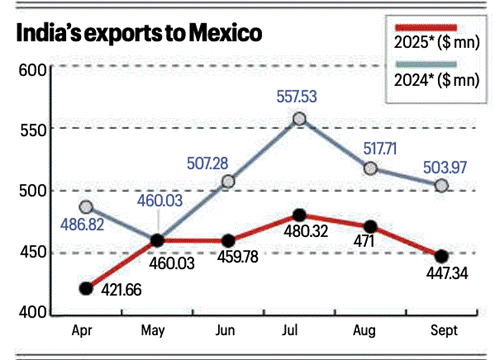
- India’s exports to Mexico—especially vehicles, auto components, machinery, chemicals, and nuclear reactors—face significant disruption.
- The tariffs come into force in January 2026, threatening India’s growing auto-export market and complicating its supply chains dependent on North America.
Relevance
GS2 – International Relations
- Trade disputes
- Diplomacy in economic policy
- Impact of U.S.-Mexico-China interactions on India
GS3 – Economy
- Export competitiveness
- Tariff impact on industries
- Protectionism and global trade dynamics
- Supply chain relocation
What exactly has Mexico done?
Tariff Decision
- Mexico has imposed:
- 50% tariff on passenger cars
- Tariffs on hundreds of other items from countries without trade agreements with Mexico.
- Affects India, China, Indonesia, Vietnam, and others.
Why Mexico Can Do This
- Mexico’s trade architecture is dominated by:
- USMCA (U.S.–Mexico–Canada Agreement)
- Few FTAs with Asian nations
- Countries without FTAs receive non-preferential MFN tariffs, which Mexico is now sharply increasing.
India’s Export Exposure
Top Indian exports to Mexico (Apr–Sep 2025):
- Vehicles & parts – $985.75 million
- Electric machinery – $316.06 million
- Nuclear reactors & parts – $284.61 million
- Organic chemicals – $163.55 million
Total India–Mexico trade is ~$15 bn annually.
Why has Mexico imposed these tariffs?
Protecting Domestic Industry
- Mexico seeks to shield:
- Local automobile industry
- Electronics and machinery producers
Given rising Asian imports, Mexican industry groups lobbied strongly for protection.
Response to Rising Asian Shipments
- In 2024–25, exports from India and China surged, partly due to:
- Diversion of supply after U.S. tariffs on China/India
- Indian automakers scaling shipments (compact cars, parts) via Mexico to the Americas
Revenue Generation
- Mexico aims to raise ₹37.6 billion additional revenue over three years through tariffs.
Anti-circumvention of U.S. Tariffs
- U.S. fears “tariff-jumping”:
Chinese/Asian goods entering U.S. via Mexico. - Mexico is tightening controls to:
- Preserve USMCA
- Avoid retaliation from the U.S.
Political & Electoral Pressure
- Strong lobbying by:
- Mexican auto workers’ unions
- Local manufacturers
- Populist political constituencies
Economic impact on India
Major Impact on Auto Exports
- India exports close to $1 billion worth of small cars and auto components to Mexico annually.
- Cars designed for Mexico may now become commercially unviable.
- 50% tariff sharply reduces price competitiveness.
Potential Loss of Market Share
- Indian exporters may lose to:
- U.S. manufacturers
- European OEMs
- Mexico-based assemblers
- Korean and Japanese firms with FTAs
Disruption to Supply Chain Linkages
- Several Indian component suppliers feed into:
- Mexican assembly lines
- North American EV ecosystem
- Tariffs could disrupt these supply chains.
Industry Reaction
- SIAM (Society of Indian Automobile Manufacturers) has flagged:
- Threat to India’s competitive position
- Need for urgent diplomatic outreach
Possible Decline in 2026 Exports
- Projections indicate a 10–15% fall in India’s Mexico-bound auto exports if tariffs remain.
Wider geopolitical context
U.S.–China–India Trade Rivalry
- U.S. has imposed tariffs on:
- EVs
- Batteries
- Autos
- Steel/aluminium
- Asian firms redirecting exports to Mexico are now being blocked.
Mexico’s Alignment with U.S. Interests
- To avoid violating USMCA, Mexico must prevent:
- Transshipment
- Duty evasion
- Over-reliance on Asian imports
Latin American Protectionism Rising
- Other Latin American countries may consider similar measures.
Implications for India’s policy and industry
Need for Trade Negotiations
- India requires:
- A bilateral trade dialogue
- Market access guarantees
- Sector-specific tariff relief
Reorientation Toward Other Markets
- Indian automakers may divert supply to:
- Southeast Asia
- Africa
- Middle East
- Latin America (non-Mexico)
Opportunities to Localise in Mexico
- Indian firms may consider:
- Setting up local assembly
- Joint ventures
- CKD/SKD pathways to bypass tariffs
Strengthening India’s Domestic Competitiveness
- Tariffs highlight need for:
- Higher R&D spending
- EV competitiveness
- Stronger supply-chain integration
What happens next?
Monitoring U.S.–Mexico–India Triangle
- Further U.S. tariffs could trigger more countries to adopt protectionist measures.
India’s Diplomatic Strategy
- Inter-ministerial discussions (MEA, Commerce) underway.
- India may seek:
- Transitional relief
- Carve-outs for EVs or small cars
- Lower tariffs on intermediate goods
Industry-level Adjustments
- Carmakers may revise:
- Product lines
- Pricing
- Export allocations
2,805 deaths while awaiting organ transplants since 2020
Why is it in News?
- The Union Health Ministry informed Parliament (Dec 2025) that 2,805 patients died while waiting for an organ transplant since 2020.
- Data provided by NOTTO (National Organ and Tissue Transplant Organisation) highlight severe organ shortages and long waiting periods.
- The government has introduced new digital reforms, including:
- Removal of mandatory domicile or registration-state restrictions.
- A new uniform national criterion for cadaveric organ allocation.
- Emphasis on centralised, equitable, need-based distribution.
The figures expose the mismatch between demand and availability, and underline the urgent need to strengthen India’s cadaveric organ donation ecosystem.
Relevance
GS2 – Health & Governance
- Public health delivery
- Organ donation policy
- Ethical governance
- Digital systems and national registries
GS3 – Science & Technology
- Medical logistics
- Transplant technologies
- Biomedicine and health infrastructure
What is Organ Transplantation in India?
Types of Donation
- Living donor transplants
- Kidney, part-liver, bone marrow
- Deceased (cadaveric) donor transplants
- Heart, lungs, pancreas, full liver, corneas
Governing Framework
- Transplantation of Human Organs and Tissues Act (THOTA), 1994
- National network:
- NOTTO (National level)
- ROTTO (Regional)
- SOTTO (State)
India’s Organ Gap
- Demand far exceeds supply:
- Kidney: need ~2 lakh/year; transplants ~25,000
- Liver: need ~50,000; transplants ~3,200
- Heart: need ~30,000; transplants <250
What the New Parliamentary Data Shows ?
Deaths While Awaiting Transplants (2020–2025)
- Total deaths: 2,805
- Highest:
- Delhi – 1,425
- Maharashtra – 297
- Tamil Nadu – 233
Patients Currently on Waitlist
- 82,285 patients awaiting organ transplants (as of Dec 2025).
State-wise waiting load
- Maharashtra: 20,553
- Gujarat: 18,992
- Tamil Nadu: 16,966
- Delhi: 8,883
- Karnataka: 7,405
These numbers demonstrate high geographic concentration of demand.
Which Organs Are Most in Demand?
Kidney
- Largest waiting list: ~65,090 patients nationwide.
Liver
- 18,724 waiting.
Heart
- 1,659 waiting.
Lung
- Smaller numbers, but mortality is high due to scarcity.
Why Do So Many Patients Die Waiting?
Low cadaveric donation rate
- India’s deceased donation rate: <0.7 per million population
- Spain: ~46 pmp
- U.S.: ~38 pmp
Limited ICU infrastructure
- Organ retrieval requires:
- Ventilator support
- Trained ICU staff
- Shortages restrict the pool of potential donors.
Logistical constraints
- Organ viability windows:
- Heart: 4 hours
- Liver: 8–12 hours
- Kidney: up to 24 hours
Lack of:
- Green corridors
- Air ambulance infrastructure
- State-level coordination
→ leads to lost organs.
Restrictive allocation rules (earlier)
- Hospitals often preferred in-state patients.
- Lack of unified national queue led to inequitable access.
Low public awareness
- Cultural hesitancy, myths, lack of donor pledges.
F. Cost Barriers
- Transplants expensive:
- Kidney: ₹5–8 lakh
- Liver: ₹20–30 lakh
Low insurance penetration compounds challenges.
Recent Reforms Introduced by NOTTO / Union Govt.
Removal of domicile restrictions
- Organs no longer restricted to:
- State of registration
- State of retrieval
→ Enables national pooling → boosts fairness.
Uniform waiting-list criteria
- Priority now based on:
- Urgency
- Waiting time
- Medical compatibility
- Severity
National-level digital registry
- Single national system covering:
- Listing
- Allocation
- Matching
- Transport logistics
Promoting organ retrieval centres
- Increasing number of authorised hospitals.
Linking Ayushman Bharat with transplant packages
- Reducing out-of-pocket burden for poorer families.
Key Ethical and Policy Considerations
Equity in Access
- Need to prevent:
- Hospital-level biases
- Regional monopolies
- “First come–first served” overriding urgency
Transparency
- Algorithms for matching must be publicly auditable.
Incentive alignment
- Non-monetary incentives for families:
- Honouring donors
- Fast-track benefits
Ethical prohibition
- No room for:
- Commercial sale of organs
- Coercion
- Exploitation of the poor
Strengthen Cadaveric Donation Movement
- Spain, U.S. models show success through:
- Mandatory referral
- Trained transplant coordinators
- National awareness drives


