
Content
- Pax Silica: India’s Likely Entry into a U.S.-Led Tech–Supply Chain Bloc
- EV Retrofit Push in India: Converting Old Cars to Electric
- AI Translation of Parliamentary Proceedings into 22 Languages
- Two Consecutive PSLV Failures
- PESA Act Implemented in Jharkhand after 25 Years: Will It Change Tribal Lives?
Pax Silica: India’s Likely Entry into a U.S.-Led Tech–Supply Chain Bloc
Context & Why in News ?
- India to be invited to join “Pax Silica”, a U.S.-led 8-nation initiative on:
- Semiconductors
- Critical minerals
- Artificial Intelligence
- Signals reset in India–U.S. strategic-tech cooperation after months of trade frictions.
- India was excluded in the initial launch (Dec, Washington) despite Quad membership.
Relevance
GS II – International Relations
- India–U.S. strategic partnership
- Minilateralism (Quad, I2U2)
- Strategic autonomy vs alignment
GS III – Economy & S&T
- Semiconductors, AI, critical minerals
- Supply chain security
- Industrial policy (PLI, Semicon India)
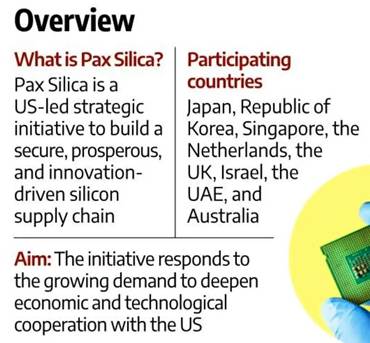
What is Pax Silica?
- Strategic techno-economic bloc, not a formal treaty.
- Aims to:
- Secure trusted semiconductor supply chains.
- Reduce dependence on China-centric manufacturing & minerals.
- Coordinate on AI governance, standards, and innovation.
- Part of broader U.S. vision of “friend-shoring” and tech alliances.
Strategic Context: Why Pax Silica Matters Now ?
- Semiconductors as geopolitics:
- Chips = core of defence, AI, telecom, EVs.
- Critical minerals:
- Lithium, cobalt, rare earths → energy transition & defence.
- AI race:
- Economic productivity + military applications.
- Pax Silica complements:
- Quad tech agenda
- I2U2 economic corridor
- U.S. CHIPS & Science Act ecosystem.
Why India’s Participation is Significant ?
Strategic Dimension
- Indo-Pacific balancing:
- Strengthens India’s role in shaping rules-based tech order.
- Trust-based alignment:
- Without formal alliance → preserves strategic autonomy.
- Enhances India’s leverage in:
- Quad
- G20
- Global tech governance forums.
Economic & Industrial Dimension
- Aligns with India’s:
- Semicon India Programme
- PLI schemes
- Access to:
- Advanced chip design ecosystems.
- Global value chains (fab, packaging, testing).
- Helps India move up from:
- Assembly → design, materials, and equipment.
Supply Chain Security
- Reduces vulnerability to:
- China-dominated rare earth processing.
- Diversification of:
- Mineral sourcing
- Manufacturing nodes.
Why India Was Initially Excluded ?
- Trade tensions:
- U.S. imposed 50% tariffs on Indian goods.
- Friction over:
- India’s Russian oil imports.
- Policy divergence:
- Data localisation
- Market access issues.
- Current invitation reflects:
- Pragmatic reset rather than ideological convergence.
Challenges & Risks for India
Strategic Risks
- Over-alignment risks perception of bloc politics.
- China factor:
- Possible retaliation in trade or border diplomacy.
Economic Risks
- High entry barriers:
- Capital-intensive fabs.
- Technology export controls (U.S. ITAR-like regimes).
Policy Risks
- AI governance:
- U.S. model vs India’s development-first approach.
- Critical minerals:
- India weak in domestic reserves → dependency persists.
Linkages with Other Groupings
- Quad:
- Security + tech norms.
- I2U2:
- Economic innovation corridor.
- BRICS:
- India must balance tech alignment with Global South leadership.
Way Forward for India
- Selective participation:
- Focus on semicon design, OSAT, minerals processing.
- Insist on technology access, not just market integration.
- Leverage Pax Silica for Global South:
- Act as bridge between advanced tech & developing world.
- Domestic reforms:
- Ease land, power, water bottlenecks for fabs.
- Parallel diversification:
- Continue cooperation with EU, Japan, South Korea.
Pax Silica – Members
- United States (Lead country)
- Japan
- Australia
- South Korea
- Singapore
- United Kingdom
- Netherlands
- Israel
- United Arab Emirates
EV Retrofit Push in India
Context & Why in News ?
- Delhi government announced incentives under its upcoming EV Policy to promote retrofitting of old ICE vehicles into EVs.
- Incentives include:
- ₹50,000 for first 1,000 retrofitted vehicles.
- Focus on 2-wheelers & 3-wheelers initially.
- Policy aims to address urban air pollution, vehicle scrappage gaps, and affordability barriers to EV adoption.
Relevance
GS III – Environment & Economy
- Electric mobility
- Urban air pollution
- Circular economy
GS II – Governance
- Urban transport policy
- Centre–State regulation (CMVR)
What is EV Retrofitting?
- Retrofitting = converting an Internal Combustion Engine (ICE) vehicle into an Electric Vehicle (EV).
- Key components replaced:
- Engine → Electric motor
- Fuel tank → Battery pack
- Transmission simplified
- Requires approval under Central Motor Vehicles Rules (CMVR) and testing by agencies like ARAI / ICAT.
Economic Analysis: Why Retrofitting Is Expensive ?
- Retrofit cost:
- 2-wheelers: ~₹60,000–₹1 lakh
- 4-wheelers: ₹3.5–6 lakh
- High cost drivers:
- Battery (~40–50% of cost)
- Low economies of scale
- Certification & compliance costs
Concerns
- Battery sourcing & disposal:
- Environmental costs of lithium extraction.
- Limited lifecycle benefit:
- If retrofit lifespan < new EV lifespan.
Technology & Industry Dimension
- Market maturity:
- Retrofit industry still nascent.
- Supply chain gaps:
- Limited certified vendors.
- Warranty issues:
- Retrofit kits often offer:
- ~3-year battery warranty
- ~1 lakh km motor warranty
- Retrofit kits often offer:
- Safety & reliability:
- Fire risk concerns if standards not enforced.
Key Challenges
Economic
- High cost vs declining cost of new EVs.
- Limited subsidy support compared to new EVs.
Institutional
- Complex approval & certification.
- Lack of uniform standards across states.
Environmental
- Battery recycling ecosystem still weak.
Market
- Low consumer confidence and limited scale.
Way Forward
- Targeted retrofitting strategy:
- Focus on:
- 2W, 3W, taxis, delivery fleets.
- Focus on:
- Battery-as-a-Service (BaaS):
- Reduce upfront retrofit cost.
- Stronger incentives:
- Link with vehicle scrappage policy.
- Standardisation:
- National retrofit standards & safety norms.
- Urban low-emission zones:
- Mandate retrofitting or EV-only access.
- Parallel push:
- Do not dilute incentives for new EVs.
AI Translation of Parliamentary Proceedings into 22 Languages
Context & Why in News ?
- From 2026, parliamentary proceedings and official paperwork will be translated using AI into 22 Scheduled Languages.
- Announcement by the Om Birla, aligned with Lok Sabha Secretariat’s digitisation drive.
- Aim: Full linguistic accessibility, real-time or near real-time translation.
Relevance
GS II – Polity & Governance
- Parliamentary functioning
- Linguistic inclusion
- E-governance
Constitutional & Legal Dimension
- Article 120:
- Allows use of Hindi/English and permits other languages as authorised by Parliament.
- Eighth Schedule:
- Recognises 22 Scheduled Languages → normative basis for inclusion.
- Article 350:
- Right to representation in one’s language.
- Spirit of the Constitution:
- Linguistic diversity + democratic participation.
Governance & Democratic Significance
- Deepening representative democracy:
- MPs, especially from non-Hindi states, can engage more effectively.
- Public accessibility:
- Citizens gain direct access to debates in their mother tongue.
- Legislative quality:
- Better comprehension → informed debate and scrutiny.
- Transparency:
- Entire proceedings, not just summaries, made accessible.
Technology & Administrative Dimension
- Use of AI/NLP tools:
- Machine translation + human post-editing.
- Phased implementation:
- Currently available in 10 languages → 22 by end-2026.
- Human–AI hybrid model:
- Contract translators + younger AI-literate professionals.
- Digitisation push:
- Linked with e-Vidhan, e-Parliament initiatives.
Ethical & Constitutional Concerns
- Accuracy & nuance:
- Legislative language is technical; mistranslation can alter meaning.
- Accountability:
- Who is responsible for errors—AI vendor or Secretariat?
- Bias & data training:
- Regional dialects under-represented in datasets.
- Digital divide:
- Access assumes digital literacy and connectivity.
Key Challenges
Technical
- Context loss in:
- Legal terms
- Sarcasm, interruptions, procedural phrases.
- Difficulty in low-resource languages.
Institutional
- Over-reliance on AI without robust human oversight.
- Version control between original and translated texts.
Democratic
- Risk of misinterpretation influencing public opinion.
- MPs may rely on AI translations during debates.
Way Forward
- Human-in-the-loop model mandatory for final versions.
- Authoritative language principle:
- Original text prevails in case of dispute.
- Standardised legislative glossaries across languages.
- Independent audit of AI tools for bias and accuracy.
- Capacity building:
- MPs & staff trained to use translated material responsibly.
- Gradual rollout with feedback loops.
Two Consecutive PSLV Failures
Context & Why in News ?
- Indian Space Research Organisation’s Polar Satellite Launch Vehicle (PSLV) has suffered two consecutive failures:
- PSLV-C61 (May 2025): Pressure drop in PS3.
- PSLV-C62 (Jan 2026): Disruption in roll rate of PS3, deviation from intended orbit.
- First time in PSLV’s 32-year history that back-to-back failures have occurred.
- Raises concerns beyond “bad luck” → systemic and organisational scrutiny.
Relevance
GS III – Science & Technology
- Space technology
- Failure analysis & reliability
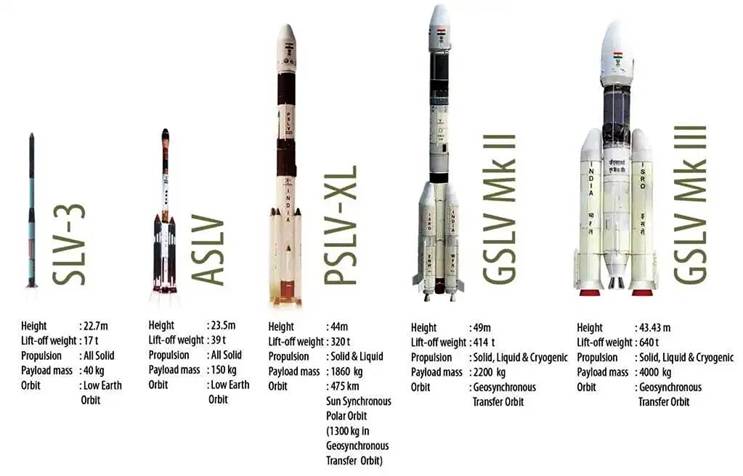
PSLV at a Glance
- Four-stage launch vehicle:
- PS1 & PS3: Solid stages
- PS2 & PS4: Liquid stages
- Known for high reliability and cost-effectiveness.
- Backbone of India’s:
- Earth observation
- Navigation (IRNSS)
- Commercial launches (earlier phase)
Failure History Snapshot
- 5 failures / partial failures in ~64 launches.
- Earlier failures were isolated & time-separated (1993, 1997, 2017).
- 2025–26 failures clustered around PS3 → commonality demands scrutiny.
Technical Analysis
Why PS3 Matters ?
- PS3 (third stage):
- Solid motor
- Provides crucial velocity shaping & attitude stability.
- Failures observed:
- Pressure drop (C61)
- Roll-rate instability (C62)
- Indicates possible issues in:
- Motor casing integrity
- Thrust vector alignment
- Sensor-actuator feedback loop
Possible Technical Causes
- Manufacturing variability in solid propellant.
- Ageing supply-chain components.
- Quality assurance gaps in:
- Pressure regulators
- Inertial navigation sensors
- Configuration management challenges due to PSLV variants (CA, XL, DL).
Strategic
- PSLV supports:
- Surveillance
- Weather & disaster management
- Strategic payloads
- Reliability dip → national security sensitivity.
Science & Technology Ecosystem Perspective
- Maturity paradox:
- Highly mature systems risk complacency.
- ISRO increasingly focused on:
- Gaganyaan
- LVM3
- Reusable Launch Vehicle
- Risk of attention dilution for “legacy” systems like PSLV.
Comparative Insight
- NASA / ESA practice:
- Mandatory public post-failure disclosures.
- Independent review boards.
- Transparency improves:
- Learning curve
- Public confidence
- International credibility
Way Forward
- Deep-dive PS3 audit:
- Design, material science, manufacturing chain.
- Public release of FAC findings (non-sensitive parts).
- Digital twin & AI-based anomaly prediction.
- Independent safety oversight board within ISRO.
- Gradual phase-out / redesign of PSLV as small-launch ecosystem matures.
- Strengthen role of private launch vehicles to reduce strategic dependence.
PESA Act Implemented in Jharkhand after 25 Years: Will It Change Tribal Lives?
Context & Why in News ?
- Panchayat (Extension to Scheduled Areas) Act rules notified in Jharkhand in 2025–26, 25 years after statehood.
- Applies fully in 13 districts, partially in 3.
- Reignites debate on Gram Sabha supremacy, customary law, and administrative control in Fifth Schedule Areas.
Relevance
GS II – Polity & Governance
- Fifth Schedule
- Tribal self-governance
- Panchayati Raj in Scheduled Areas
GS I – Indian Society
- Tribal autonomy & customary law
Constitutional / Legal Dimension
- Fifth Schedule (Article 244):
- Mandates special governance for Scheduled Areas to protect tribal autonomy.
- PESA, 1996:
- Extends Part IX (Panchayats) to Scheduled Areas with modifications.
- Core spirit: Gram Sabha as basic unit of self-governance.
- Key Constitutional Anchors:
- Article 13 (customary law protection via PESA).
- Articles 38, 39(b): distributive justice, community control over resources.
- Fault Line:
- Jharkhand rules alleged to dilute Sections 4(a), 4(d) of PESA → erosion of protection to customary law, cultural identity, community ownership.
Governance & Administrative Dimension
- What the Rules Provide:
- Gram Sabha declared “supreme” in Scheduled Areas.
- President chosen as per traditional customs.
- Powers over:
- Minor minerals, forest produce, small water bodies.
- Local dispute resolution; fines up to ₹2,000.
- Critical Governance Concerns:
- District Deputy Commissioner:
- Recognises and notifies Gram Sabhas and boundaries → top-down control.
- Gram Sabha excluded from:
- District Mineral Foundation (DMF).
- Tribal Sub Plan (TSP).
- District Deputy Commissioner:
- Institutional Tension:
- Panchayati Raj Institutions + bureaucracy vs customary institutions (Manki-Munda, Majhi-Pargana).
Economic & Resource Governance Dimension
- Resource-rich State:
- ~30% forest cover.
- ~40% of India’s mineral reserves.
- Annual mineral output: ~160 million tonnes.
- Disconnect:
- High resource extraction vs persistent tribal poverty.
- Key Issue:
- Gram Sabha authority limited to minor minerals, not major mining, DMF funds, or consent mechanisms.
Social & Human Development Dimension
- Demographic Reality:
- STs = 26.3% of population (~32.9 million).
- 32 tribal communities; 8 PVTGs.
- Persistent Deprivation:
- Literacy (STs): 57.2% (2011).
- Only 6.08% tribal households in salaried jobs.
- Health Indicators:
- 28% tribal women with BMI < 18.5 (NFHS-5).
- High anaemia, malaria burden.
- Water & Welfare:
- Jal Jeevan Mission coverage: ~55%, tribal areas lagging.
Environment & Forest Rights Dimension
- Forest Rights Act (FRA) Interface:
- 110,756 claims filed; only ~56% approved by Aug 2025.
- Civil Society Concern:
- Jharkhand Forest Rights Forum alleges:
- Bureaucratic dominance.
- Community forest management rights diluted.
- Jharkhand Forest Rights Forum alleges:
- Structural Issue:
- PESA + FRA not harmonised in rules → fragmented tribal governance.
Criticisms
Institutional
- Gram Sabha authority conditional on administrative recognition.
- Weak linkage with DMF, TSP, major development planning.
Legal
- Omission of explicit terms like “community ownership”.
- Customary law subordinated to executive discretion.
Implementation
- Risk of symbolic decentralisation.
- Panchayat secretaries and officials can override traditional institutions.
Ethical
- Violates principle of self-rule as intrinsic tribal right, not state concession.
Way Forward
- Amend Rules to fully mirror PESA Section 4:
- Explicit protection to customary law, culture, community ownership.
- Gram Sabha Primacy:
- Recognition by community, not district officials.
- Expand Economic Powers:
- Mandatory Gram Sabha consent for DMF utilisation, major mining impacts.
- PESA–FRA Convergence Framework:
- Single institutional platform for forest and village governance.
- Capacity Building:
- Legal literacy, financial powers, independent dispute resolution.
- Governor’s Fifth Schedule Role:
- Active use of discretionary powers to safeguard tribal interests.
Prelims Pointers
- PESA applies only to Fifth Schedule Areas, not Sixth Schedule.
- Jharkhand: last major Fifth Schedule state to notify PESA rules.
- Gram Sabha under PESA ≠ Gram Sabha under normal Panchayati Raj.
- Customary law protection is core to PESA, not optional.


