
Content
- Are Methane Emissions in India Being Missed?
- MH-60R Seahawk Helicopters
- Bill for overhaul of higher education regulatory framework likely soon
- Trat province
- Insurance Laws (Amendment) Bill, 2025
- Karnataka Hate Speech and Hate Crimes (Prevention) Bill, 2025
Are methane emissions in India being missed?
Why is this in News?
- Satellite-based studies (ISRO, 2023–25) reveal actual methane emissions from major Indian landfills far exceed official model-based estimates.
- NGT has constituted committees to verify satellite-detected methane hotspots (e.g., Ghazipur, Bhalswa, Pirana, Kanjurmarg).
- Highlights a critical data gap in India’s waste-sector emissions, directly affecting:
- Climate commitments (NDCs)
- Urban safety (landfill fires)
- Public health and air quality
- Renewed policy relevance under Swachh Bharat Mission, GOBARdhan, and revised Municipal Solid Waste (MSW) Rules.
Relevance
GS III – Environment & Climate Change
- Methane as a short-lived climate pollutant (SLCP)
- Waste management and landfill emissions
- India’s NDCs and climate mitigation strategies
GS III – Urban Development
- Solid waste management, landfill fires, urban safety
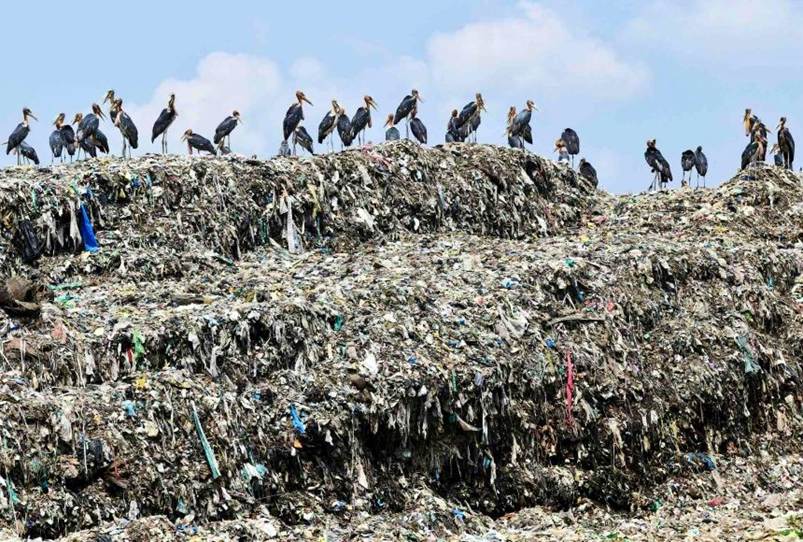
Methane: The Basics
- What is Methane (CH₄)?
- A short-lived climate pollutant (SLCP).
- 84 times more potent than CO₂ over a 20-year period (GWP-20).
- Atmospheric lifetime: ~12 years.
- Why dangerous in landfills?
- Generated via anaerobic decomposition of organic waste.
- Accumulates in open dumps → fires, explosions, toxic smoke.
- Paradox:
- Useful fuel (Bio-CNG, PNG, power generation).
- Severe climate and urban hazard if unmanaged.
Landfills as Methane Factories
- Processes mimic natural gas formation, but at accelerated rates:
- High organic content (wet waste).
- Poor segregation.
- Inadequate capping and gas capture.
- India-specific context:
- Large open dumpsites, not sanitary landfills.
- High moisture + heat = faster methane generation.
India’s Methane Profile (Waste Sector Focus)
- ~15% of India’s methane emissions come from the waste sector.
- Key advantage:
- Unlike agriculture or energy, waste offers quick mitigation wins.
- Technology, policy, and incentives already exist.
The Core Problem: Measuring an Invisible Gas
Model-based Estimation (Traditional)
- Uses:
- Waste inflow volumes.
- Standard decay coefficients.
- Limitations:
- Outdated data (State-level, often 2018).
- Aggregated → cannot locate specific hotspots.
- Heavily assumption-driven.
Ground-based Monitoring
- Challenges:
- Expensive sensors.
- Skilled manpower.
- Continuous maintenance.
- Difficult to scale across India’s urban landscape.
Satellite Monitoring: The Game Changer
Types of Satellite Data
- Regional-scale monitoring
- Covers km-level grids.
- Tracks national/regional trends.
- High-resolution hotspot detection
- Detects emissions at few square metres.
- Crucial for targeted action.
Key Missions & Platforms
- ISRO methane study (2023).
- International missions:
- CarbonMapper (Tanager).
- SRON (Netherlands).
- Data aggregators:
- ClimateTRACE
- WasteMap
What Satellites Are Revealing: The Discrepancy ?
- Global finding: Actual landfill methane ≈ 1.8× higher than model estimates.
Indian City Examples
- Delhi
- Official (2018): 1.07 Mt CO₂e (entire waste sector).
- Satellite: Ghazipur + Bhalswa alone → 0.85–0.96 Mt CO₂e.
- Mumbai
- Model: Kanjurmarg ≈ 11% of city waste emissions.
- Satellite: 1.05 Mt CO₂e (~10× higher; ~50% of Maharashtra’s waste emissions).
- Ahmedabad
- Gujarat total (model): 0.73 Mt CO₂e.
- Pirana landfill alone: 0.60–0.81 Mt CO₂e.
Inference
- Indicates:
- Gas capture failures.
- Accelerated decomposition.
- Engineering flaws.
- Risks were invisible earlier due to data blindness.
Why This Matters Beyond Climate ?
- Urban safety: Methane-driven landfill fires.
- Public health: Toxic emissions, PM spikes.
- Governance: Weak accountability of ULBs.
- Economy: Lost opportunity for Bio-CNG and power.
The Way Forward: A Three-Pillar Strategy
Expand Satellite Coverage
- Mandatory monitoring of all major dumpsites.
- Public, transparent emission dashboards.
Ground Validation Systems
- Rapid-response teams for satellite-flagged hotspots.
- Diagnose:
- Poor capping.
- Gas collection leaks.
- Illegal dumping.
Integrated Data Architecture
- Standardised data-sharing between:
- ULBs.
- SPCBs.
- NGT, CAQM (for NCR).
- Expand proposed centralised waste data portal under MSW Rules to include methane tracking.
Institutional & Policy Linkages
- Swachh Bharat Mission: Integrate methane reduction targets.
- GOBARdhan Scheme: Scale Bio-CNG plants (Indore model).
- CAQM (NCR): Regional oversight for landfill emissions.
- State Action Plans on Climate Change (SAPCCs): Update with satellite-based waste data.
Key Observation
- Methane mitigation from waste is India’s lowest-hanging climate fruit:
- High impact.
- Low cost.
- Immediate gains.
- Core governance lesson:
- “What gets measured gets managed.”
- Data integration can convert urban waste from a liability into a climate asset.
Conclusion
By synchronising satellites, street-level action, and standardised data governance, India can turn landfill methane—from a fire hazard and climate threat—into its smartest, fastest climate solution.
MH-60R Seahawk Helicopter
Why is this in News?
- The Indian Navy will commission its second MH-60R Seahawk helicopter squadron (INAS 335 – “Ospreys”) on December 17 at INS Hansa, Goa.
- Marks a key milestone in naval aviation modernisation and strengthening India’s blue-water and Indian Ocean Region (IOR) presence.
- Follows the commissioning of the first MH-60R squadron at Kochi in March 2024.
Relevance
GS III – Internal Security & Defence
- Military modernisation
- Naval aviation and force multipliers
GS II – International Relations
- India–US defence cooperation
- Indo-Pacific and Indian Ocean Region (IOR) security

MH-60R Seahawk: The Basics
- Origin: US-made, Lockheed Martin / Sikorsky.
- Type: Multi-role naval helicopter.
- Role spectrum:
- Anti-Submarine Warfare (ASW)
- Anti-Surface Warfare (ASuW)
- Surveillance & reconnaissance
- Search and Rescue (SAR)
- Maritime interdiction
- Replaces: Ageing Sea King helicopters.
Key Technical Capabilities
- Sensors & Avionics
- Advanced maritime surveillance radar.
- Dipping sonar + sonobuoys (critical for ASW).
- Electro-optical/infrared (EO/IR) systems.
- Weapons
- Air-launched torpedoes.
- Anti-ship missiles.
- Network-centric warfare
- Fully integrated with fleet operations.
- Real-time data sharing with ships and command centres.
Strategic Significance for India
Boost to Blue-Water Navy Ambitions
- Extends operational reach far from the coastline.
- Enables sustained deployments in the IOR.
Anti-Submarine Warfare Edge
- Direct response to:
- Expanding Chinese submarine presence in the IOR.
- Growing undersea contest in the Indo-Pacific.
- Enhances India’s sea denial and deterrence posture.
Maritime Domain Awareness (MDA)
- Persistent aerial surveillance over:
- Sea Lines of Communication (SLOCs).
- Chokepoints such as Malacca Strait approaches.
- Supports QUAD and IOR security architecture.
Operational Impact of INAS 335 (Goa)
- Western Seaboard focus:
- Arabian Sea.
- Protection of critical maritime trade routes.
- Complements assets deployed on:
- Aircraft carriers.
- Destroyers and frigates.
- Improves rapid response to asymmetric threats:
- Piracy.
- Maritime terrorism.
- Grey-zone operations.
Conclusion
By inducting the second MH-60R squadron, the Indian Navy decisively strengthens its maritime strike, surveillance, and deterrence capabilities, reinforcing India’s role as a net security provider in the Indian Ocean Region.
Bill for overhaul of higher education regulatory framework likely soon
Why is this in News?
- The Union Government has listed the Viksit Bharat Shiksha Adhishthan (VBSA) Bill, 2025 for introduction in Parliament’s Winter Session.
- Proposes a complete overhaul of higher education regulation by:
- Creating a single umbrella commission (VBSA).
- Subsuming UGC, AICTE, and NCTE.
- Seen as the legislative backbone for implementing NEP 2020 in higher education.
Relevance
- GS II – Governance
- Regulatory reforms and institutional restructuring
- Centre–State relations in education
- GS III – Human Capital
- Higher education quality, research, innovation ecosystem
- GS II – Social Sector
- Education reforms under NEP 2020
Background: Existing Regulatory Architecture
- UGC: Funding + regulation of universities.
- AICTE: Technical education regulation.
- NCTE: Teacher education regulation.
- Problems identified:
- Overlapping jurisdictions.
- Excessive compliance and inspections.
- Input-based regulation over outcomes.
- Weak coordination between funding, accreditation, and standards.
What is the VBSA? (Basic Design)
- Viksit Bharat Shiksha Adhishthan (VBSA):
- A 12-member umbrella commission.
- Three functional councils under VBSA:
- Viksit Bharat Viniyaman Parishad – Regulation.
- Viksit Bharat Gunvatta Parishad – Accreditation.
- Viksit Bharat Manak Parishad – Standards.
- Each council: Up to 14 members.
Key Structural Changes Proposed
Single Regulator Model
- Ends the multi-regulator fragmentation.
- Clear separation of:
- Rule-making (standards).
- Oversight (regulation).
- Quality assurance (accreditation).
UGC’s Funding Role Removed
- Grants to be disbursed through mechanisms devised by the Ministry of Education.
- Regulatory body no longer controls funding → reduces conflict of interest.
Scope of Applicability
- Covers:
- All Central and State universities.
- Colleges and HEIs.
- Technical, teacher, architectural education.
- Institutions of National Importance.
- Institutes of Eminence.
- Explicit exemptions:
- Medicine.
- Dentistry.
- Law.
- Pharmacy.
- Nursing.
- Veterinary sciences.
- Rationale: Sector-specific statutory councils already exist.
Accreditation Reform: Outcome-Based Model
- Gunvatta Parishad mandated to:
- Develop outcome-based institutional accreditation.
- Shift from:
- Infrastructure/input metrics → learning outcomes, research output, innovation, governance.
- Aligns with global best practices (OECD, QS/THE frameworks).
Internationalisation of Higher Education
Foreign Universities in India
- Regulatory Council empowered to:
- Set standards for Centre-approved foreign universities operating in India.
- Ensure quality control and academic parity.
Indian Campuses Abroad
- Facilitate high-performing Indian universities to establish overseas campuses.
- Supports India’s ambition as a global education hub.
Preventing Commercialisation
- VBSA tasked with developing a coherent policy against commercialisation of higher education.
- Balancing:
- Autonomy and competition.
- Public purpose and accessibility.
Alignment with NEP 2020
- Reflects NEP principles:
- Light but tight regulation.
- Institutional autonomy.
- Outcome-based evaluation.
- Internationalisation.
- Reduced inspector raj.
- Mirrors earlier proposal of Higher Education Commission of India (HECI), now rebranded and refined.
Key Concerns & Debates
Centralisation vs Federalism
- Applies to State universities.
- Potential friction with States over regulatory autonomy.
Ministry-Controlled Funding
- Shifting grants to Ministry mechanisms may:
- Increase executive discretion.
- Reduce arms-length academic governance.
Capacity & Transition Risks
- Smooth merger of UGC, AICTE, NCTE functions critical.
- Risk of regulatory vacuum during transition phase.
Takeaway
- The VBSA Bill marks a paradigm shift from control-based to coordination-based regulation.
- Success hinges on:
- Transparent accreditation.
- Protection of academic autonomy.
- Federal consensus-building.
Conclusion
If implemented with safeguards, the Viksit Bharat Shiksha Adhishthan Bill, 2025 can transform India’s higher education governance from fragmented control to coherent quality-led regulation, aligning education with the vision of Viksit Bharat 2047.
Trat province
Why is this in News?
- Thailand imposed a curfew in five districts of Trat province after armed clashes with Cambodia spread to coastal border areas.
- Fighting continues despite Cambodia reiterating openness to a ceasefire and US mediation claims.
- First confirmed civilian death in the current escalation reported in Thailand.
- Conflict has displaced hundreds of thousands on both sides, signalling a serious regional security escalation.
Relevance
- GS II – International Relations
- Border disputes and conflict escalation
- ASEAN’s role in regional security
- GS III – Security
- Regional instability and humanitarian consequences
Where is Trat Province?
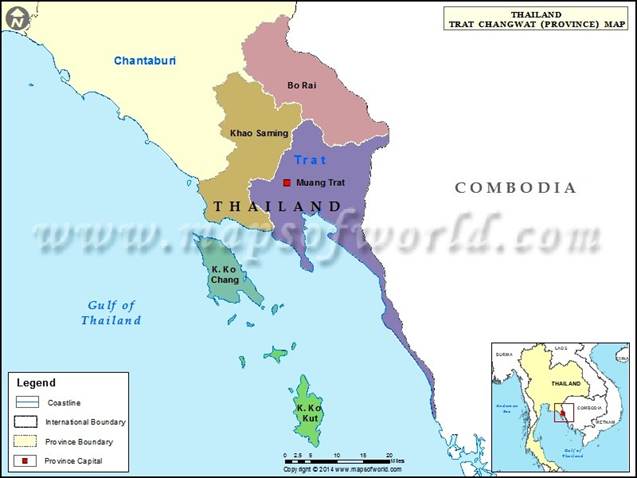
- Location: Southeastern Thailand, bordering Cambodia’s Koh Kong province.
- Geostrategic importance:
- Coastal access to the Gulf of Thailand.
- Proximity to disputed land and maritime boundary zones.
- Curfew area:
- Five mainland districts bordering Cambodia.
- Tourist islands Koh Chang and Koh Kood excluded (economic protection).
Thailand–Cambodia Border Dispute: Background
- Rooted in colonial-era boundary demarcations (French Indochina maps vs Thai interpretations).
- Historically volatile regions:
- Preah Vihear temple area (earlier flashpoint).
- Eastern and southeastern border zones (current focus).
- Periodic military skirmishes despite ASEAN norms of peaceful dispute resolution.
Why Coastal Expansion Matters ?
- Indicates horizontal escalation beyond traditional land flashpoints.
- Raises risks of:
- Maritime incidents in the Gulf of Thailand.
- Disruption to trade and fishing.
- Increases international concern due to proximity to sea lanes.
Strategic Implications
Regional Security
- Undermines ASEAN’s credibility as a peace-maintaining bloc.
- Risks militarisation of Southeast Asian coastal borders.
Humanitarian Dimension
- Large-scale displacement.
- Civilian casualties mark a shift from controlled skirmishes to population-impacting conflict.
Great Power Context
- External mediation attempts highlight:
- Growing interest of extra-regional powers in Southeast Asian stability.
- Strategic sensitivity of the Indo-Pacific periphery.
Conclusion
The curfew in Thailand’s Trat province marks a dangerous widening of the Thailand–Cambodia border conflict, exposing the limits of regional diplomacy and the enduring volatility of colonial-era boundary disputes in Southeast Asia.
Insurance Laws (Amendment) Bill, 2025
Why is this in News?
- The Union Cabinet has approved the Insurance Laws (Amendment) Bill, 2025, to be introduced in Parliament.
- The Bill proposes structural reforms in India’s insurance regulatory framework, including:
- Raising FDI limit from 74% to 100%.
- Expanding IRDAI’s regulatory and enforcement powers.
- Introducing new capital norms and easing business operations.
- Aimed at aligning India’s insurance sector with global best practices and boosting penetration under the Viksit Bharat 2047 vision.
Relevance
- GS III – Economy
- Financial sector reforms
- Insurance penetration and risk management
- FDI liberalisation
- GS II – Governance
- Role and powers of regulatory institutions (IRDAI)
Background: India’s Insurance Framework
- Governed by:
- Insurance Act, 1938
- IRDA Act, 1999
- Persistent challenges:
- Low insurance penetration (~4% vs global ~7%).
- Capital constraints.
- Limited product innovation.
- Fragmented regulation and slow approvals.
Key Provisions of the Bill
FDI Liberalisation
- FDI cap raised to 100% (from 74%).
- Objective:
- Attract stable, long-term foreign capital.
- Strengthen solvency and balance sheets.
- Enable scale, technology infusion, and risk management.
- Expected impact:
- Entry of global insurers and reinsurers.
- Increased competition and consumer choice.
Capital & Entry Norms Reform
- Proposal to lower minimum capital requirements:
- Currently:
- ₹100 crore (insurers)
- ₹200 crore (reinsurers)
- Currently:
- Rationale:
- Existing norms seen as entry barriers, especially for:
- Micro-insurance.
- Digital-only insurers.
- Health and specialised insurers.
- Existing norms seen as entry barriers, especially for:
- Outcome:
- Encourages niche, region-specific, and low-cost insurance models.
More Powers to IRDAI
- IRDAI to be empowered with:
- SEBI-like enforcement powers.
- Authority to recover illegally earned profits.
- Stronger penalties for violations.
- Significance:
- Shifts regulator from procedural oversight → outcome-based supervision.
- Enhances consumer protection and market discipline.
Simplified Regulatory Processes
- One-time registration instead of repeated approvals.
- Risk-based supervision replacing rule-based micromanagement.
- Introduction of Standard Operating Procedures (SOPs) to:
- Improve predictability.
- Reduce regulatory delays.
- Faster approvals for:
- Product launches.
- Business expansion.
- Intermediary operations.
Reinsurance & GIFT-IFSC Boost
- Greater operational freedom for:
- Foreign reinsurance branches.
- IFSC-based insurance entities (LICI).
- Objective:
- Position India as a regional reinsurance hub.
- Reduce capital flight to overseas markets.
- Improve domestic risk absorption capacity.
What the Bill Does Not Allow
- Composite licences rejected:
- Life + non-life + health under a single licence not permitted.
- Reason:
- Underwriting risks, liabilities, and actuarial models differ sharply.
- Prevents systemic risk and regulatory arbitrage.
Captive Insurers: Deferred Reform
- Proposal to allow captive insurance companies shelved for now.
- Why controversial:
- Parent companies could underprice risks.
- Potential for profit shifting and solvency concerns.
- However:
- Long-term possibility remains under tighter safeguards.
Economic & Governance Significance
Insurance as Growth Infrastructure
- Mobilises long-term savings.
- Reduces household vulnerability.
- Supports infrastructure, health, and climate risk coverage.
Market Structure Impact
- Encourages:
- Consolidation where inefficient.
- Competition where entry barriers fall.
- Improves product diversity:
- Health, crop, climate, and catastrophe insurance.
Risks & Criticisms
- Over-centralisation of power in IRDAI.
- 100% FDI may:
- Reduce domestic promoter control.
- Lead to profit repatriation.
- Consumer protection depends on regulatory capacity, not just law.
Takeaway
- The Bill marks a shift from protectionist regulation to competitive, capital-driven insurance governance.
- Success depends on:
- Strong IRDAI enforcement.
- Prudential safeguards.
- Consumer-centric supervision.
Conclusion
The Insurance Laws (Amendment) Bill, 2025 seeks to transform India’s insurance sector into a capital-rich, competitive, and innovation-driven market, making insurance a core pillar of economic resilience under Viksit Bharat 2047.
Karnataka Hate Speech and Hate Crimes (Prevention) Bill, 2025
Why is this in News?
- The Karnataka government has tabled the Karnataka Hate Speech and Hate Crimes (Prevention) Bill, 2025 in the State Legislative Assembly.
- The Bill proposes:
- A new, expansive statutory definition of hate speech.
- Stricter punishments than existing central laws.
- Executive powers to block online content deemed hateful.
- Has triggered debate on free speech, overcriminalisation, federal overlap, and constitutional validity, especially in light of recent Supreme Court jurisprudence.
Relevance
- GS II – Polity
- Fundamental rights: Article 19(1)(a) vs Article 19(2)
- Federalism and concurrent legislative powers
- GS III – Internal Security
- Social cohesion, communal harmony, online hate
Existing Legal Framework on Hate Speech
- Indian Penal Code (now BNS):
- Section 153A / 196 BNS: Promoting enmity.
- Section 295A: Outraging religious feelings.
- Section 505: Statements conducing to public mischief.
- Judicial position:
- No single codified definition of “hate speech”.
- Courts rely on context, intent, and tendency to incite violence or disorder.
- Supreme Court trend:
- Repeated emphasis on “bail, not jail”.
- Caution against chilling effect on free speech.
What Does the Karnataka Bill Propose?
Broad Definition of Hate Crime
- Includes any communication of hate speech:
- Spoken, written, signs, symbols, electronic communication.
- Targets speech against individuals or groups based on:
- Religion, race, caste, sex, gender, sexual orientation.
- Language, place of birth, residence, tribe, disability, etc.
- Objective: To meet a “prejudicial interest”.
Key Changes Introduced by the Bill
Expanded Definition of Hate Speech
- Hate speech can be invoked even without direct incitement to violence.
- Covers:
- Insults.
- Humiliation.
- Promotion or justification of hatred.
- Concern:
- Vagueness and overbreadth, risking arbitrary application.
Increased Punishment
- Mandatory minimum imprisonment: 1 year.
- Maximum punishment: Up to 7 years.
- If offence invites punishment under other laws:
- Enhanced punishment up to 10 years.
- Contrast:
- Many BNS hate speech offences carry lower or non-mandatory sentences.
Government’s Takedown Powers
- State empowered to:
- Order removal of online content.
- Direct service providers, intermediaries, platforms to block material.
- Based on Information Technology Rules, 2009.
- Appeals mechanism:
- Bureaucratic and executive-dominated.
- Limited immediate judicial oversight.
Collective Liability Provisions
- Organisations and institutions can be punished if:
- Hate crimes are committed by members.
- They fail to show “due diligence” to prevent it.
- Shifts burden of proof:
- Accused must prove lack of knowledge or preventive action.
- Raises presumption-of-guilt concerns.
Constitutional & Legal Concerns
Article 19(1)(a) vs Article 19(2)
- Free speech can be restricted only on enumerated grounds.
- Critics argue:
- The Bill goes beyond “reasonable restrictions”.
- Punishes speech without clear nexus to public order or violence.
Vagueness Doctrine
- Supreme Court has repeatedly struck down laws that:
- Use open-ended, undefined terms (e.g., Shreya Singhal case).
- Terms like:
- “Prejudicial interest”
- “Humiliation”
- “Promotion of hatred”
lack precise legal thresholds.
Chilling Effect
- Fear of prosecution may:
- Deter legitimate dissent.
- Affect academic, journalistic, and artistic expression.
- Though the Bill provides exemptions for:
- Academic inquiry.
- Fair reporting.
- Critics argue exemptions are narrow and discretionary.
Federalism Issue
- Criminal law is in the Concurrent List.
- Risk of:
- State law conflicting with central statutes (BNS, IT Act).
- Fragmentation of hate speech regulation across States.
Supreme Court Context
- Amarnath Kumar Guidelines (procedural safeguards).
- Recent observations:
- Hate speech enforcement failures often stem from selective application, not absence of law.
- Courts have questioned whether new laws are needed or better implementation of existing ones.
Arguments in Favour of the Bill
- Addresses:
- Rising identity-based violence.
- Online hate ecosystems.
- Provides:
- Victim-centric framework.
- Strong deterrence.
- Signals political commitment to social harmony.
Arguments Against the Bill
- Overcriminalisation of speech.
- Executive overreach via takedown powers.
- Risk of misuse against political opponents, activists, journalists.
- Inconsistency with SC’s free speech jurisprudence.
Takeaway
- The Karnataka Bill reflects a shift from harm-based regulation to speech-based criminalisation.
- The core question is not intent, but constitutional proportionality and precision.
- Without narrow tailoring and strong safeguards, the law risks curing hate by chilling liberty.
Conclusion
While the Karnataka Hate Speech Bill aims to combat rising social polarisation, its expansive definitions, harsh penalties, and executive-heavy enforcement raise serious concerns about free speech, federal balance, and constitutional overreach.


