Content
- Malayalam Language Bill, 2025
- Futuristic Marine and Space Biotechnology
- NGT’s Suo Motu Action on Sewage-Contaminated Drinking Water
- Ganga Biodiversity Recovery
- INS Kaudinya’s Voyage to Muscat
Malayalam Language Bill, 2025
Why in News ?
- Kerala government tabled and passed the Malayalam Language Bill, 2025 in the Kerala Legislative Assembly on 6 October 2025.
- Bill has been passed after Subject Committee scrutiny and awaits Governor’s assent.
- Karnataka government has opposed the Bill, calling it unconstitutional and harmful to Kannada-speaking linguistic minorities, especially in Kasaragod district.
Relevance
- GS II – Polity & Governance
- Official language policy; Centre–State relations.
- Linguistic minorities’ rights (Articles 29–30, 345–347).
- Role of Governor; federal accommodation in border regions.

What Does the Malayalam Language Bill, 2025 Entail?
Core Provisions
- Malayalam formally adopted as the official language of Kerala.
- Currently: Malayalam + English recognised.
- Mandates use of Malayalam across:
- Government administration
- Education
- Judiciary (phased translation of judgments)
- Public communication
- Commerce
- Digital governance (IT domain)
- All Bills and Ordinances to be introduced in Malayalam.
Education-Related Provisions
- Malayalam to be the compulsory first language:
- In government and aided schools
- Up to Class 10
- Does not automatically apply to:
- Unaided private schools
- CBSE/ICSE unless notified separately.
Institutional & Administrative Measures
- Renaming of:
- Personnel and Administrative Reforms (Official Language) Department → Malayalam Language Development Department.
- Creation of:
- Malayalam Language Development Directorate.
- Role of IT Department:
- Develop open-source software & digital tools to promote Malayalam in e-governance and IT.
Has a Similar Bill Been Introduced Earlier?
- Yes (Over a decade ago):
- Kerala had earlier attempted legislation to strengthen Malayalam’s official use.
- The earlier initiative did not reach full statutory implementation.
- 2025 Bill is more comprehensive, covering:
- Education, judiciary, IT, and digital governance.
Why Has Karnataka Opposed the Bill?
Core Objections
- Impact on Kannada linguistic minority in Kerala, particularly:
- Kasaragod district, a border region.
- Key concern:
- Students currently studying Kannada as first language may be forced to shift to Malayalam.
- Data cited:
- Kannada medium schools in Kasaragod declined from 197 to 192 in recent years.
- Karnataka’s fear:
- Bill could accelerate erosion of Kannada language presence in Kerala.
Constitutional Objection
- Bill allegedly violates:
- Rights of linguistic minorities.
- Spirit of Articles 29 and 30 (cultural & educational rights).
- Karnataka CM has stated:
- State will use all constitutional remedies, including approaching the President.
Does the Bill Make Malayalam Mandatory Across All Schools?
Clear Answer: No (with qualifications)
- Mandatory only for government and aided schools.
- Applies only up to Class 10.
- Special protections exist for linguistic minorities (see below).
- Private unaided institutions retain flexibility, subject to policy rules.
Kerala Government’s Defence
Linguistic Minority Safeguards
- Special provisions for linguistic minorities:
- Tamil, Kannada, Tulu, Konkani speakers.
- Minority citizens allowed to:
- Use mother tongue for correspondence with:
- State Secretariat
- Heads of Departments
- Local government offices in minority-dominated areas.
- Use mother tongue for correspondence with:
Legal & Constitutional Alignment
- Kerala CM argues:
- Bill aligned with:
- Official Languages Act, 1963
- Article 346 – Language for inter-State communication.
- Article 347 – Recognition of minority languages in States.
- Bill aligned with:
- Non-obstante clause (Clause 7):
- Overrides general provisions to protect linguistic minorities.
Federal & Constitutional Dimensions
Relevant Constitutional Articles
- Article 345 – State legislature may adopt official language(s).
- Article 346–347 – Inter-State communication & minority language recognition.
- Articles 29–30 – Protection of minority culture and education.
Core Federal Issue
- Balance between:
- State’s right to promote its official language
- Minority linguistic rights in border regions
- Raises questions of:
- Cooperative federalism
- Cultural accommodation vs linguistic homogenisation.
Governance & Policy Analysis
Merits
- Strengthens:
- Cultural identity
- Vernacular governance
- Access to justice (translated judgments)
- Supports:
- Digital inclusion through language tech.
- Aligns with:
- NEP 2020 emphasis on mother tongue education.
Challenges
- Border districts with mixed populations.
- Declining minority-language institutions.
- Potential:
- Inter-State linguistic friction.
- Politicisation of language policy.
Way Forward
- Explicit statutory exemptions for border linguistic pockets.
- District-wise language flexibility in education.
- Inter-State dialogue mechanisms under Inter-State Council.
- Periodic review of minority-language school viability.
- Judicial clarity post-Governor assent, if challenged.
Prelims Pointers
- Bill year: 2025
- Applies to: Government & aided schools
- Mandatory language: Malayalam (first language, up to Class 10)
- Special clause for linguistic minorities: Yes (Clause 7)
- Opposition State: Karnataka
- Border district concerned: Kasaragod
What is Futuristic Marine and Space Biotechnology?
Core Concept
- Futuristic biotechnology exploits extreme and underexplored environments:
- Deep oceans
- Outer space
- Objective:
- Generate new biological knowledge
- Develop novel materials, processes, and biomanufacturing pathways
Relevance
- GS III – Science & Technology / Economy
- Biotechnology, biomanufacturing, frontier technologies.
- Blue Economy, Deep Ocean Mission, BioE3.
- Space applications: microgravity biology, long-duration missions.
- GS II – Governance
- Mission-mode programmes; science policy coordination.
Marine Biotechnology
- Focus areas:
- Marine microorganisms
- Algae & seaweeds
- Deep-sea organisms
- Products & applications:
- Bioactive compounds (drugs, nutraceuticals)
- Enzymes
- Biomaterials
- Food ingredients
- Biostimulants
- Unique advantage:
- Organisms adapted to high pressure, salinity, low light, nutrient-poor conditions
- Leads to novel molecules not found on land
Space Biotechnology
- Studies biological systems under:
- Microgravity
- Cosmic radiation
- Focus:
- Microbial behaviour
- Plant growth
- Human physiology
- Applications:
- Closed-loop life-support systems
- Space food production
- Drug discovery & protein crystallisation
- Regenerative medicine
- Long-duration human space missions
Global Landscape
European Union
- Large-scale funding for:
- Marine bioprospecting
- Algae-based biomaterials
- Bioactive compounds
- Institutional strength:
- Shared research infrastructure such as European Marine Biological Resource Centre (EMBRC).
- Policy approach:
- Integration of research, sustainability, and industrial strategy.
China
- Rapid expansion of:
- Seaweed aquaculture
- Marine bioprocessing
- Focus on:
- Scale
- Export-oriented marine bio-products.
United States
- Leadership in space biotechnology:
- NASA + International Space Station.
- Research domains:
- Microbial behaviour
- Protein crystallisation
- Stem cells
- Closed-loop life-support
- Spillover benefits:
- Drug discovery
- Regenerative medicine
- Space manufacturing.
Why Does India Need Marine & Space Biotechnology?
Natural Endowments
- Coastline: ~11,000 km
- Exclusive Economic Zone (EEZ): ~2 million sq. km
- Rich marine biodiversity & biomass.
Strategic Rationale
- India’s share in global marine bio-output remains low → underutilised potential.
- Marine biomanufacturing can:
- Unlock new sources of:
- Food
- Energy
- Chemicals
- Biomaterials
- Reduce pressure on:
- Land
- Freshwater
- Agriculture
- Unlock new sources of:
- Space biotechnology is essential for:
- Human spaceflight
- Long-term space habitation
- Advanced biomanufacturing under extreme conditions.
Where Does India Stand Today?
Marine Biotechnology
- Seaweed cultivation:
- ~70,000 tonnes annually (modest by global standards).
- Dependence:
- Imports agar, carrageenan, alginates for:
- Food
- Pharma
- Cosmetics
- Medical applications.
- Imports agar, carrageenan, alginates for:
- Policy push:
- Blue Economy agenda
- Deep Ocean Mission
- BioE3 (Biotechnology for Economy, Environment & Employment).
- Emerging ecosystem:
- Private players:
- Sea6 Energy
- ClimaCrew
- Public institutions:
- ICAR–Central Marine Fisheries Research Institute
- State initiatives:
- Vibrant Gujarat Regional Conference.
- Private players:
Space Biotechnology
- ISRO’s microgravity biology programme:
- Experiments on:
- Microbes
- Algae
- Biological systems.
- Experiments on:
- Research objectives:
- Food production in space
- Life-support regeneration
- Human health management under microgravity.
Why Are These “Futuristic” Frontiers?
Strategic Characteristics
- High entry barriers.
- Long gestation periods.
- First-mover advantage leads to:
- Technological leadership
- Standard-setting power
- Strategic autonomy.
Key Challenges for India
- Fragmented R&D efforts.
- Limited scale of marine biomass production.
- Weak linkage between:
- Research
- Manufacturing
- Markets.
- Absence of:
- Dedicated national roadmap
- Clear timelines & outcome metrics.
Way Forward
Strategic Interventions
- Develop a dedicated national roadmap for:
- Marine biotechnology
- Space biotechnology.
- Define:
- Clear milestones
- Funding priorities
- Translational pathways.
- Strengthen:
- Shared research infrastructure.
- Public–private partnerships.
- Integrate:
- BioE3
- Blue Economy
- Space missions with biomanufacturing goals.
- Promote:
- Downstream biomanufacturing
- Export-oriented marine bio-products.
Prelims Pointers
- Marine biotechnology exploits extreme marine environments.
- Space biotechnology studies biology in microgravity & radiation.
- India seaweed output: ~70,000 tonnes/year.
- Key missions:
- Deep Ocean Mission
- BioE3
- ISRO microgravity biology programme.
NGT Suo Motu on Sewage-Contaminated Drinking Water
Why in News ?
- National Green Tribunal (NGT) took suo motu cognisance of media reports on sewage contamination of drinking water in Rajasthan, Madhya Pradesh, and Uttar Pradesh.
- Principal Bench (Chairperson Prakash Shrivastava, Expert Member A. Senthil Vel) issued notices to State governments and concerned agencies; sought affidavits.
- Central Pollution Control Board (CPCB) directed to file a response.
- Cities cited: Udaipur, Jodhpur, Kota, Banswara, Jaipur, Ajmer, Bora (Rajasthan); Greater Noida (UP); Bhopal, Indore (MP).
Relevance
- GS III – Environment
- Water pollution, urban environmental governance.
- Enforcement of Water Act, 1974 & EPA, 1986.
- GS II – Polity & Governance
- Role of NGT; environmental adjudication.
- ULB responsibilities (Art. 243W).
Facts & Evidence
- Reports indicate decades-old, corroded pipelines with drinking water lines passing through open sewage drains.
- Health impacts:
- Greater Noida: residents (including children) reported vomiting and diarrhoea.
- Bhopal: E. coli detected in drinking water due to sewage leakage into tube-wells.
- Indore: at least six deaths linked to consumption of contaminated piped water.
- NGT’s prima facie finding: violations of:
- Environment (Protection) Act, 1986
- Water (Prevention and Control of Pollution) Act, 1974
NGT’s Jurisdiction & Legal Basis
- Suo motu powers: NGT can act on its own based on credible information (including news reports) where environmental harm is alleged.
- Mandate:
- Adjudication of disputes under environmental laws.
- Polluter Pays, Precautionary Principle, Sustainable Development.
- Why Water Contamination fits NGT:
- Drinking water contamination is both environmental pollution and public health risk.
- Direct linkage to Water Act, 1974 and EPA, 1986.
Issues Identified by NGT
- Infrastructure failure:
- Aging pipelines, corrosion, poor maintenance.
- Governance gaps:
- Inadequate surveillance, delayed repairs, weak accountability of Urban Local Bodies (ULBs).
- Public health emergency:
- Water-borne diseases; risk amplification in dense urban settings.
- Regulatory non-compliance:
- Failure to prevent sewage ingress; unsafe distribution systems.
Constitutional & Governance Dimensions
- Article 21: Right to life includes right to safe drinking water (SC jurisprudence).
- Article 243W & 12th Schedule: ULBs responsible for water supply and sanitation—capacity and funding gaps evident.
- Centre–State–ULB coordination:
- CPCB/SPCB oversight vs municipal execution—fragmentation highlighted.
Environmental & Public Health Linkages
- Water-borne pathogens (e.g., E. coli) signal faecal contamination.
- Environmental neglect translates into acute health crises—NGT bridges this interface.
- Reinforces One Health perspective (environment–animal–human health continuum).
Accountability & Compliance
- Affidavits detailing:
- Source of contamination; pipeline maps; age and material of networks.
- Immediate containment steps; chlorination and flushing protocols.
- Health surveillance data and compensation, if any.
- Action plans:
- Time-bound replacement of pipelines; separation of sewer and water lines.
- Continuous water quality monitoring; public disclosure.
- Liability:
- Fixing responsibility on agencies; application of Polluter Pays where applicable.
Challenges
- Chronic underinvestment in urban water infrastructure.
- Lack of real-time water quality monitoring at distribution endpoints.
- Poor asset management and GIS mapping.
- Reactive responses post-outbreak rather than preventive maintenance.
Way Forward
- Immediate:
- Emergency disinfection, alternate safe water supply, health camps.
- Short-term:
- Audit and replace corroded pipelines; ensure physical separation from sewers.
- Ward-level water testing with public dashboards.
- Medium-term:
- Asset management plans; leak detection; pressure management.
- Strengthen SPCBs/ULBs with funds and technical capacity.
- Regulatory:
- Enforce Water Act standards; penalties for non-compliance.
- Institutionalise NGT directions into municipal SOPs.
Prelims Pointers
- NGT can take suo motu cognisance of environmental violations.
- Water contamination falls under Water Act, 1974 and EPA, 1986.
- CPCB is the apex technical body at the Centre.
- E. coli indicates faecal contamination.
Ganga Biodiversity Recovery: Fish Species & Gharials
Why in News ?
- 230 fish species recorded in the Ganga River, the highest in ~50 years.
- Over 3,000 gharials documented across the Ganges basin.
- Findings from nationwide scientific assessments led by ICAR institutes and wildlife agencies.
Relevance
- GS III – Environment & Ecology
- River ecology, freshwater biodiversity, flagship species conservation.
- Outcomes of Namami Gange; e-flow norms.
- GS II – Governance
- Basin-level, inter-State coordination.
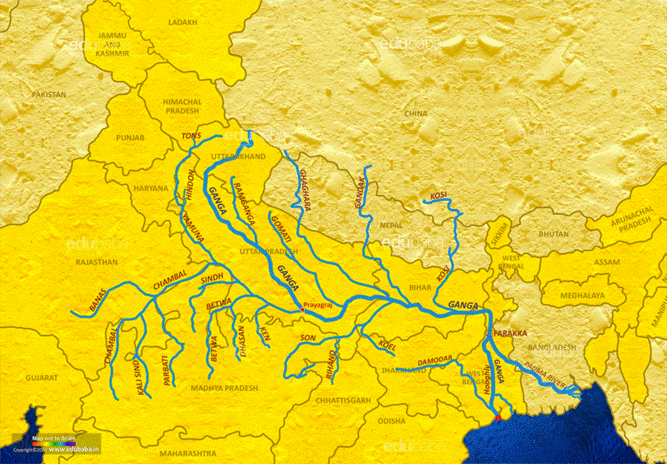
Fish Diversity (Freshwater Biodiversity)
- Survey agency: ICAR-CIFRI.
- Coverage:
- 2,525 km of the Ganga mainstem.
- 67 tributaries + 6 floodplain wetlands.
- Trend:
- 1822: 271 species
- 1974: 150 species
- 2004: 104 species
- 2023: 230 species (strong recovery signal).
- High-diversity sites:
- Farakka (109 spp.)
- Buxar (85)
- Baharampore (76)
- Low-diversity sites:
- Diamond Harbour (38)
- Gadkhali (32)
Gharial Status (Flagship Indicator Species)
- Assessment led by Wildlife Institute of India with partners.
- Basin-wide count: >3,000 gharials.
- Strongholds:
- Chambal River (≈2,097 individuals).
- Other rivers (Gandak, Ghaghara, Son, Ganga):
- Much lower encounter rates (~0.02 per km surveyed).
- Context:
- Gharial = Critically Endangered; recovery indicates improved riverine conditions in select stretches.
What Explains the Recovery?
Governance & Policy Drivers
- Namami Gange Mission:
- Improved sewage treatment capacity.
- Reduced industrial effluents.
- River habitat interventions:
- Wetland restoration.
- Environmental flow (e-flow) norms.
- Fisheries management:
- Ranching & restocking by ICAR-CIFRI (e.g., ~47 lakh fish juveniles released since 2010; ~6,031 tagged).
Environmental Significance
- Fish diversity = proxy for:
- Water quality
- Habitat connectivity
- Flow regimes.
- Gharials = apex, flow-dependent species:
- Require deep, sandy banks and clean water.
- Signals partial success of river rejuvenation, though spatially uneven.
Governance & Federal Dimensions
- Multi-agency coordination:
- ICAR, State fisheries departments, SPCBs, wildlife agencies.
- River basin approach:
- Tributaries and wetlands critical—not just the main river.
- Need for inter-State coordination across the Ganga basin.
Economic & Livelihood Angle
- Inland fisheries:
- Support nutrition and livelihoods.
- Biodiversity recovery can raise sustainable yields.
- Eco-tourism potential:
- Gharial and dolphin habitats (with safeguards).
Challenges
- Spatial disparity:
- Recovery concentrated in few stretches; delta & lower reaches lag.
- Anthropogenic pressures persist:
- Sand mining, barrages, fishing bycatch.
- Flow fragmentation:
- Dams/barrages affect migratory species and gharials.
- Data continuity:
- Need for long-term, standardised monitoring.
Way Forward
- Scale basin-wide habitat restoration (tributaries + floodplains).
- Strengthen e-flow enforcement and fish passages at barrages.
- Expand community-based fisheries management.
- Protect gharial nesting sites; reduce bycatch with gear modifications.
- Integrate biodiversity metrics into Namami Gange performance dashboards.
Prelims Pointers
- Highest fish species count in Ganga in ~50 years: 230.
- Apex research body for inland fisheries: ICAR-CIFRI.
- Gharial status: Critically Endangered.
- Gharial stronghold: Chambal River.
- Fish diversity hotspots vary significantly along the river.
INS Kaudinya Voyage to Muscat
Why in News ?
- INS Kaudinya successfully completed a historic voyage to Muscat (Oman).
- The journey recreated ancient Indian Ocean trade routes using a hand-stitched wooden ship, based on traditional shipbuilding techniques.
- The expedition commemorates India’s maritime heritage and civilisational links with West Asia, especially Oman.
Relevance
- GS II – International Relations
- Maritime diplomacy; India–Oman ties.
- Soft power; Indian Ocean Region engagement.
- GS III – Security
- Maritime awareness; SAGAR doctrine.
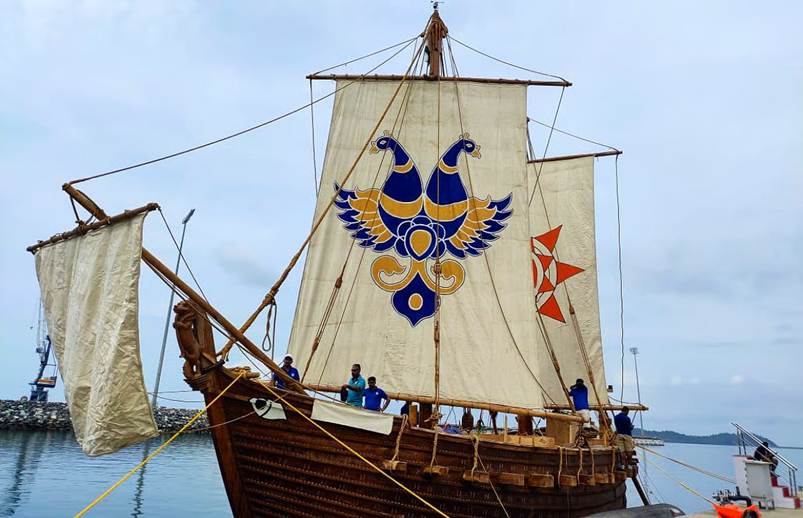
What is INS Kaudinya?
- A traditional hand-stitched wooden vessel, inspired by ancient Indian shipbuilding.
- Built without modern metal fastenings:
- Wooden planks stitched together using traditional methods.
- Operated as a seagoing vessel, not merely a ceremonial replica.
- Named after Kaudinya, an ancient Indian mariner associated with early Indian Ocean trade and cultural diffusion.
Historical & Civilisational Significance
Ancient Indian Ocean Trade
- India maintained robust maritime trade with:
- Oman
- Arabia
- East Africa
- Southeast Asia
- Traded goods included:
- Spices
- Textiles
- Beads
- Metalware
- Indian merchants and sailors were key carriers of:
- Commerce
- Culture
- Ideas
Muscat’s Importance
- Muscat was a critical node in:
- Indian Ocean trade networks.
- Reflects centuries-old India–Oman maritime linkages.
Strategic & Geopolitical Relevance
Maritime Diplomacy
- Voyage reinforces India’s soft power through civilisational diplomacy.
- Strengthens ties with:
- Oman
- West Asia
- Complements India’s:
- Indo-Pacific vision
- SAGAR doctrine (Security and Growth for All in the Region).
Cultural Diplomacy
- Demonstrates India as a historical maritime civilisation, not only a continental power.
- Aligns with:
- Vasudhaiva Kutumbakam
- People-to-people connect initiatives.
Technological & Knowledge Dimension
Indigenous Knowledge Systems
- Validates:
- Traditional shipbuilding
- Indigenous maritime engineering
- Shows:
- Ancient Indian ships were deep-sea capable, not limited to coastal navigation.
- Reinforces the importance of:
- Documenting and reviving traditional technologies.
Security & Naval Dimension
- Highlights:
- Indian Navy’s role beyond combat—heritage, diplomacy, outreach.
- Enhances:
- Maritime awareness
- Oceanic domain familiarity.
- Symbolically supports:
- India’s role as a net security provider in the Indian Ocean Region (IOR).
Cultural & Educational Value
- Encourages:
- Public interest in maritime history.
- Academic research on Indian Ocean studies.
- Counters narratives that:
- Underplay India’s seafaring past.
Challenges & Critiques
- Symbolic initiatives must be:
- Backed by academic research.
- Integrated into school curricula & museums.
- Risk of:
- Remaining a one-off event without sustained follow-up.
Way Forward
Coastal community engagement.
Institutionalise maritime heritage diplomacy through:
- Regular heritage voyages.
Joint research with IOR countries.
Integrate findings into:
- NCERT curricula.
Maritime museums & digital archives.
Link heritage initiatives with:
- Contemporary Indo-Pacific strategy.