
Content
- Viksit Bharat – Guarantee For Rozgar and Ajeevika Mission (Gramin) Bill (VB-GRAM Bill)
- Viksit Bharat Shiksha Adhishthan (VBSA) Bill, 2025
- One in Six People Exposed to Conflict Worldwide (ACLED Report, 2025)
- Biosecurity in India: Risks, Preparedness, and the Need for a Unified Framework
- Amicus Suggestions on Disabled Cadets Similar to DMA’s 2022 Plan
- GRAP-IV in Delhi–NCR
Viksit Bharat – Guarantee For Rozgar and Ajeevika Mission (Gramin) Bill (VB-GRAM Bill)
Why is this in News?
- The Union Government is set to introduce the VB-GRAM Bill in the Lok Sabha to replace MGNREGA, 2005.
- The Bill proposes a structural shift:
- From demand-driven employment guarantee → supply-driven, budget-capped framework.
- Strong Opposition objections on:
- Dilution of legal right to work.
- Increased State financial burden.
- Removal of Mahatma Gandhi’s name.
- Centralisation of power via area notification by the Union.
Relevance
- GS II:
- Welfare schemes, rights-based vs executive-driven governance
- Federalism, Centre–State fiscal relations
- Decentralisation, role of Panchayati Raj Institutions
- GS III:
- Inclusive growth, rural employment, poverty alleviation
- Public finance, fiscal discipline vs social protection
MGNREGA (2005): Core Basics
- Legal right to employment under Article 21 (Right to livelihood – judicial interpretation).
- Guarantees:
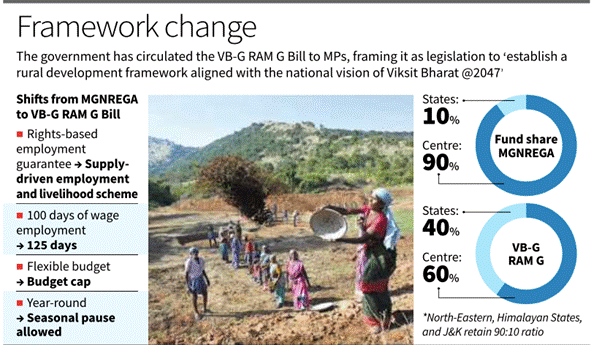
- 100 days of unskilled manual work per rural household per year.
- Work on demand within 15 days, failing which unemployment allowance is payable.
- Cost sharing:
- Centre: ~90% (wages + material).
- States: ~10% (mainly unemployment allowance).
- Decentralised:
- Gram Panchayat as principal planning and implementing authority.
- Key objectives:
- Livelihood security.
- Creation of durable rural assets.
- Strengthening grassroots democracy.
What is VB-GRAM Bill?
- Replaces MGNREGA with a new employment and livelihood mission.
- Key shifts:
- Supply-driven scheme (no statutory demand guarantee).
- Fixed annual budget cap decided by Union Government.
- Employment only in Centre-notified rural areas.
- Guaranteed workdays increased from 100 → 125 days.
- State contribution raised to 40% of total expenditure.
Demand-Driven vs Supply-Driven: Conceptual Difference
Demand-Driven (MGNREGA)
- Employment is a right, not discretion.
- Fiscal outlay expands automatically with demand.
- Strong shock absorber during:
- Droughts.
- Pandemic-like crises.
- Agrarian distress.
Supply-Driven (VB-GRAM)
- Employment limited by budget ceilings.
- Government decides:
- Where work is provided.
- How much work is available.
- Converts entitlement into welfare discretion.
Key Changes at a Glance
| Aspect | MGNREGA | VB-GRAM Bill |
| Nature | Legal right | Welfare scheme |
| Workdays | 100 | 125 |
| Trigger | Worker demand | Govt allocation |
| Budget | Demand-responsive | Fixed, capped |
| Area coverage | All rural India | Centre-notified areas |
| State share | ~10% | ~40% |
| Federal tilt | Decentralised | Centralised |
Constitutional & Federalism Concerns
- Article 246 + Seventh Schedule:
- Rural employment, agriculture, land → State List/Concurrent List orientation.
- Increased State share:
- Unfunded mandate.
- Violates spirit of cooperative federalism.
- Central notification of eligible areas:
- Weakens Gram Sabha autonomy (Article 243).
Socio-Economic Implications
Positive Arguments (Government’s Likely Rationale)
- Fiscal predictability and expenditure control.
- Better targeting of backward regions.
- Alignment with Viksit Bharat 2047 productivity narrative.
- Shift from relief-oriented work to “livelihood mission”.
Negative Implications
- Exclusion risk for distress-hit but non-notified areas.
- Loss of automatic safety net during economic shocks.
- Higher State burden may lead to:
- Delays in wage payments.
- Reduced work provision.
- Weakens women’s participation (MGNREGA had ~55–60% women workers).
- Potential rollback of poverty reduction gains:
- MGNREGA contributed significantly to fall in rural poverty and distress migration.
Political Economy Dimension
- Removal of Mahatma Gandhi’s name:
- Symbolic break from rights-based welfare architecture.
- Shift reflects broader trend:
- From rights-based legislations (RTI, MGNREGA, NFSA)
- To executive-driven missions.
- Raises question: Welfare state → Developmental state with fiscal discipline?
Governance & Accountability Issues
- No clarity on:
- “Parameters” for budget allocation.
- Criteria for area notification.
- Reduced legal enforceability:
- No unemployment allowance guarantee.
- Potential erosion of social audit effectiveness.
Way Forward
- Retain statutory demand-based core, even with budget rationalisation.
- Transparent, rule-based criteria for area notification.
- Restore balanced Centre-State cost sharing.
- Strong social audit and grievance redress mechanisms.
- Parliamentary scrutiny via Standing Committee.
Viksit Bharat Shiksha Adhishthan (VBSA) Bill, 2025
Why is this in News?
- The Union Government has introduced the VBSA Bill, 2025 to replace the University Grants Commission (UGC).
- Government has proposed referring the Bill to a Joint Parliamentary Committee (JPC) amid strong Opposition resistance.
- Opposition alleges:
- Executive overreach in higher education.
- Erosion of federalism and institutional autonomy.
- Imposition of Hindi through nomenclature.
- Excessive regulatory and penalty powers.
Relevance
- GS II:
- Governance, regulatory institutions, executive accountability
- Federalism (education in Concurrent List)
- Parliamentary processes (JPC, legislative scrutiny)
- GS I:
- Education, linguistic diversity, cultural pluralism
UGC: Background and Role
- Established under UGC Act, 1956.
- Constitutional basis:
- Entry 66, Union List – coordination and determination of standards in higher education.
- Core functions:
- Funding universities.
- Setting minimum standards.
- Recognition of institutions.
- Criticism of UGC:
- Over-centralisation.
- One-size-fits-all regulation.
- Slow approvals and compliance-heavy culture.
What is the VBSA Bill, 2025?
- Proposes creation of Viksit Bharat Shiksha Adhishthan (VBSA) as a single, overarching regulator for higher education.
- Aligns with NEP 2020 vision of regulatory overhaul and graded autonomy.
- Seeks to subsume or replace existing regulatory architecture led by UGC.
Key Features of the VBSA Bill
Regulatory Restructuring
- UGC replaced by VBSA with:
- Expanded powers over recognition, compliance, penalties, and closure.
- Stronger executive involvement in appointments and oversight.
Graded Autonomy Framework
- Institutions categorised based on performance.
- Autonomy linked to:
- Accreditation scores.
- Compliance history.
- Critics argue autonomy is conditional, not inherent.
Compliance and Penalty Regime
- Introduces:
- Intrusive inspections.
- Heavy financial penalties.
- Powers to suspend or shut institutions.
- Shift from facilitative regulation → command-and-control oversight.
Language and Nomenclature Issue
- Naming the authority and Bill in Hindi.
- Opposition from non-Hindi-speaking States:
- Seen as cultural centralisation.
- Contradicts linguistic pluralism under Articles 29–30.
Federalism Concerns
- Education is in the Concurrent List (Entry 25).
- VBSA centralises:
- Regulatory power.
- Norm-setting.
- Enforcement mechanisms.
- States fear:
- Reduced say in higher education governance.
- Marginalisation of State universities.
- Kerala and Tamil Nadu objections reflect:
- Long-standing Centre–State friction in education policy.
Executive Overreach: Core Criticism
- Concentration of powers:
- Rule-making.
- Enforcement.
- Penalisation.
- Weak parliamentary or independent checks.
- Undermines:
- Institutional autonomy.
- Academic freedom.
- Risks politicisation of:
- Curriculum.
- Appointments.
- Institutional functioning.
Implications for Higher Education
Potential Advantages
- Uniform national standards.
- Faster decision-making.
- Alignment with global benchmarks.
- Reduced multiplicity of regulators.
Serious Risks
- Chilling effect on academic freedom.
- Compliance burden on public universities.
- Disproportionate impact on State-funded institutions.
- Possible decline in diversity of pedagogical models.
Comparison: UGC vs VBSA
| Aspect | UGC | VBSA (Proposed) |
| Nature | Statutory regulator | Statutory super-regulator |
| Autonomy | Limited but institutional | Conditional, performance-linked |
| Federal balance | Relatively accommodative | Strong central tilt |
| Penalty powers | Limited | Extensive, including closure |
| Language sensitivity | Neutral | Hindi-centric nomenclature |
Why JPC Reference Matters
- Allows:
- Detailed clause-by-clause scrutiny.
- Stakeholder consultations (States, universities, faculty).
- Signals:
- Political sensitivity.
- Federal and cultural contestation.
- However:
- Final outcome still depends on government majority.
Constitutional & Governance Lens
- Article 246 + Seventh Schedule: Balance between Centre and States.
- Academic freedom as part of:
- Article 19(1)(a) (judicial interpretation).
- Risk of undermining university autonomy, a core democratic institution.
Way Forward
- Clearly demarcate:
- Standard-setting vs day-to-day regulation.
- Independent appointments mechanism.
- Strong appellate and grievance redress bodies.
- Linguistically neutral nomenclature.
- Formal role for States in regulatory councils.
One in Six People Exposed to Conflict Worldwide (ACLED Report, 2025)
Why is this in News?
- ACLED (Armed Conflict Location and Event Data) released its 2025 global conflict assessment.
- Key headline:
- 831 million people exposed to conflict in 2025.
- Roughly one in six people globally.
- Reveals:
- Sharp rise in violent events.
- Increasing state involvement in violence, including against civilians.
- Changing nature of warfare, especially use of commercial drones by non-state actors.
Relevance
- GS II:
- International relations, global conflict trends
- Role of UN, multilateralism, peacekeeping
- GS III:
- Internal security: non-state actors, emerging technologies in warfare
What is ACLED?
- An independent, globally recognised conflict data collection and analysis organisation.
- Tracks:
- Political violence.
- Armed conflict.
- Protest events.
- Used by:
- UN agencies.
- Governments.
- Researchers and humanitarian organisations.
Key Global Findings (2025)
Scale of Conflict
- ~200,000 violent events recorded globally.
- Nearly double compared to four years ago.
- 10% of global population exposed to conflict environments.
Nature of Contemporary Conflicts
1. Increased Violence, Reduced Restraint
- Armed actors show:
- Higher willingness to use force.
- Disregard for civilian harm.
- Reflects erosion of:
- International Humanitarian Law (IHL).
- Norms protecting non-combatants.
2. Rising Role of State Forces
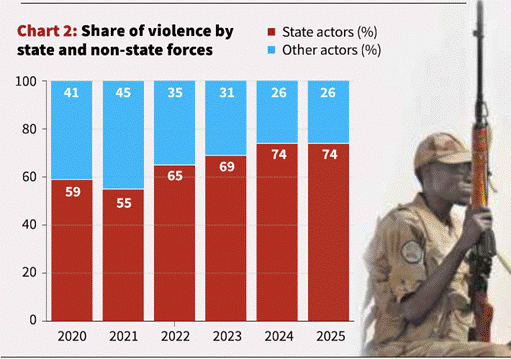
- 74% of violent events involved state forces in 2025.
- State-led violence against civilians:
- Increased from 20% (2020) → 35% (2025).
- Indicates:
- Militarisation of internal conflicts.
- Shrinking space for civilian protection.
Civilians at the Centre of Violence
- 56,000+ incidents of violence directed at civilians.
- Highest in the last five years.
- Two critical patterns:
- States increasingly targeting civilians.
- Non-state groups causing the majority of fatalities.
Region-wise Trends
Europe
- Largest increase in violence globally.
- Driven overwhelmingly by:
- Russia–Ukraine war.
- Highest number of people affected since 2022 invasion.
West Asia
- 48% decline in violent events compared to 2024.
- Key reasons:
- End of Syria’s civil war.
- Ceasefires in Gaza and Lebanon.
- Reduced Israeli and Turkish air campaigns:
- Led to 17% global drop in aerial warfare.
Africa
- Continues to bear:
- High civilian fatalities.
- Complex multi-actor conflicts.
- Sudan, DRC, Myanmar remain major hotspots.
State vs Non-State Actors: A Nuanced Picture
State Actors
- Israel and Russia:
- Responsible for ~90% of cross-border state violence targeting civilians.
- Myanmar military:
- Accounted for ~33% of state violence against its own civilians.
Non-State Armed Groups
- Responsible for ~60% of civilian fatalities.
- Major perpetrators:
- Rapid Support Forces (RSF), Sudan:
- 4,200 civilians killed.
- ~11% of all non-state group fatalities globally.
- 4,200 civilians killed.
- Allied Democratic Forces (ADF):
- ≥1,370 civilian deaths.
- M23 movement (DRC):
- 1,100 civilian deaths.
- 1,100 civilian deaths.
- Rapid Support Forces (RSF), Sudan:
- Numbers likely undercounted due to reporting gaps.
Technological Shift in Warfare
Weaponisation of Commercial Drones
- 469 non-state armed groups have used drones at least once in last five years.
- 14% increase over the previous year.
- Significance:
- Democratisation of military technology.
- Low-cost, high-impact tools bypass traditional state monopoly on force.
- Raises challenges for:
- Airspace control.
- Counter-terrorism.
- Civilian safety.
Broader Implications
International Humanitarian Law (IHL)
- Rising civilian targeting signals:
- Weak enforcement of Geneva Conventions.
- Normalisation of civilian harm.
Global Security
- Conflicts are:
- More frequent.
- More lethal.
- More fragmented.
- Multi-actor conflicts harder to resolve diplomatically.
Humanitarian Impact
- Increased displacement.
- Food insecurity.
- Collapse of health and education systems in conflict zones.
India and Global Governance Lens
- Reinforces need for:
- Stronger multilateral conflict prevention.
- UN Security Council reform.
- Regulation of emerging military technologies (drones, AI).
- Relevant for India’s role in:
- UN peacekeeping.
- Global South diplomacy.
- Norm-building on warfare ethics.
Biosecurity in India: Risks, Preparedness, and the Need for a Unified Framework
Why is this in News?
- Renewed policy focus following expert commentary highlighting:
- Gaps in India’s biosecurity preparedness.
- Absence of a unified national biosecurity framework.
- Concerns amplified by:
- Rapid advances in biotechnology.
- Rising role of non-state actors.
- India’s low response capacity score on the Global Health Security Index (GHSI) (Rank: 66).
Relevance
- GS II:
- Governance, institutional coordination, national security architecture
- GS III:
- Internal security, disaster management, science & technology
- Health security, bioterrorism, dual-use technologies
What is Biosecurity?
- Biosecurity:
- Set of practices, policies, and systems to prevent intentional misuse of:
- Biological agents.
- Toxins.
- Biotechnology.
- Set of practices, policies, and systems to prevent intentional misuse of:
- Covers:
- Laboratory security.
- Surveillance and early detection.
- Containment of deliberate outbreaks.
- Protection of human, animal, and plant health.
- Biosecurity vs Biosafety:
- Biosafety: Prevents accidental release of pathogens.
- Biosecurity: Prevents deliberate misuse.
- Strong biosafety protocols are a prerequisite for biosecurity.
Global Context: Biological Weapons Convention (BWC)
- Adopted in 1975.
- First treaty to:
- Prohibit development, production, stockpiling of biological weapons.
- Mandate destruction of existing stockpiles.
- India:
- A signatory to the BWC.
- Participates in export-control regimes like the Australia Group.
Why Does India Need Robust Biosecurity?
Structural Vulnerabilities
- Geography:
- Porous borders → cross-border bio-risks.
- Ecology:
- Biodiversity-rich zones vulnerable to zoonotic spillovers.
- Demography:
- High population density → rapid transmission potential.
- Economy:
- Heavy dependence on agriculture and livestock.
Emerging Threat Landscape
- Non-state actors exploring biological tools:
- Example: Alleged preparation of Ricin toxin for terror use.
- Rapid spread of new-age biotechnologies:
- Gene editing.
- Synthetic biology.
- Lower entry barriers:
- Dual-use research increasingly accessible.
India’s Existing Biosecurity Architecture
Legal Framework
- Environment (Protection) Act, 1986
- Governs hazardous microorganisms and GMOs.
- Biosafety Rules, 1989
- 2017 Guidelines
- Recombinant DNA research.
- Biocontainment standards.
- WMD Act, 2005
- Criminalises biological weapons and delivery systems.
Institutional Mechanisms
- Department of Biotechnology (DBT):
- Research governance and lab safety.
- National Centre for Disease Control (NCDC):
- Outbreak surveillance and response.
- Department of Animal Husbandry & Dairying:
- Livestock biosecurity, transboundary animal diseases.
- Plant Quarantine Organisation of India:
- Agricultural import-export regulation.
- National Disaster Management Authority (NDMA):
- Guidelines on biological disaster management.
Key Gaps in India’s Biosecurity System
Fragmentation
- Multiple agencies with overlapping mandates.
- Lack of:
- Central coordination.
- Unified command during bio-emergencies.
Capability Deficits
- GHSI Ranking: 66
- Detection score: Improved.
- Response capacity: Declined.
- Indicates:
- Surveillance without commensurate response readiness.
- Inadequate surge capacity.
Governance Gaps
- No dedicated National Biosecurity Policy or Authority.
- Limited integration of:
- Health.
- Agriculture.
- Defence.
- Internal security.
Risks Ahead if Gaps Persist
- High-impact, low-probability events:
- Bioterror attacks.
- Engineered pandemics.
- Massive human cost:
- Lives of billions potentially at risk.
- Economic consequences:
- Food security shocks.
- Supply-chain disruptions.
- Strategic vulnerability:
- Biosecurity as a national security issue, not just public health.
Way Forward: Building a National Biosecurity Framework
Core Elements Needed
- Unified National Biosecurity Strategy:
- Clear roles and responsibilities.
- Central Coordinating Authority:
- Inter-ministerial integration.
- Capability Mapping:
- Identify lab, surveillance, response gaps.
- Regulation of Dual-Use Research:
- Ethical oversight.
- Capacity Building:
- Skilled workforce.
- Rapid response units.
- International Cooperation:
- Intelligence-sharing.
- Norm-setting on emerging biotechnologies.
Amicus Suggestions on Disabled Cadets Similar to DMA’s 2022 Plan
Why is this in News?
- The Supreme Court, in a case concerning medically discharged officer cadets, received amicus curiae recommendations.
- The amicus suggested adopting provisions similar to the Department of Military Affairs (DMA) 2022 proposal.
- The issue highlights:
- Disability rights in armed forces.
- Gaps between policy intent and implementation.
- Constitutional guarantees of equality and dignity.
Relevance
- GS II:
- Welfare of armed forces, role of judiciary
- Executive accountability and policy implementation
- GS I:
- Disability issues, social justice
Who are Medically Discharged Cadets?
- Officer cadets discharged due to:
- Injuries or disabilities attributable to or aggravated by military training.
- Many are released before commissioning, leading to:
- Denial of pensions and post-service benefits.
- Unequal treatment compared to commissioned officers.
Legal & Constitutional Background
Constitutional Provisions
- Article 14: Equality before law.
- Article 21: Right to life with dignity.
- Article 33: Permits restrictions on armed forces, but not arbitrary discrimination.
Statutory Framework
- Rights of Persons with Disabilities Act, 2016 (RPwD Act):
- Recognises service-related disability.
- Mandates non-discrimination and reasonable accommodation.
- Judicial trend:
- Courts have repeatedly held that training-related injuries are service-related.
What Did the DMA Propose in 2022?
A comprehensive welfare package for disabled officer cadets, including:
- Statutory disability pension with parity:
- Same benefits as commissioned officers.
- Broad-banding of disability percentage:
- Prevents denial due to marginal assessment differences.
- Family pension provisions.
- Healthcare coverage:
- Access to Ex-Servicemen Contributory Health Scheme (ECHS).
- Rehabilitation support:
- Prosthetics.
- Physiotherapy.
- Mental health care.
- Resettlement assistance:
- Skill development and alternative employment.
Status:
- Proposal approved by Service Headquarters.
- Yet to be implemented by the government.
Amicus Curiae’s Key Suggestions
- Implement DMA 2022 plan in toto for disabled cadets.
- Extend statutory disability pension even if discharge occurs pre-commission.
- Apply broad-banding to ensure parity and fairness.
- Ensure continuity of medical and rehabilitation support.
- Avoid ad hoc, case-by-case relief; adopt a uniform policy.
Core Issues Highlighted
Arbitrary Classification
- Cadets injured:
- Before commissioning → denied benefits.
- After commissioning → eligible.
- Violates reasonable classification test under Article 14.
Gap Between Policy and Practice
- DMA framework exists.
- Non-implementation reflects:
- Bureaucratic inertia.
- Weak accountability mechanisms.
Dignity and Moral Obligation
- Cadets injured while preparing to serve the nation.
- Denial of support undermines:
- State’s duty of care.
- Military morale and ethical governance.
Broader Implications
Military Human Resource Management
- Discourages talented youth from joining armed forces.
- Weakens trust in institutional fairness.
Disability Rights Discourse
- Tests inclusivity within uniformed services.
- Aligns with India’s commitments under:
- UN Convention on the Rights of Persons with Disabilities (UNCRPD).
Civil-Military Relations
- Welfare of soldiers and cadets central to:
- Democratic oversight.
- Professional armed forces.
Way Forward
- Immediate implementation of DMA 2022 proposal.
- Statutory backing to avoid executive discretion.
- Time-bound decision-making in disability assessment.
- Independent medical boards with transparency.
- Harmonisation with RPwD Act, 2016.
GRAP-IV in Delhi–NCR
Why is this in News?
- On 13 December 2025, air quality in Delhi–NCR deteriorated to ‘Severe+’ levels.
- Daily average AQI crossed 450, prompting authorities to invoke GRAP-IV, the strictest stage of India’s air-pollution emergency framework.
- Decision taken by the Commission for Air Quality Management (CAQM) following an emergency meeting, citing:
- Rising AQI trend.
- Unfavourable meteorological conditions (low wind speed, temperature inversion).
Relevance
- GS III (Environment & Disaster Management)
- Air pollution and urban environmental challenges
- Public health emergencies due to environmental degradation
- Disaster management: response to severe air-quality events
- Sustainable urban development
What is GRAP?
- GRAP – Graded Response Action Plan:
- A pre-defined, stage-wise emergency response framework to tackle air pollution in Delhi–NCR.
- Approved by the Supreme Court in 2016 (MC Mehta case).
- Statutory backing:
- Implemented and enforced by CAQM under the CAQM Act, 2021.
- Objective:
- Move from ad-hoc bans → predictable, rule-based escalation of actions as pollution worsens.
GRAP Stages and AQI Thresholds
| GRAP Stage | AQI Range | Air Quality Category |
| GRAP-I | 201–300 | Poor |
| GRAP-II | 301–400 | Very Poor |
| GRAP-III | 401–450 | Severe |
| GRAP-IV | >450 | Severe+ / Hazardous |
What is GRAP-IV?
- Emergency pollution control stage activated when:
- AQI exceeds 450.
- Reflects conditions posing serious health risks, even to healthy individuals.
- Focus:
- Immediate reduction of pollution sources, regardless of economic disruption.
Measures Enforced Under GRAP-IV
Transport Restrictions
- Ban on entry of BS-IV trucks into Delhi.
- Exceptions:
- Vehicles carrying essential commodities.
- Emergency services.
Construction and Infrastructure
- Complete ban on:
- Construction and demolition (C&D) activities.
- Highways, roads, flyovers, overbridges.
- Power transmission, pipelines, telecom infrastructure.
- Rationale:
- C&D dust is a major PM₂.₅ and PM₁₀ contributor.
Educational Institutions
- Hybrid mode for:
- Classes VI–IX and XI.
- Objective:
- Reduce exposure of children to toxic air.
- Lower transport-related emissions.
Offices and Workplaces
- 50% capacity rule for:
- Public, municipal, and private offices.
- Remaining staff:
- Work From Home (WFH).
- Aim:
- Curtail vehicular movement and congestion.
Institutional Framework Behind GRAP
Commission for Air Quality Management (CAQM)
- Statutory body (2021).
- Jurisdiction:
- Delhi + NCR states (Haryana, UP, Rajasthan).
- Powers:
- Issue binding directions.
- Override State government actions if required.
- Addresses:
- Fragmentation in air-quality governance.
Why Does Delhi–NCR Repeatedly Enter GRAP-IV?
Structural Causes
- Geography & meteorology:
- Landlocked region.
- Winter temperature inversion.
- Emission sources:
- Vehicular emissions.
- Construction dust.
- Biomass and waste burning.
- Industrial emissions.
- Seasonal factors:
- Crop residue burning (October–November).
- Low wind speeds in winter.
Critical Evaluation of GRAP-IV
Strengths
- Rule-based, predictable response.
- Judicial backing ensures compliance.
- Region-wide coordination via CAQM.
- Immediate health protection focus.
Limitations
- Reactive, not preventive:
- Triggered after pollution becomes hazardous.
- High economic and social cost:
- Construction halt.
- Disrupted livelihoods.
- Weak enforcement at local levels.
- Does not address year-round emission sources.
GRAP-IV vs Long-Term Air Pollution Control
| Aspect | GRAP-IV | Long-Term Measures |
| Nature | Emergency response | Structural reform |
| Time horizon | Short-term | Continuous |
| Focus | Source suppression | Emission reduction |
| Examples | Bans, WFH, closures | Clean energy, transport reform, urban planning |
Way Forward
Short-Term
- Better forecasting and early activation of lower GRAP stages.
- Strict enforcement of dust-control norms year-round.
Medium to Long-Term
- Shift from seasonal firefighting to:
- Clean transport transition.
- Industrial emission standards.
- Waste management reforms.
- Strengthen airshed-based governance beyond NCR.
- Integrate GRAP with:
- National Clean Air Programme (NCAP).
- State-level clean air action plans.


