
Content
- Linking BRICS CBDCs: India’s Digital Finance Diplomacy
- India–UAE Strategic Partnership: From Energy Security to Geopolitical Convergence
- Odisha’s Saltwater Crocodile Conservation: A Success Story with Emerging Challenges
- Child Trafficking in India: Legal Framework, Judicial Response and Way Forward
- India & the Gaza Peace Board: Strategic Dilemmas and Diplomatic Calibration
- Unclaimed Bank Deposits in India: Scale, Causes and Policy Implications
Linking BRICS CBDCs: India’s Digital Finance Diplomacy
Context and Core Development
- The Reserve Bank of India has recommended that interlinking central bank digital currencies (CBDCs) of BRICS countries be placed on the agenda of the 2026 BRICS Summit, to be hosted by India.
- The proposal aims to facilitate faster, cheaper, and more efficient cross-border payments among BRICS members by enabling interoperability between sovereign digital currencies issued by their respective central banks.
Relevance
- GS II – BRICS, India’s foreign policy, strategic autonomy, multilateral and minilateral diplomacy
- GS III – Digital currency, RBI, fintech, cross-border payments, global financial architecture, de-risking
Strategic Rationale Behind the RBI’s Proposal
- Cross-border payments today remain costly, slow, and opaque, with average transaction costs globally still around 6–7 percent, disproportionately affecting developing economies.
- Interlinked CBDCs could significantly reduce settlement time, transaction costs, and correspondent banking dependence, improving trade and remittance efficiency among BRICS economies.
Building on BRICS 2025 Declaration
- The RBI proposal builds upon the 2025 BRICS Summit Declaration in Brazil, which called for interoperability between national payment systems to enhance cross-border transaction efficiency.
- This reflects an incremental approach, moving from payment system interoperability toward sovereign digital currency connectivity, rather than abrupt systemic disruption.
Current Status of CBDCs in BRICS Countries
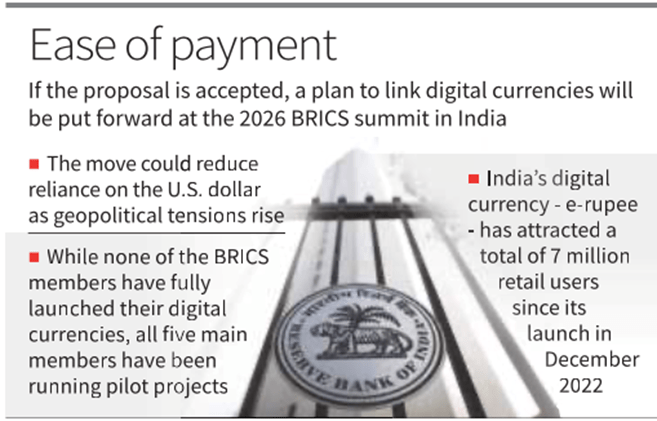
- None of the BRICS members have fully launched retail CBDCs, but all five core members are running pilot programmes, reflecting convergent experimentation without formal adoption.
- India’s e₹ (Digital Rupee) pilot, launched in 2022, has crossed 1.3 million users and over 400,000 merchants as of 2024, making it one of the most advanced pilots globally.
India’s Digital Rupee as a Technological Anchor
- The RBI has publicly expressed interest in linking the digital rupee with other countries’ CBDCs, positioning India as a technology and standards leader in sovereign digital finance.
- India’s strong digital public infrastructure, including UPI, Aadhaar, and India Stack, provides a scalable foundation for cross-border CBDC experimentation.
Implications for Trade and Payments within BRICS
- Interoperable CBDCs could enable direct settlement of trade invoices in local digital currencies, reducing reliance on intermediary currencies and lowering foreign exchange conversion costs.
- This is particularly relevant as intra-BRICS trade exceeded USD 450 billion, yet remains heavily dollar-denominated despite growing local currency trade efforts.
Dollar Dependence and De-risking, Not De-dollarisation
- Although CBDC linkage could reduce reliance on the U.S. dollar for settlements, the RBI has clarified that India’s intent is not ideological de-dollarisation, but pragmatic payment efficiency.
- This distinction is crucial to preserve India’s access to Western capital markets, technology flows, and financial credibility.
Geopolitical Sensitivities and U.S. Response
- The proposal risks irritating the United States, which has repeatedly warned against initiatives perceived as bypassing the dollar-dominated global financial system.
- U.S. President Donald Trump has previously labelled BRICS as “anti-American” and threatened tariffs on members, raising geopolitical costs of misaligned signalling.
India’s Balancing Act within BRICS
- India must carefully balance its role in BRICS by supporting functional financial innovation without allowing the grouping to drift into overt anti-West or currency-bloc narratives.
- This aligns with India’s broader strategy of strategic autonomy and multi-alignment, engaging diverse power centres without rigid bloc politics.
Financial Sovereignty and Payment Resilience
- CBDC interoperability enhances financial sovereignty by reducing exposure to sanctions risks, payment disruptions, and chokepoints in traditional correspondent banking networks.
- This is particularly relevant after recent global experiences of financial sanctions and weaponisation of payment systems.
Technical and Regulatory Challenges
- Linking CBDCs requires robust solutions for interoperability standards, cybersecurity, data localisation, privacy protection, and settlement finality across jurisdictions.
- Divergent regulatory frameworks and capital control regimes among BRICS members could complicate harmonisation and slow operationalisation.
Monetary Policy and Financial Stability Concerns
- Cross-border CBDC use raises concerns regarding currency substitution, capital flow volatility, and potential spillovers into domestic monetary policy transmission.
- Central banks will need safeguards to ensure CBDC linkages do not undermine capital controls or domestic financial stability.
Institutional Architecture and Governance
- Any BRICS CBDC linkage would require a multilateral governance framework, potentially involving a shared settlement platform or coordinated clearing mechanisms.
- Lessons may be drawn from BIS-led projects such as mBridge, which explores multi-CBDC cross-border payment systems.
BRICS as a Laboratory for Digital Finance
- BRICS provides a relatively safe experimental space for South–South financial innovation, given shared concerns over payment efficiency and development finance constraints.
- Successful CBDC linkage could later be scaled to other emerging economies, enhancing BRICS’ relevance beyond rhetoric.
Implications for Global Financial Architecture
- While not replacing existing systems like SWIFT, interoperable CBDCs could introduce parallel settlement channels, increasing redundancy and resilience in global finance.
- Over time, this may gradually reshape norms around cross-border payments, settlement transparency, and sovereign control.
India’s Opportunity as BRICS Host in 2026
- As host of the 2026 BRICS Summit, India has agenda-setting power to frame CBDC linkage as a technical, development-oriented initiative rather than a geopolitical statement.
- India can emphasise efficiency, inclusion, and resilience, aligning the proposal with Global South development priorities.
Way Forward: Calibrated and Incremental Approach
- India should advocate pilot-based, sandbox-driven implementation, starting with limited corridors and trade-linked transactions to test operational feasibility.
- Parallel diplomatic engagement with Western partners can mitigate misperceptions and reassure stakeholders about India’s non-confrontational intent.
India–UAE Strategic Partnership: From Energy Security to Geopolitical Convergence
Context and Strategic Backdrop
- Prime Minister Narendra Modi’s meeting with UAE President Sheikh Mohamed bin Zayed Al Nahyan in New Delhi underscores the deepening Comprehensive Strategic Partnership between India and the UAE amid heightened West Asian geopolitical churn.
- The visit occurred against the backdrop of the Gaza conflict and the Gaza Board of Peace initiative, highlighting India–UAE coordination on regional stability, de-escalation, and diplomatic engagement.
Relevance
- GS II – India–UAE relations, West Asia policy, strategic partnerships, CEPA, regional diplomacy
- GS III – Energy security, LNG, trade agreements, infrastructure investment, IMEC connectivity
Trade Ambition: $200 Billion Target
- India and the UAE have set an ambitious bilateral trade target of USD 200 billion, building on rapid growth following the India–UAE Comprehensive Economic Partnership Agreement (CEPA).
- Since CEPA’s implementation in 2022, non-oil trade has crossed USD 50 billion, with the UAE emerging as one of India’s top three trading partners.
CEPA as the Economic Backbone
- CEPA has reduced tariffs on over 80 percent of traded goods, improved market access for Indian textiles, gems, jewellery, pharmaceuticals, and services.
- The agreement positions the UAE as a gateway for Indian exports to Africa and Europe, while attracting Emirati capital into Indian infrastructure and manufacturing.
Energy Security: LNG and Beyond
- Energy cooperation, particularly long-term LNG supply contracts, remains central as India seeks diversified, stable, and affordable energy sources.
- The UAE is among India’s key hydrocarbon partners, supporting India’s growing energy demand while enabling a gradual transition toward cleaner fuels.
Strategic Importance of LNG
- LNG agreements help India manage price volatility in global energy markets, especially amid disruptions caused by geopolitical conflicts and supply chain shocks.
- For the UAE, long-term LNG partnerships with India ensure stable demand and market diversification, reinforcing mutual energy interdependence.
Defence and Security Cooperation
- Defence cooperation featured prominently, reflecting shared concerns over maritime security, terrorism, and regional instability in the Indian Ocean and West Asia.
- Joint military exercises, defence industrial collaboration, and intelligence sharing have expanded, marking a shift from buyer-seller dynamics to strategic defence alignment.
Maritime and Indian Ocean Security
- India and the UAE share convergent interests in securing sea lanes of communication, energy shipping routes, and ports critical to global trade.
- Cooperation aligns with India’s vision of the Indian Ocean as a zone of peace, and the UAE’s growing maritime footprint.
West Asia Geopolitics and Balancing
- The meeting reflects India’s calibrated West Asia diplomacy, maintaining strong ties with Israel, the UAE, Saudi Arabia, and Iran simultaneously.
- India leverages its credibility as a non-interventionist and development-focused partner to engage across regional fault lines.
Gaza and the Board of Peace Context
- The reference to the Gaza Board of Peace signals India–UAE convergence on humanitarian diplomacy, ceasefire advocacy, and regional stabilisation efforts.
- India’s engagement balances humanitarian concerns with strategic neutrality, reinforcing its image as a responsible global stakeholder.
Economic Diversification and Investment Flows
- UAE sovereign wealth funds, including ADIA and Mubadala, are major investors in Indian infrastructure, renewable energy, logistics, and digital platforms.
- This capital supports India’s National Infrastructure Pipeline and Make in India goals, while offering long-term returns to Emirati investors.
IMEC and Connectivity Synergies
- India–UAE cooperation is integral to the India–Middle East–Europe Economic Corridor (IMEC), linking South Asia, West Asia, and Europe through ports, rail, and digital infrastructure.
- IMEC strengthens supply-chain resilience and offers a strategic alternative to China-centric connectivity models.
Diaspora as a Strategic Asset
- Over 3.5 million Indians live and work in the UAE, making them the largest expatriate community and a vital pillar of bilateral relations.
- Remittances, skills transfer, and people-to-people ties add social depth and economic resilience to the partnership.
Technology and Digital Cooperation
- India and the UAE are expanding cooperation in fintech, digital payments, artificial intelligence, and smart infrastructure, leveraging complementarities between India’s scale and UAE’s capital.
- Integration of digital public infrastructure enhances efficiency, transparency, and innovation across trade and services.
Multipolar World and Strategic Autonomy
- The India–UAE partnership exemplifies India’s broader strategy of multi-alignment, engaging major regional powers without rigid bloc commitments.
- Such partnerships strengthen India’s autonomy in an increasingly polarised and unstable international system.
Geoeconomic Significance
- The focus on trade, energy, and connectivity highlights the growing primacy of geoeconomics over pure geopolitics in India’s foreign policy calculus.
- Economic interdependence acts as a stabiliser in a volatile regional and global environment.
Challenges and Constraints
- Regional instability, energy price fluctuations, and global trade uncertainties pose risks to long-term targets such as the USD 200-billion trade goal.
- Regulatory harmonisation, logistics bottlenecks, and skills alignment will be critical to sustain momentum.
Way Forward
- Deepening CEPA implementation, expanding defence industrial cooperation, securing long-term energy contracts, and operationalising IMEC are key priorities.
- Sustained political engagement and institutional follow-through will determine whether ambition translates into durable outcomes.
Odisha’s Saltwater Crocodile Conservation: A Success Story with Emerging Challenges
Core Development and Context
- Odisha’s saltwater (estuarine) crocodile population has increased to 1,858, registering a rise of 32 individuals, according to the State Forest and Environment Department’s latest census.
- The estimation was conducted using a pilot drone-based survey, marking a significant technological upgrade in wildlife population assessment and monitoring practices.
Relevance
- GS I – Physical geography, estuarine ecosystems, mangroves, biodiversity distribution
- GS III – Wildlife conservation, endangered species protection, use of drones in ecology
Census Methodology and Data Details
- The census was conducted between January 8 and 10, ensuring minimal seasonal movement bias and improved visibility of crocodiles in estuarine and riverine habitats.
- Of the total 1,858 crocodiles, the count includes 531 hatchlings, 365 juveniles, 167 sub-adults, and 353 adults, indicating a healthy age-structure distribution.
Spatial Distribution and Habitat Concentration
- A maximum of 1,424 saltwater crocodiles were recorded in Bhitarkanika National Park (Kanika Wildlife Range), reaffirming it as India’s strongest habitat for estuarine crocodiles.
- Bhitarkanika’s mangrove-dominated estuarine ecosystem, fed by the Brahmani–Baitarani river system, provides optimal breeding and nesting conditions.
Species Profile: Saltwater Crocodile (Crocodylus porosus)
- The saltwater crocodile is the largest living reptile in the world, capable of inhabiting marine, estuarine, and freshwater ecosystems, making it ecologically versatile.
- In India, it is primarily found in Odisha, West Bengal (Sundarbans), and the Andaman & Nicobar Islands, with Odisha hosting the largest mainland population.
Legal and Conservation Status
- The species is listed under Schedule I of the Wildlife Protection Act, 1972, affording it the highest level of legal protection in India.
- Globally, it is classified as “Least Concern” on the IUCN Red List, reflecting successful recovery efforts across parts of its range.
Role of the Crocodile Conservation Project
- Odisha’s success builds on the Crocodile Conservation Project (1975), one of India’s earliest species-specific conservation programmes under Project Tiger-era wildlife planning.
- The project focused on habitat protection, captive breeding, restocking, and strict anti-poaching measures, particularly after population crashes in the mid-20th century.
Significance of Drone-Based Wildlife Surveys
- The use of drones improves accuracy, coverage, and safety in monitoring large, dangerous reptiles inhabiting inaccessible mangrove and tidal ecosystems.
- Drone surveys reduce human–wildlife conflict risks for forest staff and allow real-time spatial mapping of crocodile distribution.
Child Trafficking in India: Legal Framework, Judicial Response and Way Forward
Core Issue and Magnitude of the Problem
- Child trafficking remains a grave human rights violation in India, involving recruitment, transportation, harbouring, or receipt of children for exploitation, despite an extensive constitutional, statutory, and judicial protection framework.
- According to NCRB data, about 3,098 children below 18 years were rescued in 2022, while over 53,000 children were rescued between April 2024 and March 2025 from labour, trafficking, and kidnapping.
- Despite large-scale rescue operations, the conviction rate for trafficking-related offences between 2018 and 2022 was only 4.8 percent, indicating serious enforcement and prosecution gaps.
Relevance
- GS I – Social issues, vulnerable sections, children, poverty, migration
- GS II – Constitution (Articles 23, 24, 39), BNS 2023, POCSO Act, Supreme Court judgments
International Legal Framework: Palermo Protocol
- The UN Palermo Protocol, 2000, defines child trafficking broadly as recruitment, transportation, transfer, harbouring, or receipt of a child for the purpose of exploitation, irrespective of consent.
- India, as a signatory, is obligated to prevent trafficking, protect victims, and prosecute offenders, integrating international norms into domestic law and policy frameworks.
Domestic Legal Definition under Bharatiya Nyaya Sanhita, 2023
- Section 143 of the Bharatiya Nyaya Sanhita (BNS), 2023 defines trafficking expansively, covering threats, force, coercion, abduction, fraud, deception, abuse of power, inducement, and payments.
- The definition includes sexual exploitation, forced labour, slavery, servitude, and organ removal, ensuring trafficking is punishable irrespective of victim consent, especially in the case of children.
Constitutional Protection of Children
- Article 23 prohibits human trafficking, begar, and forced labour, forming the constitutional foundation for India’s anti-trafficking regime.
- Article 24 explicitly bans employment of children below 14 years in hazardous industries, reinforcing the right to safe childhood and dignity.
- Article 39(e) and (f) directs the State to protect children from abuse, exploitation, and moral or material abandonment, linking child protection to Directive Principles of State Policy.
Statutory Framework Addressing Child Trafficking
- Sections 98 and 99 of BNS, 2023 specifically criminalise the selling and buying of minors, strengthening earlier IPC provisions.
- The Immoral Traffic (Prevention) Act, 1956 addresses trafficking for sexual exploitation, particularly commercial sexual exploitation of children.
- The Juvenile Justice (Care and Protection of Children) Act, 2015 provides for rescue, care, rehabilitation, and social reintegration of trafficked children.
Role of POCSO Act, 2012
- The Protection of Children from Sexual Offences (POCSO) Act, 2012 assumes critical importance by criminalising sexual assault, harassment, and child pornography through a gender-neutral framework.
- The Act prescribes stringent punishments including life imprisonment and death penalty in extreme cases, reflecting a zero-tolerance approach.
- Around 400 fast-track POCSO courts are operational nationwide, with a target of disposing 165 cases annually per court, aiming to reduce judicial delays.
Judicial Approach to Child Trafficking
- In Vishal Jeet vs Union of India (1990), the Supreme Court recognised trafficking and child prostitution as serious socio-economic problems requiring a preventive and humanistic approach.
- In M.C. Mehta vs State of Tamil Nadu (1996), the Court issued guidelines prohibiting child labour in hazardous industries and mandated rehabilitation measures.
- In Bachpan Bachao Andolan vs Union of India (2011), the Court issued comprehensive directions to address large-scale child trafficking and exploitation.
Recent Supreme Court Intervention: K.P. Kiran Kumar Case
- In K.P. Kiran Kumar vs State, the Supreme Court held that child trafficking grossly violates the fundamental right to life under Article 21.
- The Court issued strict preventive guidelines, emphasising victim-centric investigation, speedy trials, and accountability of enforcement agencies.
- The judgment stressed considering socio-economic vulnerabilities, particularly of children from marginalised and disadvantaged communities.
Socio-Economic Drivers of Child Trafficking
- Structural factors such as poverty, unemployment, migration, natural disasters, and breakdown of family systems significantly increase children’s vulnerability to traffickers.
- Marginalised communities face disproportionate risk due to lack of education, weak social protection, and limited access to institutional support.
Role of Digital Platforms and Social Media
- The spread of social media and online platforms has facilitated trafficking through deceptive recruitment, fake job offers, and promises of modelling or entertainment opportunities.
- Weak digital monitoring and limited cyber-policing capacity have allowed traffickers to exploit online anonymity and reach vulnerable children quickly.
Implementation and Enforcement Gaps
- Low conviction rates reflect poor investigation quality, witness intimidation, inter-State coordination failures, and procedural delays in the criminal justice system.
- Inadequate training of police and prosecutors in handling child-centric cases further weakens effective enforcement.
Importance of Centre–State Coordination
- Law and order and policing being State subjects, effective anti-trafficking action requires strong Centre–State coordination, intelligence sharing, and joint task forces.
- Inter-State trafficking networks cannot be dismantled without harmonised enforcement and real-time cooperation across jurisdictions.
Rehabilitation and Reintegration Challenges
- Rescue alone is insufficient without long-term rehabilitation, including education, counselling, skill development, and family reintegration.
- Weak post-rescue monitoring increases the risk of re-trafficking, especially in economically vulnerable regions.
Preventive and Rights-Based Approach
- A rights-based approach requires strengthening education access, nutrition, healthcare, social security, and child protection institutions to address root vulnerabilities.
- Preventive policies must integrate child welfare, labour reforms, disaster management, and migration governance.
Way Forward: Strengthening India’s Response
- India must focus on improving conviction rates through specialised anti-trafficking units, forensic support, fast-track courts, and victim protection mechanisms.
- Enhanced digital surveillance, cybercrime units, and platform accountability are essential to curb online recruitment and trafficking networks.
- Community awareness, school-level vigilance, and NGO partnerships can strengthen early detection and reporting mechanisms.
India & the Gaza Peace Board: Strategic Dilemmas and Diplomatic Calibration
Core Development and Immediate Context
- The United States has invited India to join the proposed Gaza Board of Peace, a multilateral body expected to oversee Gaza’s governance, stabilisation, and redevelopment following the ongoing conflict.
- New Delhi has not yet formally responded to the invitation, reflecting India’s cautious approach toward sensitive West Asian political arrangements involving sovereignty, legitimacy, and long-term regional stability.
Relevance
- GS II – India–US relations, Palestine issue, UN vs minilateral frameworks, strategic autonomy
- GS III – Peacekeeping, humanitarian assistance, reconstruction diplomacy
Structure and Mandate of the Gaza Board of Peace
- The Gaza Board of Peace is proposed to be headed by U.S. President Donald Trump, with participation from selected countries and heads of state invited by Washington.
- The Board is expected to oversee funding, governance, and redevelopment of Gaza, until the Palestinian Authority completes a stipulated political and administrative reform programme.
Governance Model Proposed for Gaza
- Under the plan, Gaza would be administered by a temporary transitional governance structure, described as a technocratic Palestinian political committee.
- This arrangement is intended to fill the governance vacuum following the conflict, while limiting Hamas’s role, which Israel seeks to exclude from future administration.
Security Dimension and International Presence
- The plan reportedly envisages deployment of a temporary international stabilisation force (ISF) to maintain order and support reconstruction efforts in Gaza.
- The United States has been in discussions with multiple countries regarding participation, indicating a potential multinational security footprint in the territory.
India’s Strategic Position So Far
- Indian officials have confirmed that the invitation is “in hand,” but emphasised that New Delhi has not yet committed to participation, signalling strategic deliberation rather than rejection.
- India has historically avoided direct involvement in external territorial administration, preferring diplomatic, humanitarian, and developmental engagement.
India’s Consistent Position on Palestine
- India has long supported a two-State solution, advocating an independent, sovereign Palestine coexisting peacefully with Israel.
- Participation in an externally led governance mechanism could be perceived as endorsing imposed arrangements, potentially complicating India’s principled stance on Palestinian self-determination.
Diplomatic Sensitivities in West Asia
- India maintains strong and parallel relationships with Israel, the Palestinian Authority, the UAE, Saudi Arabia, Iran, and Egypt, requiring careful diplomatic balancing.
- Joining the Gaza Board risks upsetting this balance if seen as aligning too closely with one geopolitical camp.
U.S. Strategic Motivations
- The proposal reflects Washington’s attempt to shape post-conflict governance in Gaza, reduce regional instability, and prevent a resurgence of militant control.
- It also allows the U.S. to share political and financial responsibility for reconstruction with select international partners.
Link with Broader Minilateral Diplomacy
- The Gaza Board of Peace fits into a wider trend of minilateral crisis-management mechanisms, operating outside traditional UN frameworks perceived as slow or gridlocked.
- This aligns with evolving global practices but raises questions about legitimacy, inclusiveness, and international law compliance.
Comparison with UN-Led Mechanisms
- Unlike UN peacekeeping or trusteeship arrangements, the Gaza Board appears to be U.S.-initiated and selectively constituted, limiting universal participation.
- India traditionally prefers UN-mandated frameworks, which provide legal legitimacy and multilateral consensus.
India’s Experience with Peace Operations
- India is one of the largest contributors to UN peacekeeping missions, with a long history of participation under clear mandates and rules of engagement.
- However, India has generally avoided politically contested peace-enforcement or governance roles lacking UN authorisation.
Strategic Risks for India
- Participation could expose India to security risks, reputational costs, and diplomatic backlash if the arrangement fails or is contested by Palestinians.
- It could also complicate India’s domestic political narrative, given sensitivities around West Asia and global conflicts.
Potential Strategic Opportunities
- If calibrated carefully, participation could enhance India’s profile as a responsible stakeholder in global peace-building and humanitarian reconstruction.
- It could allow India to shape redevelopment priorities, emphasising civilian welfare, infrastructure, and institutional capacity-building.
Economic and Developmental Dimensions
- The Board is expected to oversee large-scale international funding for Gaza’s redevelopment, potentially involving infrastructure, housing, health, and education projects.
- India’s experience in development cooperation and capacity-building could be a value addition, without assuming political control.
Regional Reactions and Arab World Perceptions
- Arab states are closely watching the proposal, with concerns about external control over Palestinian territories and dilution of Palestinian agency.
- India’s image as a non-colonial, non-interventionist partner in the Global South could be affected by its decision.
Domestic Considerations for India
- India’s decision must account for domestic political sensitivities, diaspora interests, and public opinion related to West Asian conflicts.
- Strategic ambiguity allows India time to assess internal and external implications before committing.
Strategic Autonomy and Decision-Making
- India’s hesitation reflects its broader doctrine of strategic autonomy, avoiding automatic alignment even with close partners like the United States.
- This approach preserves policy flexibility in an increasingly polarised international system.
Possible Middle Path for India
- India may consider a limited, non-military role, such as humanitarian assistance, development expertise, or financial contributions, without joining governance or security structures.
- Such calibrated engagement would align with India’s traditional foreign policy principles.
Linkages with India–UAE and Regional Diplomacy
- The invitation comes alongside intensified India–UAE engagement, with the UAE playing a significant role in West Asian diplomacy and post-conflict reconstruction.
- India’s decision may factor in convergence with key regional partners, particularly Gulf states.
Conclusion
- The invitation to join the Gaza Board of Peace places India at a strategic crossroads, balancing humanitarian responsibility, diplomatic principles, and geopolitical realities.
- India’s eventual response will signal how it navigates minilateral crisis governance while safeguarding strategic autonomy, legitimacy, and long-standing positions on sovereignty and self-determination.
Unclaimed Bank Deposits in India: Scale, Causes and Policy Implications
Core Data and Recent Trend
- Unclaimed deposits with commercial banks in India rose to ₹62,314 crore in 2024, nearly nine times higher than 2015, reflecting rapid financial deepening alongside weak account usage and awareness.
Relevance
- GS I – Financial inclusion, social inequalities, demographic factors
- GS II – RBI regulation, depositor protection, governance and accountability
- GS III – Banking sector, DEAF, financial literacy, efficiency of financial intermediation
Long-Term Growth Pattern
- The amount of unclaimed deposits increased from ₹918 crore in 2005 to ₹6,835 crore in 2015, before accelerating sharply post-2015 due to mass account openings.
Link with Financial Inclusion Drive
- Large-scale schemes such as Pradhan Mantri Jan Dhan Yojana (PMJDY) expanded banking access but also led to a surge in inactive and zero-balance accounts.
Definition of Unclaimed Deposits
- Bank deposits become “unclaimed” when there is no customer-initiated transaction for 10 years, including savings, current accounts, fixed deposits, and accrued interest.
Transfer to RBI’s DEAF
- As per RBI norms, unclaimed deposits are transferred to the Depositor Education and Awareness Fund (DEAF), established in 2014, while ownership rights of depositors remain intact.
Purpose of DEAF
- DEAF funds are used exclusively for financial literacy, depositor awareness programmes, and consumer protection initiatives, not for general government expenditure.
Governance and Accountability Aspect
- Although deposits are transferred to RBI, banks remain liable to repay depositors or legal heirs upon valid claim, ensuring depositor rights are legally protected.
Causes: Demographic and Social Factors
- Migration, urbanisation, informal employment, death of depositors without nominee details, and weak financial literacy contribute significantly to accounts becoming dormant.
KYC and Nomination Gaps
- Lack of updated Know Your Customer (KYC) information and absence of registered nominees are major institutional factors delaying claims and increasing unclaimed balances.
Digitalisation Paradox
- Despite digital banking expansion, account dormancy persists, indicating that access alone does not ensure meaningful financial inclusion or regular account usage.
Risks to Financial Efficiency
- Large unclaimed deposits represent idle financial resources, reducing allocative efficiency within the banking system and masking the true level of household savings activity.
Consumer Protection Concerns
- Unclaimed deposits disproportionately affect elderly, rural, migrant, and low-income households, raising concerns of equity and financial justice.
RBI’s Recent Measures
- RBI has directed banks to launch centralised web portals, proactive customer outreach, SMS/email alerts, and periodic reviews to reduce the accumulation of unclaimed deposits.
UDGAM Portal Initiative
- The UDGAM portal (2023) enables depositors to search unclaimed deposits across multiple banks through a single interface, improving transparency and ease of claim.
Legal and Ethical Dimension
- While legally safeguarded, prolonged dormancy raises ethical concerns about information asymmetry, especially when vulnerable depositors remain unaware of their entitlements.
Comparison with Global Practices
- Many countries impose time-bound escheatment to the State, whereas India’s DEAF model preserves depositor ownership, reflecting a citizen-centric regulatory approach.
Fiscal Neutrality of Unclaimed Deposits
- Unlike tax revenues, unclaimed deposits do not strengthen government finances, as RBI merely acts as a custodian, maintaining neutrality and depositor primacy.
Way Forward: Strengthening Usage
- Financial inclusion must shift from account opening to account usage, linking accounts with DBT, pensions, insurance, and credit to ensure regular activity.


