
Content
- India’s First National Anti-Terror Policy
- Jnanpith Award & the Demise of Vinod Kumar Shukla
- The Upskilling Gap: Why Women Risk Being Left Behind by AI
- How India’s Exports Are Concentrated in a Few States
- Rhino Dehorning and the Decline in Poaching
- Made-in-Tihar Products Go Online
India’s First National Anti-Terror Policy
Why is it in News?
- Union Government finalising India’s first comprehensive National Counter-Terrorism Policy and Strategy.
- Inputs consolidated by the Ministry of Home Affairs with operational feedback from National Investigation Agency.
- NIA anti-terror conference (26–27 December, New Delhi) to outline policy contours.
Relevance
- GS III – Internal Security
- Terrorism and counter-terrorism strategies
- Role of intelligence agencies (NIA, IB, NSG)
- Border management (India–Nepal open border)
- Terror financing, digital radicalisation, identity fraud
Strategic Context
- India lacked a unified anti-terrordoctrine; counter-terror responses have been:
- Statute-based (UAPA, NIA Act)
- Agency-driven (NIA, IB, NSG)
- Incident-reactive rather than prevention-centric
- Contrast:
- National Policy & Action Plan on LWE (2015) → integrated security-development model.
- Terrorism domain lacked an equivalent pan-India template.
Key Threat Vectors Driving the Policy
Digital Radicalisation (High Priority)
- Shift from physical indoctrination to algorithm-driven online recruitment.
- NIA interrogation after Nov 10 car-borne suicide attack near Red Fort:
- Perpetrators radicalised entirely online.
- Identified risks:
- Encrypted messaging platforms
- Social media micro-targeting
- Foreign-hosted servers beyond Indian jurisdiction
- Institutional gap:
- Very limited number of trained cyber-radicalisation spotters at police-station level.
Foreign-Funded Conversion & Radicalisation Networks
- Intelligence inputs point to:
- Overseas religious centres acting as ideological nodes.
- Suspected linkages with Pakistan’s ISI.
- Pattern:
- Funding → conversion → ideological grooming → terror facilitation.
- Policy likely to integrate:
- Financial intelligence
- Social media monitoring
- NGO & charity oversight (within constitutional limits).
Open Border Exploitation (Nepal Corridor)
- India–Nepal border:
- ~1,750 km
- Visa-free, largely unfenced
- Reported modus operandi:
- Khalistani operatives enter Nepal on foreign passports.
- Discard passports → enter India illegally → move via UP–Bihar corridor to Punjab.
- Policy focus:
- Border intelligence fusion
- Joint surveillance with Nepal
- Technology-enabled profiling (without border closure).
Aadhaar Spoofing & Identity Fraud
- Emerging threat:
- Synthetic identities used for SIM cards, bank accounts, logistics.
- Links to:
- Arms trafficking
- Drug-terror financing nexus
- Requires coordination between:
- UIDAI
- Financial Intelligence Units
- State police cyber cells.
Institutional Architecture Being Integrated
Core Agencies
- National Investigation Agency – federal investigations, terror financing, international linkages.
- National Security Guard – tactical response, hostage rescue, urban counter-terror.
- Intelligence Bureau – threat anticipation, radicalisation tracking.
- State ATS & Special Branches – ground-level intelligence.
Technology Backbone
- National Intelligence Grid (NATGRID):
- Secure access to 20+ databases (immigration, banking, telecom, vehicle, travel).
- Shift from post-event investigation → pre-emptive detection.
Policy Orientation: From Reaction to Prevention
| Old Approach | Proposed Policy Shift |
| Incident-led response | Intelligence-led prevention |
| Central agency dominance | State-centric capacity building |
| Post-attack prosecution | Early detection & disruption |
| Fragmented data | Integrated data grids |
| Elite-unit focus | Police station-level vigilance |
Federal Dimension
- Policy designed as a template, not command-and-control.
- States consulted post-Pahalgam terror attack (April 22).
- Emphasis on:
- Training local police
- Standard operating procedures (SOPs)
- Shared best practices across States.
Significance for Internal Security (GS III)
- First attempt at doctrinal clarity in counter-terrorism.
- Acknowledges non-traditional threats: digital ecosystems, identity fraud, ideological financing.
- Balances:
- National security
- Federal autonomy
- Civil liberties (critical for judicial sustainability).
Likely Challenges
- Online radicalisation vs freedom of speech.
- Inter-state coordination asymmetries.
- Capacity gaps at thana level.
- Managing foreign policy sensitivities (Canada, Nepal).
Conclusion
- The proposed policy marks India’s transition from event-driven counter-terrorism to ecosystem-based prevention.
- If implemented effectively, it can become the internal security equivalent of the LWE framework (2015)—but success hinges on State-level absorption, training depth, and tech-human integration.
Jnanpith Award & Demise of Vinod Kumar Shukla
- Vinod Kumar Shukla, celebrated Hindi poet and novelist, passed away at age 88 in Raipur.
- He was the 2024 Jnanpith Award recipient — India’s highest literary honour.
- First writer from Chhattisgarh to receive the Jnanpith Award.
Relevance
- GS I – Art & Culture
- Indian literature and literary institutions
- Regional language contributions (Hindi literature)
- Cultural diversity and non-metropolitan voices
- Prelims
- Jnanpith Award: year, nature, eligibility, administering body
- First Jnanpith awardee from Chhattisgarh

Vinod Kumar Shukla
- Born: 1937, Rajnandgaon (present-day Chhattisgarh).
- Literary career began: 1971.
- Known for:
- Minimalist language
- Poetic treatment of everyday life
- Quiet subversion of power, class, and alienation.
Major Works
- Poetry
- Lagbhag Jaihind (debut, 1971)
- Kavita Se Lambi Kavita
- Novels
- Naukar Ki Kameez
- Adapted into a critically acclaimed film.
- Deewar Mein Ek Khidki Rehti Thi
- Naukar Ki Kameez
- Literary style often compared with:
- Post-Nayi Kavita humanism
- Everyday realism rather than ideological grand narratives.
Awards & Recognitions
- Jnanpith Award (2024)
- Sahitya Akademi Award
- Numerous state and national recognitions for poetry and fiction.
Jnanpith Award:
- Instituted: 1961
- First awarded: 1965
- Administered by: Bharatiya Jnanpith (trust founded by Sahu Jain family).
- Eligibility:
- Indian citizens
- Works in any 8th Schedule language.
- Nature:
- Awarded for overall literary contribution, not a single book.
Award Components
- Cash prize: ₹11 lakh
- Citation
- Bronze replica of Saraswati, Hindu goddess of knowledge.
Significance
- Considered the literary equivalent of the Bharat Ratna.
- Recognises lifetime achievement and cultural impact.
Conclusion
- Vinod Kumar Shukla’s death is not only a personal loss but a civilisational moment for Hindi literature.
- His 2024 Jnanpith Award symbolised the recognition of simplicity, empathy, and everyday realism as enduring literary values.
The Upskilling Gap: Why Women Risk Being Left Behind by AI
Why is it in News?
- Recent analysis based on India’s latest Time Use Survey (2024) highlights a structural time poverty faced by women, raising concerns that the AI-driven future of work may deepen gender inequality.
- As India pushes AI-led growth through initiatives like the India AI Mission, evidence shows women lack time, access, and flexibility required to upskill for AI-era jobs.
- Aligns with broader debates on:
- Automation risks
- Right to disconnect
- Gender budgeting
- India’s Viksit Bharat @2047 vision.
Relevance
- GS I – Society
- Gender roles and unpaid care work
- Time poverty and gender inequality
- GS II – Governance
- Gender budgeting
- Social infrastructure (childcare, transport, water, energy)
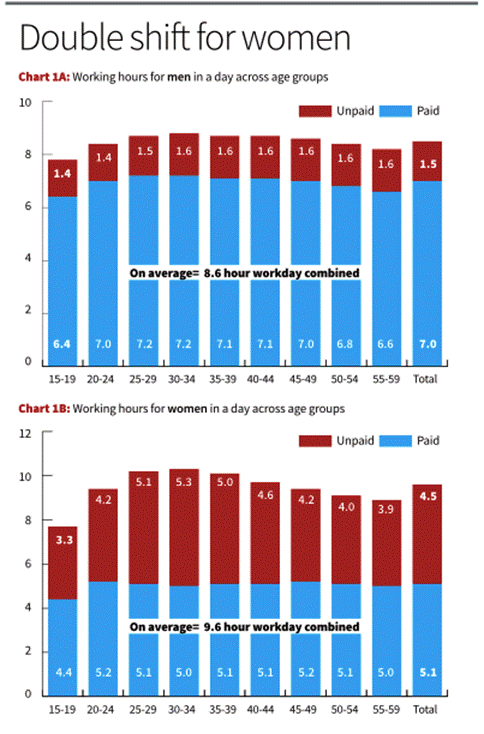
Women’s Workload & Time Poverty
- Labour force participation (women): ~40% (2024).
- Average daily work (paid + unpaid):
- Women: ~9.6 hours/day
- Peaks at 70–80 hours/week for ages 25–39.
- Key driver:
- ~40% of women outside the labour force cite household & caregiving responsibilities.
- Nature of work increase:
- Over 80% of recent rise in women’s workforce participation comes from:
- Unpaid family work
- Low-paid self-employment
- Informal, low-productivity jobs.
- Over 80% of recent rise in women’s workforce participation comes from:
Gender Gap in Paid vs Unpaid Work
Across the Life Cycle
- Men:
- Total work: 54–60 hours/week
- Unpaid work: minimal and stable across ages.
- Women:
- Total work exceeds men at almost all ages.
- 25–39 age group:
- Women spend 2× more time on unpaid caregiving than men.
- Childcare is the largest component.
- Even in later life:
- Men’s unpaid work rises marginally (elderly care),
- Structural inequality at home persists across income, occupation, and age.
AI-Specific Risks for Women
1. Higher Automation Exposure
- Women overrepresented in:
- Routine, clerical, low-skill service jobs
- Informal and home-based work
- These roles are more automation-prone under AI adoption.
2. Algorithmic Bias
- AI-driven productivity metrics:
- Ignore caregiving interruptions
- Penalise time constraints
- Reward uninterrupted, long-hour availability
- Care work remains invisible to algorithms.
3. Upskilling Time Deficit
- Women spend ~10 hours less per week than men on:
- Learning
- Skill enhancement
- Self-development
- Gap widens to 11–12 hours/week in prime working years.
- Result:
- Limited transition from low-skill to high-value AI-linked jobs.
Health & Well-being Costs
- Women sleep 2–2.5 hours less per week than men during peak working years.
- Time adjustment happens at the cost of:
- Rest
- Mental health
- Physical well-being
- Long-term impact:
- Lower productivity
- Higher burnout
- Reduced career longevity.
Policy & Governance Solutions Highlighted
1. Time-Centric Policy Design
- Shift from job-counting to outcome-based employment metrics.
- Explicit use of time-use data in:
- Labour policy
- Skill missions
- AI governance.
2. Gender Budgeting as an Enabler
- Integrate time-use indicators into gender budgeting.
- Prioritise sustained spending on:
- Affordable childcare
- Elderly care services
- Piped water
- Clean cooking energy
- Safe public transport.
3. AI-Era Upskilling for Women
- Design lifelong, flexible, modular skilling:
- Local delivery
- Hybrid / online formats
- Low time-intensity learning
- Scale targeted programmes:
- India AI Mission
- AI Careers for Women
- Focus on:
- Digital literacy
- Applied AI tools
- Locally relevant vocational tech skills.
Conclusion
- AI will not automatically empower women; without time-sensitive policy design, it may entrench inequality.
- Until women’s time is valued, freed, and integrated into growth strategy, India’s AI ambitions and Viksit Bharat @2047 vision will remain constrained by:
- Invisible labour
- Time poverty
- Underutilised human capital.
How India’s Exports Are Concentrated in a Few States
Why is it in News?
- Recent analysis using the RBI Handbook of Statistics on Indian States 2024–25 shows India’s export growth is increasingly concentrated in a handful of States, raising concerns about:
- Regional inequality
- Jobless export growth
- Breakdown of the traditional export–industrialisation–employment link
- Despite a weakening rupee and record export values, export-led development is not translating into broad-based industrial employment.
Relevance
- GS III – Indian Economy
- Export-led growth model
- Industrialisation and jobless growth
- Capital deepening and labour absorption
- GS I – Regional Development
- Inter-State disparities
- Core–periphery model
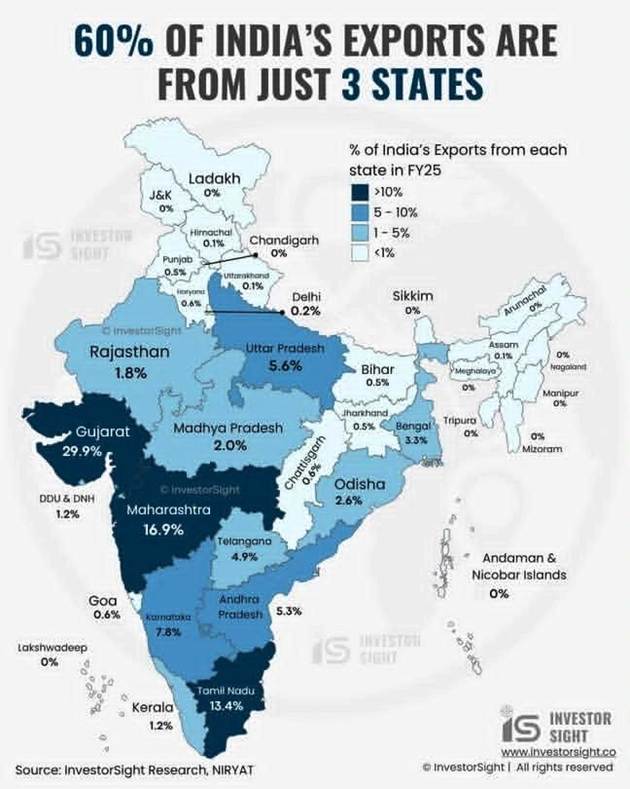
Core Export Concentration:
- Top 5 exporting States:
- Maharashtra
- Gujarat
- Tamil Nadu
- Karnataka
- Uttar Pradesh
- Share of national exports:
- ~65% (5 years ago)
- ~70% now
- Implication:
- National export aggregates mask severe regional divergence.
Rising Geographic Concentration (HHI Evidence)
- Export geography measured using Herfindahl–Hirschman Index (HHI):
- Rising HHI → increasing concentration.
- Pattern emerging:
- Core–periphery structure
- Coastal western & southern States → tightly integrated into global supply chains.
- Northern & eastern hinterland → decoupling from export growth.
- Core–periphery structure
- Agglomeration logic:
- Firms prefer existing industrial clusters due to:
- Logistics efficiency
- Supplier ecosystems
- Skilled labour pools
- Firms prefer existing industrial clusters due to:
Global Context: Why Convergence Is Failing ?
Shrinking Global Trade Window
- World Trade Organization data:
- Merchandise trade volume growth slowed to 0.5–3% band.
- UN Trade and Development (2023):
- Top 10 exporters control ~55% of global merchandise trade.
- Consequence:
- Latecomers face entry barriers.
- Global capital now seeks complexity, not just cheap labour.
Shift from Volume to Value
Economic Complexity Trap
- Modern exports cluster around dense product spaces:
- Automobiles
- Electronics
- Precision machinery
- These sectors:
- Require advanced logistics
- Depend on accumulated industrial capabilities
- Regions exporting low-complexity goods face:
- High barriers to upgrading
- Weak backward–forward linkages.
Export Growth ≠ Employment Growth
Capital Deepening Evidence
- Annual Survey of Industries (ASI) 2022–23:
- Fixed capital growth: +10.6%
- Employment growth: +7.4%
- Fixed capital per worker: ₹23.6 lakh
- Indicates:
- Rising capital–labour ratio
- Factories becoming less labour-absorptive.
Manufacturing Employment Stagnation
- Periodic Labour Force Survey (PLFS):
- Manufacturing employment share:
- Stuck at ~11.6–12%
- Despite record export values.
- Manufacturing employment share:
- Interpretation:
- Employment elasticity of exports has collapsed.
- Exports are generating value, not mass jobs.
Capital Bias & Wage Compression
- ASI data shows:
- Wage share in Net Value Added (NVA) declining.
- Productivity gains in:
- Petrochemicals
- Electronics
- Gains accrue disproportionately to capital owners.
- Outcome:
- High industrial GDP growth
- Limited mass prosperity
Spatial Stickiness of New-Age Exports
- Electronics exports (PLI-driven):
- ~47% YoY growth
- Locked into:
- Kancheepuram (TN)
- Noida (UP)
- Reason:
- High supply-chain complexity
- Precision logistics unavailable in hinterland districts.
Financial Divide: Credit-Deposit Ratios
Coastal vs Hinterland
- RBI Credit–Deposit (CD) ratios:
- Tamil Nadu, Andhra Pradesh: >90%
- Local savings reinvested locally.
- Bihar, eastern Uttar Pradesh: <50%
- Savings mobilised but lent elsewhere.
- Tamil Nadu, Andhra Pradesh: >90%
- Effect:
- Capital flight from hinterland to coast
- Reinforces regional divergence.
Structural Diagnosis
- Exports no longer act as:
- A bridge from agriculture → industry
- A mass employment generator
- Instead, exports are now:
- An outcome of prior structural capacity
- A mirror of accumulated industrial wealth.
Policy Implications
Why Old Assumptions Fail ?
- Export-led growth ≠ labour-intensive industrialisation.
- India bypassing East Asian trajectory of:
- Low-skill manufacturing
- Broad middle-class creation.
Need for New Metrics
- Export growth ≠ inclusive development.
- Policy must track:
- Employment elasticity
- Wage share
- Regional diffusion
- Otherwise:
- Risk mistaking outcomes for instruments.
Bottom Line
- India’s export success is real but narrow.
- Without correcting:
- Capital bias
- Financial asymmetry
- Human capital gaps
- Export growth will deepen regional inequality rather than resolve it, making inclusive industrialisation increasingly elusive.
Rhino Dehorning & Poaching Decline
Why is it in News?
- A peer-reviewed study published in Science reports that rhino dehorning led to a near-elimination of poaching in African wildlife reserves.
- The study analysed 7 years of data (2017–2023) from 11 reserves in South Africa’s Greater Kruger ecosystem, home to the world’s largest rhino population.
- Findings challenge the dominance of technology-heavy anti-poaching strategies and reframe conservation economics.
Relevance
- GS III – Environment & Conservation
- Wildlife protection strategies
- Anti-poaching models
- Biodiversity conservation
- GS II – Governance
- Evidence-based policymaking
- Institutional capacity vs incentives
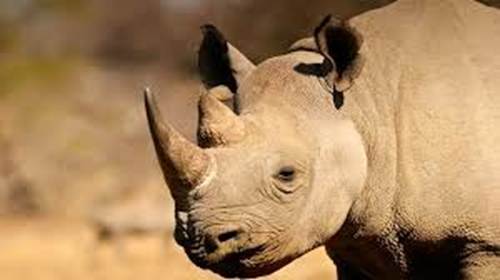
Global Rhino Status:
- Global rhino population (2024): < 28,000 (all five species combined).
- Major threat: Poaching for horns, driven by illicit international demand.
- Greater Kruger losses:
- 1,985 black & white rhinos killed (2017–2023).
- ~6.5% population loss per year, despite heavy surveillance.
- Anti-poaching expenditure:
- ~$74 million spent on:
- Armed patrols
- Tracking dogs
- AI cameras
- Aerial surveillance.
- ~$74 million spent on:
Core Findings of the Study
Impact of Dehorning
- 2,284 rhinos dehorned across 8 reserves.
- Poaching outcomes:
- 75% reduction compared to pre-dehorning levels.
- 78% drop where dehorning was implemented rapidly (1–2 months).
- 95% lower poaching risk for dehorned rhinos vs horned rhinos.
- Cost efficiency:
- Achieved using only 1.2% of total anti-poaching budgets.
Methodology
- Data type: Quarterly poaching records (2017–2023).
- Analytical method:
- Hierarchical Bayesian regression modelling.
- Comparison:
- Dehorned vs non-dehorned reserves.
- Before–after intervention analysis.
- Outcome:
- Strong causal inference rather than correlation.
Why Dehorning Works ?
Economics of Poaching
- Rhino horn:
- Composed of keratin (same as hair & nails).
- No proven medicinal value.
- Illicit market value:
- $874 million – $1.13 billion (2012–2022), per Wildlife Justice Commission.
- Removing horns:
- Eliminates primary incentive, not the animal.
Behavioural Reality of Poachers
- Killing the rhino allows:
- Faster removal
- No resistance
- Dehorned rhinos:
- Offer minimal reward
- Increase risk–reward imbalance for poachers.
Limits of Enforcement-Only Models
- Arrests and patrols showed limited deterrence due to:
- Corruption
- Weak prosecution
- Cross-border trafficking loopholes
- Surveillance ≠ prevention when incentives remain intact.
How Dehorning Is Done (Animal Welfare) ?
- Conducted by veterinarians:
- Sedation, blindfolding, earplugs.
- 90–93% of horn removed, above the germinal layer.
- Horn regrows naturally.
- Stump sealed to prevent infection.
- Considered non-lethal and reversible.
India–Africa Contrast
African Context
- Large landscapes.
- High-value illicit trade routes.
- Enforcement stretched thin.
Indian & Nepali Model
- India & Nepal do not dehorn.
- Losses:
- 1–2 rhinos in last 3 years.
- Kaziranga National Park success drivers:
- Smart patrolling
- Community participation
- Local intelligence
Role of Local Communities & Rangers
- Research involved:
- 1,000+ hours of workshops with rangers.
- Rangers:
- Often local residents.
- Hold critical ecological knowledge.
- Study highlights:
- Ranger welfare (pay, safety, training) is as vital as technology.
Conservation Economics:
- Dehorning shifts strategy from:
- Policing supply → collapsing incentive.
- Represents preventive conservation, not reactive enforcement.
- More cost-effective than high-tech surveillance alone.
Conclusion
- Rhino dehorning is not a silver bullet, but it is:
- Highly effective
- Cost-efficient
- Data-validated
- The study redefines conservation success:
- Remove incentives, not just criminals.
- Policy lesson:
- Conservation outcomes improve when economics, ecology, and local capacity align.
Rhinoceros
- Species & Distribution
- Five species globally: White, Black (Africa); Greater one-horned, Javan, Sumatran (Asia).
- India hosts the Greater one-horned rhinoceros, mainly in Assam (Kaziranga, Pobitora).
- Conservation Status
- IUCN:
- Javan & Sumatran – Critically Endangered
- Black – Critically Endangered
- Greater one-horned – Vulnerable
- White – Near Threatened
- Global population (2024): < 28,000.
- IUCN:
- Major Threats
- Poaching for horn (illegal trade worth ~$0.9–1.1 billion, 2012–22).
- Habitat loss, fragmentation, and human–wildlife conflict.
- Biology & Horn
- Rhino horn is made of keratin (same as hair and nails); no proven medicinal value.
- Used for digging, defence, and mating displays.
Made-in-Tihar Products Go Online
Why is it in News?
- Delhi Prison Administration plans to sell Made-in-Tihar products on major e-commerce platforms such as Flipkart and Amazon.
- Marks a shift from offline-only sales (jail canteens, courts, exhibitions) to nationwide digital marketplaces.
- Aimed at improving inmate rehabilitation, skill utilisation, and post-release employability.
Relevance
- GS II – Governance & Social Justice
- Prison reforms
- Rehabilitation of convicts and undertrials
- Reformative vs retributive justice

What Are “Made-in-Tihar” Products?
- Produced by inmates inside Tihar Jail, South Asia’s largest prison complex.
- Product range includes:
- Food items: cookies, mustard oil
- Handicrafts: bags, footwear
- Household items: furniture, paper products
- Around 13 categories currently marketed.
Scale of the Programme
- Inmate workforce:
- ~5,000 inmates engaged daily in manufacturing and vocational work.
- Production units:
- Multiple industrial workshops across Tihar Jail complex.
- Revenue generation:
- ₹2.42 crore turnover in FY 2023–24.
- Average inmate earnings:
- ₹412 per day (credited to prison accounts).
- Skill coverage:
- About 70 different products across food processing, carpentry, tailoring, and handicrafts.
Economic Dignity of Prison Labour
- Shifts narrative from:
- “Prison labour” → “Correctional industry”.
- Supports constitutional values:
- Article 21 (right to live with dignity).
- Reinforces Supreme Court guidance on:
- Fair remuneration
- Voluntary skill-based work.
Governance & Implementation Aspects
- Sales via:
- Government-approved accounts on platforms.
- Branding:
- “Made-in-Tihar” already has recall value due to:
- Quality perception
- Ethical consumption appeal.
- “Made-in-Tihar” already has recall value due to:
- Oversight:
- Delhi Prison Department ensures:
- No forced labour
- Wage crediting
- Product quality control.
- Delhi Prison Department ensures:
Comparative Context
- Similar initiatives:
- Open prisons in Rajasthan
- Prison handicraft programmes in Kerala & Maharashtra.
- Distinction:
- Tihar is among the largest prison-based industrial ecosystems in India.
Challenges & Caveats
- Pricing competitiveness with private brands.
- Logistics and supply consistency.
- Ensuring:
- Non-exploitation
- Transparency in revenue sharing.
- Need for:
- Skill certification linkage with NSQF
- Post-release job placement pipelines.
Conclusion
- Taking Made-in-Tihar products online transforms prison labour into a scalable rehabilitation model.
- If implemented with safeguards, it can:
- Humanise incarceration
- Generate ethical livelihoods
- Recast prisons as institutions of correction, not exclusion.


