
Content
- An alternative to Viksit Bharat Shiksha Adhisthan Bill
- Bolstering deterrence through submarine dominance
An alternative to Viksit Bharat Shiksha Adhisthan Bill
Source : The Hindu
Why in News ?
- VBSA Bill under scrutiny of Joint Parliamentary Committee, inviting stakeholder inputs amid concerns of centralisation, autonomy erosion, and constitutional overreach.
Context & Basics
- VBSA Bill seeks to statutorily implement NEP 2020, restructuring governance of higher education institutions (HEIs) through centralised regulatory councils.
- Covers Central, State, and private universities, replacing existing frameworks like University Grants Commission (UGC) consultative mechanisms.
Relevance
GS II (Polity & Governance)
- Federalism vs centralisation in education governance.
- Role of University Grants Commission and proposed regulatory overhaul.
- Judicial precedents like T.M.A. Pai Foundation v. State of Karnataka.
GS III (Economy)
- Human capital development and higher education financing.
- GER expansion (28.4%) vs quality and equity trade-offs.
Practice Question
Q1.“The VBSA Bill represents a shift from cooperative federalism to centralised control in higher education.”Critically examine and suggest an alternative governance framework. (250 words)
Constitutional & Legal Background
- Entry 66, Union List empowers Centre only for coordination and determination of standards, not full-scale regulatory control.
- Education in Concurrent List, requiring cooperative federalism between Centre and States.
- Supreme Court in T.M.A. Pai Foundation case (2002) emphasised institutional autonomy and federal balance in education governance.
Key Provisions of VBSA Bill
- Creation of centralised councils for regulation (Viniyaman Parishad), accreditation (Gunvatta Parishad), and standards (Manak Parishad).
- The VBSA Bill explicitly separates regulation from funding. Unlike the current UGC (which does both), the VBSA Adhisthan will only regulate. Funding will be handled by the Ministry or a separate “Higher Education Grants Council.”
- Inspection powers without consultation, diluting UGC Act Section 13 safeguards.
- Introduction of output-based evaluation linked to global rankings, patents, publications.
Data & Evidence
- India has over 1,100 universities and 43,000+ colleges, with States funding majority of institutions.
- GER in higher education ~28.4% (AISHE 2023), requiring expansion with equity and quality balance.
- Public expenditure on education ~4.1% of GDP, below NEP target of 6%, raising concerns of privatisation push.
Overview
- Bill shifts from cooperative federalism to centralised governance, undermining State autonomy in education policy.
- Weakens institutional autonomy of IITs, IIMs, universities, contradicting global best practices of academic freedom.
- Moves towards bureaucratic control over academic decision-making, reducing role of faculty and academic bodies.
- Emphasis on global rankings and outputs risks neglecting local relevance, social justice, and national innovation priorities.
- Potential shift towards market-driven higher education, increasing dependence on loans and private funding.
Challenges
- Constitutional overreach risk, as Centre exceeds mandate under Entry 66, potentially inviting judicial challenges and federal conflicts.
- Erosion of institutional autonomy, with centralised inspection and regulation weakening academic freedom and innovation ecosystems.
- Marginalisation of States, despite their dominant role in funding and managing higher education institutions.
- Bureaucratisation of governance, where non-academic administrators dominate decision-making, undermining peer-driven academic processes.
- Neglect of social justice provisions, including absence of explicit safeguards for reservation policies (SC/ST/OBC).
- Over-reliance on output metrics, ignoring outcome-based goals like societal impact, regional development, and equity.
- Privatisation concerns, as reduced public funding emphasis may push institutions towards commercialisation and student loans.
- Weak role of SHGs, local institutions, and regional diversity, leading to cultural homogenisation under “Bhartiya Knowledge” narrative.
Way Forward
- Ensure constitutional alignment by limiting Centre’s role to coordination, while empowering States in regulation and governance.
- Introduce shared governance model with 50:50 representation of State Higher Education Councils (SHECs) and central bodies.
- Establish Higher Education Grants Council (HEGC) for equitable and need-based funding, especially for State universities.
- Mandate consultative decision-making involving faculty, students, and institutional bodies to preserve academic autonomy.
- Shift evaluation towards outcome- and impact-based metrics, including social justice, innovation, and regional development.
- Strengthen affirmative action provisions explicitly within regulatory framework.
- Promote regional councils to address linguistic, ecological, and socio-economic diversity.
- Ensure balanced regulation with academic leadership, reducing excessive bureaucratic control.
Prelims Pointers
- Entry 66, Union List – coordination and determination of standards in higher education.
- Education – Concurrent List subject.
- UGC Act Section 13 mandates consultation before inspection.
- NEP 2020 proposes National Research Foundation (NRF).
Bolstering deterrence through submarine dominance
Source : The Hindu
Why in News ?
- Speculation over commissioning of INS Aridhaman following remarks by Rajnath Singh and confirmation of final trials by Navy leadership.
- Marks expansion of India’s SSBN programme and strengthening of nuclear triad capabilities amid rising Chinese presence in Indian Ocean Region (IOR).
Context & Basics
- INS Aridhaman is the third SSBN (nuclear ballistic missile submarine) after INS Arihant (2016) and INS Arighat (2024).
- SSBNs are core to credible minimum deterrence and second-strike capability under India’s No First Use (NFU) policy.
- Nuclear triad = land-based missiles + air-delivered weapons + sea-based nuclear systems.
Relevance
GS III (Internal Security / Defence)
- Nuclear doctrine and second-strike capability.
- Maritime security in Indo-Pacific.
GS II (IR)
- Strategic competition with China in IOR.
- Role in Indo-Pacific balance of power.
GS III (S&T)
- Indigenous defence tech: nuclear propulsion, missile systems.
Practice Question
Q1.“Sea-based nuclear deterrence is the most survivable leg of the nuclear triad.”Analyse in the context of India’s SSBN programme. (250 words)
Static Background
- India’s nuclear doctrine (2003) emphasises credible minimum deterrence and second-strike survivability.
- SSBNs provide stealth, survivability, and assured retaliation, unlike vulnerable land/air assets.
- Only P5 nations (US, Russia, China, France, UK) and India possess operational nuclear triad capability.
Key Features of INS Aridhaman
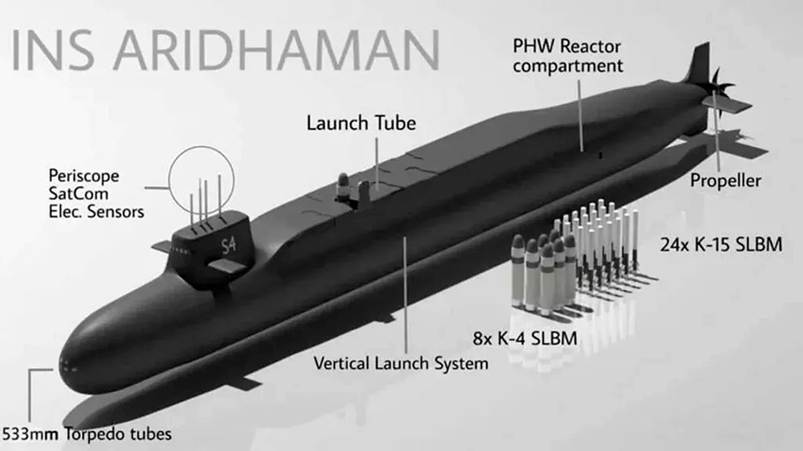
- ~7000-tonne submarine, larger than previous Arihant-class vessels, indicating technological progression.
- Can carry 24 K-15 Sagarika missiles or 8 K-4/K-5 nuclear missiles, doubling earlier payload capacity.
- Enhances range, firepower, and deterrence credibility in maritime domain.
Strategic Significance
- Strengthens second-strike capability, ensuring credible deterrence even after a nuclear first strike.
- Counters China’s expanding naval footprint and dual-use surveillance vessels in Indian Ocean Region.
- Provides continuous at-sea deterrence (CASD), critical for nuclear stability.
- Enhances India’s ability to respond in multi-domain warfare scenarios (land-air-sea integration).
- Reinforces India’s position as a major maritime power in Indo-Pacific.
Changing Nature of Warfare
- Modern conflicts increasingly multi-domain, as seen in West Asia conflicts and maritime choke points like Strait of Hormuz.
- Naval assets now central to power projection, deterrence, and escalation control.
- Possibility of spillover from land/air conflicts to maritime domain necessitates stronger naval deterrence.
Economic & Technological Aspects
- Boosts Atmanirbhar Bharat in defence, reducing reliance on foreign suppliers (notably Russia).
- Development of SSBNs strengthens indigenous shipbuilding, nuclear propulsion, and missile technology ecosystems.
- Future plans include indigenous SSN programme (2036 onwards), expanding underwater warfare capability.
Challenges
- High capital and operational costs of SSBN programme strain defence budget allocation priorities.
- Need to balance submarine expansion with emerging technologies like AI, autonomous systems, and cyber warfare integration.
- Technological gaps in propulsion, stealth, and detection avoidance compared to advanced navies like China and US.
- Ensuring continuous at-sea deterrence (CASD) requires multiple operational submarines and robust command-control systems.
- Vulnerability to anti-submarine warfare (ASW) advancements by adversaries.
- Strategic risk of arms race escalation in Indo-Pacific, especially with China’s rapid naval expansion.
Way Forward
- Accelerate indigenous SSBN and SSN programmes to ensure fleet redundancy and continuous deterrence.
- Invest in advanced stealth, sonar evasion, and underwater communication systems.
- Integrate AI and autonomous technologies in submarine operations and surveillance.
- Strengthen tri-service coordination for effective multi-domain deterrence strategy.
- Enhance maritime domain awareness (MDA) and anti-submarine warfare capabilities.
- Maintain strategic stability through adherence to NFU and credible minimum deterrence doctrine.
Prelims Pointers
- SSBN = nuclear-powered submarine carrying ballistic missiles.
- K-15 (Sagarika) range ~750 km; K-4 ~3500 km.
- Nuclear triad ensures second-strike capability.
- INS Arihant (2016) – India’s first SSBN.


