
Content
- Courts must protect, not regulate free speech
- The right moment to boost India-Ethiopia ties
Courts must protect, not regulate free speech
Why is this in the News?
- Supreme Court observations (Nov 27, 2025) in Ranveer Allahbadia vs Union of India raised concerns by:
- Suggesting creation of neutral, autonomous bodies to regulate online content.
- Asking the government to publish draft regulatory guidelines for public consultation.
- The Court also expanded the scope of the case (March 3, 2025) to examine regulation of content “offensive to moral standards”, triggering debate on judicial overreach in free speech regulation.
Relevance
GS II – Polity & Constitution
- Fundamental Rights: Scope and limits of Article 19(1)(a) and Article 19(2).
- Judicial Role: Constitutional umpire vs policy-maker.
- Separation of Powers: Judicial restraint, institutional competence.
- Judicial Overreach: Expansion of case scope beyond pleadings.
Practice Questions
- “Courts must act as sentinels of free speech, not as architects of its regulation.”Critically examine this statement in light of recent Supreme Court observations on online content regulation.(250 words)
Free Speech: Constitutional Basics
- Article 19(1)(a): Guarantees freedom of speech and expression.
- Article 19(2): Permits reasonable restrictions, only on enumerated grounds:
- Sovereignty and integrity of India
- Security of the State
- Friendly relations with foreign states
- Public order
- Decency or morality
- Defamation
- Contempt of court
- Incitement to an offence
- Key principle: Grounds under Article 19(2) are exhaustive, not illustrative.
Existing Legal Framework Regulating Speech
Criminal & Statutory Provisions
- IT Act, 2000:
- Section 66: Computer-related offences.
- Section 66E: Violation of privacy (publishing personal images).
- Section 66F: Cyber terrorism.
- Section 67: Obscenity online.
- Bharatiya Nyaya Sanhita (BNS), 2023:
- Sections 294–296: Obscenity and offences against religious sentiments.
Subordinate Legislation
- IT (Intermediary Guidelines & Digital Media Ethics Code) Rules, 2021:
- Central government oversight mechanism.
- Prior restraint obligations on publishers.
- Clause II(c): Requires “due caution and discretion” regarding religious or racial groups.
- Criticism:
- Overbreadth.
- Chilling effect.
- Executive dominance in oversight.
Core Concern Raised by the Editorial
Nature of the Case
- Case concerned quashing FIRs against accused creators.
- Online content regulation was not the original subject matter.
- Judicial expansion of scope raises issues of:
- Procedural propriety.
- Separation of powers.
Separation of Powers: Constitutional Red Line
- Legislation and policy design fall within the legislative domain.
- Common Cause vs Union of India (2008):
- Court cautioned itself against entering policy-heavy areas beyond institutional competence.
- Constituent Assembly Debates:
- Pandit Thakur Dass Bhargava:
- Supreme Court as constitutional umpire, not law-maker.
- Role limited to testing reasonableness of restrictions, not creating them.
- Pandit Thakur Dass Bhargava:
- Implication:
- Courts must adjudicate validity, not initiate regulatory frameworks.
Regulation vs Unlawful Restraint
- Thin constitutional line between:
- Permissible regulation.
- Impermissible prior restraint.
- Sahara India Real Estate Corp. vs SEBI (2012):
- Five-judge Bench:
- Blanket pre-censorship must be avoided at all costs.
- Postponement orders on media only as last resort, with strict proportionality.
- Five-judge Bench:
- Judicially driven regulatory enthusiasm risks:
- Prior censorship.
- Statutory gag on speech.
Exhaustiveness of Article 19(2)
- Kaushal Kishor (2023) — Constitution Bench:
- No additional restrictions beyond Article 19(2).
- Competing fundamental rights cannot justify new speech restrictions.
- Direct relevance:
- Court cannot invent new moral or societal standards as independent grounds.
Judicial Self-Restraint: Past Practice
- Adarsh Co-operative Housing Society vs Union of India (2018):
- Court refused to mandate disclaimers in films.
- Held:
- Decision lies with Censor Board, not judiciary.
- Even Censor Board acts post-creation, not as pre-emptive censor.
- Indicates a tradition of restraint, now at risk.
Comparative Perspective: Global Democracies
Liberal Democracies
- EU – Digital Services Act, 2022:
- Focus on content removal, not pre-censorship.
- Germany – Network Enforcement Act, 2017:
- Time-bound takedown of unlawful content.
- UK – Online Safety Act, 2023:
- Removal + fines for non-compliance.
- Australia – Online Safety Act, 2021:
- Penalties for failure to act, not prior control.
Illiberal States
- China, Russia:
- Surveillance-driven.
- Pre-censorship.
- Draconian controls.
- Risk:
- Democratic backsliding when courts enable restrictive regimes.
Scholarly Warning
- David Landau & Rosalind Dixon (2020):
- Courts can be captured by “would-be authoritarians”.
- Judicial review itself may become a tool of democratic erosion.
- Relevance:
- Judicial endorsement of speech regulation legitimises executive excess.
Broader Democratic Implications
- Court-driven calls for stricter laws + executive readiness:
- Normalise censorship.
- Shrink civic space.
- Undermine marketplace of ideas.
- Salman Rushdie’s dictum captures the core:
- Free speech is foundational to all liberties.
Conclusion
In a constitutional democracy, courts must act as sentinels of free speech, not as architects of its regulation, lest protection turn into pre-censorship and guardianship into democratic erosion.
Disclaimer : The views and opinions expressed here are based on the original article published in THE HINDU and do not reflect the official stance of Legacy IAS Academy. This content is provided solely for Academic purposes.
The right moment to boost India-Ethiopia ties
Why is Ethiopia in the News?
- Renewed high-level engagement: Meeting between PM Narendra Modi and PM Abiy Ahmed Ali on the sidelines of the G20 Summit, Johannesburg has reinvigorated bilateral ties.
- Ethiopia’s entry into BRICS: Enhances its geopolitical weight and opens new multilateral convergence with India.
- Post-conflict political transition: Ethiopia is rebuilding after civil conflict, creating a strategic opening for external partnerships.
- Strategic churn in the Horn of Africa: Red Sea security, access to ports, and great-power competition have brought Ethiopia into sharper focus.
Relevance
GS II – International Relations
- India–Africa Relations: Strategic partnerships, South–South cooperation.
- Multilateralism: BRICS, G20, AU engagement.
- Diplomacy: Post-conflict engagement, capacity building, defence cooperation.
GS III – Economy & Security
- Critical Minerals: Supply-chain security.
- Energy Security: Renewables, hydropower diplomacy.
- Defence Exports: Indigenous defence manufacturing.
- Trade Architecture: AfCFTA, DFTP scheme.
Practice Question
- Why is Ethiopia emerging as a pivotal partner for India in Africa? Analyse the strategic, economic, and geopolitical dimensions of India–Ethiopia relations.(/250 words)
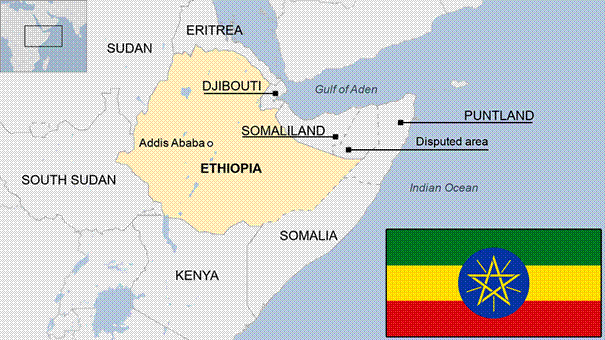
Ethiopia: Basic Profile
- Population: ~109 million (2024) – second-largest in Africa.
- Political system: Federal parliamentary republic.
- Capital: Addis Ababa.
- Strategic location: Horn of Africa; close to Red Sea trade routes.
- Special status: Headquarters of the African Union (AU).
- Economy: Among Africa’s fastest-growing; large domestic market.
- Energy potential: Hydropower-driven renewable energy hub (GERD).
Strategic Importance of Ethiopia
- Regional anchor state in a conflict-prone Horn of Africa (Somalia, Sudan, Eritrea).
- Military capacity: One of Africa’s largest and most experienced armed forces.
- Energy geopolitics: Potential exporter of renewable electricity to East Africa.
- Logistics ambition:
- Landlocked but seeks diversified access beyond Djibouti.
- Outreach to Somaliland and Eritrea reflects push for strategic autonomy.
- Gateway role:
- Under AfCFTA, Ethiopia can serve as a manufacturing and trade hub.
Historical Depth of India–Ethiopia Relations
- Education as foundation:
- Indian teachers and professors shaped Ethiopia’s modern education system for over a century.
- High social capital and goodwill for India.
- Digital education pioneer:
- Ethiopia was the pilot country (2007) for India’s Pan-African e-Network Project.
- Long-standing tele-education partnership with IIT Delhi.
- Human capital linkage:
- One of the largest African student cohorts in India.
- Highest number of African PhD students in India.
- Graduates helped staff Ethiopia’s newly established universities.
Education Cooperation: Future Potential
- Priority domains:
- Digital learning platforms.
- Vocational and skill-based training.
- University-to-university linkages.
- Revised scholarship frameworks.
- Strategic value:
- Soft power amplification.
- Capacity building aligned with Ethiopia’s demographic dividend.
Economic & Investment Relations
Current Status
- Indian investment stock: Over $4 billion.
- Indian investors: ~2,500 companies.
- Sectors:
- Earlier focus: Agriculture (many exited due to taxation and operational issues).
- Emerging focus: Pharmaceuticals, agro-processing, light manufacturing, mining.
Structural Challenges
- Foreign exchange shortages.
- Regulatory inconsistency.
- Taxation disputes.
- Approval delays.
What India Can Do
- Update DTAA and Bilateral Investment Treaty.
- Align investments with IMF conditionalities Ethiopia is operating under.
- Promote export-oriented manufacturing with buy-back arrangements.
Mining & Critical Minerals: Strategic Opportunity
- Untapped potential:
- Gold.
- Critical minerals.
- Rare earth elements.
- Indian Embassy mining survey:
- Identifies high potential with regulatory and logistics constraints.
- Strategic relevance for India:
- Renewable energy.
- Batteries.
- Semiconductors.
- Way forward:
- Joint commissioning and operation of mines.
- Mining as a pillar of strategic economic partnership.
Defence & Security Cooperation
- Historical roots:
- Establishment of Harar Military Academy (1956) with Indian assistance.
- Ongoing engagement:
- Indian defence training teams active since 2009.
- Current Ethiopian needs:
- Post-conflict military modernisation.
- Replacement of Soviet-era platforms.
- India’s advantage:
- Cost-effective, battle-tested defence platforms.
- Recent developments:
- New Defence Cooperation MoU.
- First meeting of Joint Defence Cooperation Committee.
- Financing:
- Ethiopia’s credible repayment record under IDEAS strengthens case for defence LoCs.
Multilateral & Trade Convergence
- Platforms:
- BRICS.
- G20.
- South–South cooperation frameworks.
- Trade architecture:
- AfCFTA enables Ethiopian-based Indian firms to access continental markets.
- Global context:
- Uncertainty in US–EU trade regimes (e.g., AGOA).
- India’s Duty-Free Tariff Preference (DFTP) scheme remains crucial for Ethiopian exports.
Indian Diaspora Factor
- Influential and organised via the India Business Forum.
- Acts as a bridge for investment and policy feedback.
- Highlights foreign exchange access as the single biggest bottleneck.
Challenges in the Relationship
- Domestic political fragility in Ethiopia.
- Regulatory unpredictability affecting investors.
- Infrastructure and logistics gaps.
- Foreign exchange controls.
Way Forward: Strategic Roadmap
- Align India–Ethiopia partnership with:
- Ethiopia’s post-conflict reconstruction.
- India’s supply-chain diversification goals.
- Prioritise:
- Education and skills.
- Mining and critical minerals.
- Defence exports and training.
- Export-oriented manufacturing.
- Leverage:
- BRICS membership.
- AfCFTA market access.
- Long-standing people-to-people trust.
Conclusion
With historical goodwill, converging strategic interests, and Ethiopia’s political regeneration, India–Ethiopia relations are poised to emerge as one of India’s most consequential partnerships in Africa over the next decade.


