
Why in News ?
- The Supreme Court of India ruled that forest land cannot be diverted for non-forestry purposes (including agriculture) without prior statutory approvals.
- The ruling came while cancelling cultivation permissions granted by district authorities in Gujarat to a cooperative farming society over 134 acres of forest land.
Relevance
GS II (Polity & Governance)
- Federalism
- Rule of law
- Judicial review of executive action
GS III (Environment)
- Forest conservation
- Environmental legislation
- Sustainable development
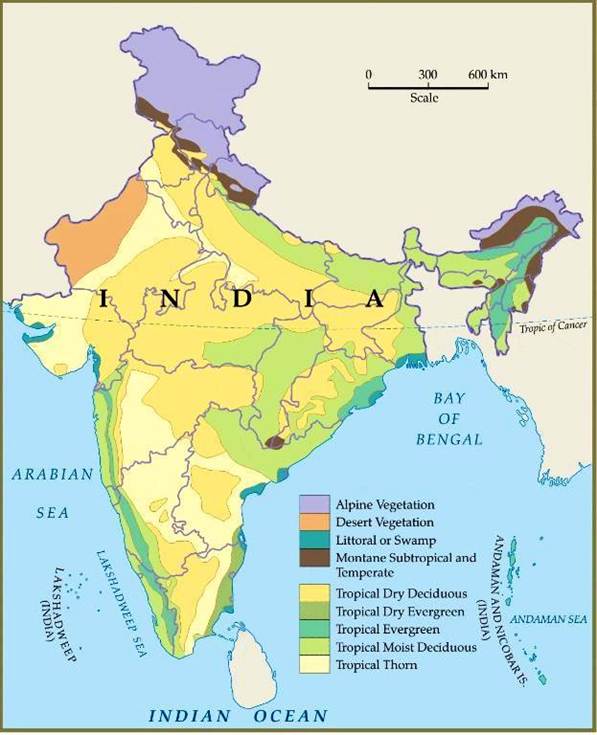
Legal Background: The Forest (Conservation) Framework
- Core law: Forest (Conservation) Act, 1980.
- Section 2 of the Act:
- Prohibits:
- De-reservation of forests
- Use of forest land for non-forest purposes
- Unless prior approval of the Central Government is obtained.
- Prohibits:
- “Non-forest purpose” explicitly includes:
- Agriculture
- Mining
- Industry
- Infrastructure
- Commercial plantations (other than permitted forestry activities)
What the Supreme Court Held ?
- Mandatory Central approval is a jurisdictional requirement, not a procedural formality.
- District collectors / state authorities:
- Have no independent power to permit non-forest use.
- Cannot bypass or dilute Section 2 safeguards.
- Cultivation on forest land, even if:
- Cooperative-led
- Livelihood-oriented
- Administratively sanctioned
→ remains illegal without central clearance.
Key Constitutional & Jurisprudential Principles Reinforced
A. Environmental Rule of Law
- Statutory environmental protections override executive discretion.
- Administrative convenience ≠ legal authority.
B. Doctrine of Public Trust
- Forests are held by the State in trust for present and future generations.
- Cannot be alienated or repurposed casually.
C. Sustainable Development
- Economic activity allowed only within ecological limits.
- Agriculture ≠ environmentally benign by default if it degrades forests.
Federal Dimension: Centre–State Balance
- Forests fall under Concurrent List (42nd Constitutional Amendment).
- Central oversight under the Forest (Conservation) Act ensures:
- Uniform national ecological standards.
- Prevention of competitive forest diversion by states.
- Judgment reaffirms central supremacy in forest diversion approvals.
Administrative Lapses Highlighted
- District authorities:
- Granted cultivation rights without legal competence.
- Ignored statutory clearance procedures.
- Reflects systemic issues:
- Weak legal literacy at district level.
- Pressure to regularise encroachments post-facto.
- Tension between short-term livelihoods and long-term ecology.
Implications of the Judgment
A. Governance Implications
- Strengthens enforcement of forest laws.
- Curtails discretionary misuse of land records and revenue powers.
- Signals zero tolerance for “administrative regularisation” of illegality.
B. Environmental Implications
- Protects forest cover from:
- Gradual agricultural creep.
- Fragmentation and biodiversity loss.
- Reinforces India’s climate commitments (carbon sinks).
C. Livelihood & Social Implications
- Raises concerns for:
- Communities dependent on forest land.
- However:
- Livelihood solutions must flow through legal routes:
- Forest Rights Act, 2006
- Agro-forestry policies
- Rehabilitation & alternative land allocation
- Livelihood solutions must flow through legal routes:
Interface with Forest Rights Act (FRA), 2006
- Judgment does not dilute FRA rights.
- Distinction:
- Recognised forest rights (individual/community) → legally protected.
- Administrative cultivation permissions without FRA process → invalid.
- Reinforces need for:
- Proper Gram Sabha-led FRA recognition, not executive shortcuts.
Critical Evaluation
- Strengths:
- Upholds ecological constitutionalism.
- Prevents piecemeal erosion of forest law.
- Concerns:
- Requires parallel strengthening of:
- FRA implementation
- Livelihood alternatives
- Administrative capacity at local levels
- Requires parallel strengthening of:
Conclusion
The Supreme Court has drawn a hard legal line: forests are ecological assets governed by statute, not revenue land open to administrative discretion—even for agriculture.


