
Why in News ?
- Union Cabinet approved India’s updated NDC on 25 March 2026 for submission to United Nations Framework Convention on Climate Change under the Paris Agreement cycle (post-2030 targets).
- India’s third NDC submission comes ahead of global climate negotiations after COP29–30 cycle, signalling enhanced ambition and Global South leadership.
Issue in Brief
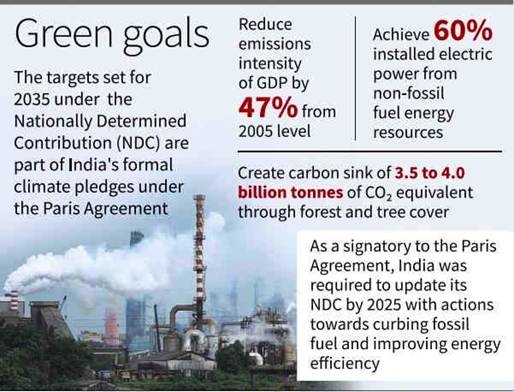
- India commits to:
- 47% reduction in emissions intensity of GDP (from 2005 levels) by 2035
- 60% installed power capacity from non-fossil sources by 2035
- 3.5–4 billion tonnes CO₂ equivalent carbon sink
- Targets build upon earlier commitments (2022 NDC) and align with Net-Zero target of 2070 and Viksit Bharat 2047 vision.
Relevance
- GS III (Environment & Economy): Energy transition, climate commitments, NDCs.
- GS II (IR): Global climate negotiations, CBDR-RC principle.
- GS III (Energy Security): Renewable energy, decarbonisation.
Practice Questions
- Q1. India’s updated NDC reflects a balance between development and climate responsibility. Critically analyse. (250 words)
Static Background
- NDC (Nationally Determined Contribution): Voluntary national climate targets under Paris Agreement (2015) to reduce emissions and adapt to climate change.
- Guided by principle of CBDR-RC (Common But Differentiated Responsibilities) balancing development needs with climate responsibility.
- Reviewed every 5 years, based on Global Stocktake (GST, first completed in 2023) assessing global progress toward 1.5°C goal.
Comparison with Previous Targets
2015 NDC (Original)
- 33–35% emissions intensity reduction by 2030
- 40% non-fossil capacity
- 2.5–3 billion tonnes carbon sink
2022 Updated NDC
- 45% emissions intensity reduction by 2030
- 50% non-fossil capacity by 2030
2026 Updated NDC (2031–35)
- 47% emissions intensity reduction by 2035
- 60% non-fossil capacity by 2035
- 3.5–4 billion tonnes carbon sink
India’s Current Progress
- ~36% emissions intensity reduction achieved (2005–2020), close to 2030 target well in advance.
- ~52% installed power capacity from non-fossil sources (2025–26), exceeding earlier 50% target ahead of deadline.
- ~2.3 billion tonnes CO₂ carbon sink created (2005–2019), nearing lower bound of earlier NDC target.
- Forest and tree cover increased from ~21% (2005) to ~24.6% (2021), though below 33% national target.
Key Analysis
1. Energy Transition & Power Sector
- Moving to 60% non-fossil capacity by 2035 driven by solar, wind, hydro, nuclear, biomass, along with battery storage and green hydrogen.
- However, only ~25% of actual electricity generation is non-fossil, indicating capacity vs generation gap due to intermittency and coal dependence.
2. Emissions Intensity Reduction
- Target of 47% reduction by 2035 reflects incremental ambition beyond 45% (2030), but remains moderate given India’s current trajectory and growth constraints.
- Indicates focus on energy efficiency + structural economic shift, not absolute emission cuts.
3. Carbon Sink Expansion
- Target of 3.5–4 billion tonnes CO₂ sink requires large-scale afforestation and ecosystem restoration, beyond current ~2.3 billion tonnes achievement.
- Forest cover still ~24.6% vs 33% policy goal, indicating significant gap in land and ecological capacity.
4. Strategic Positioning
- India’s NDC reflects balance between climate ambition and energy security, especially amid global energy shocks and fossil fuel volatility (West Asia conflicts).
- Positions India as leader of Global South, especially as developed countries show policy rollback and slow progress.
Challenges / Criticism
- Coal dependency (~70% electricity generation) likely to continue till 2035, limiting deep decarbonisation despite rising renewable capacity.
- 60% non-fossil target seen as conservative, given projections of ~70% capacity by 2035–36 (CEA estimates).
- Climate finance gap and technology dependence constrain faster transition, especially in storage, green hydrogen, and industrial decarbonisation.
- Global context of weak climate ambition by developed countries undermines collective progress towards 1.5°C pathway.
Way Forward
- Accelerate renewable energy + storage integration to bridge capacity vs generation gap.
- Scale up green hydrogen, electrification (transport, industry) to reduce fossil dependence structurally.
- Expand afforestation and nature-based solutions to meet enhanced carbon sink targets.
- Strengthen domestic manufacturing (solar, batteries) to reduce import dependence and enhance energy security.
- Leverage platforms like ISA, BRICS, G20 to secure climate finance and technology transfer.
Prelims Pointers
- NDCs are voluntary commitments, not legally binding emission targets.
- CBDR-RC principle recognises differentiated responsibilities of developed vs developing countries.
- India’s Net-Zero target year: 2070.


