Why is this in News?
- November–December 2025:
- A first-of-its-kind Indian study, published in Environment International, has flagged inhalable microplastics as a serious and overlooked air pollutant.
- Conducted across Delhi, Mumbai, Kolkata, and Chennai by IISER Kolkata.
- Context:
- Severe winter smog episodes in NCR.
- Public protests demanding the right to clean air.
- Key finding:
- City residents inhale ~132 micrograms of microplastics daily, with Delhi and Kolkata worst affected.
Relevance
GS III – Environment & Public Health
- Emerging environmental contaminants.
- Limitations of AQI and existing pollution frameworks.
- Urban air pollution and health externalities.
- Plastic waste management failures.
What are Microplastics?
- Microplastics:
- Plastic particles <5 mm in size.
- Inhalable microplastics:
- Particles <10 micrometres (µm).
- Small enough to:
- Bypass nasal filtration.
- Penetrate deep lung tissue.
- Source:
- Primary: Microbeads, synthetic fibres.
- Secondary: Breakdown of larger plastic waste.
Traditional Air Pollution Framework
- Focus on criteria pollutants:
- PM2.5, PM10.
- SO₂, NOx, CO, ozone, lead.
- AQI:
- Does not explicitly account for microplastics.
- Gap:
- Emerging contaminants like microplastics remain outside regulatory radar.
Key Findings of the Study
Concentration Levels
- Average inhalable microplastics (4 cities):
- 8.8 µg/m³.
- Daily exposure:
- ~132 µg per person per day.
- City-wise exposure:
- Delhi: 14.18 µg/m³
- Kolkata: 14.23 µg/m³
- Mumbai: 2.65 µg/m³
- Chennai: 4 µg/m³
Seasonal Variation
- Winter evenings:
- 32.7 particles/m³
- Non-winter evenings:
- 18.8 particles/m³
- 74% increase during winter due to:
- Temperature inversion.
- Low wind speed.
- Poor dispersion.
“Trojan Horse” Effect
- Microplastics act as carriers for:
- Heavy metals:
- Lead (highest in Kolkata).
- Cadmium.
- Endocrine-disrupting chemicals:
- Diethyl phthalates.
- Microbes:
- Fungi like Aspergillus fumigatus.
- Antibiotic-resistance genes.
- Heavy metals:
- Net impact:
- Amplifies toxicity beyond physical particles.
Health Implications
- Deep lung penetration → chronic exposure.
- Linked risks:
- Respiratory diseases.
- Hormone-related disorders.
- Cancer.
- Breast and reproductive health issues.
- High-risk groups:
- Traffic police.
- Construction workers.
- Urban informal labour.
- Tyre-wear microplastics:
- Identified as particularly carcinogenic.
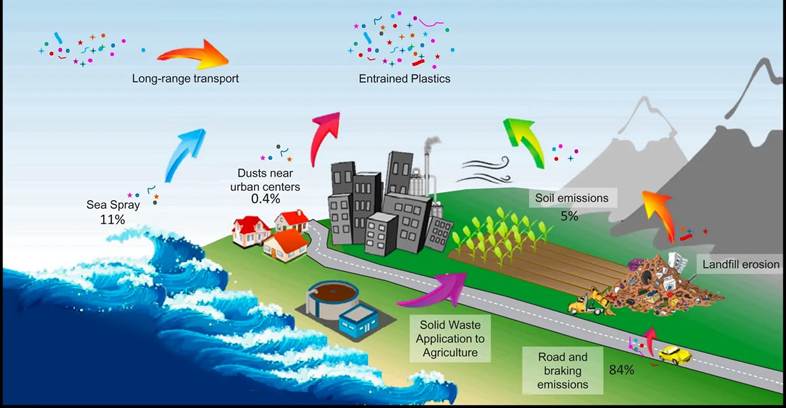
Sources of Inhalable Microplastics
- Urban origins:
- Tyre wear.
- Synthetic textiles.
- Packaging materials.
- Cosmetics.
- Construction activities.
- Household waste.
- Waste management failures:
- Open dumping.
- Burning of plastics.
- Poor segregation.
Why Delhi and Kolkata are Worse Affected
- High population density.
- Severe waste mismanagement.
- Landlocked geography.
- Adverse winter meteorology.
- Contrast:
- Mumbai and Chennai benefit from:
- Coastal winds.
- Better atmospheric dispersion.
- Mumbai and Chennai benefit from:
Governance and Policy Gaps
- AQI framework:
- Not designed to capture microplastics.
- Plastic regulation:
- Weak enforcement of single-use plastic bans.
- Occupational safety:
- No specific standards for microplastic exposure.
- Waste management:
- Persistent urban governance failures.