Why in News ?
- Kerala government tabled and passed the Malayalam Language Bill, 2025 in the Kerala Legislative Assembly on 6 October 2025.
- Bill has been passed after Subject Committee scrutiny and awaits Governor’s assent.
- Karnataka government has opposed the Bill, calling it unconstitutional and harmful to Kannada-speaking linguistic minorities, especially in Kasaragod district.
Relevance
- GS II – Polity & Governance
- Official language policy; Centre–State relations.
- Linguistic minorities’ rights (Articles 29–30, 345–347).
- Role of Governor; federal accommodation in border regions.
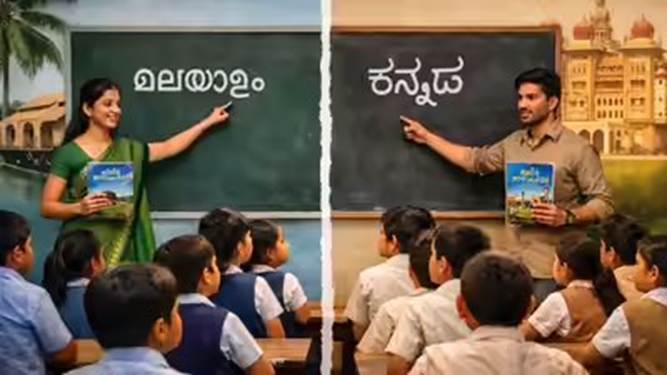
What Does the Malayalam Language Bill, 2025 Entail?
Core Provisions
- Malayalam formally adopted as the official language of Kerala.
- Currently: Malayalam + English recognised.
- Mandates use of Malayalam across:
- Government administration
- Education
- Judiciary (phased translation of judgments)
- Public communication
- Commerce
- Digital governance (IT domain)
- All Bills and Ordinances to be introduced in Malayalam.
Education-Related Provisions
- Malayalam to be the compulsory first language:
- In government and aided schools
- Up to Class 10
- Does not automatically apply to:
- Unaided private schools
- CBSE/ICSE unless notified separately.
Institutional & Administrative Measures
- Renaming of:
- Personnel and Administrative Reforms (Official Language) Department → Malayalam Language Development Department.
- Creation of:
- Malayalam Language Development Directorate.
- Role of IT Department:
- Develop open-source software & digital tools to promote Malayalam in e-governance and IT.
Has a Similar Bill Been Introduced Earlier?
- Yes (Over a decade ago):
- Kerala had earlier attempted legislation to strengthen Malayalam’s official use.
- The earlier initiative did not reach full statutory implementation.
- 2025 Bill is more comprehensive, covering:
- Education, judiciary, IT, and digital governance.
Why Has Karnataka Opposed the Bill?
Core Objections
- Impact on Kannada linguistic minority in Kerala, particularly:
- Kasaragod district, a border region.
- Key concern:
- Students currently studying Kannada as first language may be forced to shift to Malayalam.
- Data cited:
- Kannada medium schools in Kasaragod declined from 197 to 192 in recent years.
- Karnataka’s fear:
- Bill could accelerate erosion of Kannada language presence in Kerala.
Constitutional Objection
- Bill allegedly violates:
- Rights of linguistic minorities.
- Spirit of Articles 29 and 30 (cultural & educational rights).
- Karnataka CM has stated:
- State will use all constitutional remedies, including approaching the President.
Does the Bill Make Malayalam Mandatory Across All Schools?
Clear Answer: No (with qualifications)
- Mandatory only for government and aided schools.
- Applies only up to Class 10.
- Special protections exist for linguistic minorities (see below).
- Private unaided institutions retain flexibility, subject to policy rules.
Kerala Government’s Defence
Linguistic Minority Safeguards
- Special provisions for linguistic minorities:
- Tamil, Kannada, Tulu, Konkani speakers.
- Minority citizens allowed to:
- Use mother tongue for correspondence with:
- State Secretariat
- Heads of Departments
- Local government offices in minority-dominated areas.
- Use mother tongue for correspondence with:
Legal & Constitutional Alignment
- Kerala CM argues:
- Bill aligned with:
- Official Languages Act, 1963
- Article 346 – Language for inter-State communication.
- Article 347 – Recognition of minority languages in States.
- Bill aligned with:
- Non-obstante clause (Clause 7):
- Overrides general provisions to protect linguistic minorities.
Federal & Constitutional Dimensions
Relevant Constitutional Articles
- Article 345 – State legislature may adopt official language(s).
- Article 346–347 – Inter-State communication & minority language recognition.
- Articles 29–30 – Protection of minority culture and education.
Core Federal Issue
- Balance between:
- State’s right to promote its official language
- Minority linguistic rights in border regions
- Raises questions of:
- Cooperative federalism
- Cultural accommodation vs linguistic homogenisation.
Governance & Policy Analysis
Merits
- Strengthens:
- Cultural identity
- Vernacular governance
- Access to justice (translated judgments)
- Supports:
- Digital inclusion through language tech.
- Aligns with:
- NEP 2020 emphasis on mother tongue education.
Challenges
- Border districts with mixed populations.
- Declining minority-language institutions.
- Potential:
- Inter-State linguistic friction.
- Politicisation of language policy.
Way Forward
- Explicit statutory exemptions for border linguistic pockets.
- District-wise language flexibility in education.
- Inter-State dialogue mechanisms under Inter-State Council.
- Periodic review of minority-language school viability.
- Judicial clarity post-Governor assent, if challenged.
Prelims Pointers
- Bill year: 2025
- Applies to: Government & aided schools
- Mandatory language: Malayalam (first language, up to Class 10)
- Special clause for linguistic minorities: Yes (Clause 7)
- Opposition State: Karnataka
- Border district concerned: Kasaragod