
WHY IN NEWS ?
- India’s elderly population (60+) is 153 million today, projected to reach 347 million by 2050.
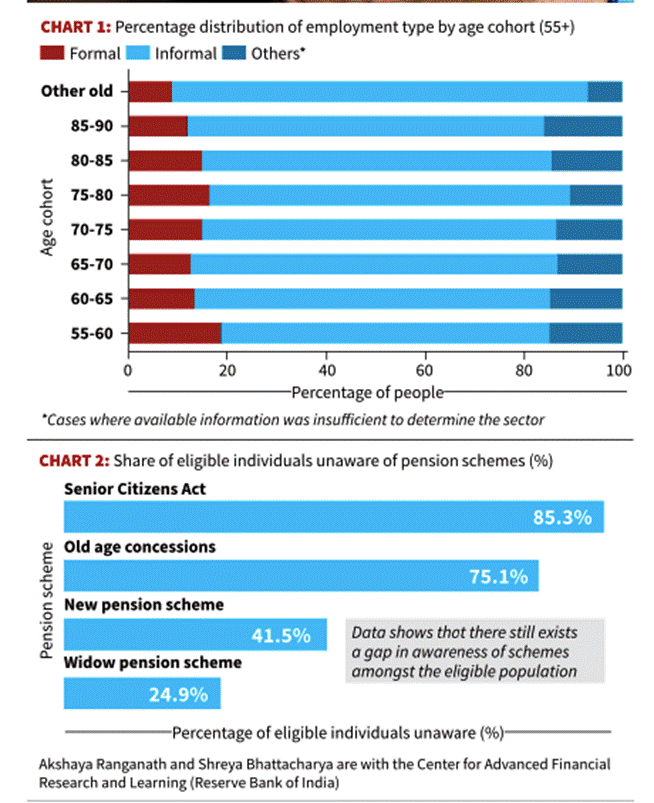
- Over 88% of senior citizens work in the informal sector with no assured pension or social security.
- Renewed focus due to:
- Expansion and redesign of Atal Pension Yojana and National Pension System,
- Launch of e-SHRAM portal,
- Labour Codes reform redefining “wages” for pension calculations.
- LASI Survey (2017–18) and Comprehensive Annual Modular Survey (2022–23) reveal:
- 42% of people above 55 unaware of NPS.
- 63% of elderly lack basic internet usage skills.
Relevance :
GS Paper II – Governance & Social Justice
- Welfare schemes for the vulnerable sections (elderly, informal workers)
- Social security architecture: IGNOAPS, NPS, APY, e-SHRAM
- Role of Labour Codes in redefining wage-linked social protection
- Digital exclusion and governance delivery gaps
- Institutional mechanisms for old-age welfare
GS Paper I – Indian Society
- Demographic transition and population ageing
- Informalisation of labour and its social consequences
- Gendered vulnerability in old-age employment
GS Paper III – Indian Economy
- Household savings and capital market deepening
- Pension funds as long-term infrastructure financing source
- Fiscal sustainability of OPS vs contributory pensions
BASICS: WHAT IS A PENSION SYSTEM?
- Pension = Regular post-retirement income for old-age security.
- Two broad types:
- Social Assistance (Non-contributory) → Government-funded.
- Contributory Pension → Individual + employer/government contribution.
INDIA’S DEMOGRAPHIC & STRUCTURAL CHALLENGE
- Rapid ageing + Informalisation:
- Informal sector share among 55+:
- Women: 75.6%
- Men: 68%
- Informal sector share among 55+:
- Consequence:
- No employer pensions.
- No assured retirement income.
- Continued old-age labour → poverty risk + dignity deficit.
FIRST PHASE: WELFARE-BASED SOCIAL ASSISTANCE
Indira Gandhi National Old Age Pension Scheme (1995)
- Target: BPL elderly (65+)
- Nature: Non-contributory
- Role:
- First national effort to assure minimum old-age income security.
- Expanded coverage and benefit levels over time.
- Limitation:
- Very low pension amount.
- No linkage to savings or investment behaviour.
Old Pension Scheme (Pre-2004)
- For government employees.
- Defined benefit; fully state-funded.
- Problem:
- Heavy fiscal burden.
- Unsustainable with rising life expectancy.
SECOND PHASE: SHIFT TO CONTRIBUTORY PENSIONS
National Pension System (2004)
- Replaced OPS for new recruits.
- Features:
- Defined contribution.
- Market-linked returns.
- Applies to:
- Government employees.
- Corporate sector workers.
- Recent reform: NPS 2.0
- 100% equity option.
- Multiple Scheme Framework (MSF).
- Targets young, high-risk investors.
Atal Pension Yojana (2015–16)
- For informal sector workers (18–40 years).
- Features:
- Monthly/quarterly/half-yearly contribution.
- Government guarantees minimum pension.
- Behavioural impact:
- Encourages formal savings culture.
- Improves retirement planning in low-income groups.
THIRD PHASE: BRIDGING FORMAL–INFORMAL DIVIDE
e-SHRAM portal
- National database of informal workers.
- Functions:
- Registration for welfare schemes.
- Eligibility discovery.
- Attempted integration into formal social security.
Challenges:
- Aadhaar–bank–mobile linkage errors.
- Digital exclusion:
- 63% elderly cannot use the internet.
- Risk of exclusion errors > inclusion gains.
ROLE OF LABOUR CODES IN PENSION SECURITISATION
- Uniform definition of wages:
- Basic pay ≥ 50% of total earnings.
- Direct impact:
- Higher:
- PF contribution,
- Gratuity,
- Pension base.
- Higher:
- Closes employer strategy of inflating allowances to reduce social security burden.
POLICY EVOLUTION: SEQUENTIAL LOGIC
- Stage 1 – Welfare Protection:
- IGNOAPS, OPS.
- Stage 2 – Financial Behaviour Change:
- NPS, NPS 2.0.
- Stage 3 – Informal Inclusion:
- APY, e-SHRAM.
- Current Direction:
- Data-driven targeting + contributory security.
CRITICAL GAPS
- Awareness deficit:
- 42% above 55 unaware of NPS.
- Coverage vs Access mismatch:
- Availability ≠ Effective utilisation.
- Digital divide:
- Elderly excluded from portal-based access.
- Pension adequacy:
- APY pension slabs insufficient for inflation-adjusted living.
IMPACT ON FINANCIAL SYSTEM
- Promotes:
- Long-term household savings.
- Capital market deepening.
- Reduced old-age dependency ratio pressure over time.
- Shifts India:
- From welfare-centric pension state
- To participatory, market-linked social security state.


