Content
- DRDO celebrates 68th Foundation Day
- Jan Samarth Portal
DRDO celebrates 68th Foundation Day
Why in News ?
- DRDO celebrated its 68th Foundation Day on 01 January 2026.
- Review of 2025 achievements & 2026 targets by Raksha Mantri and DRDO leadership.
- Record defence indigenisation momentum:
- 22 Acceptance of Necessity (AoN) approvals worth ~₹1.30 lakh crore for DRDO-developed systems to be manufactured by Indian industries — highest ever in a single year.
- 11 acquisition contracts worth ₹26,000 crore signed with DRDO production partners.
Relevance
GS 3 — Internal Security & Defence Technology
- Indigenous defence R&D, strategic autonomy, Aatmanirbhar Bharat in defence
- Force modernisation — missiles, air defence, EW, naval systems, ISR, artillery
- Defence production ecosystem, DPSU–private–MSME integration
- Technology depth — cyber, AI, space, hypersonics, CBRN capabilities
- Import substitution + export orientation in defence manufacturing

DRDO — Basics
- Founded: 1958
- Headquarters: New Delhi
- Parent Ministry: Ministry of Defence
- Head: Secretary, Defence R&D & Chairman DRDO
- Mandate:
- Indigenous development of missiles, radars, EW, naval systems, aeronautics, armaments, life sciences, CBRN, AI & cyber systems.
- Vision: Strengthen strategic deterrence & defence self-reliance (Aatmanirbhar Bharat).
- Network: ~50+ laboratories, strong industry-academia ecosystem.
Key Highlights of 2025 – Output & Indigenisation Push
- AoN approvals (~₹1.30 lakh crore) for major systems including:
- IADWS, Conventional Ballistic Missile System
- QRSAM ‘Anant Shastra’, LRASSCM
- IDDIS Mk-II, Astra Mk-II (BVRAAM)
- NAG (Tracked) Mk-2, Advanced Light Weight Torpedo
- PBMM-NG mines, AEW&C Mk-1A
- Mountain Radars, LCA Mk-1A Full Mission Simulator
- 11 signed contracts (~₹26,000 crore) for:
- Nag Missile System, Ashwini LLTR Radar
- ADFCR, EW Suite for Mi-17 V5
- Area Denial Munition, HEPF-Pinaka
- Infantry Floating Foot Bridge
- Wargaming System
- ACADA, ATAGS, etc.
User Evaluation Trials — Completed / Final Stage
- Pralay (S-to-S Missile)
- Akash-NG
- Pinaka – Guided Extended Range
- Advanced Light Weight Torpedo
- ER-ASR, MPATGM
- EW Systems for plains/deserts
- Border Surveillance System (BOSS)
- Software Defined Radio
- CBRN Water Purification System
Pipeline for 2026 Induction
- Indian Light Tank
- VSHORADS, VL-SRSAM
- NASM-SR, Long Range LACM
- Rudram-2
- ULPGM-V3
- CL-ATGM for Arjun MBT
- Long-Range Glide Bomb ‘Gaurav’
- Long-Range & VHF Radars
- High-Power Microwave Systems
- Microwave Obscurant Chaff Rockets
- OBOGS-centric ILSS (LCA)
- Automatic Fire Protection (Dornier-228)
Strategic Significance
- Boost to Defence Self-Reliance
- Largest-ever AoN + contracting pipeline → reduces import dependence.
- Technology Depth
- Shift toward next-gen domains: cyber, space, AI, EW, hypersonics, advanced missiles.
- Operational Edge
- Enhances air defence, precision strike, naval ASW, border surveillance, artillery lethality.
- Industrial Multipliers
- Strengthens MSME–DPSU–private sector value chains.
- Export Potential
- Several systems (Pinaka, radars, missiles) align with India’s defence export push.
Way Forward — Policy & Capability Priorities
- Accelerate spiral development & modular upgrades.
- Deepen private-sector prime integration in complex platforms.
- Invest in materials, propulsion, EW & sensor fusion research.
- Expand dual-use & civilian spin-offs (cyber, space, disaster management).
- Strengthen export certification & after-sales frameworks.
Jan Samarth Portal
Why in News ?
- Credit Guarantee Scheme for Exporters (CGSE) made operational through the Jan Samarth Portal from 1 December 2025.
- In the first month (till 31 Dec 2025):
- 1,788 applications worth ₹8,599 crore received
- 716 sanctions worth ₹3,141 crore
- Government provides 100% credit guarantee for additional export-linked loans.
- Scheme supports liquidity, market diversification, competitiveness and employment, especially for MSME exporters.
Relevance
GS 3 — Economy (Growth, MSMEs, Exports)
- Export competitiveness, market diversification, current-account stability
- MSME integration into global value chains; employment in export clusters
- Credit access & risk-sharing mechanisms to strengthen trade finance
- Counter-cyclical liquidity support during global economic headwinds
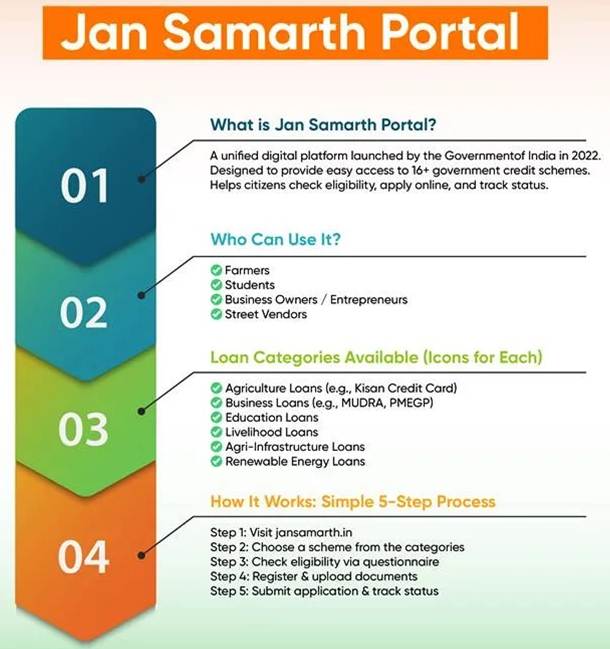
Basics — Jan Samarth Portal
- Launched: 2022
- Purpose: National credit-linked schemes platform integrating banks & government schemes.
- Enables end-to-end digital processing:
- Eligibility check → Application → Approval → Tracking
- Covers schemes under DFS, MSME, Housing, Education, Agriculture, etc.
- For CGSE, it acts as the digital facilitation and monitoring platform.
Credit Guarantee Scheme for Exporters (CGSE) — Key Features
- Implementing Ministry: Department of Financial Services (DFS), Ministry of Finance
- Guarantee Agency: NCGTC (National Credit Guarantee Trustee Company Ltd.)
- Beneficiaries:
- MSME and non-MSME exporters (direct & indirect exporters)
- Nature of Support:
- Additional collateral-free working capital
- Up to 20% of existing export credit / WC limits
- Government Guarantee: 100% guarantee on the additional facility
- Scheme Size / Cap: Up to ₹20,000 crore guarantees
- Validity: Till 31 March 2026 or till guarantees of ₹20,000 crore are issued
- Lending Agencies: Member Lending Institutions (MLIs) — banks & FIs
Operational Objectives
- Cushion exporters during global uncertainty & trade headwinds
- Improve liquidity and business continuity
- Enable market diversification & competitiveness
- Support employment in export-oriented industries
- Reinforce macro–stability via export performance
Context & Economic Significance
- Exports = ~21% of India’s GDP
- ~45 million people employed (direct + indirect) in export sectors
- MSMEs ≈ 45% of India’s total exports
- Sustained exports help:
- Current Account Balance
- Foreign exchange stability
- Manufacturing ecosystem & supply chains
How CGSE Works ?
- Exporter applies via Jan Samarth Portal
- Bank assesses existing limit + 20% top-up eligibility
- Loan sanctioned without additional collateral
- NCGTC issues guarantee to the bank
- Reduces lender risk → increases credit flow to exporters
Challenges / Risks
- Need to avoid over-leveraging of stressed MSMEs
- Monitoring of credit quality & end-use essential
- Awareness gap among smaller exporters / cluster firms
- Coordination needed between banks–NCGTC–DGFT ecosystems
Way Forward
- Expand coverage to supply-chain vendors of export firms
- Faster portal-based turnaround time (TAT)
- Integrate with trade finance, invoice discounting, TReDS
- Encourage transition from short-term liquidity → capability upgrading
- Strengthen export credit analytics & risk scoring