
Content
- Study of stellar Twins reveal secrets of evolution and future of stars
- Mission 100% Electrification: Powering the Future of Indian Railways
Study of stellar Twins reveal secrets of evolution and future of stars
Why is it in news?
- A joint team from ARIES (Nainital) and PRL (Ahmedabad) studied four W Ursae Majoris–type (W UMa) contact binary stars using
- 1.3-m Devasthal Fast Optical Telescope (DFOT) and
- NASA’s TESS space telescope
- Results were published in the Astrophysical Journal (2026), revealing new evidence on binary star evolution, mass transfer, orbital changes, and magnetic activity.
Relevance
- GS-3 | Science & Technology — Space Research & Astrophysics
- Advances understanding of stellar evolution, binary mergers, angular-momentum loss
- Strengthens India’s role in observational astronomy & indigenous research capacity (ARIES–PRL collaboration)
- Supports precision in exoplanet transit science (better stellar mass–radius calibration)
- Application to astrophysical modelling, space science innovation, and data-driven research
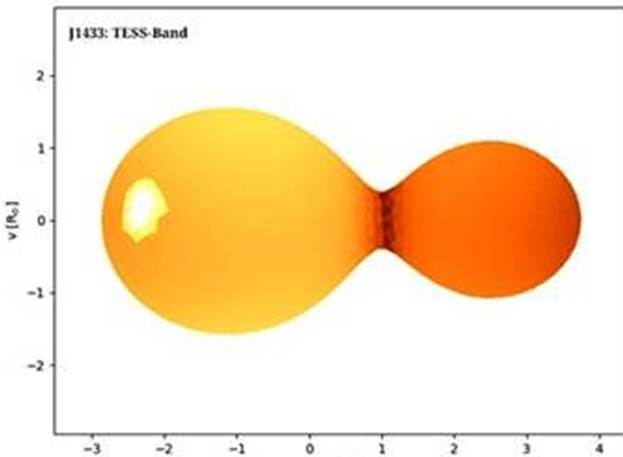
Basics — What are W Ursae Majoris (W UMa) Stars?
- Type: Short-period contact binary systems
- Orbital period: Typically 0.2–1.0 days (very fast)
- Morphology: Dumbbell-shaped, both stars share a common outer envelope
- Composition: Generally low-mass, main-sequence stars
- Energy sharing: Thermal contact → nearly equal surface temperatures
- Scientific value: Natural laboratories to determine mass, radius, luminosity, temperature, angular momentum loss
Key Findings
- Mass transfer & orbital evolution
- Evidence of mass exchange between stars
- Slight orbital period variations → angular-momentum redistribution
- Shared stellar envelope
- Stars share outer layers, confirming contact-binary energy coupling
- Magnetic activity & star spots
- Dark star spots cause asymmetric brightness (“lopsided light curves”)
- Strong magnetic fields + star-spot cycles
- Spectral emissions confirm flare-linked outer-layer activity
- Improved mass–radius calibration
- Results refine empirical relations for low-mass stars
- Critical for stellar structure & evolutionary models
Scientific Significance
- Enhances understanding of:
- Binary star evolution & merger pathways
- Angular-momentum loss mechanisms
- Energy transport in contact binaries
- Supports:
- Exoplanet transit studies
(accurate stellar radii = accurate planet sizes)
- Astrophysical population models
- Calibration of stellar evolutionary tracks
- Exoplanet transit studies
Conclusion
- The study of W UMa contact binaries provides high-precision evidence on mass transfer, orbital evolution, and magnetic activity, strengthening models of stellar evolution and merger pathways.
- It enhances India’s scientific capability in space research and improves mass–radius calibration crucial for exoplanet studies and astrophysical modelling.
Mission 100% Electrification: Powering the Future of Indian Railways
Why is it in news?
- Indian Railways has reached ~99.2% Broad Gauge (BG) electrification as of Nov 2025 (≈ 69,427 RKM electrified out of 70,001 RKM), signalling near-completion of Mission 100% Electrification.
- Electrification pace rose from 1.42 km/day (2004–14) to >15 km/day (2019–25) — a 10× acceleration.
- Solar capacity on the network expanded from 3.68 MW (2014) to 898 MW (Nov 2025), of which 629 MW for traction and 269 MW for non-traction uses.
- India now ranks among the most extensively electrified rail networks globally, comparable to Switzerland (100%), and ahead of China (82%) and Japan (64%).
Relevance
- GS-3 | Infrastructure, Energy & Economy
- Enhances logistics efficiency, freight competitiveness, operating cost savings
- Reduces diesel import dependence → strengthens energy security
- Demonstrates large-scale infrastructure modernisation + mechanised project execution
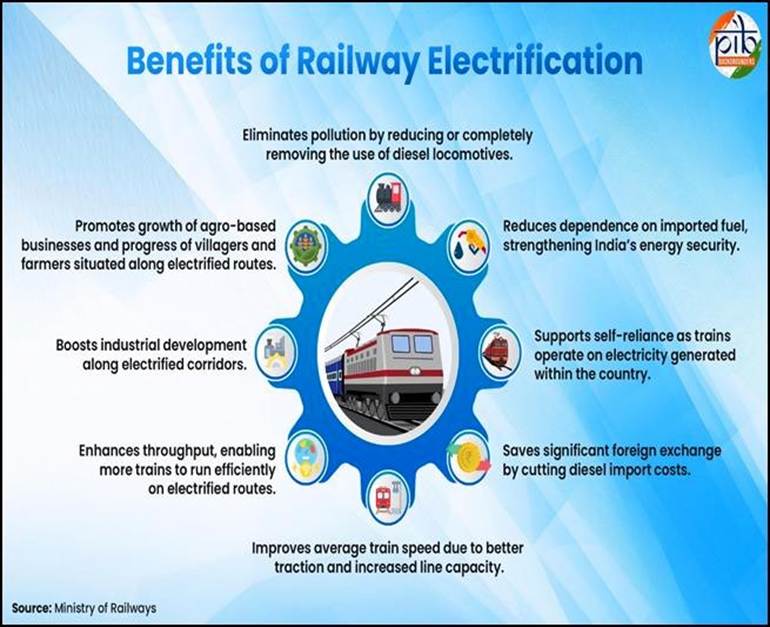
Basics — What is Railway Electrification?
- Meaning: Replacing diesel traction with electric traction powered through Overhead Equipment (OHE) and traction substations.
- Traction energy mix: Grid electricity + increasing share of solar and renewable power.
- Operational logic
- Higher energy efficiency (electric traction ≈ 70% more economical than diesel)
- Higher haulage capacity & acceleration
- Lower maintenance + lower dependency on imported fuel
- Environmental logic
- Reduced GHG emissions, air pollution, noise
- Enables future migration to green grids / RE integration
Status Snapshot
- Network electrified: 69,427 RKM (≈ 99.2% of BG network)
- Electrified since 2014: 46,900 RKM
- Electrified share over time
- 2000: 24%
- 2017: 40%
- 2024: >96%
- 2025: ~99.2%
States — Residual Sections (574 RKM pending; 0.8%)
| State | % Electrified | Balance (RKM) |
| Rajasthan | 99% | 93 |
| Tamil Nadu | 97% | 117 |
| Karnataka | 96% | 151 |
| Assam | 92% | 197 |
| Goa | 91% | 16 |
25 States/UTs already 100% electrified.
Global Positioning
- Switzerland: 100%
- India: ~99%+
- China: 82%
- Spain: 67%
- Japan: 64%
- France: 60%
- Russia: 52%
- UK: 39%
Inference: India is among the world leaders in network-scale electrification.
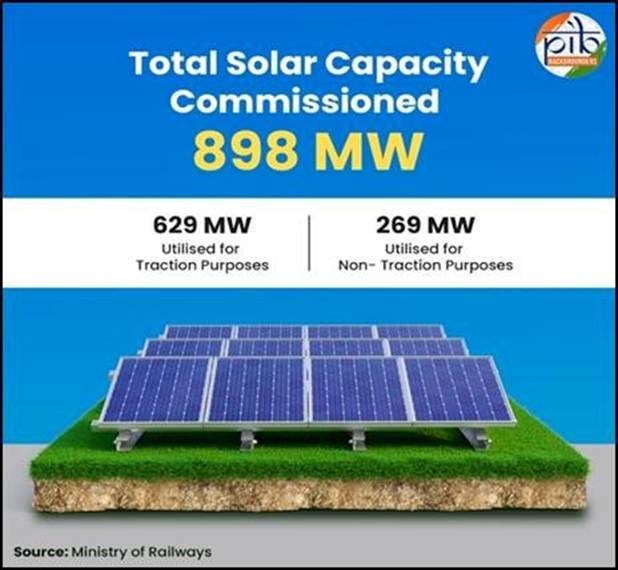
Solar Power Integration — Data Highlights
- Total solar installed: 898 MW
- 629 MW (≈70%) — Traction supply
- 269 MW — Non-traction (stations, workshops, service buildings, housing)
- Stations using solar power: 2,626
- Outcome
- Reduced grid draw + electricity costs
- Greater energy security + decarbonisation of traction
Engineering & Technology Interventions
- Cylindrical mechanised foundations (augering)
- Faster OHE mast installation, less manual excavation, superior consistency
- Automatic Wiring Train
- Simultaneous catenary + contact wire installation
- Accurate tensioning → higher safety, faster execution
- Mechanisation + standardisation
- Shorter project cycles, fewer failures, improved quality
Why Electrification Matters ?
- Economic
- Lower fuel bill, reduced dependence on diesel imports
- Higher throughput → freight efficiency & logistics competitiveness
- Environmental
- Lower emissions; enables shift toward renewable-powered mobility
- Operational
- Higher speeds, reliability, and network capacity
- Regional development
- Electrified corridors catalyse industrial & rural connectivity
Conclusion
- Near-complete railway electrification, backed by rapid pace and large-scale solar integration, marks a major leap in infrastructure modernisation, energy efficiency, and logistics competitiveness.
- It significantly reduces diesel dependence and emissions, positioning Indian Railways as a global leader in sustainable, low-carbon transport transformation.


