
Content
- India’s Solar Momentum
- Export Promotion Mission
India’s Solar Momentum
Why in News ?
- India’s solar capacity touched ~129 GW, up from 3 GW in 2014 (over 40× growth in 11 years).
- Non-fossil installed power capacity crossed 50% of India’s total ~500 GW electricity capacity five years ahead of the 2030 target.
- Massive scale-up recorded under PM Surya Ghar, PM-KUSUM, Solar Parks, and PLI for Solar PV Manufacturing.
- 8th Assembly of the International Solar Alliance (ISA) hosted by India in Oct 2025, reinforcing India’s global solar leadership.
Relevance
GS II (Governance, International Relations)
- Climate diplomacy leadership via International Solar Alliance
- South–South cooperation through solar finance & capacity building
- Federal cooperation in renewable energy deployment
- Energy as a tool of strategic diplomacy (OSOWOG grid vision)
GS III (Economy, Infrastructure, Energy, Environment)
- Energy security: Reduced fossil fuel import dependence
- Infrastructure: Grid integration at high RE penetration
- Industrial policy: PLI for Solar PV Manufacturing
- Agriculture: Solar pumps under PM-KUSUM
- Circular economy: Solar panel recycling challenge
Why Solar Matters for India ?
- India is:
- 3rd largest energy consumer globally
- Among the top 3 CO₂ emitters, though per capita emissions remain low
- Solar power addresses:
- Energy security (reduces fossil fuel imports)
- Climate mitigation (zero operational emissions)
- Rural electrification
- Job creation & manufacturing growth
- High natural advantage:
- 300+ sunny days/year
- 4–7 kWh/m²/day solar radiation
- Strategic shift from coal-dominant mix → renewables-led grid
Solar Capacity Growth: Structural Transformation
- 2014: 3 GW
- Oct 2025: ~129 GW
- Growth rate: Over 40-fold increase
- Now largest contributor to renewable energy, ahead of wind & biomass
- Share in India’s renewable mix:
- Solar now forms ~50%+ of total RE capacity
- Impact:
- Reduced long-term power costs
- Improved grid diversification
- Lower exposure to global fuel price shocks
Non-Fossil Power Milestone
- Non-fossil installed capacity: ~259 GW
- Total national capacity: ~500 GW
- Result: >50% electricity capacity from non-fossil
- Covers:
- Solar
- Wind
- Hydro
- Nuclear
- Biomass
- India achieved its 2030 climate electricity mix target in 2025 itself
Global Standing in Renewables (2025)
- As per IRENA Renewable Energy Statistics 2025:
- 3rd in solar capacity
- 4th in wind power
- 4th in total renewable installed capacity
- Implication:
- India is now a system-shaper, not just a follower, in global clean energy markets
Policy Anchor: Panchamrit at COP26
Announced at COP26, 2021
Five Pillars:
- 500 GW non-fossil capacity by 2030
- 50% power capacity from non-fossil by 2030 (already achieved)
- 1 billion tonne CO₂ emission reduction by 2030
- 45% reduction in carbon intensity vs 2005
- Net Zero by 2070
Function:
- Aligns energy policy, industry, transport, urban planning with climate goals
Key Government Programmes Powering Solar Expansion
A. PM Surya Ghar (Rooftop Solar Revolution)
- Launch: Feb 2024
- Outlay: ₹75,021 crore
- Target: 1 crore households
- Benefit: Up to 300 free electricity units/month
- Status (Dec 2025):
- 23.9 lakh homes covered
- 7 GW rooftop capacity installed
- ₹13,464.6 crore subsidy released
- Impact:
- Direct household cost savings
- Decentralised energy generation
- Urban & semi-urban grid decongestion
B. National Solar Mission (2010)
- Technology-wise deployment:
- Ground-mounted: 98.72 GW
- Rooftop: 22.42 GW
- Hybrid (solar share): 3.32 GW
- Off-grid: 5.45 GW
- Strategic value:
- Enabled India’s utility-scale solar parks
- Drove tariff discovery through reverse bidding
C. PLI Scheme for Solar PV Manufacturing
- Implemented by Ministry of New and Renewable Energy
- Outlay: ₹24,000 crore (Tranche I & II)
- Manufacturing capacity awarded: ~48.3 GW
- Investments attracted (Sept 2025): ₹52,900 crore
- Jobs generated: ~44,400
- Significance:
- Reduces import dependence on China
- Builds end-to-end domestic solar supply chain
- Supports Atmanirbhar Bharat in clean tech
D. PM-KUSUM (Solarisation of Agriculture)
- Launched: 2019
- Components:
- A: Grid-connected solar plants on fallow land
- B: Standalone solar pumps
- C: Solarisation of grid-connected pumps
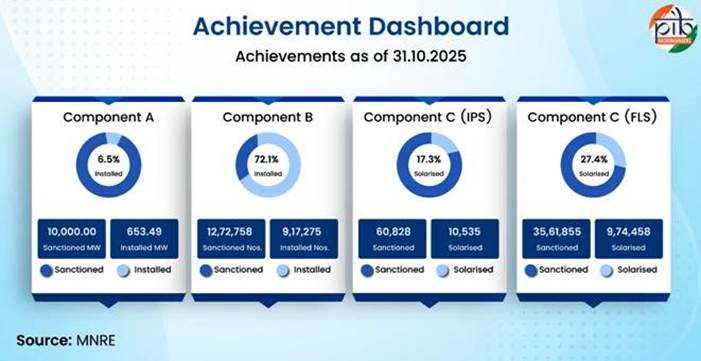
- Status (Oct 2025):
- ~9.2 lakh standalone solar pumps (B)
- 10,535 grid solarised pumps (C)
- 9.74 lakh feeder-level solarised pumps
- Subsidy:
- 30–50% CFA up to 15 HP pumps
- Impacts:
- Cuts diesel subsidy
- Boosts farm incomes
- Supports daytime irrigation
E. Solar Parks & Ultra Mega Solar Projects
- Launched: 2014
- Target enhanced: 20 GW → 40 GW
- Status (Oct 2025):
- 55 solar parks
- 39.97 GW sanctioned
- 14.92 GW already commissioned
- Benefits:
- Common infrastructure
- Faster land acquisition
- Lower project risks
- Extended till March 2029
India’s Global Solar Diplomacy
International Solar Alliance (ISA)
- Co-founded by India & France
- HQ: Gurugram
- 125+ member countries
- Functions:
- Solar finance mobilisation
- Technology transfer
- Capacity building
- Global risk mitigation
8th ISA Assembly (Oct 2025, New Delhi)
- 550+ delegates, 30+ ministers
- Focus areas:
- Resilient solar value chains
- Inclusive solar access
- Job creation & women leadership
- OSOWOG grid integration
One Sun, One World, One Grid (OSOWOG)
- Proposed by India (2018)
- Vision:
- Global renewable power interconnection
- Solar trading across time zones
- Strategic outcome:
- Enhances energy security
- Cuts global storage costs
- Positions India as a transnational grid leader
Strategic Significance of India’s Solar Surge
- Economic
- Lower power tariffs
- Reduced fossil fuel imports
- Manufacturing-led green growth
- Environmental
- Emission intensity reduction
- Coal displacement
- Social
- Rural electrification
- Farmer income diversification
- Geopolitical
- Leadership in climate diplomacy
- South–South solar cooperation via ISA
Critical Challenges Ahead
- Intermittency & storage adequacy
- Grid balancing at high RE penetration
- Land conflicts in ultra-mega parks
- Recycling & end-of-life solar panels
- Dependence on imported critical minerals
Conclusion: What This Milestone Really Means
- India is no longer just adding renewables—it is:
- Restructuring its entire power system
- Indigenising clean-tech manufacturing
- Exporting solar governance models globally
- Crossing 50% non-fossil power capacity in 2025 marks:
- A historic energy transition point
- A firm foundation towards 500 GW by 2030 & Net Zero by 2070
Export Promotion Mission
Why in News ?
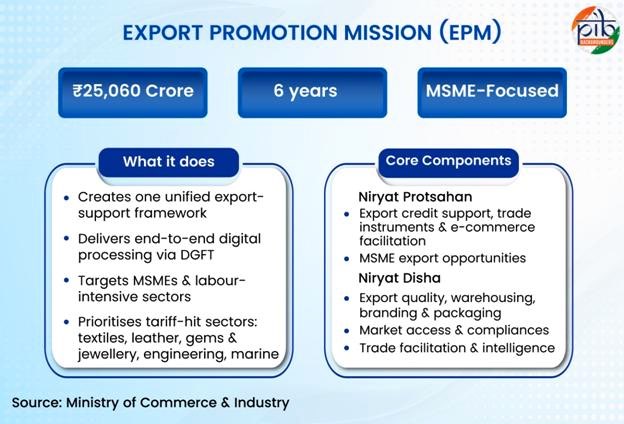
- Government approved the Export Promotion Mission (EPM) with an outlay of ₹25,060 crore (FY 2025–26 to FY 2030–31).
- Launch announced in Union Budget 2025–26 as a single, unified, digital export-support framework.
- Implemented through Directorate General of Foreign Trade (DGFT).
- Backed by:
- ₹20,000 crore Credit Guarantee Scheme for Exporters
- Major regulatory relief by Reserve Bank of India (RBI) amid global trade disruptions.
- Special focus on MSMEs, labour-intensive sectors, tariff-hit sectors and low-export districts.
Relevance
GS II (Governance, Polity, Federalism)
- Mission-mode governance replacing fragmented schemes
- Digital governance through DGFT’s unified export platform
- Cooperative federalism via district export promotion
- Role of RBI in economic stabilization
- Centre–State coordination in trade facilitation
GS III (Economy, Trade, MSME, Banking)
- Export-led growth strategy
- MSME credit access via ₹20,000 crore credit guarantee
- Trade finance reforms & interest subvention
- Logistics cost reduction for interior districts
- Global value chain integration
Why Exports Matter for India ?
- Exports drive:
- Manufacturing growth
- MSME employment
- Foreign exchange stability
- Global value-chain integration
- Key structural issues earlier:
- Fragmented export schemes
- High cost of trade finance
- Logistics disadvantages in interior districts
- Weak branding & standards compliance among MSMEs
- EPM responds to the need for:
- Unified governance
- Digitally delivered incentives
- Outcome-based export promotion
What is Export Promotion Mission (EPM)?
- A national, mission-mode export reform framework
- Outlay: ₹25,060 crore (6 years)
- Coverage:
- Merchandise exports
- Services exports
- Objective:
- Strengthen finance, market access, standards, branding, and district-level participation
- Replaces: Multiple fragmented export-support schemes with one integrated digital architecture
Policy Rationale: Why a Mission Approach?
- Earlier ecosystem suffered from:
- Overlapping schemes
- Slow approvals
- Weak inter-ministerial coordination
- EPM focuses on:
- Affordable trade finance
- Export-quality certification & standards
- Market access & branding
- Logistics rebates for interior exporters
- Designed as:
- Adaptive to global trade shocks
- Digitally monitored
- Outcome-linked
Institutional Structure & Governance
- Nodal Implementing Agency: DGFT
- Key Stakeholders:
- Department of Commerce
- Ministry of MSME
- Ministry of Finance
- Export Promotion Councils
- Commodity Boards
- Financial institutions
- State Governments
- Digital Backbone:
- End-to-end processing
- Application → Approval → Disbursal
- Integration with customs & trade systems
- Governance Model:
- Inter-ministerial coordination
- State partnership
- Data-driven monitoring
Two Core Sub-Schemes Under EPM
A. Niryat Protsahan – Financial Enablers
Targets export financing constraints, especially for MSMEs.
Key Instruments:
- Interest subvention on:
- Pre-shipment credit
- Post-shipment credit
- Export factoring
- Deep-tier financing
- Credit cards for e-commerce exporters
- Collateral support for export loans
- Credit enhancement for:
- New exporters
- High-risk markets
Impact:
- Lowers cost of capital
- Expands credit access
- Encourages first-time exporters
B. Niryat Disha – Non-Financial Enablers
Targets market-readiness and competitiveness.
Key Supports:
- Testing, certification & compliance
- International branding & packaging
- Trade fairs, expos & buyer-seller meets
- Export warehousing & logistics
- Inland transport reimbursement (for remote districts)
- Cluster-level & district export facilitation
Impact:
- Bridges quality and branding gap
- Integrates Indian MSMEs into global market standards
- Expands exports from non-coastal and low-export districts
Sectoral & Regional Focus
- Priority sectors:
- Textiles
- Leather
- Gems & Jewellery
- Engineering goods
- Marine products
- Target groups:
- MSMEs
- First-time exporters
- Labour-intensive industries
- Regional thrust:
- Interior districts
- Low-export-intensity regions
- Strategic intent:
- Geographic diversification of exports
- Reduce coastal concentration
Credit Guarantee Scheme for Exporters (CGSE)
- Approved alongside EPM
- Additional credit support: ₹20,000 crore
- Implemented by:
- Department of Financial Services (DFS)
- National Credit Guarantee Trustee Company Limited (NCGTC)
- Features:
- 100% Government of India guarantee
- Collateral-free export credit
- Additional working capital up to 20% of sanctioned limits
- Valid till 31 March 2026
- Objective:
- Liquidity assurance
- Market expansion support
- Risk mitigation for lenders
RBI Regulatory & Liquidity Support (Nov 2025)
Issued as “Trade Relief Measures Directions, 2025”
(i) Moratorium on Repayments
- Applicable: 1 Sept – 31 Dec 2025
- Simple interest, no compounding
- Interest convertible into Funded Interest Term Loan (FITL)
(ii) Export Credit Tenure Extension
- Pre & post-shipment credit tenure extended to 450 days
- Applies to credit disbursed up to 31 March 2026
(iii) Working-Capital Flexibility
- Drawing power recalculation
- Margin reduction & reassessment permitted
(iv) Regulatory Forbearance
- Relief period excluded from DPD
- Not treated as restructuring
- No adverse impact on credit bureau records
(v) Provisioning Requirement
- Minimum 5% general provision on eligible standard accounts
(vi) FEMA Relaxations
- Export realisation period extended 9 → 15 months
- Advance payment shipment window extended 1 → 3 years
Macro Impact:
- Prevents NPA stress
- Preserves export liquidity
- Stabilises trade during global slowdown
Digital Implementation & Monitoring
- DGFT operates:
- Unified exporter database
- Automated approvals
- Scheme-wise benefit tracking
- Features:
- Paperless processing
- Real-time monitoring
- Outcome-based fund release
- Policy Advantage:
- Reduces transaction cost
- Improves transparency
- Speeds up exporter onboarding
Expected Outcomes of EPM
- Improved access to affordable export finance
- Higher compliance readiness for global standards
- Enhanced branding & international visibility
- Increased exports from:
- Non-traditional districts
- First-time exporters
- Employment generation in:
- Manufacturing
- Logistics
- Services
- Supports:
- Atmanirbhar Bharat
- Export-led growth model
- Viksit Bharat @ 2047 vision
Strategic Significance
- Converts India’s export policy from:
- Fragmented schemes → Mission-mode governance
- Strengthens:
- Trade finance ecosystem
- MSME global integration
- District-level export capacity
- Aligns with:
- Industrial corridor development
- Gati Shakti logistics reforms
- Digital public infrastructure
Key Risks & Challenges
- Global demand slowdown
- Tariff protectionism in developed markets
- MSME compliance cost burden
- Logistics bottlenecks in remote districts
- Banking risk aversion despite guarantees
Conclusion
- The Export Promotion Mission (EPM) represents a structural reform in India’s export governance.
- By integrating:
- Digital delivery (DGFT)
- Credit guarantees (NCGTC)
- Monetary relief (RBI)
- Financial & non-financial enablers (Niryat Protsahan & Disha)
- It creates a whole-of-government export ecosystem focused on:
- MSME empowerment
- Market diversification
- Trade resilience
- EPM operationalises India’s shift towards technology-driven, inclusive and globally competitive exports.


