
Content
- India Hosts UNESCO’s 20th ICH Session
- National Mission on Edible Oils (NMEO)
India Hosts UNESCO’s 20th ICH Session
Why in News?
- India is hosting the 20th Session of the UNESCO Intergovernmental Committee for Safeguarding of Intangible Cultural Heritage (ICH) from 8–13 December 2025 at Red Fort, New Delhi.
- First time ever India is hosting this global ICH governance body.
- Coincides with 20 years of India’s ratification (2005) of the UNESCO 2003 Convention on ICH.
- Chaired by Vishal V. Sharma, India’s Permanent Delegate to UNESCO.
- Nodal agencies:
- Ministry of Culture
- Sangeet Natak Akademi
Relevance
GS 1 — Indian Heritage & Culture
- Intangible Cultural Heritage (ICH) vs Tangible Heritage
- 2003 ICH Convention:
- Objectives, safeguarding mechanism
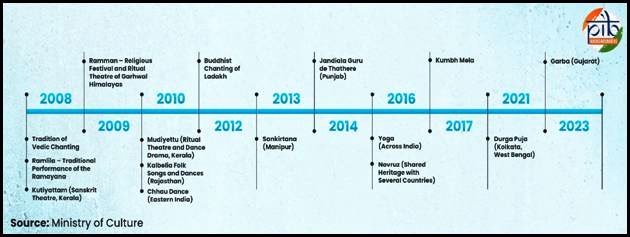
- Indian elements on UNESCO ICH List (15 elements)
- Living traditions:
- Rituals, festivals, crafts, oral traditions
- Culture as a dynamic, community-owned process, not static monuments
GS 2 — International Relations & Global Institutions
- Role of UNESCO in global cultural governance
- India as:
- Chair and host of a major multilateral cultural body
- Voice of the Global South in heritage governance
- Convention diplomacy:
- Cultural cooperation as a tool of IR
- Cultural multilateralism as a pillar of norm-setting
What is Intangible Cultural Heritage (ICH)?
- Living traditions including:
- Oral traditions, performing arts
- Rituals, festivals, social practices
- Traditional craftsmanship and indigenous knowledge
- Dynamic, community-owned, and inter-generationally transmitted
- Differs from tangible heritage (monuments, artifacts)
2003 UNESCO Convention on ICH — Core Architecture
- Adopted: 17 October 2003, 32nd UNESCO General Conference, Paris
- Entry into force: 2006
- Four objectives:
- Safeguard ICH
- Ensure community respect
- Raise national & global awareness
- Promote international cooperation
Intergovernmental Committee — Key Functions
- Implements the 2003 Convention
- Decides on:
- ICH Representative List
- ICH in Need of Urgent Safeguarding
- Register of Good Safeguarding Practices
- Controls:
- ICH Fund utilisation
- International assistance grants
- Reviews:
- State Party periodic reports
India’s Role in Global ICH Governance
- India has served three terms on the ICH Committee.
- 15 Indian elements inscribed on the UNESCO ICH Representative List.
- 2025 Nominations:
- Diwali
- Chhath Mahaparva
Strategic Objectives of India as Host
- Showcase India’s ICH safeguarding model:
- Institutional support
- Community participation
- National inventory & documentation
- Promote:
- Joint multinational nominations
- Capacity building and knowledge exchange
- Boost:
- Cultural tourism
- Global research & funding for Indian traditions
- Strengthen:
- Youth participation in heritage transmission
- Advance:
- Soft power & cultural diplomacy
- Integrate:
- Heritage + Sustainable Development + Livelihoods
Economic & Social Significance of ICH for India
- Livelihood security:
- Artisans, performers, crafts communities
- Social cohesion:
- Reinforces pluralism across caste, tribe, region, religion
- Knowledge preservation:
- Ecology, folk medicine, oral histories, rituals
- Soft power dividends:
- Global branding via Yoga, Garba, Durga Puja, Kumbh, etc.
Institutional Framework in India
1. National ICH Scheme (Ministry of Culture)
- Objectives:
- Documentation & digitisation
- UNESCO nomination dossiers
- Preservation & promotion
- Training & skill development
- Stakeholders:
- States, universities, NGOs, local practitioners
2. Sangeet Natak Akademi (SNA)
- Capacity building
- Field documentation
- Awareness & transmission programs
Governance + Development Linkage (UPSC Value Addition)
- ICH supports SDGs:
- SDG 1 (Livelihoods)
- SDG 4 (Education & knowledge transmission)
- SDG 8 (Cultural economy)
- SDG 11 (Sustainable communities)
Emerging Challenges
- Commercialisation vs authenticity
- Urbanisation-driven skill loss
- Youth disengagement from traditional practices
- Inadequate grassroots documentation
- Digital misappropriation of community knowledge
Conclusion
- Hosting the 20th ICH Session elevates India as:
- A global heritage leader
- A voice of the Global South in cultural governance
- Reinforces India’s model of:
- Community-centric safeguarding
- Heritage-led sustainable development
- Converts India’s cultural diversity into:
- Diplomatic capital
- Economic opportunity
- Civilisational continuity
National Mission on Edible Oils (NMEO)
Why in News?
- Government released latest progress update (Dec 2025) on:
- NMEO–Oil Palm (OP) area expansion & CPO production
- NMEO–Oilseeds (OS) implementation scale-up
- NITI Aayog’s 2024 report highlighted:
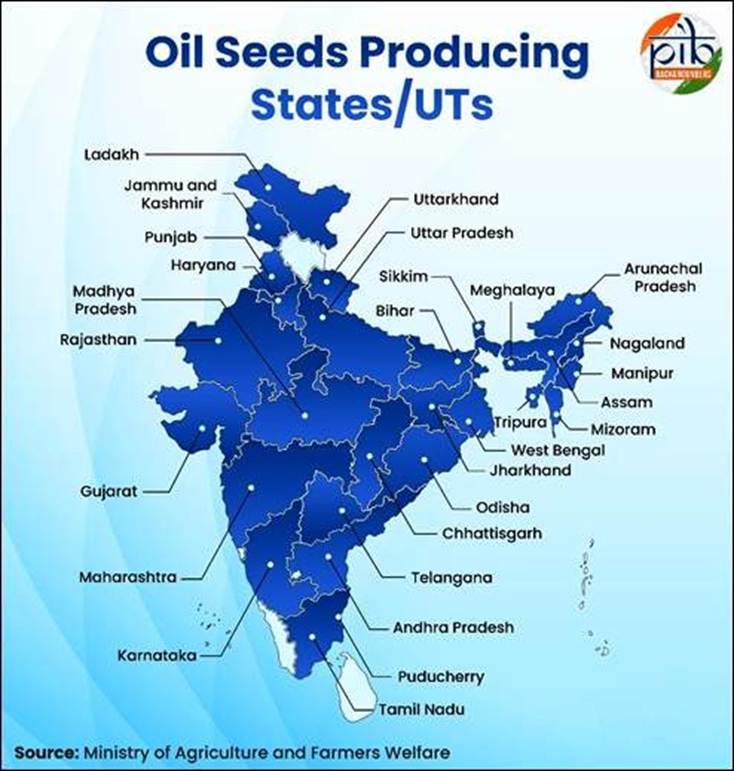
- India ranks No. 1 globally in production of rice bran oil, castor, safflower, sesame, niger
- By Nov 2025:
- 2.50 lakh ha freshly covered under NMEO-OP
- Total oil palm area now 6.20 lakh ha
- CPO output doubled from 1.91 lakh tonnes (2014–15) to 3.80 lakh tonnes (2024–25)
Relevance
GS Paper 3 — Agriculture
- Oilseeds as:
- Second-largest crop group after foodgrains
- NMEO verticals:
- NMEO–Oil Palm (2021)
- NMEO–Oilseeds (2024)
- Yield gap, rainfed dependence, seed replacement strategy
GS 3 — Food Security & Nutrition
- Edible oils as:
- Core source of fats & fat-soluble vitamins
- Per capita consumption rise vs domestic supply gap
- Import dependence risks on nutritional security
Strategic Context
- India meets only ~44% of edible oil demand from domestic production (2023–24).
- Import dependence:
- Fell from 63.2% (2015–16) → 56.25% (2023–24)
- Edible oil imports (2023–24): 15.66 million tonnes
- Consumption surge (2004–05 → 2022–23):
- Rural: +83.7%
- Urban: +48.7%
Historical Background
- Yellow Revolution (1990s) via Technology Mission on Oilseeds:
- Near self-sufficiency achieved through:
- MSP
- Import substitution
- Near self-sufficiency achieved through:
- Post-WTO phase:
- Reduced tariffs + weaker price support
- Imports surged, domestic productivity stagnated
National Mission on Edible Oils (NMEO)
- Launched to achieve:
- Atmanirbharta in edible oils
- Import substitution
- Farmer income enhancement
- Two verticals:
- NMEO–Oil Palm (2021)
- NMEO–Oilseeds (2024)
- Implemented by Department of Agriculture & Farmers Welfare under Ministry of Agriculture and Farmers Welfare
NMEO – Oil Palm (OP)
Why Oil Palm?
- Highest oil yield per hectare among all oilseeds
- Oil yield ≈ 5× traditional oilseeds
- Produces:
- Palm oil (food)
- Palm kernel oil (industrial)
Financial Architecture
- Total outlay: ₹11,040 crore
- Centre: ₹8,844 cr
- States: ₹2,196 cr
- Centrally Sponsored Scheme
Core Innovations
- Viability Price (VP) for Fresh Fruit Bunches (FFBs):
- Protects farmers from global CPO price volatility
- Input subsidy enhanced:
- Planting material: ₹12,000 → ₹29,000 per ha
- Rejuvenation of old gardens: ₹250 per plant
- Focus on:
- Drip irrigation
- Inter-cropping during 4-year gestation
- Crop diversification from low-yield cereals
Regional Focus
- Traditional leaders:
- Andhra Pradesh, Telangana (98% production)
- New expansion:
- North-East, Gujarat, Chhattisgarh, Odisha
Targets vs Progress
| Indicator | Target | Current Status |
| Area | 6.5 lakh ha by 2025–26 | 6.20 lakh ha |
| CPO | 11.2 lakh t by 2025–26 | 3.80 lakh t |
| Long-term CPO | 28 lakh t by 2029–30 | On track |
NMEO – Oilseeds (OS)
- Approved: 2024–25 to 2030–31
- Outlay: ₹10,103 crore
Coverage
- Primary oilseeds:
- Mustard, Groundnut, Soybean, Sunflower, Sesame, Safflower, Niger, Linseed, Castor
- Secondary sources:
- Cottonseed, Rice bran, Coconut
- Tree-Borne Oilseeds (TBOs) included
Targets (By 2030–31)
- Area: 29 → 33 million ha
- Production: 39 → 69.7 million tonnes
- Yield: 1,353 → 2,112 kg/ha
- Additional:
- 40 lakh ha expansion via:
- Rice fallows
- Potato fallows
- Intercropping
- 40 lakh ha expansion via:
- Combined with NMEO–OP:
- Domestic oil production target: 25.45 million tonnes
- Demand met: ~72%
Implementation Framework
- 600+ Value Chain Clusters
- Coverage: >10 lakh ha annually
- Managed by:
- FPOs
- Cooperatives
- Farmers receive:
- Free quality seeds
- GAP training
- Pest & weather advisory
- Post-harvest:
- Oil extraction & storage support
Digital & Institutional Backbone
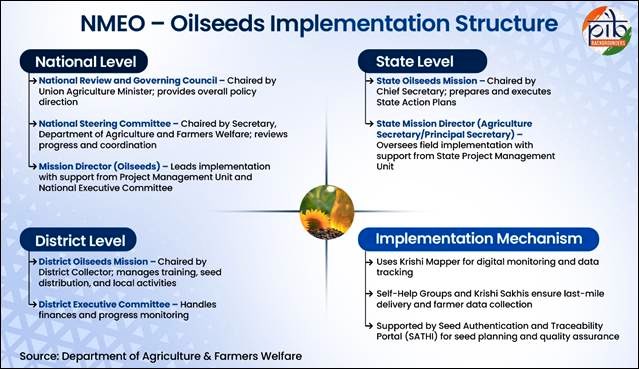
- SATHI Portal:
- 5-year rolling seed plan
- Infrastructure:
- 65 seed hubs
- 50 seed storage units
- Monitoring:
- Krishi Mapper
- Last-mile delivery:
- Krishi Sakhis (CASPs) via SHGs
Role of Research & Technology
Implemented by Indian Council of Agricultural Research through AICRPs:
- 432 high-yielding varieties notified (2014–25)
- Focus on:
- Hybrid breeding
- Gene editing
- Climate-resilient varieties
- Seed Performance Metrics:
- VRR (Varietal Replacement Rate)
- SRR (Seed Replacement Rate)
- Breeder seed production (2019–24):
- 1.53 lakh quintals
Complementary Policy Support
- PM-AASHA:
- MSP procurement via NAFED, NCCF
- Pradhan Mantri Fasal Bima Yojana:
- Crop insurance for oilseeds
- Import duties raised:
- Crude oils: 5.5% → 16.5%
- Refined oils: 13.75% → 35.75%
- MSP raised for mustard, soybean, groundnut
Strategic Significance
- Macro-Economic:
- Saves foreign exchange
- Reduces vulnerability to global price shocks
- Farmer Welfare:
- Assured pricing + stable demand
- Nutritional Security:
- Addresses fat and vitamin deficiencies
- Agro-Industrial Growth:
- Strengthens oil processing ecosystem
- Atmanirbhar Bharat:
- Core pillar of agri self-reliance
Key Challenges
- High rainfed dependence (76%)
- Yield gaps vs global benchmarks
- Long gestation of oil palm
- Environmental risks (monoculture, water stress)
- Market volatility despite price assurance
Relevance
- GS-3:
- Agriculture, food security, MSP, agri-import substitution
- Essay:
- Atmanirbhar Bharat through agricultural transformation
- Prelims:
- NMEO–OP vs NMEO–OS
- Viability Price (VP), SATHI, Krishi Sakhi
Conclusion
- NMEO represents India’s most comprehensive edible oil reform since the Yellow Revolution.
- Combines:
- Oil palm expansion
- Traditional oilseed productivity
- Advanced seed systems
- Digital governance
- If executed sustainably, NMEO can:
- Cut import dependence to below 30%
- Transform oilseeds into a high-value farmer income engine
- Secure India’s nutritional and economic sovereignty.


