
Content
- India Designated Country of the Year at BIOFACH 2026, Germany
- Democratising AI in India
India Designated Country of the Year at BIOFACH 2026, Germany
Basics & Context
What is BIOFACH?
- BIOFACH is the world’s largest exclusive organic trade fair, held annually at Nuremberg, Germany, focusing on certified organic food, standards harmonisation, sustainability innovations, and global value-chain linkages in organic agriculture.
- Organised since 1990 by NürnbergMesse, BIOFACH connects producers, certifiers, traders, and policymakers, shaping global organic regulations, labelling norms, and sustainable consumption standards, influencing international organic governance architecture.
Significance of India’s Designation
- Being named “Country of the Year 2026” provides international branding, buyer confidence, and regulatory credibility, improving market access and premium price realisation for Indian organic exporters and farmer collectives.
- Recognition after 14 years reflects expansion of certified organic area, export readiness, and global demand for residue-free food, aligning India with sustainability-driven global agri-trade narratives.
Relevance
- GS 3 (Economy / Environment / Agriculture):
Organic agriculture, agri-export diversification, value addition, soil health, climate-resilient farming, SDGs, green economy, market access, certification ecosystem.
Institutional Framework
APEDA’s Role
- APEDA (est. 1985) under Ministry of Commerce & Industry promotes export of scheduled agri-products, develops infrastructure, standards, and market intelligence, and supports value-added and organic product exports.
- APEDA implements National Programme for Organic Production (NPOP) covering third-party certification, accreditation, traceability systems, and equivalence agreements with major markets like EU, enabling smoother export acceptance.
Constitutional / Legal Dimension
- Organic agriculture advances Article 48A (environment protection) and judicially expanded Article 21 (right to healthy environment), supporting sustainable agriculture, rural livelihoods, and intergenerational equity under Directive Principles.
- Regulatory backing via FSSAI organic regulations, Jaivik Bharat logo, and NPOP standards ensures traceability, consumer protection, and international compliance, strengthening legal credibility of Indian organic exports.
Governance / Administrative Dimension
- Participation of FPOs, cooperatives, laboratories, commodity boards, and state agencies reflects cooperative federalism, decentralised export promotion, and integration of states into global organic value chains.
- India Pavilion covering 1,074 sq. metres with 67 co-exhibitors shows administrative scale in branding, certification support, logistics coordination, and trade diplomacy in international agri-exhibitions.
Economic Dimension
- Organic exports diversify India’s basket toward high-value niches—spices, herbs, essential oils, GI rice, enabling better farmer margins, forex earnings, and reduced dependence on bulk commodity exports.
- Global organic market > USD 130 billion, dominated by EU and North America; India strategically targets these premium markets where certified organic products command higher price premiums.
Social / Ethical Dimension
- Organic farming reduces farmer exposure to toxic agrochemicals, improving occupational health, while promoting traditional knowledge, indigenous seeds, and community-based sustainable practices.
- Promotion of GI-tagged heritage rice—Navara, Gobindbhog, Chak Hao—preserves agro-biodiversity, cultural heritage, and local identities, supporting ethical consumption and rural cultural economies.
Environmental Dimension
- Organic farming enhances soil organic carbon, biodiversity, and water retention, reduces chemical runoff, and supports climate-resilient agriculture, aligning with NAPCC and SDGs 12, 13, 15.
- Lower use of synthetic fertilisers and pesticides reduces nitrous oxide emissions and groundwater contamination, promoting ecological sustainability and long-term agricultural productivity.
Data & Evidence
- India has among the world’s highest number of organic producers and large certified areas; Madhya Pradesh, Rajasthan, Maharashtra lead in certified acreage.
- Participation from 20+ States/UTs shows pan-India adoption; decade-long BIOFACH participation reflects sustained export-oriented organic sector development.
Challenges / Criticisms
- High certification costs, long conversion periods, and compliance burdens deter smallholders; fragmented supply chains and traceability gaps reduce competitiveness in strict markets like EU.
- Yield fluctuations during transition, limited domestic premium markets, and inadequate labs constrain scalability; experts recommend cluster-based organic zones and assured procurement mechanisms.
Way Forward
- Expand Participatory Guarantee Systems (PGS) domestically while strengthening NPOP for exports, reducing certification costs and improving inclusivity for small and marginal farmers.
- Invest in residue-testing labs, digital traceability, blockchain-based supply chains, enhancing credibility, transparency, and compliance with importing-country standards.
- Integrate organic farming with Natural Farming, agroecology, and GI branding, focusing on value addition, processing, and branding to capture higher-value global segments.
Democratising AI in India
Basics & Context
AI Democratisation — Concept
- AI democratisation means making compute, datasets, models, and applications widely accessible, affordable, and usable, enabling startups, researchers, governments, and citizens to participate in the digital and innovation economy.
- It shifts AI from elite, capital-intensive technology to a public digital infrastructure, similar to UPI, Aadhaar, and mobile internet, ensuring inclusive growth aligned with Viksit Bharat 2047 vision.
Strategic Significance for India
- AI is becoming a general-purpose technology like electricity or internet, driving productivity in agriculture, healthcare, education, governance, and climate action, shaping long-term national competitiveness and state capacity.
- India’s model emphasises scale + inclusion + affordability, positioning AI as a development multiplier for a population-scale democracy with regional diversity and large informal workforce.
Relevance
- GS 3 (Economy / S&T / Infrastructure / Environment):
AI ecosystem, semiconductor mission, startups, digital economy, supercomputing, 5G, data centres, renewable energy for tech infrastructure.
Institutional & Policy Framework
IndiaAI Mission
- IndiaAI Mission (approved March 2024) with ₹10,371.92 crore outlay for five years builds national AI capacity through compute access, datasets, skilling, startups, and responsible AI frameworks.
- Treats AI stack—applications, models, compute, chips, infrastructure, energy—as interconnected national capabilities, ensuring systemic ecosystem development rather than fragmented interventions.
Digital Public Infrastructure (DPI) Link
- Builds on DPI philosophy: UPI (payments), Aadhaar (identity), ONDC (commerce)—AI becomes next layer of public digital infrastructure enabling scalable, low-cost innovation.
Constitutional / Legal Dimension
- Advances Article 21 (life with dignity via better services) and Article 38 (social order for welfare) by improving access to healthcare, finance, agriculture advisories, and education.
- Digital Personal Data Protection Act 2023 ensures privacy, consent, and accountability, balancing innovation with fundamental rights protection in AI-driven data ecosystems.
- Government Open Data License + NDAP enable reuse of non-sensitive public data, supporting innovation while preserving sovereignty and citizen rights.
Governance / Administrative Dimension
- AI enhances e-governance efficiency, predictive policy design, and real-time monitoring, improving service delivery in agriculture advisories, telemedicine, disaster forecasting, and welfare targeting.
- MeghRaj (GI Cloud) provides secure, scalable, pay-per-use cloud for government; 2,170+ ministries/departments onboarded (Dec 2025), lowering barriers for AI adoption in governance.
Economic Dimension
- India hosts 6+ million tech/AI workforce, creating strong human capital base for AI-led growth, exports, and digital services competitiveness.
- India ranks among top 3 global startup ecosystems with 2 lakh+ startups, and ~90% AI-enabled, showing deep AI penetration in innovation landscape.
- Chip market projected $100–110 billion by 2030, signalling AI-driven semiconductor demand and domestic manufacturing opportunity.
Access to Compute
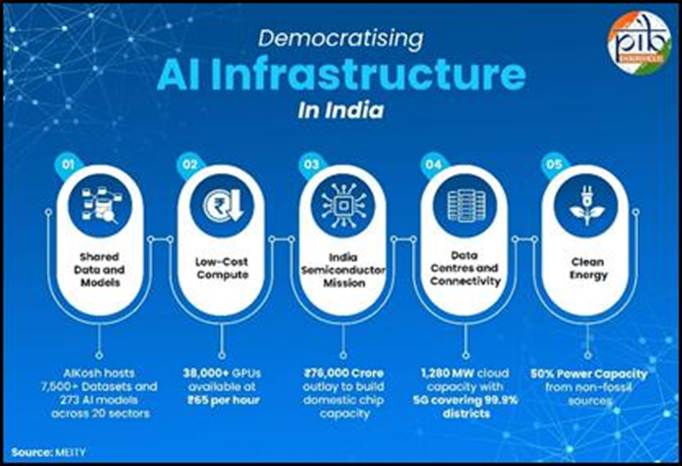
- 38,000+ GPUs available at ₹65/hour, nearly one-third global average cost, breaking entry barriers for startups, universities, and MSMEs in AI development.
- 1,050 TPUs onboarded, expanding high-performance AI processing capacity for model training, inference, and research applications.
- National Supercomputing Mission deployed 40+ petaflops capacity across IITs/research institutions; systems like PARAM Siddhi-AI, AIRAWAT support language, weather, and drug discovery research.
Access to Data & Models
- AIKosh platform aggregates 7,541 datasets + 273 models across 20 sectors, enabling reusable national AI resources and reducing duplication of effort.
- Recorded 3.85 lakh visits, 11,000 users, 26,000 downloads, indicating active ecosystem utilisation and demand for shared AI assets.
- Indigenous multimodal AI models in Indian languages enhance technological self-reliance and contextual relevance for local governance and services.
Connectivity & Data Centres
- 5G covers 99.9% districts and 85% population, with 5.08 lakh BTS installed (Oct 2025), enabling real-time AI applications and IoT integration.
- Data centre capacity at 1,280 MW, projected 4–5× growth by 2030, supporting AI, cloud, and digital economy expansion.
- India holds ~20% global data but only 3% global data-centre capacity, indicating major growth potential and strategic opportunity.
Semiconductor Ecosystem
- India Semiconductor Mission (₹76,000 crore) approved 10 projects worth ₹1.60 lakh crore across 6 states, strengthening domestic chip ecosystem.
- ISM 2.0 (Budget 2026–27) allocates ₹1,000 crore, focusing on industry-led R&D and training for future-ready semiconductor workforce.
Energy Dimension
- AI data centres are energy-intensive; India reached 50% installed power capacity from non-fossil fuels (June 2025)—5 years ahead of 2030 target.
- Renewable capacity reached 253.96 GW (Nov 2025); 44.5 GW added in 2025 alone, supporting green AI infrastructure.
- Nuclear capacity 8.78 GW → projected 22.38 GW by 2031–32, providing stable baseload for AI-driven digital economy.
Social / Ethical Dimension
- AI tools support farmers (pest prediction, irrigation), patients (telemedicine), students (personalised learning), reducing access inequalities.
- Bhashini supports 36+ languages, 1.2M+ downloads, 350+ models, improving linguistic inclusion and digital access for non-English populations.
- NITI Aayog notes AI can empower 490 million informal workers via better market access, finance, and services.
Skilling & Human Capital
- SOAR programme offers 15-hour student modules and 45-hour educator modules, building early AI literacy and ethical awareness.
- IndiaAI fellowships support 500 PhD, 5,000 PG, 8,000 UG students; 31 AI labs launched, 174 more planned in Tier-2/3 regions.
- AI Competency Framework for officials strengthens evidence-based policymaking and techno-administrative capacity.
Global Cooperation
- India–AI Impact Summit 2026—first Global South AI summit—hosts 15–20 Heads of Government, 50+ ministers, 100+ CXOs, signalling diplomatic AI leadership.
- Democratising AI Resources Working Group (India–Egypt–Kenya) promotes AI as global public good, shared infrastructure, and capacity building.
Challenges / Criticisms
- Risk of digital divide if rural areas lack last-mile access, digital literacy, or affordable devices despite infrastructure expansion.
- Data quality, bias, and algorithmic opacity may affect fairness and accountability in governance decisions.
- High energy and water footprint of data centres raises sustainability concerns.
- Dependence on imported high-end chips still persists despite domestic push.
Way Forward
- Develop Responsible AI frameworks ensuring transparency, auditability, and bias mitigation in public-sector AI.
- Promote federated data architectures and privacy-preserving AI to balance innovation with rights.
- Incentivise green data centres using renewables, efficient cooling, and carbon accounting.
- Expand AI literacy through school curricula and local-language training ecosystems.


