
Content
- Revival of Traditional Lakes, Ponds, and Reservoirs
- Conservation of Snow Leopards
Revival of Traditional Lakes, Ponds, and Reservoirs
Why Is It in News?
- PIB released updated details on Central Government schemes, funding flows, technological measures, and community-PPP models for reviving traditional water bodies.
- Highlights include:
- Rs. 545.35 crore central assistance released under PMKSY–HKKP (RRR of Water Bodies) till March 2025.
- 1.97 crore water-related works completed under Jal Shakti Abhiyan: Catch The Rain (2025).
- 3031 projects worth Rs. 6270.51 crore approved under AMRUT 2.0 for water body rejuvenation.
- Push for GIS mapping, geo-tagging, unique coding and PPP/community participation.
Relevance
GS1 – Geography / Society
- Traditional water bodies as part of India’s ecological heritage and rural socio-cultural systems.
- Changing land use, urbanisation, and demographic pressures degrading local hydrological systems.
GS3 – Environment, Conservation, Agriculture
- Critical for groundwater recharge, climate resilience, drought mitigation.
- Boosts irrigation efficiency and reduces stress on major irrigation systems.
- Technological interventions (GIS, geo-tagging, unique codes) → evidence-based policymaking.
- Supports Jal Shakti Abhiyan, AMRUT 2.0, PMKSY-HKKP goals on water security.
What Are Traditional Water Bodies?
- Man-made or natural storage structures: tanks, lakes, ponds, step-wells, johads, talabs, cheruvus, ooranis, ahars-pynes, etc.
- Ecological & socio-economic functions:
- Local irrigation + groundwater recharge
- Drinking & livestock water
- Flood buffer + micro-climate regulation
- Biodiversity habitats
- Support traditional livelihoods (fisheries, agriculture)
Why Revival Is Critical?
- India’s water stress: 18% population, 4% freshwater.
- CGWB: 1,034 blocks over-exploited.
- NITI Aayog: ~75% households face water scarcity; 21 cities to hit zero groundwater.
- Traditional water bodies historically contributed:
- 10–15% irrigation in many regions (pre-Green Revolution).
- 30–40% recharge in semi-arid belts.
- Degradation drivers:
- Encroachments, urbanisation, siltation
- Catchment degradation
- Weak local governance post-abolition of local customary systems (e.g., Kudimaramathu decline, temple tank neglect)
Current Government Framework
A. Federal Context
- Water = State Subject → States identify, plan, implement rejuvenation.
- Centre provides policy direction, financial assistance, technology tools, monitoring frameworks.
Major Schemes
(1) PMKSY–HKKP (Har Khet Ko Pani) – RRR of Water Bodies
- Objective: Restore storage capacity, improve command area irrigation, groundwater recharge.
- States may propose individual or cluster water bodies, including transient-storage structures.
- GIS-based census → unique code + geo-tagging for every approved water body.
- Funding: Rs. 545.35 crore CA released till 31 March 2025.
- Components:
- Desiltation
- Catchment treatment
- Bund/sluice strengthening
- Irrigation canal repair
- Command area development
(2) Irrigation Census Scheme (Minor Irrigation Statistics Wing)
- 100% centrally sponsored.
- Creates national database on:
- MI structures
- Major/medium irrigation
- Water bodies & springs
- Basis for planning & PMKSY approvals.
(3) Jal Shakti Abhiyan: Catch The Rain (JSA: CTR) – 2025
- Theme: “Jal Sanchay Jan Bhagidari: Jan Jagrukta ki Or”.
- Focus: 148 groundwater-stressed districts.
- Outcomes till 09.12.2025:
- 1.97 crore water-related works (desilting, recharge pits, tank repairs).
- 712 Jal Shakti Kendras established.
- Focus areas:
- Renovation of traditional tanks
- Encroachment removal
- Inventory creation
- Community awareness & behavioural change
(4) AMRUT & AMRUT 2.0
- Urban water security mission.
- Water body rejuvenation is a core component.
- 3031 projects approved; Rs. 6270.51 crore sanctioned.
- PPP provisioning:
- 10% of funds for water body rejuvenation projects in million-plus cities can be executed in PPP mode.
- AMRUT Mitra Initiative:
- Engaging women SHGs for water quality monitoring, demand management.
Technological Interventions
- Geo-tagging of each water body under PMKSY.
- GIS mapping to assess catchment, inflow pathways, encroachment boundaries.
- Unique Code System for uniform identification.
- Scientific desiltation:
- Sediment analysis
- Capacity computation
- Hydrological modelling:
- Outflow–inflow modelling
- Flood cushioning behaviour
- Digital dashboards:
- Real-time monitoring (CWC, State Water Resources Departments).
Best Practices (National & International)
- Hydrological & Structural Assessment before restoration.
- Catchment Area Treatment → vegetation revival, erosion control.
- Silt reuse protocols → for agriculture, brick making (as per sediment quality).
- Strengthening bunds, sluices & spillways.
- Integrated watershed approach (sub-basin scale).
- Nature-based solutions:
- Wetlands as bio-filters
- Floating wetlands for nutrient removal
- International templates:
- Japan: community-managed satoyama ponds.
- Spain: ancient acequia systems revived through participatory irrigation communities.
Community & PPP Models
- Water User Associations (WUAs): planning + O&M.
- Panchayati Raj Institutions: ownership and monitoring.
- Local NGOs: technical/social mobilization support.
- Women SHGs (AMRUT Mitra): water testing and demand management.
- PPP involvement:
- Up to 10% fund utilization in AMRUT cities.
- Potential models: lakefront development + ecological restoration.
Major Challenges
- Fragmented ownership (Revenue, WRD, Urban Local Bodies).
- Chronic encroachments and weak enforcement.
- Urban sewerage inflow into traditional lakes.
- Climate variability reducing inflows.
- Over-focus on beautification vs. hydrological restoration.
- Lack of post-restoration maintenance funds.
Conservation of Snow Leopards
Why Is It in News?
- Parliament reply (11 Dec 2025) detailed India’s first nationwide Snow Leopard Census (SPAI), population estimates, methodology, and follow-up conservation strategy.
- SPAI 2.0 launched in Wildlife Week 2025.
- Updated actions under NSLEP, Project Snow Leopard, and SECURE Himalaya highlighted.
- Reaffirmation of Schedule I protection, biosphere reserve coverage, and landscape-level conservation.
Relevance
GS3 – Environment, Biodiversity, Climate Change
- Snow leopard as a keystone & flagship species → indicator of ecosystem health.
- SPAI as a model for scientific wildlife monitoring in India.
- Landscape-level conservation planning under NSLEP and Project Snow Leopard.
- Climate change impacts on alpine prey species and habitat range shifts.
- Biosphere reserves and PA networks strengthening India’s biodiversity commitments.
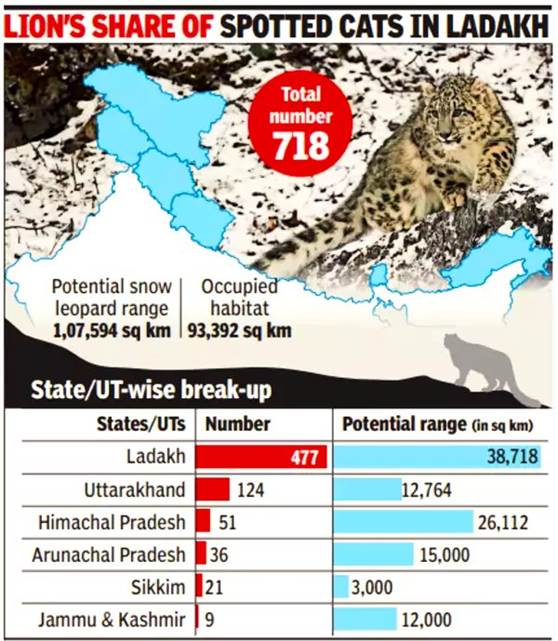
Snow Leopard (Panthera uncia)
- Apex predator of High Himalayas (3,000–5,000 m).
- Keystone species maintaining prey–predator balance.
- Flagship for high-altitude ecosystem conservation.
- Range: Ladakh, J&K, Himachal Pradesh, Uttarakhand, Sikkim, Arunachal Pradesh.
- The snow leopard (Panthera uncia) is listed as Vulnerable on the IUCN Red List, a status changed from Endangered in 2017
Ecological roles:
- Controls herbivore populations (bharal, ibex, argali).
- Indicator of habitat integrity and climate change vulnerability.
First Nationwide Snow Leopard Census (SPAI)
A. Population Estimate (2019–2023)
- Total = 718 individuals
- Ladakh – 477
- Uttarakhand – 124
- Himachal Pradesh – 51
- Arunachal Pradesh – 36
- Sikkim – 21
- J&K – 9
B. Scale & Coverage
- 1,20,000 km² surveyed
- 70% of India’s potential snow leopard range covered.
C. Scientific Framework
- Two-stage methodology:
- Stage 1: Occupancy-based sampling → mapping spatial distribution.
- Stage 2: Camera trap-based abundance estimation (stratified).
- Field effort:
- 13,450 km walked for sign surveys.
- 1,971 camera-trap stations.
- 1,80,000 trap nights.
- 241 distinct snow leopards identified.
D. Coordination
- Lead: Wildlife Institute of India (WII).
- Partners: Range States/UTs + local NGOs.
E. SPAI 2.0 (Launched 2025)
- Stronger scientific framework:
- Improved population monitoring cycle.
- Multi-taxa assessments (associated species).
- Expanded community-led conservation modules.
Conservation Architecture and Government Support
A. Species Recovery Programme (Centrally Sponsored: Development of Wildlife Habitats)
- Snow leopard is one of 24 species under targeted recovery.
- Funding for:
- Anti-poaching and patrolling
- Habitat restoration
- Scientific research
- Community conflict mitigation
B. Foundation for Strategic Action
- SPAI findings are baseline for:
- Long-term monitoring
- Landscape-level interventions
- Habitat quality assessment
- Species recovery benchmarks
National Snow Leopard Ecosystem Protection Priorities (NSLEP)
- India’s long-term strategy for high-altitude biodiversity.
- Prioritized actions:
- Habitat protection and corridor management
- Climate-resilient conservation planning
- Strengthened research and monitoring
- Community-based stewardship
Project Snow Leopard (PSL)
- Multi-state initiative involving:
- Ladakh, J&K, HP, Uttarakhand, Sikkim, Arunachal Pradesh
- Anchored in:
- Landscape approach: conservation beyond PAs.
- Participatory management with herders and local communities.
- Livelihood diversification to reduce ecological pressure.
Secure Himalaya
- India–UNDP–GEF partnership.
- Objective:
- Protect high-altitude Himalayan ecosystems.
- Conserve snow leopard populations.
- Enhance local livelihoods (eco-tourism, handicrafts, sustainable grazing).
- Reduce human–wildlife conflict.
Legal & Policy Protection
- Schedule I, Wildlife Protection Act, 1972 → highest protection.
- High-altitude PA network expansion.
- Enforced through:
- Anti-poaching units
- Habitat protection forces
- Inter-agency coordination (Army, ITBP, local forest departments)
Biosphere Reserves Securing Snow Leopard Habitat
- Cold Desert Biosphere Reserve (HP) → part of UNESCO WNBR; 7,770 km² habitat.
- Nanda Devi Biosphere Reserve (Uttarakhand).
- Khangchendzonga Biosphere Reserve (Sikkim).
These secure critical alpine, cold desert, and trans-Himalayan landscapes.
Long-Term Conservation Focus
- Landscape-level conservation (not just PAs).
- Scientific monitoring (SPAI cycle).
- Habitat degradation prevention:
- Regulating grazing
- Reducing fragmentation
- Controlling infrastructure expansion
- Community-based programs:
- Insurance schemes for livestock depredation
- Predator-proof corrals
- Eco-development committees
- Inter-agency collaboration:
- MoEFCC, WII, State Forest Departments, ITBP, Local Councils
Key Challenges
- Human–wildlife conflict (livestock predation).
- Climate change reducing alpine prey availability.
- Infrastructure expansion in fragile zones (roads, defence, tourism).
- Sparse population & difficult terrain → monitoring challenges.
- Limited baseline ecological data before SPAI.


