Content
- PRAGATI: A Decade of Cooperative, Outcome-Driven Governance
- YUVA AI for All: Democratising AI Literacy for India’s Youth
PRAGATI: A Decade of Cooperative, Outcome-Driven Governance
Core Identity
- PRAGATI: Flagship digital governance & project monitoring platform chaired by the Prime Minister.
- Launched: 2015; inspired by SWAGAT (Gujarat, 2003).
- Purpose: Resolve inter-ministerial, Centre–State, land, environment, finance, and execution bottlenecks through real-time decision-making.
Relevance
GS II (Polity, Governance, Constitution)
- Governance
- Digital governance, e-governance models.
- Accountability, transparency, responsiveness (2nd ARC).
- Federalism
- Cooperative federalism in practice (Art. 256–263).
- Centre–State coordination in multi-jurisdiction projects.
- Executive Functioning
- PM-led coordination without constitutional dilution.
- Role of Cabinet Secretariat & PMO in policy execution.
- Public Service Delivery
- Project monitoring, grievance redressal, time-bound decisions

Why PRAGATI Was Needed ?
- Chronic time & cost overruns in public projects (CAG repeatedly flagged weak inter-agency coordination).
- Federal coordination failures in multi-jurisdiction projects.
- Fragmented digital systems → no single source of truth.
- Weak accountability beyond file-based reviews.
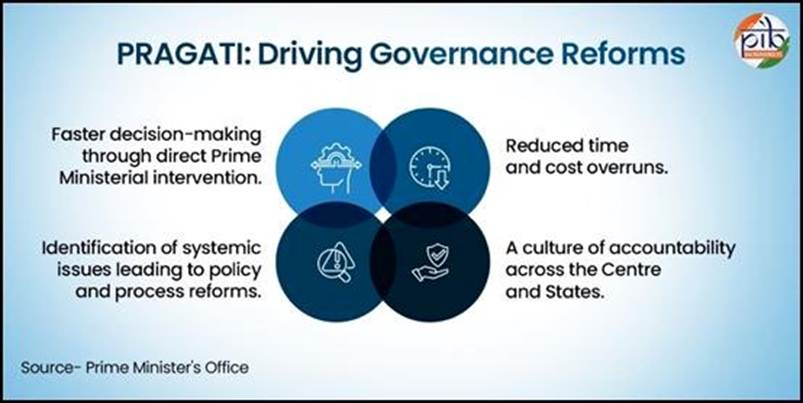
Design & Operating Architecture
- Technology Stack:
- Digital dashboards + video conferencing + GIS/geo-spatial inputs.
- Institutional Setup:
- Apex review chaired by PM with Chief Secretaries & Union Secretaries.
- Cabinet Secretariat monitors projects; Ministries track schemes & grievances under PMO oversight.
- Escalation Logic:
- Routine → Ministry level; complex/critical → PRAGATI.
- Platform Integration:
- PM GatiShakti (planning), PARIVESH (environment), PMO grievance portals.
Scale & Outcomes
- ₹85+ lakh crore projects fast-tracked.
- 382 major national projects reviewed.
- 3,187 issues identified; 2,958 resolved (~93% resolution).
- Tangible reduction in delays, idle capital, escalation costs.
Constitutional & Federal Dimension
- Cooperative Federalism in action (Art. 256–263 spirit):
- Joint accountability of Centre & States, real-time answers, shared ownership.
- Executive Leadership Model:
- Within constitutional framework—no dilution of federal autonomy; coordination, not command.
- Good Governance Values:
- Transparency, accountability, responsiveness (2nd ARC principles).
Economic Dimension
- Faster asset monetisation → earlier economic returns (transport, power, logistics).
- Reduced ICOR by cutting gestation lags.
- Unlocking stalled projects → crowding-in private investment.
- Supports national programmes: Bharatmala, National Gas Grid, Rail connectivity, Power capacity.
Social Sector & Citizen-Centric Governance
- Expansion beyond infrastructure to health, education, grievances.
- Examples:
- AIIMS Bibinagar, Jammu, Guwahati – acceleration post-PRAGATI reviews.
- Earlier access → healthcare, mobility, jobs, regional equity (NE, J&K).
Environmental & Sustainability Dimension
- Early visibility of eco-sensitivities via GIS under PM GatiShakti.
- Faster but compliance-bound clearances → avoids redesign delays that increase emissions.
- Digital reviews reduce carbon footprint of administrative travel.
- Balance between development & safeguards (not deregulation).
Security & Strategic Dimension
- Strategic projects unlocked:
- Bogibeel Bridge, Jammu–Srinagar–Baramulla rail link → defence mobility & border logistics.
- Energy security: Thermal projects, transmission corridors, gas pipelines.
Illustrative High-Impact Unlocks (Value-Addition Examples)
- Bogibeel Bridge (conceived 1997) → completed 2018.
- Navi Mumbai International Airport (1997) → Phase-I inaugurated Oct 2025.
- Bhilai Steel Plant modernisation → resolved PSU & contractual bottlenecks.
- JHBDPL Gas Pipeline → modular execution post-PRAGATI.
- Mumbai Trans Harbour Link (Atal Setu) → disciplined, time-bound delivery.
Global Recognition
- Oxford Saïd Business School Case Study:
- PRAGATI as global benchmark in senior-level accountability.
- “Single Source of Truth” for complex project delivery.
- Replicable model for developing economies.
Challenges
- Centralisation Risk: Heavy reliance on PM-led reviews; scalability concerns.
- Institutionalisation Gap: Outcomes depend on leadership intensity, not yet rule-based.
- Capacity Constraints: States/districts with weaker digital & project management capacity.
- Transparency Limits: Public disclosure of dashboards still selective.
- Environmental Concerns: Speed must not translate into perception of diluted scrutiny.
Way Forward
- Institutionalise PRAGATI-like reviews at sectoral & state levels (CM-led, CS-led).
- Codify Standard Operating Protocols for escalation & follow-up.
- Integrate outcome budgeting & asset performance metrics post-completion.
- Strengthen district-level project management units (PMUs).
- Greater public transparency of non-sensitive dashboards.
- Align with SDG 9 (Infrastructure), SDG 16 (Institutions).
YUVA AI for All: Democratising AI Literacy for India’s Youth
Core Identity
- YUVA AI for All: Flagship foundational AI literacy course under the National AI Literacy Program.
- Launch Context: National Youth Day (12 Jan 2026); highlighted at Rajasthan Regional AI Impact Summit, Jaipur (6 Jan 2026).
- Vision Alignment: Viksit Bharat, Digital Public Infrastructure (DPI), inclusive & responsible AI adoption.
Relevance
GS III (Economy, Science & Technology) – CORE RELEVANCE
- Science & Technology
- AI literacy, responsible AI, ethics in emerging technologies.
- AI for public good vs market-driven AI.
- Employment & Skills
- Future workforce readiness; MSME productivity.
- Complementarity with Skill India & digital economy.
- Innovation Ecosystem
- Broad-based AI awareness → bottom-up innovation.
Why YUVA AI for All Was Needed ?
- AI knowledge asymmetry: Concentrated among urban, technical elites.
- Employability gap: Youth unprepared for AI-integrated workplaces (MSMEs, services, governance).
- Ethical & social risks: Low awareness of AI bias, privacy, misinformation.
- Language & access barriers: English-centric, paid AI learning ecosystem.
Program Design & Architecture
- Target Group: Youth (students, job-seekers, entrepreneurs), no prior technical background required.
- Course Structure:
- Duration: ~4 hours (foundational).
- Modules:
- What is AI
- How AI works
- Using AI to learn, create, plan
- AI ethics
- Future of AI
- Delivery Platforms:
- FutureSkills Prime
- iGOT Karmayogi
- DIKSHA
- Languages: 11 Indian languages → linguistic inclusion.
- Cost: Free; Government of India certification on completion.
Constitutional & Ethical Dimension
- Article 21 (Right to Life): Digital literacy as enabler of dignified livelihood.
- Article 38 & 39: Reducing digital inequality; equitable access to future skills.
- Ethics-by-design: Explicit AI ethics module → bias, accountability, responsible use.
- Democratic AI: Knowledge diffusion prevents concentration of AI power.
Economic Dimension
- Productivity boost: Especially for MSMEs & small entrepreneurs using AI in daily workflows.
- Future workforce readiness: Lowers reskilling costs; complements Skill India.
- Innovation ecosystem: Broad base of AI-literate citizens → bottom-up innovation.
- Target Scale: 10 lakh learners in one year (as articulated by MeitY).
Social Dimension
- YUVA Shakti focus: Youth as agents, not just consumers, of AI.
- Gender & regional inclusion: Vernacular delivery reduces structural exclusion.
- Citizenship literacy: Understanding AI’s impact on democracy, media, society.
Technology & Digital Public Infrastructure (DPI) Dimension
- Leverages existing DPI rather than creating siloed platforms.
- Interoperability across skilling, education, and governance ecosystems.
- Scalable, low-cost model → public good approach to AI education.
International & Strategic Dimension
- Positions India as leader in AI for Public Good, not just AI markets.
- Aligns with global discourse on responsible AI, UNESCO AI ethics principles.
- Soft power: Replicable model for Global South nations.
Challenges
- Depth limitation: 4-hour course → awareness, not professional competency.
- Outcome measurement: Certification ≠ behavioural or productivity change.
- Digital divide persists: Connectivity & device access still uneven.
- Trainer & mentor ecosystem: Limited handholding beyond course completion.
- Ethics operationalisation: Translating ethics modules into real-world practice.
Way Forward
- Layered pathway: Foundational → sector-specific → advanced AI skilling.
- Integrate with NSQF & formal education curricula.
- Local AI use-cases for agriculture, health, MSMEs, governance.
- Community-led AI labs in colleges & ITIs.
- Periodic AI literacy impact audits (employability, productivity, ethics awareness).
- Align with SDG 4 (Quality Education) & SDG 8 (Decent Work).