
Content
- Lok Adalats: Justice That Speaks for the People
- From Red Corridor to Naxal-Free Bharat: A Decade of Decisive Gains (2014–2025)
Lok Adalats: Justice That Speaks for the People
Why is it in News?
- PIB release (13 December 2025, Delhi) highlighted Lok Adalats as a key pillar of people-centric justice delivery.
- Emphasis on:
- Expansion of National Lok Adalats and E-Lok Adalats.
- Strengthening Permanent Lok Adalats (PLAs) for public utility services.
- Their role in reducing pendency, speedy justice, and inclusive access.
- Context:
- India’s courts face over 5 crore pending cases (NJDG).
- Push towards ADR mechanisms aligned with Article 39A (Access to Justice).
Relevance
GS-II (Polity & Governance)
- Access to justice.
- Judicial reforms.
- Alternative Dispute Resolution.
- Article 39A.
What are Lok Adalats? (Basics)
- Lok Adalat literally means People’s Court.
- A statutory Alternative Dispute Resolution (ADR) mechanism.
- Core philosophy:
- Consensus, not contest
- Conciliation, not adjudication
- Objective:
- Speedy, inexpensive, informal, and amicable settlement of disputes.
- No strict application of:
- Civil Procedure Code (CPC)
- Indian Evidence Act
Constitutional & Legal Basis
Constitutional Foundation
- Article 39A:
- Equal justice and free legal aid.
- State obligation to ensure justice is not denied due to economic or social disability.
Statutory Backbone
- Legal Services Authorities Act, 1987
- Institutionalised free legal aid and Lok Adalats nationwide.
- Converted a social experiment into a legally enforceable justice mechanism.
Key Legal Features (LSA Act, 1987)
- Lok Adalats can take up:
- Pending court cases
- Pre-litigation disputes
- No court fee; if already paid → refunded.
- Procedure:
- Purely non-adversarial.
- Award of Lok Adalat:
- Deemed a civil court decree.
- Final and binding.
- No appeal permitted.
- Enhances:
- Finality
- Certainty
- Speed
Institutional Architecture (4-Tier Structure)
Ensures justice from Supreme Court to grassroots.
National Legal Services Authority (NALSA)
- Head: Chief Justice of India
- Functions:
- Policy formulation.
- National Lok Adalat calendar.
- Monitoring & coordination.
State Legal Services Authority (SLSA)
- Head: Chief Justice of High Court
- Functions:
- Implement NALSA policies.
- Organise State & High Court Lok Adalats.
- Legal aid delivery.
District Legal Services Authority (DLSA)
- Head: District & Sessions Judge
- Functions:
- District-level Lok Adalats.
- Coordination with Taluk committees.
- Local legal aid.
Taluk Legal Services Committee (TLSC)
- Head: Senior-most Judicial Officer
- Functions:
- Grassroots access.
- First contact point for citizens.
- Rural & semi-urban justice delivery.
National Lok Adalats (NLAs): Mission-Mode Justice
- Conducted simultaneously across India on pre-notified dates.
- NALSA releases annual calendar.
- Covers:
- Pre-litigation matters.
- Pending cases at all judicial levels.
- Process:
- Pre-Lok Adalat sittings.
- Identification of settlement-prone cases.
- Technology:
- Disposals updated on National Judicial Data Grid (NJDG).
- Innovation:
- E-Lok Adalats during COVID → virtual participation.
Significance
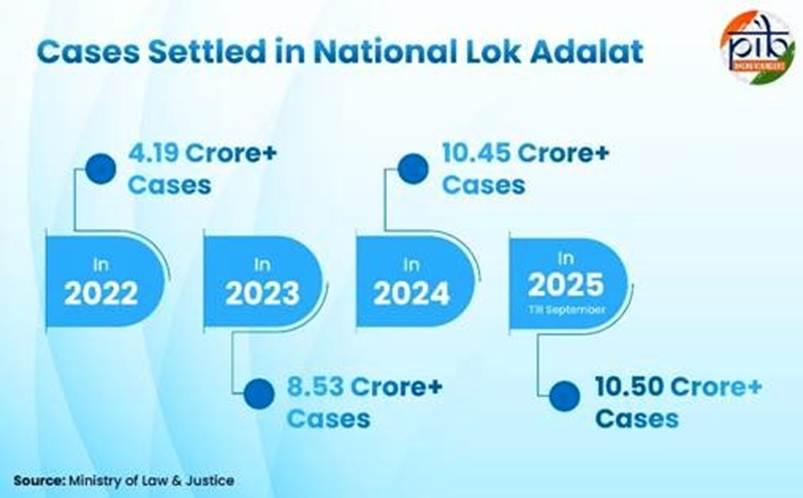
- Massive scale settlement in single-day drives.
- Reduces backlog with:
- Speed
- Uniformity
- Administrative coordination
Permanent Lok Adalats (PLAs)
Legal Basis
- Sections 22B–22E, LSA Act, 1987.
Scope
- Public Utility Services, such as:
- Transport
- Electricity
- Water supply
- Postal services
- Telecom
Key Features
- Pre-litigation forum only.
- Jurisdiction: Disputes up to ₹1 crore.
- Composition:
- Chairperson (judicial background)
- Two members (subject expertise).
- Unique power:
- If conciliation fails → PLA can adjudicate.
- Award:
- Final and binding.
Importance
- Prevents routine service disputes from entering courts.
- Ensures certainty and continuity of essential services.
Performance & Impact
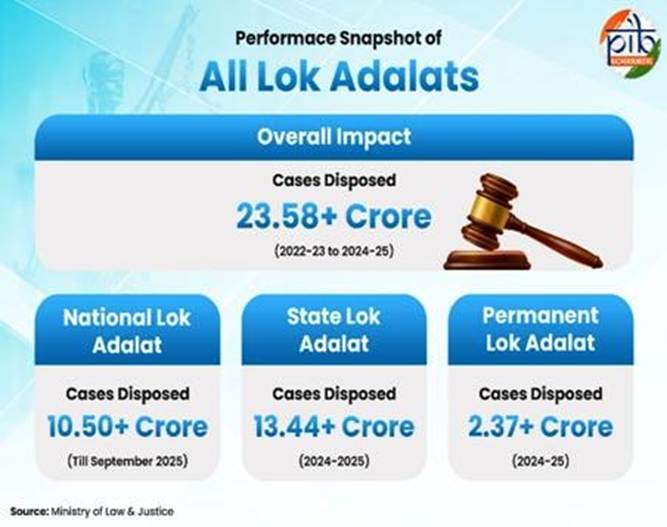
- Millions of cases resolved annually through:
- National Lok Adalats
- State/District Lok Adalats
- Permanent Lok Adalats
- E-Lok Adalats
- Tangible outcomes:
- Reduced pendency.
- Faster compensation (MACT, bank recovery, service disputes).
- Cost and time savings.
- Intangible outcomes:
- Increased public trust.
- Reduced litigation fatigue.
- Humanised justice delivery.
Advantages
- Speedy disposal.
- Zero or minimal cost.
- Informal, citizen-friendly process.
- Enforceable outcomes.
- Strengthens participatory justice.
Limitations & Critiques
- Only compoundable / settlement-friendly cases.
- Risk of:
- Pressure to settle.
- Unequal bargaining power.
- Limited scope in:
- Serious criminal offences.
- Complex constitutional disputes.
Conclusion
- Lok Adalats represent procedural justice with a human face.
- They shift focus from:
- Winning vs losing → mutual settlement.
- In a system burdened by pendency, Lok Adalats demonstrate that:
- Justice can be fast yet fair,
- Efficient yet empathetic,
- Legal yet humane.
- They reaffirm a core constitutional promise:
Justice must reach the last person, not wait at the last step.
From Red Corridor to Naxal-Free Bharat: A Decade of Decisive Gains (2014–2025)
Why is it in News?
- PIB release (13 December 2025) highlighted near-elimination of Left Wing Extremism (LWE).
- Key claims:
- LWE-affected districts reduced from 126 (2014) → 11 (2025).
- Most-affected districts down from 36 → 3.
- Target announced: Naxal-free India by March 2026.
- Significance:
- One of the largest internal security turnarounds since Independence.
- Demonstrates shift from reactive policing to integrated counter-insurgency + development strategy.
Relevance
GS-III (Internal Security)
- LWE strategy.
- Counter-insurgency doctrine.
- Role of development in security.
GS-II (Governance)
- Cooperative federalism.
- State capacity building.
What is Left Wing Extremism (LWE)?
- Ideology:
- Based on Maoist–Marxist revolutionary thought.
- Advocates armed struggle against the Indian State.
- Organisational core:
- CPI (Maoist) and its armed wing PLGA (People’s Liberation Guerrilla Army).
- Geography:
- Historically concentrated in the Red Corridor:
- Chhattisgarh, Jharkhand, Odisha, Maharashtra, Andhra Pradesh–Telangana belt, parts of Bihar, MP, WB.
- Historically concentrated in the Red Corridor:
- Nature of threat:
- Internal security challenge under Seventh Schedule – Union responsibility.
- Targets state authority, infrastructure, elections, and civilians.
Why Did Naxalism Grow?
- Chronic underdevelopment and tribal alienation.
- Land and forest rights issues.
- Weak local governance and service delivery.
- Poor connectivity enabling insurgent sanctuaries.
- Exploitation of grievance narratives by armed cadres.
Strategic Shift After 2014: The Core Doctrine
From fragmented responses → unified national strategy
Guiding Principles
- Dialogue → Security → Development → Coordination
- Clear political resolve and time-bound target (March 2026).
Measurable Outcomes: 2014–2025
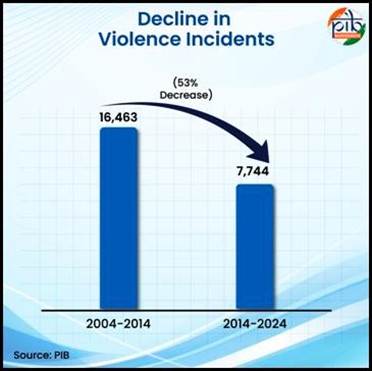
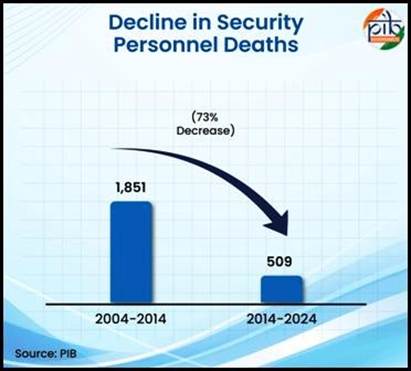
Decline in Violence (2004–14 vs 2014–24)
- Violent incidents: –53%
- Security force deaths: –73%
- Civilian deaths: –70%
Territorial Shrinkage
- Total affected districts: 126 → 11
- Most-affected districts: 36 → 3
- Police stations reporting incidents: 330 (2013) → 52 (2025)
Operational Successes (2024–2025)
- 2025 (till date):
- 317 Naxals neutralised.
- 862 arrested.
- 1,973 surrendered.
- Leadership decapitation:
- 28 top leaders neutralised since 2024.
- Major operations:
- Operation Black Forest.
- Clearing of Abujhmad and PLGA core zones.
- Result:
- Collapse of Tactical Counter Offensive Campaign (TCOC) 2024.
Security Perimeter Strengthening
- 586 fortified police stations (vs 66 pre-2014).
- 361 new forward camps in last 6 years.
- 68 night-landing helipads for rapid deployment.
- Bastions liberated after 30 years:
- Budha Pahad, Parasnath, Chakrabandha, Baramasia, Abujhmad.
Financial Choking of Naxals
- Dedicated anti-Naxal vertical in NIA.
- Asset seizures:
- NIA: ₹40+ crore.
- States: ₹40+ crore.
- ED attachments: ₹12 crore.
- Impact:
- Disruption of logistics, propaganda, and urban support networks.
Capacity Building of States
Security Funding
- ₹3,331 crore under SRE scheme (155% increase).
- Special Infrastructure Scheme (SIS):
- ₹371 crore (SF & SIB).
- ₹620 crore + ₹140 crore for fortified police stations.
- SCA to LWE districts: ₹3,817.59 crore.
- ACALWEMS:
- Camp infrastructure + hospitals.
Human Resources
- Bastariya Battalion:
- 1,143 recruits.
- Local youth from worst-affected districts.
- Converts former conflict zones into security manpower hubs.
Infrastructure as Counter-Insurgency
Roads
- 12,000 km constructed (2014–25).
- 17,589 km approved, ₹20,815 crore.
- Ends Maoist geographical isolation.
Telecom
- 2G towers: 2,343.
- Additional towers: 2,542.
- 4G saturation:
- 8,527 towers approved.
- Strategic impact:
- Intelligence flow.
- Civilian–state integration.
- Governance reach.
Financial Inclusion
- 1,804 bank branches.
- 1,321 ATMs.
- 37,850 banking correspondents.
- 5,899 post offices.
- Result:
- Weakens parallel Maoist “taxation” system.
- Integrates locals into formal economy.
Education & Skill Development
- 48 ITIs (₹495 crore).
- 61 Skill Development Centres.
- Focus:
- Youth employment.
- Reducing recruitment pool.
- Long-term deradicalisation through livelihoods.
Surrender & Rehabilitation Policy
- High-rank cadres: ₹5 lakh.
- Middle/lower rank: ₹2.5 lakh.
- Monthly stipend: ₹10,000 for 36 months.
- Result:
- 1,000+ surrenders recently.
- Collapse of cadre morale and cohesion.
Strategic Assessment
Why the Strategy Worked ?
- Simultaneous pressure:
- Security + Development + Finance + Ideology.
- No safe havens:
- Physical, financial, or informational.
- Local participation:
- Tribal youth in forces.
- Institutional coordination:
- Centre–State–Agency alignment.
Challenges Ahead
- Residual pockets in dense forests.
- Risk of ideological mutation into:
- Urban networks.
- Digital propaganda.
- Need for:
- Sustained governance.
- Rights-based development.
- Post-conflict reconciliation.
Conclusion
- Between 2014 and 2025, India has broken the territorial, financial, and ideological spine of Naxalism.
- The Red Corridor has been reduced to isolated remnants.
- While vigilance must continue till March 2026, the evidence is decisive:
- LWE is no longer a pan-Indian insurgency but a residual security issue.
- The transition from guns to governance marks one of India’s most consequential internal security successes.


