Content
- Setting up Five National Centres of Excellence (NCoEs) for Skilling
- India’s Green Maritime Odyssey
Setting up Five National Centres of Excellence (NCoEs) for Skilling
Why is this in News?
- Lok Sabha written reply (15 Dec 2025) by MoS (IC) for Skill Development & Entrepreneurship.
- Cabinet approval (07 May 2025) for five National Centres of Excellence (NCoEs) announced in Budget 2025–26.
- Marks a shift from generic skilling to sector-specific, industry-led, globally benchmarked training under PM-SETU.
Relevance : GS II – Governance, Social Justice
- Government policies & interventions: PM-SETU scheme; Budget 2025–26 announcement.
- Institutional reforms: Shift from state-controlled ITIs to industry-led governance (IMC model).
- Cooperative federalism: Centre–State–Industry partnership in skilling.
- Role of international cooperation: India–Singapore collaboration in advanced manufacturing.
- Capacity building: Strengthening public institutions (NSTIs) for service delivery.
What are National Centres of Excellence (NCoEs)?
- High-end skilling institutions embedded within select National Skill Training Institutes (NSTIs).
- Focus on:
- Advanced, future-ready skills.
- Deep industry integration.
- Global best practices and certifications.
- Act as hubs for training, curriculum innovation, and trainer upskilling.
Institutional Framework: PM-SETU Scheme
- PM Skilling and Employability through Upgraded ITIs (PM-SETU).
- Objective:
- Modernise ITIs.
- Improve employability.
- Align skills with Industry 4.0 requirements.
- Two components:
- Component I: Upgradation of 1,000 Government ITIs (Hub-and-Spoke).
- Component II: Establishment of National Centres of Excellence.
Approved NCoEs: Location & Rationale
- Bhubaneswar (Odisha)
- Chennai (Tamil Nadu)
- Hyderabad (Telangana)
- Kanpur (Uttar Pradesh)
- Ludhiana (Punjab)
Selection criteria:
- Adequate land area.
- Trade diversity.
- Existing training capacity.
- Scope for expansion.
- Availability of qualified faculty.
Regional logic:
- Covers east, south, north, and industrial belts.
- Aligns skilling with regional economic specialisation.
Sectoral & Global Partnerships
- Global partnership with Singapore finalised.
- MoU signed for Advanced Manufacturing NCoE at NSTI Chennai.
- Expression of Interest (EoI) floated to onboard Lead Industry Partners for all five NCoEs.
- Reflects dual-track model:
- Global benchmarking.
- Domestic industry anchoring.
Governance Model: Institute Management Committee (IMC)
- Chairperson: Nominated by Lead Industry Partner.
- Central Government nominees: DGT/MSDE.
- State Government nominee: Host state.
- Industry experts: Technical and financial contributors.
- Director of NSTI: Ex-officio Member Secretary.
- Industry Associations: FICCI, CII, SSCs, regional bodies.
- Academia representatives.
Size: 9–15 members (flexible).
Significance:
- Breaks traditional government-only control.
- Ensures industry-driven curriculum, assessment, and placement.
Role & Functions of NCoEs
- Design and deliver industry-aligned training programs.
- Continuous curriculum upgradation.
- Trainer capacity building.
- Facilitate apprenticeships and placements.
- Serve as knowledge hubs for surrounding ITIs.
Component I: Hub-and-Spoke ITI Upgradation
- 1,000 Government ITIs to be upgraded.
- Industry collaboration mandatory.
- States given flexibility to:
- Propose sector-specific skill centres.
- Align skilling with local economic needs.
- Examples:
- Agriculture, food processing, dairy.
- Region-specific focus like Seemanchal–Kosi (Bihar).
Why is this Reform Significant?
Addressing Structural Skill Gaps
- India faces:
- Low formal skilling rate (~5–6%).
- Mismatch between training and industry demand.
- NCoEs target quality, not just quantity.
Industry 4.0 Readiness
- Focus on advanced manufacturing and emerging technologies.
- Supports Make in India, PLI-led manufacturing expansion.
Federal & Cooperative Approach
- Centre–State–Industry collaboration.
- Regional customisation within national framework.
Global Benchmarking
- Singapore partnership brings:
- Modular curricula.
- Competency-based certification.
- Strong industry linkage models.
Challenges & Concerns
- Sustaining industry interest beyond initial phase.
- Ensuring uniform quality across centres.
- Avoiding regional imbalance in access.
- Measurable outcomes: placement quality, wage premiums.
Prelims Pointers
- NCoEs approved under Component II of PM-SETU.
- Five locations: Bhubaneswar, Chennai, Hyderabad, Kanpur, Ludhiana.
- Global partner: Singapore (Advanced Manufacturing, Chennai).
- IMC chaired by Lead Industry Partner nominee.
- Component I targets 1,000 ITIs via Hub-and-Spoke model.
India’s Green Maritime Odyssey
Why is this in News?
- PIB release (15 Dec 2025) outlining India’s green maritime transition.
- Links Maritime India Vision (MIV) 2030, Maritime Amrit Kaal Vision 2047, Sagarmala, Green Hydrogen Mission, and Indian Ports Bill, 2025 into a single sustainability narrative.
- Signals India’s intent to emerge as a global green maritime power, not just a logistics hub.
Relevance : GS III – Infrastructure, Economy, Environment
- Infrastructure development:
- Ports, coastal shipping, inland waterways (Sagarmala).
- Green growth & decarbonisation:
- Green hydrogen, LNG, methanol, electric port equipment.
- Energy transition:
- National Green Hydrogen Mission (hard-to-abate sector).
- Blue Economy:
- Sustainable use of marine resources.
- Coastal livelihoods and ecosystem protection.
- Climate change mitigation:
- Emission reduction in shipping and ports.
- Logistics & competitiveness:
- Reduced turnaround time, lower logistics cost.
- Technology & innovation:
- Smart ports, digital corridors, shore-to-ship power.
What is “Green Maritime”?
- Integration of economic efficiency + environmental sustainability + social responsibility in ports and shipping.
- Covers:
- Clean fuels and low-emission vessels.
- Renewable-powered ports.
- Marine ecosystem protection.
- Climate-resilient and digitally smart maritime infrastructure.
- Aligned with IMO decarbonisation goals and UN SDGs (9 SDGs relevant to ports).
Context: Why Maritime Sustainability Matters for India
- Coastline: ~7,500 km with mangroves, reefs, lagoons, and dense coastal livelihoods.
- Maritime sector:
- Backbone of trade and logistics.
- Growing environmental footprint (emissions, oil spills, dredging).
- Challenge: Balance trade expansion with ocean health and coastal resilience.
Vision Framework: India’s Green Maritime Roadmap
1. Maritime India Vision (MIV) 2030
- Blueprint for:
- Greener ports.
- Cleaner shipping.
- Digital and efficient logistics.
- Projected investment: ₹3–3.5 lakh crore.
- Focus areas:
- Port modernisation.
- Inland waterways.
- Shipbuilding and ship repair.
- Green technologies.
2. Maritime Amrit Kaal Vision 2047
- Long-term roadmap aligned with 100 years of Independence.
- Investment commitment: ~₹80 lakh crore.
- More than 300 actionable initiatives.
- Key thrusts:
- Green shipping corridors.
- Methanol, LNG, hydrogen-based vessels.
- Smart and carbon-neutral ports.
- Making India a top global shipbuilding nation.
Sagarmala Programme: Green Logistics Backbone
- Flagship port-led development programme.
- 840 projects worth ₹5.8 lakh crore by 2035.
- 272 completed (₹1.41 lakh crore).
- 217 under implementation (₹1.65 lakh crore).
- Objectives:
- Reduce logistics cost.
- Promote coastal shipping and inland waterways.
- Generate employment.
- Acts as the execution arm of MIV 2030 and Vision 2047.
Clean Fuels & Energy Transition in Maritime Sector
National Green Hydrogen Mission
- Target by 2030:
- 5 million tonnes/year green hydrogen.
- ₹8 lakh crore investment.
- 6 lakh jobs.
- ₹1 lakh crore fossil fuel import savings.
- Identified Green Hydrogen Port Hubs:
- Kandla
- Paradip
- Tuticorin
- Supports zero-emission shipping fuels: hydrogen, ammonia, methanol.
India’s Green Port Initiatives (Supply-Side Decarbonisation)
Renewable Energy at Ports
- Solar:
- Rooftop PV on warehouses and offices.
- Floating solar on calm port waters.
- Wind:
- Onshore wind on port land, breakwaters.
- Offshore wind near Okha, southern peninsula, Kutch salt fields.
- Tidal energy:
- Pilot in Gulf of Cambay/Kutch (8,000–12,000 MW potential).
- Wave & solar thermal:
- OWC wave energy pilots (Vizhinjam model).
Flagship Green Maritime Programmes
Harit Sagar – Green Port Guidelines (2023)
- Framework for:
- Carbon neutrality.
- Zero ecological disturbance.
- Promotes:
- Sustainable materials.
- Cleaner technologies.
- Ecosystem-sensitive port expansion.
Green Tug Transition Programme (GTTP), 2024
- Transition from diesel harbour tugs to green alternatives.
- Part of Panch Karma Sankalp.
- Government support: 30% financial assistance.
- Ports procuring green tugs:
- JNPA
- VO Chidambaranar
- Paradip
- Deendayal
- Aligns with Make in India and maritime manufacturing.
Harit Nauka (Green Vessel) Initiative
- Promotes greener inland waterway vessels.
- Targets emissions reduction in riverine transport.
Coastal Green Shipping Corridor
- First corridor: Kandla–Tuticorin.
- Partners:
- SCI
- Deendayal Port Authority
- VO Chidambaranar Port Authority.
- Pilot for low-emission coastal shipping.
Cleaner Ports: Demand-Side & Operational Reforms
Vehicle & Equipment Electrification
- Target: 50% port vehicles on clean fuels by 2030.
- Two-phase electrification:
- Phase I: Ship–shore cranes.
- Phase II: RTGCs, reach stackers, forklifts, yard equipment.
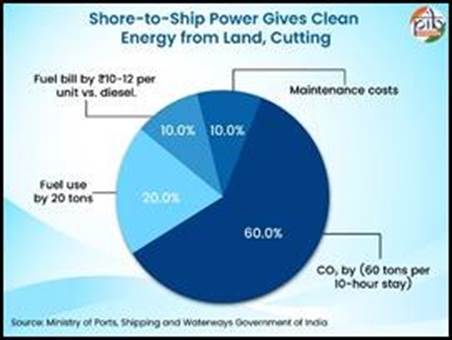
Shore-to-Ship Power
- Ships at berth draw electricity from shore.
- Cuts emissions from onboard diesel generators.
LNG Bunkering
- LNG advantages:
- 80% lower CO₂, PM, NOx than diesel.
- Sulphur ≤0.5% (IMO compliant).
- 40–50% cheaper than diesel.
- India promoting LNG bunkering awareness and infrastructure.
Dust & Air Emission Control
- Diesel usage: 500–5,000 KL per port annually.
- Measures:
- Covered storage.
- Mechanised handling.
- Emission monitoring (towards automation).
Green Belts
- MoEF&CC mandate: 33% green cover.
- Benefits:
- Carbon absorption.
- Noise and dust reduction.
- Biodiversity and groundwater recharge.
- Challenge: Land scarcity at ports.
Indian Ports Bill, 2025: Legal Backbone
- Replaces outdated Indian Ports Act, 1908.
- Mandates:
- Global green norms.
- Disaster and oil-spill readiness.
- Context:
- Cargo handling: 855 MT (FY 2024–25).
- Port capacity: +87% since 2014–15.
- Turnaround time reduced to 48 hours.
- 9 Indian ports in World Bank CPPI.
- Marks shift from regulatory lag to global leadership.
Global Green Maritime Diplomacy
Sagarmanthan Dialogue
- Global platform on:
- Blue economy.
- Green logistics.
- Sustainable supply chains.
India–Singapore Green & Digital Shipping Corridor
- Accelerates:
- Low-emission technologies.
- Digital maritime tools.
- Smart port operations.
Green Shipping Conclave
- Focus on:
- GTTP.
- Harit Nauka.
- Sustainable ship recycling (Alang).
Marine Pollution & Oil Spill Preparedness
- Robust oil-spill response plans.
- Satellite-based monitoring.
- Oil sensitivity mapping.
- Priority to mangroves, corals, aquaculture zones.
- Coordination with Navy and coastal agencies.
Strategic Significance
Economic
- Lower logistics costs.
- Global competitiveness in shipping and ports.
- Job creation in green maritime technologies.
Environmental
- Decarbonisation of hard-to-abate sector.
- Marine biodiversity protection.
- Climate-resilient coastal infrastructure.
Geopolitical
- Positions India as:
- Indo-Pacific maritime leader.
- Norm-setter in green shipping.
Challenges
- High upfront cost of green fuels and vessels.
- Technology readiness (hydrogen, ammonia).
- Port land constraints for renewables and green belts.
- Coordination across Centre–State–Port Authorities.
Prelims Pointers
- MIV 2030 investment: ₹3–3.5 lakh crore.
- Vision 2047 investment: ~₹80 lakh crore.
- Sagarmala: 840 projects, ₹5.8 lakh crore.
- First Green Shipping Corridor: Kandla–Tuticorin.
- Ports Bill replaces 1908 law.