Content
- International Year of Cooperatives 2025
- Bharat Steel 2026
International Year of Cooperatives 2025
Global Background & United Nations Perspective
- The United Nations formally declared 2025 as the International Year of Cooperatives on 19 June 2024, recognising cooperatives as resilient, people-centric economic institutions capable of addressing inequality, unemployment, food insecurity, and sustainability challenges simultaneously.
- The official theme, “Cooperatives Build a Better World,” underscores the ability of cooperatives to integrate economic growth with social justice and environmental sustainability, directly contributing to the achievement of SDGs 1, 2, 5, 8, 10 and 12.
- Through IYC-2025, the UN seeks to encourage policy convergence, legislative reforms, institutional financing, and grassroots mobilisation, urging governments to mainstream cooperatives within national development and recovery strategies.
- According to the International Cooperative Alliance (ICA), cooperatives worldwide support nearly 12 percent of global employment, making them one of the largest institutional vehicles for inclusive economic participation.
Relevance:
- GS I – Cooperative movement in India, rural social institutions, women-led SHGs, community participation, inclusive social structures
- GS II – 97th Constitutional Amendment, Article 19(1)(c), Article 43B, cooperative federalism, Supreme Court Rajendra Shah (2021), decentralised governance, institutional accountability
- GS III – Inclusive growth, agricultural credit reforms, PACS modernisation, FPOs and FFPOs, rural storage infrastructure, financial inclusion, NABARD–NCDC role, digital public infrastructure
Philosophical, Constitutional & Ethical Foundations in India
- India’s cooperative movement draws civilisational legitimacy from “Vasudhaiva Kutumbakam,” which emphasises collective well-being, mutual trust, and shared prosperity rather than individual profit maximisation.
- Constitutionally, cooperatives are strengthened through the 97th Constitutional Amendment Act, 2011, which elevated the right to form cooperatives to a fundamental right under Article 19(1)(c).
- Article 43B (Directive Principles) mandates the State to promote voluntary, democratic, autonomous, and professionally managed cooperatives, linking cooperative growth directly with constitutional governance values.
The Supreme Court in Union of India vs Rajendra Shah (2021) reaffirmed federal autonomy over state cooperatives while upholding Union jurisdiction over Multi-State Cooperative Societies,
Historical Evolution of the Cooperative Movement in India
- The cooperative movement began with the Cooperative Credit Societies Act, 1904, aimed at addressing rural indebtedness caused by moneylenders under colonial agrarian distress.
- Post-Independence, cooperatives became key instruments of planned development, especially in rural credit, dairy, sugar, housing, handloom, fisheries, and labour welfare sectors.
- Institutions such as NCDC (1963) and NABARD (1982) created a structured financial and supervisory ecosystem that enabled large-scale cooperative expansion across rural India.
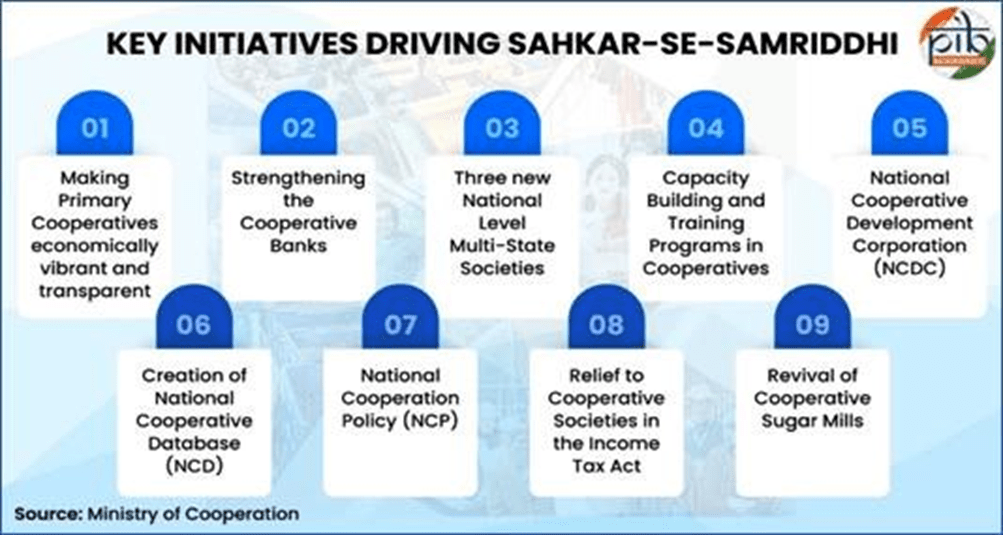
- The creation of a dedicated Ministry of Cooperation on 6 July 2021 marked a global first, signalling India’s strategic commitment to cooperative-led development under the vision of “Sahkar Se Samriddhi.”
Scale, Reach & Socio-Economic Significance
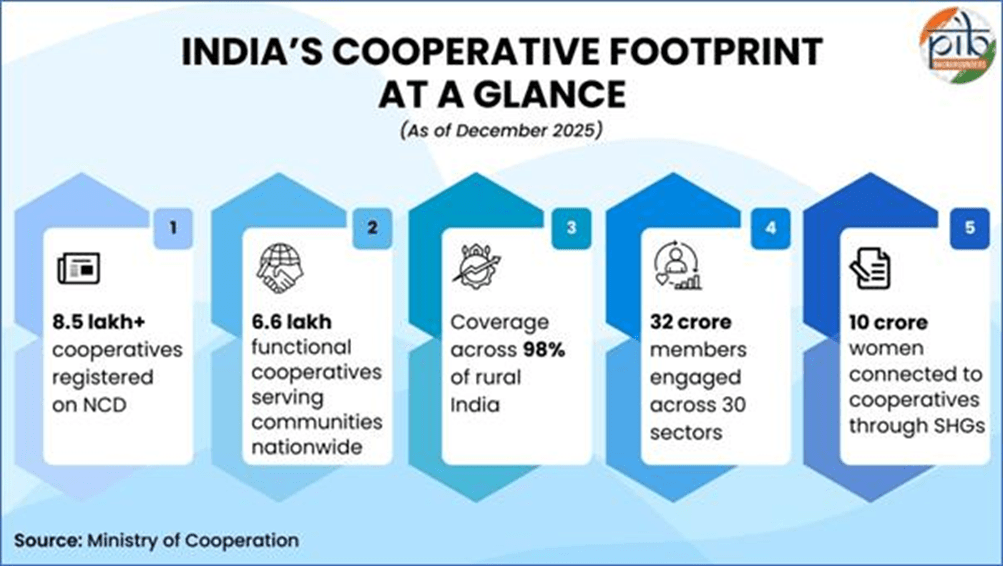
- India has over 8.5 lakh registered cooperative societies, of which approximately 6.6 lakh are functional, making India home to more than one-fourth of the world’s cooperatives.
- Cooperative societies operate across 30 diverse sectors, covering agriculture, credit, dairy, fisheries, housing, sugar, transport, labour, services, and emerging digital platforms.
- The cooperative network covers nearly 98 percent of rural India, serving around 32 crore members, making it one of the deepest grassroots institutional frameworks globally.
- Women’s inclusion is significant, with nearly 10 crore women integrated through SHGs and women-led cooperatives, contributing directly to gender empowerment and financial inclusion.
PACS Reforms: Economic Vibrancy & Governance Transformation
- The Government introduced Model Bye-laws for PACS, enabling them to undertake more than 25 economic activities, ranging from storage, processing, retail, fuel distribution to digital services.
- These bye-laws mandate women and SC/ST representation, democratic elections, transparency norms, and accountability mechanisms, addressing historical governance capture and elite domination.
- As of 2025, 32 States and Union Territories have adopted or aligned their cooperative legislation with the Model Bye-laws, signalling growing federal consensus.
- PACS, traditionally limited to short-term credit, are now being transformed into multipurpose village-level economic institutions, capable of generating sustainable non-credit income streams.
Digitalisation of PACS: ERP-Based Structural Reform
- The Government approved a ₹2,925.39 crore national project to computerise functional PACS and integrate them into a common ERP-based national software platform for the period 2022–27.
- As on date, 79,630 PACS have been approved for computerisation, with 59,261 PACS actively using ERP software, reflecting rapid digital adoption.
- Hardware infrastructure, including computers, biometric devices, printers, VPNs, and webcams, has been delivered to 65,151 PACS, covering nearly 82 percent of the target.
- The ERP system has processed 34.94 crore financial and operational transactions, supports 22 functional modules, and is available in 14 Indian languages, enhancing inclusivity.
- 42,730 PACS have completed online audits, while 32,119 PACS are fully operational as e-PACS, strengthening transparency, auditability, and trust.
Expansion of Multipurpose Cooperatives at Panchayat Level
- To ensure universal cooperative coverage, the Government approved the creation of new multipurpose PACS, dairy, and fisheries cooperatives across all panchayats and villages within five years.
- According to the National Cooperative Database, 32,009 new cooperatives have already been registered under this initiative, reflecting accelerated grassroots institutionalisation.
- PACS currently operate in 2,55,881 Gram Panchayats, dairy cooperatives cover 87,159 Gram Panchayats, while fisheries cooperatives reach 29,964 Panchayats nationwide.
- This expansion strengthens cooperative presence in previously uncovered regions, improving rural market access, livelihood diversification, and local employment generation.
PACS as Village-Level Service Delivery Hubs
- 38,190 PACS have been converted into Pradhan Mantri Kisan Samriddhi Kendras, supplying fertilisers, seeds, pesticides, and advisory services at village level.
- 51,836 PACS now function as Common Service Centres, delivering over 300 digital public services, including banking, insurance, certificates, and welfare enrolment.
- 812 PACS have been operationalised as Pradhan Mantri Bhartiya Janaushadhi Kendras, improving access to affordable medicines in rural and semi-urban areas.
- PACS have also been enabled to operate petrol, diesel, LPG distributorships, and Paani Samitis under Jal Jeevan Mission, transforming them into comprehensive rural service nodes.
Farmer Producer Organisations via Cooperative Framework
- Under the national FPO scheme, 1,100 additional FPOs were allocated to NCDC specifically within the cooperative sector to strengthen farmer collectivisation.
- A total of 1,863 cooperative-sector FPOs have been formed, with 1,117 FPOs emerging through the strengthening of PACS, ensuring institutional continuity.
- Financial support of ₹206 crore has been disbursed to FPOs and Cluster-Based Business Organisations (CBBOs), improving aggregation, processing, and market access.
Fish Farmer Producer Organisations (FFPOs)
- To strengthen fisheries value chains, 1,070 FFPOs have been registered by NCDC, with an approved outlay of ₹225.5 crore.
- Additionally, 2,348 FFPOs are under strengthening, focusing on cold chains, processing facilities, and export linkages.
- So far, ₹98 crore has been disbursed, enhancing income security and market resilience for fishing communities.
Financial Inclusion through Cooperative Bank Mitras
- Dairy and fisheries cooperatives have been enabled to act as Bank Mitras of DCCBs and StCBs, expanding doorstep financial services in rural areas.
- In Gujarat, 12,219 Bank Mitras equipped with 12,624 Micro-ATMs now cover all 14,330 Gram Panchayats, creating over 15,000 rural jobs.
- This model enhances last-mile banking, digital transactions, and cooperative income diversification, with nationwide rollout planned.
RuPay Kisan Credit Cards via Cooperatives
- A pilot project in Gujarat enabled cooperative society members to receive RuPay Kisan Credit Cards, expanding institutional credit access.
- Over 22 lakh KCCs have been issued, facilitating loan disbursement exceeding ₹10,000 crore, supporting farm entrepreneurship and allied activities.
World’s Largest Decentralised Grain Storage Plan
- Approved on 31 May 2023, the decentralised grain storage plan aims to address India’s chronic storage deficits at the grassroots level.
- As of December 2025, 112 PACS have completed godowns, creating 68,702 metric tonnes of storage capacity.
- The scheme converges with AIF, AMI, SMAM, and PMFME, enabling integrated rural infrastructure development.
White Revolution 2.0
- White Revolution 2.0 aims to increase milk procurement by 50 percent over five years, focusing on uncovered regions and women producers.
- Since launch, 20,070 new Dairy Cooperative Societies have been registered across 31 States and Union Territories, strengthening India’s dairy cooperative dominance.
Atmanirbharta in Pulses & Maize
- Under the cooperative-led Atmanirbharta Abhiyan, 56,673 PACS/FPOs and 54.74 lakh farmers registered on digital platforms e-Samridhi and e-Samyukti.
- Procurement achievements include 9.08 LMT of pulses and 45,105 MT of maize, strengthening MSP-based income assurance.
New National-Level Multi-State Cooperatives
- BBSSL (Bharatiya Beej Sahakari Samiti Limited) has enrolled 31,605 cooperatives, strengthening seed sovereignty under the “Bharat Beej” brand.
- NCOL (National Cooperative Organics Limited) supports 10,035 cooperatives, markets 28 organic products, and conducts batch-wise testing for 245 pesticides.
- NCEL (National Cooperative Exports Limited) exported 13.77 LMT of agri commodities worth ₹5,556 crore, distributing 20 percent dividend to members.
Capacity Building & Human Capital Development
- Tribhuvan Sahkari University (2025), India’s first cooperative university, was established by converting IRMA to develop professional cooperative leadership.
- NCCT and NABARD conducted 4,389 training programmes in 2024-25, training 3.15 lakh participants, strengthening governance and managerial capacity.
Financial Support & NCDC Role
- NCDC disbursed ₹95,183 crore in FY 2024-25 and ₹95,000 crore in FY 2025-26 (till date), supporting both farm and non-farm cooperatives.
- The Government has allowed NCDC to issue ₹2,000 crore in government-guaranteed bonds, enhancing long-term cooperative financing capacity.
National Cooperation Policy 2025
- Launched on 24 July 2025, the policy aligns cooperative development with Viksit Bharat 2047.
- It outlines 16 objectives across six mission pillars, focusing on governance reforms, digital readiness, inclusivity, market integration, and youth participation.
Challenges & Critical Gaps
- Persistent challenges include uneven state capacity, political interference, weak professional management, credit risk exposure, and limited global competitiveness of most cooperatives.
Way Forward
- Full implementation of Model Bye-laws, professional audits, technology-driven governance, global branding of cooperative products, and climate-resilient cooperative models remain critical.
Bharat Steel 2026
Context and Significance
- Bharat Steel 2026, a two-day global summit in New Delhi, represents India’s strategic intent to reposition itself from a volume-centric producer to a technology-driven, climate-aligned global steel leader.
- The summit comes amid global economic uncertainty, supply-chain fragmentation, protectionist tariffs, and tightening climate regulations, making coordinated dialogue on steel production models both timely and geopolitically significant.
- By convening policymakers, technology leaders, investors, and industry captains, Bharat Steel aims to shape a global consensus on resilient, low-emission, innovation-led steelmaking for the coming decades.
Relevance
- GS III – Core industries, industrial policy, infrastructure development, green steel transition, hydrogen economy, CCUS, Industry 4.0, supply-chain resilience, energy security
Steel as a Pillar of Economic Development
- The Prime Minister’s description of steel as the “skeleton of modern economies” reflects its foundational role in infrastructure, transport, urbanisation, defence manufacturing, and industrial corridors.
- Sectors such as high-speed rail, smart cities, shipping, renewable energy, and national logistics corridors remain steel-intensive, ensuring sustained long-term demand even during global economic slowdowns.
- As India targets a $5 trillion economy, steel functions as a core multiplier sector, stimulating employment, capital formation, downstream manufacturing, and regional industrial development.
India’s Global Position in the Steel Economy
- India is currently the world’s second-largest steel producer, reflecting both scale advantages and expanding domestic demand across infrastructure, housing, railways, defence, and energy sectors.
- Unlike export-dependent producers, India benefits from structurally strong internal demand, reducing vulnerability to cyclical global downturns and volatile international trade flows.
- This demand-driven resilience provides India with a strategic platform to experiment with new technologies, green processes, and specialty steels without immediate export dependency pressures.
Long-Term Capacity Ambitions and Strategic Targets
- India has set an ambitious target of 300 million tonnes (MT) of steel production capacity by 2030, aligning with infrastructure expansion and industrial growth trajectories.
- The longer-term vision of 500 MT steel capacity by 2047, aligned with Viksit Bharat 2047, positions steel as a backbone of India’s developed-economy aspirations.
- Achieving 500 MT is not merely a capacity challenge but requires raw material security, regulatory certainty, logistics efficiency, technological upgradation, and sustainability integration.
Supply-Side Challenges and Structural Reforms
- A major structural constraint is India’s high dependence on imported coking coal, exposing the steel sector to global price volatility and geopolitical supply risks.
- The government emphasises domestic beneficiation of iron ore, reduced waste, and improved value extraction to strengthen raw material self-sufficiency and cost competitiveness.
- Logistics reforms, faster environmental and mining approvals, and predictable regulatory frameworks are identified as critical enablers for sustained capacity expansion.
Production Linked Incentive (PLI) Scheme for Specialty Steel
- The PLI scheme for specialty steel marks a decisive shift from commodity-grade steel toward high-value, precision-engineered steel products critical for advanced manufacturing sectors.
- Specialty steels are essential inputs for automotive, aerospace, defence platforms, renewable energy systems, and advanced infrastructure, directly linking steel policy with strategic autonomy.
- The scheme aims to reduce import dependence, improve technological depth, and integrate Indian steelmakers into high-end global value chains.
Green Steel as the Core of Future Competitiveness
- Global steel production accounts for 7–9 percent of global CO₂ emissions, making decarbonisation unavoidable as climate norms tighten worldwide.
- India’s Green Steel Roadmap 2024, released by the Ministry of Steel, outlines a structured transition toward low-emission steelmaking pathways.
- Key pillars include clean energy integration, green hydrogen pilots, CCUS deployment, expanded scrap usage, and alternative processes such as direct electrolysis.
Energy Transition and Technological Pathways
- Hydrogen-based Direct Reduced Iron (DRI) technology is prioritised as a long-term decarbonisation route, especially as renewable energy costs decline.
- Carbon Capture, Utilisation and Storage (CCUS) is seen as a bridging technology, enabling emission reduction from existing blast furnace infrastructure.
- Increased scrap-based electric arc furnaces offer immediate emission reductions while improving material circularity and reducing energy intensity.
Digitalisation and Industry 4.0 in Steelmaking
- Digitalisation is a core theme of Bharat Steel 2026, encompassing IoT-based monitoring, robotics, automation, AI-driven optimisation, and predictive maintenance systems.
- AI-based process optimisation can significantly reduce energy consumption, raw material wastage, downtime, and defect rates, improving both sustainability and profitability.
- Digital twins and real-time analytics enhance quality control, traceability, and compliance with emerging carbon-accounting and ESG reporting standards.
Research, Development, and Innovation Ecosystem
- India recognises that global leadership in steel requires expanded R&D investments, moving beyond incremental improvements to breakthrough process innovations.
- Bharat Steel emphasises pilot-scale trials, industry–academia partnerships, and international technology collaborations to accelerate commercialisation of emerging technologies.
- Clearer technology-transfer frameworks and intellectual property regimes are essential to attract global innovators and strategic investors into India’s steel ecosystem.
Trade, Carbon Norms, and Export Strategy
- Global trade is increasingly shaped by carbon border mechanisms and embedded-emission disclosures, particularly in the EU and other advanced economies.
- India aims to position itself as a reliable exporter of low-emission, high-grade steel, pre-empting future trade barriers and compliance costs.
- The National Steel Strategy promotes joint ventures and international partnerships in hydrogen-based steelmaking, CCUS, and electrolysis technologies.
Bharat Steel 2026 as a Global Agenda-Setting Platform
- Bharat Steel 2026 is not merely an industry event but a strategic diplomatic platform to shape global norms on sustainable, secure, and competitive steel production.
- By articulating a development-compatible decarbonisation pathway, India challenges the notion that climate ambition and industrial growth are mutually exclusive.
- The summit positions India as a norm entrepreneur, influencing future steel standards, technology trajectories, and climate-aligned industrial policies.
Scale, Participation, and Ecosystem Representation
- The summit will host over 700 global delegates, representing the entire steel value chain, from raw material suppliers to advanced technology providers.
- Participation includes Partner Country Pavilions, Partner State Pavilions, Maharatna PSUs, private sector leaders, startups, scale-ups, innovators, and global investors.
- This multi-stakeholder presence reflects India’s intent to build a collaborative, innovation-driven, and investment-friendly steel ecosystem.
Alignment with Viksit Bharat 2047 Vision
- Bharat Steel 2026 directly reinforces the Prime Minister’s vision of Viksit Bharat 2047, emphasising self-reliance, technological sophistication, and global industrial leadership.
- Steel is positioned not merely as a material input, but as a strategic enabler of economic resilience, energy transition, defence preparedness, and infrastructure modernisation.
- The summit underscores India’s aspiration to be a rule-shaper rather than rule-taker in global industrial and climate governance.
Challenges and Critical Risks
- Key risks include high capital costs of green technologies, uncertain hydrogen availability, skills gaps, global demand volatility, and uneven technology diffusion among producers.
- Balancing affordability, competitiveness, and climate compliance remains a complex policy challenge, particularly for small and medium steel producers.
Way Forward
- India must pursue phased decarbonisation, predictable regulatory frameworks, concessional green finance, skill development, and global technology partnerships to realise its steel ambitions.
- Strategic coordination between industry, government, research institutions, and international partners will determine whether Bharat Steel’s vision translates into durable leadership.
Conclusion
- Bharat Steel 2026 marks a defining moment, where India seeks to chart a global roadmap for a steel sector that is resilient, innovation-led, climate-aligned, and development-compatible.
- By integrating scale with sustainability, and growth with responsibility, India positions steel not just as the backbone of infrastructure, but as the spine of future global industrial leadership.