
Content
- Strengthening Groundwater Management for India’s Water Future
- India’s Power Transmission Network Crosses 5 Lakh Circuit Kilometres
Strengthening Groundwater Management for India’s Water Future
Why in News?
- A PIB release highlighted India’s expanding groundwater monitoring infrastructure and progress under schemes like Atal Jal, JSA: Catch the Rain, NAQUIM 2.0, amid rising groundwater stress and climate risks.
Context and Significance of Groundwater in India
Strategic Importance
- Groundwater constitutes nearly 99% of Earth’s liquid freshwater and forms the backbone of India’s water security, supporting 62% irrigation, 85% rural drinking water, and 50% urban demand, ensuring climate resilience.
Rising Stress on Resources
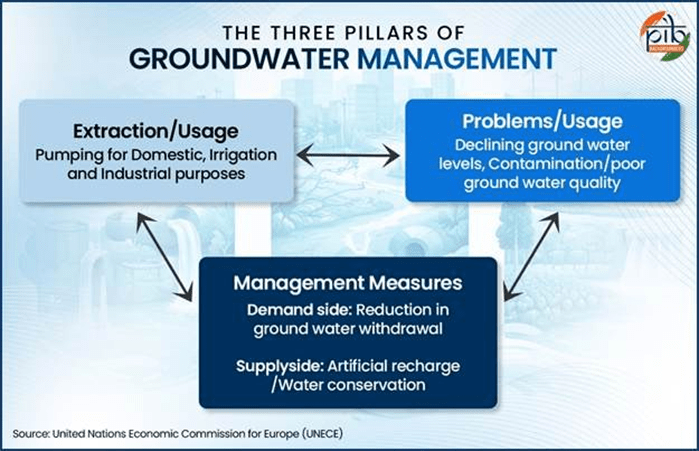
- Rapid population growth, water-intensive agriculture, industrialisation, and urban expansion have led to over-extraction, declining water tables, and deteriorating quality, threatening long-term ecological and economic sustainability.
Relevance
- GS 1: Aquifers and groundwater flow, regional groundwater distribution in India, human–environment interaction, impact of population growth and urbanisation on water resources.
- GS 3: Groundwater depletion and pollution, sustainable water management, agriculture–water–energy nexus, climate change adaptation, SDG 6 and environmental sustainability.
Understanding Groundwater and Aquifer Systems
Conceptual Foundations
- Groundwater is freshwater stored in subsurface geological formations called aquifers, which naturally recharge rivers, wetlands, and springs, and are accessed through wells, tube wells, and borewells for human use.
Role in Ecosystem Stability
- Healthy aquifers sustain base flows in rivers, protect wetlands, and buffer climate variability, making groundwater management central to integrated water resources management (IWRM) and ecological balance.
Necessity for Effective Groundwater Management
Over-Extraction and Declining Water Tables
- Unregulated pumping using affordable drilling and motor technologies has caused widespread groundwater depletion, especially in north-western and peninsular India, reflecting structural governance and regulatory gaps.
Groundwater Quality Degradation
- Industrial effluents, mining, fertiliser-pesticide runoff, and geogenic contaminants like arsenic and fluoride have impaired groundwater quality, posing serious public health and environmental risks.
Developmental and Climate Imperatives
- Sustainable groundwater management is essential for achieving SDG 6 (Water), SDG 11 (Sustainable Cities), and SDG 12 (Responsible Consumption), and for meeting India’s COP-21 climate resilience commitments.
Governance Framework and Policy Architecture
Constitutional and Federal Context
- Water being a State subject, the Union Government plays a facilitative role through technical guidance, financial assistance, and model legislation, enabling cooperative federalism in groundwater governance.
Model Groundwater Bill
- The Model Groundwater (Regulation and Control of Development and Management) Bill provides a legal framework for regulating extraction, promoting recharge, and empowering States; 21 States/UTs have adopted it so far.
Major Government Initiatives for Groundwater Management
Jal Shakti Abhiyan – Catch the Rain (JSA: CTR)
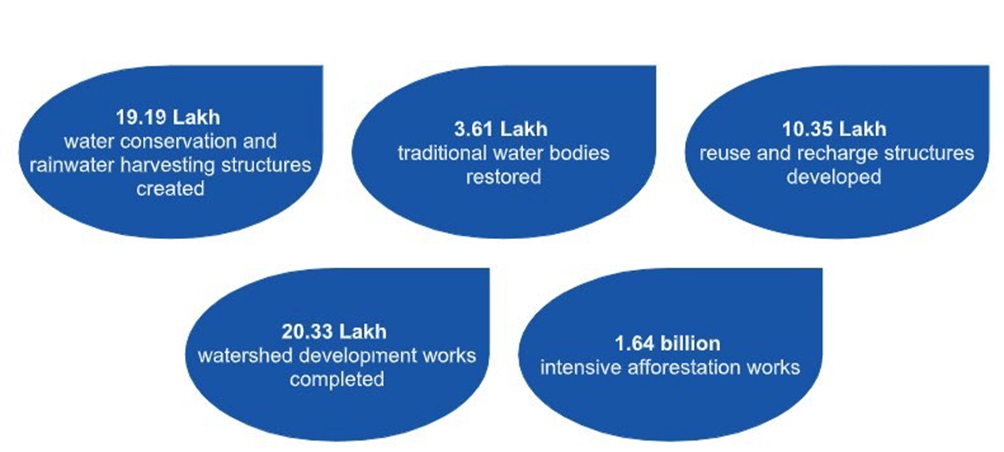
- Launched in March 2021, JSA: CTR promotes rainwater harvesting, water body rejuvenation, Jal Shakti Kendras, afforestation, and mass awareness, embedding water conservation as a people’s movement.
Jal Sanchay Jan Bhagidari (JSJB)
- Introduced in September 2024, JSJB focuses on community-led artificial recharge, borewell recharge, and aquifer restoration, achieving 39.6 lakh recharge structures cumulatively by January 2026.
National Aquifer Mapping and Management Programme (NAQUIM 2.0)
- NAQUIM 2.0 delivers high-resolution aquifer data up to Panchayat level, targeting stressed, coastal, urban, industrial, and poor-quality aquifer zones for evidence-based local planning.
Master Plan for Artificial Recharge to Groundwater 2020
- The Plan proposes 1.42 crore recharge structures to harness 185 BCM of water using terrain-specific techniques, addressing overexploitation, urban runoff loss, and arid-region scarcity.
Atal Bhujal Yojana (Atal Jal)
- Covering 7 water-stressed States, Atal Jal incentivises community-led demand management, supported by a ₹6,000 crore outlay, strong data systems, and measurable outcomes in water-use efficiency.
Mission Amrit Sarovar
- Launched in April 2022, it promotes construction and rejuvenation of village ponds with minimum one-acre area and 10,000 cubic metre capacity, enhancing recharge, irrigation, and local water resilience.
Groundwater Monitoring and Knowledge Infrastructure
National Monitoring Network
- India operates 43,228 groundwater level monitoring stations, supported by 53,264 water quality stations, 6,519 piezometers, and 8,201 rain gauges, enabling continuous scientific assessment.
Institutional Support Systems
- 712 Jal Shakti Kendras function as district-level technical hubs, providing advisory services, disseminating best practices, and strengthening grassroots capacity for sustainable groundwater management.
Challenges and Gaps
Regulatory and Institutional Weaknesses
- Fragmented regulation, weak enforcement of groundwater laws, and limited aquifer-level governance continue to undermine sustainability despite expanding infrastructure and schemes.
Demand-Side Management Deficit
- Persistent reliance on water-intensive cropping patterns, free or subsidised electricity, and low water-use efficiency limits the long-term impact of recharge-focused interventions.
Way Forward
Strengthening Aquifer-Based Governance
- Shift from administrative-unit management to aquifer-based planning, integrating NAQUIM data with Panchayat-level water security plans and local regulatory mechanisms.
Aligning Agriculture with Water Sustainability
- Promote crop diversification, micro-irrigation, water pricing reforms, and convergence with PMKSY and climate-smart agriculture to reduce groundwater demand structurally.
Deepening Community Participation
- Expand incentive-based, outcome-linked models like Atal Jal, embedding behavioural change, social accountability, and citizen science in groundwater governance.
Prelims Pointers
- Groundwater meets 62% irrigation, 85% rural, 50% urban water demand.
- NAQUIM 2.0 provides Panchayat-level aquifer data.
- Atal Jal covers 7 States with ₹6,000 crore outlay.
- Mission Amrit Sarovar ponds: 1 acre area, 10,000 m³ capacity.
India’s Power Transmission Network Crosses 5 Lakh Circuit Kilometres
Why in News?
- A PIB release announced that India’s national power transmission network crossed 5 lakh circuit kilometres, marking a major milestone in grid expansion and renewable energy evacuation.
Background and Strategic Context
Scale of the National Grid
- India now operates over 5,00,000 circuit kilometres of transmission lines at 220 kV and above, supported by 1,407 GVA transformation capacity, making it the world’s largest synchronous national grid.
Recent Milestone Achievement
- The milestone was achieved on 14 January 2026 with commissioning of a 765 kV, 628 ckm Bhadla II–Sikar II line, strengthening renewable power evacuation from Rajasthan’s solar-rich zones.
Relevance
- GS 1: Spatial integration of regions through national grid, regional development enabled by infrastructure connectivity, human geography of energy distribution.
- GS 3: Energy infrastructure development, renewable energy integration, 500 GW non-fossil target, grid stability, energy security, climate change mitigation.
Growth Trajectory since 2014
Expansion of Transmission Infrastructure
- Since April 2014, India’s transmission network expanded by 71.6%, adding 2.09 lakh ckm of high-voltage lines, reflecting sustained public investment in grid backbone infrastructure.
Increase in Transformation Capacity
- Over the same period, transformation capacity increased by 876 GVA, enabling higher power handling capability, reduced congestion, and improved reliability across inter-regional and intra-regional electricity flows.
Renewable Energy Integration Dimension
Evacuation of Renewable Power
- The newly commissioned 765 kV line enables evacuation of an additional 1,100 MW from Bhadla, Ramgarh, and Fatehgarh solar complexes, critical for large-scale renewable integration.
Alignment with 500 GW Non-Fossil Target
- Transmission expansion directly supports India’s 500 GW non-fossil capacity target by 2030, addressing evacuation bottlenecks that often constrain renewable generation despite adequate installed capacity.
Inter-Regional and National Integration
Strengthening One Nation–One Grid
- Inter-regional transfer capacity now stands at 1,20,340 MW, enabling seamless electricity exchange across regions and operationalising the vision of “One Nation – One Grid – One Frequency.”
Grid Stability and Energy Security
- Enhanced interconnections improve grid resilience, enable balancing of regional demand-supply mismatches, and reduce vulnerability to localised outages or generation shocks.
Ongoing and Future Transmission Projects
Inter-State Transmission Projects
- Ongoing Inter-State Transmission System (ISTS) projects will add nearly 40,000 ckm of lines and 399 GVA capacity, strengthening national-level power evacuation and market integration.
Intra-State Transmission Expansion
- Intra-State Transmission projects under implementation are expected to add 27,500 ckm and 134 GVA, improving last-mile connectivity and reducing internal state-level congestion.
Economic and Governance Significance
Enabling Affordable and Reliable Power
- A robust transmission network reduces technical losses, optimises generation dispatch, lowers power procurement costs, and supports affordable electricity supply to households and industry.
Institutional and Policy Support
- Expansion reflects coordinated planning by Ministry of Power, CEA, and POWERGRID, leveraging long-term transmission planning, competitive bidding, and public sector execution capacity.
Challenges and Critical Gaps
Right-of-Way and Environmental Clearances
- Land acquisition delays, forest clearances, and social resistance continue to affect project timelines, particularly for high-voltage corridors passing through ecologically sensitive regions.
Grid Modernisation Requirements
- High renewable penetration necessitates parallel investments in smart grids, flexible AC transmission systems, and storage integration to manage intermittency and maintain grid stability.
Way Forward
Renewable-Evacuation-Centric Planning
- Transmission planning must remain closely aligned with renewable energy zones, offshore wind corridors, and green hydrogen hubs to avoid future evacuation mismatches.
Technology and Market Reforms
- Greater use of HVDC lines, dynamic line rating, digital grid management, and regional power markets will maximise utilisation of existing assets while improving system efficiency.
Prelims Pointers
- Transmission milestone: 5 lakh circuit kilometres (220 kV and above)
- Transformation capacity: 1,407 GVA
- Inter-regional transfer capacity: 1,20,340 MW
- Renewable target supported: 500 GW non-fossil by 2030


