Content
- Exploring Extremes: A Landmark Year of Discoveries by India’s Ministry of Earth Sciences
- Intergenerational Bonds
Exploring Extremes: A Landmark Year of Discoveries by India’s Ministry of Earth Sciences
Why is it in News?
- Year-End Review 2025 of the Ministry of Earth Sciences (MoES) highlights a landmark year of scientific ‘firsts’ with direct socio-economic impact.
- Achievements span deep-ocean exploration, weather forecasting, disaster resilience, polar science, desalination, supercomputing, and urban climate services, aligned with India’s Vision 2047.
Relevance:
- GS III (Science & Tech, Disaster Management, Environment): Deep-sea mining, HPC-based forecasting, tsunami warning systems.
- GS II (Governance): Science-to-society delivery, inter-institutional coordination (MoES–NDMA–States).
Science with Measurable Human Impact
- Cost–Benefit Breakthrough (Third-party Audit):
- Investment: ~₹1,000 crore (Monsoon Mission + HPC).
- Economic Returns: ~₹50,000 crore (50:1 return).
- Beneficiaries: ~11 million BPL families—small farmers & fisherfolk using daily weather/ocean advisories.
- One of India’s first quantified ROI audits of scientific public spending.
Breaking Records: Deep & Dark Oceans
- Deep-Sea Mining Trial:
- Successful test at 5,270 m depth—deepest such test globally.
- Strategic relevance: critical minerals, Atmanirbhar Bharat, UNCLOS-linked seabed exploration.
- Samudrayaan Mission:
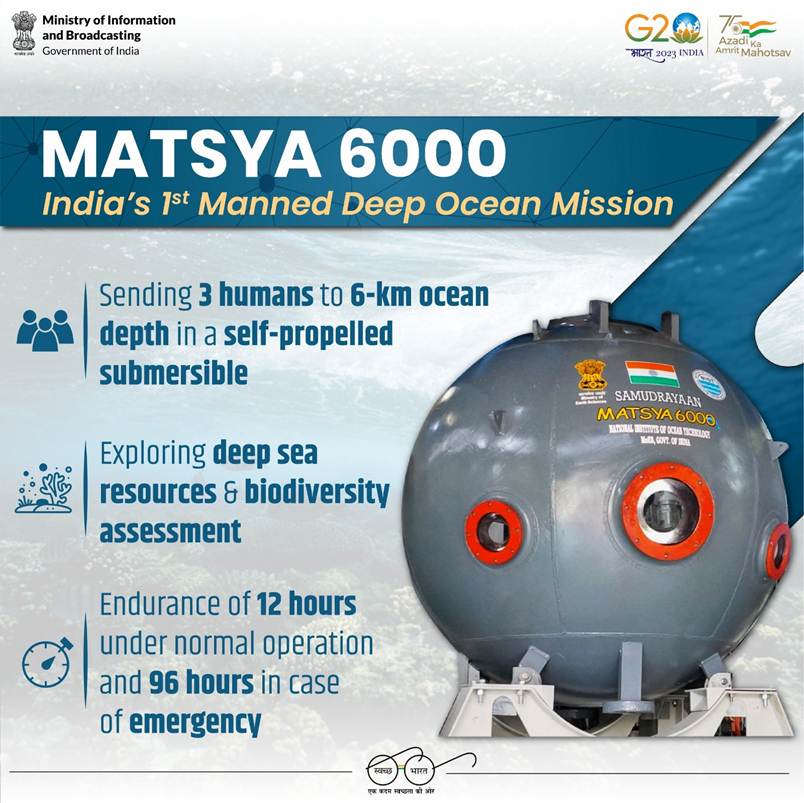
- MATSYA human submersible cleared comfort & stability tests.
- Indian scientists reached 5,002 m depth in the Atlantic (international collaboration) → new benchmark for Indian oceanography.
Coasts, Islands & Blue Economy
- Lakshadweep Water Security:
- 3 eco-friendly desalination plants commissioned.
- Flagship: 1.5 lakh litre/day LTTD plant at Chetlat (NIOT).
- Make in India – Ocean Research Fleet:
- Indigenous vessels Sagar Tara & Sagar Anveshika deployed for ocean health monitoring.
- Disaster Readiness:
- Tsunami Early Warning Centre monitored 32 major earthquakes in 2025—zero missed threats to Indian shores.
Weather, Climate & Computing Power
- Mission Mausam & IMD Vision 2047: Launched 14 Jan 2025 to future-proof weather–climate services.
- Supercomputing Leap:
- HPC capacity enhanced to ~21 PFlops → high-resolution coupled weather–climate models among the world’s best.
- Forecast Infrastructure:
- Doppler Weather Radars inaugurated at Raipur & Mangalore (27 Nov 2025).
- Urban Climate Services:
- UES25 platform (NSM-funded) integrates weather, air quality, urban flood intelligence for municipalities & disaster managers.
Polar, Ocean & Earth System Science Push
- NCPOR Infrastructure (22 May 2025):
- Polar Bhavan (11,378 sqm; ₹55 cr): advanced labs + Science on Sphere (South Asia’s first Polar & Ocean Museum—Phase I).
- Sagar Bhavan (1,772 sqm; ₹13 cr): ice labs & cleanrooms.
- Polar Science Leadership:
- 4th National Conference on Polar Science (Sept 2025): 265 participants; 160 young researchers.
- ESSO Review (Shillong | 19 Dec 2025):
- Roadmap alignment with Vision 2047 across weather, climate, ocean, Earth systems.
Technology, Labs & Capacity Building
- Underwater Acoustics: Acoustic Test Facility designated as national laboratory (12 Apr 2025).
- Ocean Sensors: India’s first conductivity & temperature sensor calibration facility at NIOT (11 Feb 2025).
- Advanced Geochemistry: Q-ICP-MS Lab at NCESS (30 Oct 2025).
- AI in Aquaculture:
- 10 m submerged open-sea cage with AI/ML-based fish biomass estimation deployed in Andaman (17 Apr 2025).
Governance, Safety & Global Engagement
- Heat Action Plans: Co-developed with NDMA + States to reduce heat mortality.
- SAHAV Platform: Released at UN Ocean Conference-3 as a global model for tech-enabled ocean governance.
- Extended Continental Shelf:
- Multi-channel seismic surveys via ONGC to strengthen India’s ECS submissions under UNCLOS.
- Atmospheric Electricity & Extremes:
- 9th National Lightning Conference focused on resilience to lightning–extreme weather linkages.
Strategic Takeaways
- Science-to-Society Model: Weather & ocean science delivering quantified welfare gains.
- Blue Economy + Security: Deep ocean capability + tsunami vigilance enhance economic & strategic autonomy.
- Data-Driven Governance: HPC, AI, and integrated platforms (UES25) mainstream predictive governance.
- Vision 2047 Alignment: Institutions, infrastructure, and talent pipelines positioned for long-term resilience.
Conclusion
- 2025 establishes MoES as a global-standard Earth System Science ministry—where frontier research, indigenous technology, and public welfare converge with measurable returns.
Intergenerational Bonds
Why is it in News?
- The Department of Social Justice & Empowerment organised “Celebration of Intergenerational Bonds” on 22 December 2025 at Chhatarpur, Madhya Pradesh, reinforcing India’s policy push on active, dignified ageing and social cohesion.
Relevance
- GS II – Governance & Social Justice:
- Senior citizen welfare, inclusive policies, community participation.
- GS I – Society:
- Family structure changes, ageing population, value transmission.
Policy Context: Why Intergenerational Bonds Matter ?
- Demographic Transition:
- India’s elderly (60+) population projected to rise from ~10% (2021) to ~20% by 2050 (UN estimates).
- Social Challenge:
- Urbanisation, nuclear families, and migration are weakening traditional family-based elder support.
- Governance Imperative:
- Shift from welfare-only to participatory ageing—elders as contributors, not dependents.
Key Government Interventions Highlighted
1. Rashtriya Vayoshri Yojana (RVY)
- Objective: Assistive devices for mobility, vision, hearing to promote independent living.
- Coverage: 7.28 lakh+ senior citizens benefited nationwide.
- Governance Insight: Links health, dignity, and productivity of elders.
2. Elderline 14567
- Function: 24×7 toll-free support—guidance, distress response, emergency assistance.
- Utilisation: 27 lakh+ calls received.
- Significance: First structured national-level grievance & support ecosystem for elders.
3. Community & School-Based Outreach
- Grandparents’ Day in Schools:
- Institutionalises intergenerational value transmission at early ages.
- Cultural & Community Programmes:
- Reduce loneliness, improve mental health, and strengthen social capital.
Conceptual Framework
- Active Ageing (WHO):
- Optimising health, participation, and security to enhance quality of life as people age.
- Intergenerational Solidarity:
- Mutual exchange of experience (elders) and energy/innovation (youth) → balanced social development.
- Social Capital Theory (Putnam):
- Strong community bonds → higher trust, cooperation, and governance outcomes.
Outcomes & Significance
- Social: Reduced generational divide; improved empathy and mutual respect.
- Psychological: Tackles elder loneliness; enhances youth social sensitivity.
- Institutional: Demonstrates soft-governance tools beyond cash transfers.
- Normative: Reinforces elders as mentors, custodians of values, and nation-builders.
Critical Takeaway
- India’s elder-care strategy is evolving from assistance-based welfare to engagement-based governance.
- Programmes like Celebration of Intergenerational Bonds operationalise constitutional values of dignity, fraternity, and inclusiveness, making ageing a shared societal responsibility, not a private burden.
Conclusion:
- Intergenerational harmony is no longer a cultural ideal alone—it is emerging as a core pillar of India’s social policy architecture under Viksit Bharat@2047.