
Content
- Indian Railways Deploys Humanoid Robot ASC ARJUN
- One District One Product (ODOP)
Indian Railways Deploys Humanoid Robot ASC ARJUN
Background & Why in News ?
- Indian Railways deployed its first humanoid robot ASC ARJUN at Visakhapatnam Railway Station (PIB, 23 Jan 2026).
- Objective: enhance passenger safety, security, surveillance, and service delivery through indigenous AI-enabled systems.
- Aligned with India’s broader push towards AI adoption in public service delivery and Atmanirbhar Bharat.
Relevance
- GS 1 – Urbanisation & public spaces, impact of technology on society, changing nature of work
- GS 2 – E-governance, technology in service delivery, role of RPF, good governance
- GS 3 – Artificial Intelligence, robotics, internal security, critical infrastructure security, Make in India
Key Features & Functional Capabilities
Security & Surveillance
- Face Recognition System (FRS) for intrusion detection.
- AI-based crowd monitoring with real-time alerts to RPF control rooms.
- 24×7 patrol capability along predefined routes.
Emergency Response
- Fire and smoke detection sensors for early warning.
- Supports faster response during stampede, fire, or sabotage scenarios.
Passenger Services
- Automated public announcements in English, Hindi, Telugu.
- Interactive interface for guidance and basic assistance.
- Human-centric design: Namaste gesture for passengers; salute for RPF.
Operational Technology
- Semi-autonomous navigation with obstacle avoidance.
- Optimises manpower deployment, especially during peak hours.
- Indigenous design & development completed in ~1 year at Visakhapatnam.
Governance & Administrative Significance
- Reflects technology-led policing by RPF.
- Supports Minimum Government, Maximum Governance.
- Reduces over-reliance on human surveillance in high-footfall zones.
- Pilot model for scaling across major junctions and terminals.
Economic & Efficiency Dimension
- Cost-efficiency over lifecycle: upfront capex vs long-term manpower savings.
- Potential reduction in:
- Security breaches
- Emergency response time
- Overcrowding-related disruptions
- Boosts domestic robotics and AI ecosystem under Make in India.
Social & Ethical Issues
- Public trust & acceptance of humanoid surveillance.
- Risk of algorithmic bias in FRS.
- Need for:
- Transparent SOPs
- Human-in-the-loop oversight
- Clear grievance redress mechanisms
Internal Security & Technology Dimension
- High relevance for:
- Anti-sabotage measures
- Crowd control during festivals, elections, disasters
- Integrates AI, robotics, IoT → part of smart transport infrastructure.
- Supports national security preparedness in critical infrastructure.
Data & Evidence
- Indian Railways transports ~23 million passengers/day (pre-COVID baseline).
- RPF responsible for security across 68,000+ km rail network.
- AI-based surveillance increasingly used globally in metros (Japan, China, EU hubs).
Challenges &Gaps
- Privacy concerns due to FRS without a comprehensive data protection law (DPDP Act rules still evolving).
- Interoperability issues with existing CCTV and control room systems.
- Maintenance & skill gaps at divisional level.
- Risk of tech-solutionism without addressing structural crowd management issues.
Way Forward
- Frame clear SOPs for AI use aligned with DPDP Act principles.
- Ensure human override & auditability in AI decisions.
- Gradual scaling via pilot evaluation at high-footfall stations.
- Integrate with:
- National Smart Cities Mission
- India AI Mission
- Regular ethical AI audits and bias testing.
Prelims Pointers
- ASC ARJUN:
- First humanoid robot deployed by Indian Railways.
- Indigenous development at Visakhapatnam.
- Features: FRS, AI crowd monitoring, fire/smoke detection.
- Deployed to assist Railway Protection Force (RPF).
One District One Product (ODOP)
Why in News ?
- ODOP, a flagship initiative that began in Uttar Pradesh (2018), has now been scaled nationally to 770+ districts.
- Recognised as India’s most prominent place-based economic transformation model.
- Strengthened through:
- GeM–ODOP Bazaar
- PM Ekta (Unity) Malls
- Global promotion via Indian Missions & G20 platforms.
Relevance
- GS 1 – Indian handicrafts, cultural heritage, role of artisans, women SHGs, migration issues
- GS 2 – Cooperative federalism, district-level governance, public policy design, role of DPIIT
- GS 3 – Inclusive growth, MSMEs, rural economy, exports, Make in India, digital markets
Core Idea & Philosophy
- Identify one unique, district-specific product based on local skills, raw material, and tradition.
- Provide end-to-end support:
- Branding & GI linkage
- Skill upgradation
- Credit & toolkit support
- Market & export access
- Converts cultural capital into economic capital.
Institutional & Governance Framework
Nodal & Implementing Structure
- Nodal Ministry: Department for Promotion of Industry and Internal Trade (DPIIT).
- Implementation through:
- State Governments
- District Administrations
- States/UTs select products based on existing ecosystem & comparative advantage.
- Final product list communicated to DPIIT.
Scale & Coverage
- 770+ districts covered (as of Dec 2025).
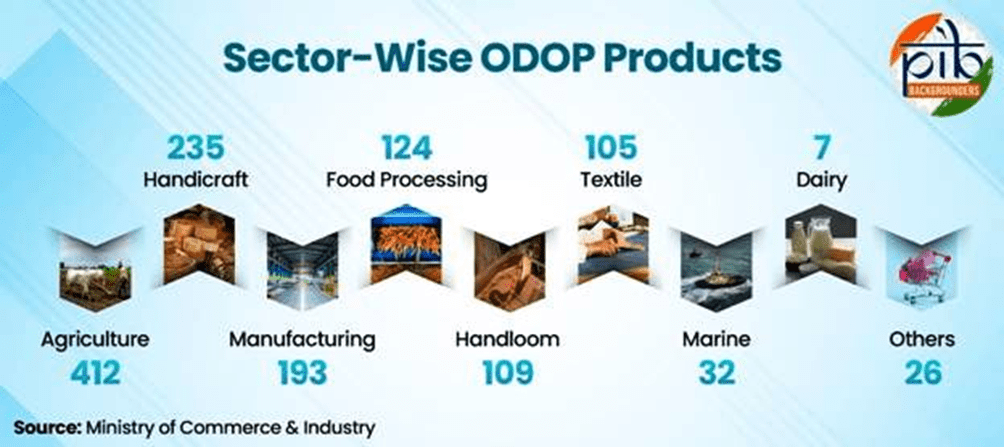
- 1,200+ ODOP products listed on DPIIT digital portal.
- Product range:
- Handicrafts
- Textiles
- Agri & food products
- Minerals & local manufacturing.
Economic & Developmental Significance
Balanced Regional Development
- Shifts focus from metro-centric growth to district-led development.
- Reduces regional disparities by:
- Unlocking local strengths
- Building district-level value chains.
Employment & Livelihoods
- Empowers:
- Artisans
- Weavers
- Farmers
- SHGs & MSMEs
- Promotes rural entrepreneurship aligned with Aatmanirbhar Bharat.
Export Promotion
- Integrated with:
- Districts as Export Hubs
- Make in India
- Vocal for Local
- Enables districts to directly participate in global trade networks.
Market Access & Digital Integration
E-Commerce & Platforms
- Dedicated ODOP storefront on Government e-Marketplace (GeM).
- State-level e-commerce platforms for wider outreach.
- DPIIT digital portal for visibility & discovery.
Physical Market Infrastructure
- PM Ekta (Unity) Malls as permanent national showcases.
PM Ekta (Unity) Malls: Structural Game-Changer
Concept & Design
- Dedicated retail & experience hubs for:
- ODOP products
- GI-tagged goods
- Handicrafts
- One earmarked space for each State/UT.
Key Facts
- ₹5,000 crore interest-free support (≥ ₹100 crore per state).
- 29 Unity Malls approved across 27 states.
- Operates under PPP model with state ownership.
- Features:
- Iconic architecture
- Multilingual signage
- Experience zones, theatres, food courts.
Governance Impact
- Converts ODOP from a scheme into a permanent market institution.
- Enhances branding, footfall, and sustained income.
Case Study: Uttar Pradesh – Model State
Trade & Exhibition Platforms
- UP International Trade Show (UPITS) 2025:
- ODOP Pavilion with 466 stalls.
- Business leads worth ₹20.77 crore.
- Mahakumbh 2025 (Prayagraj):
- 6,000 sq. m ODOP exhibition zone.
- Showcased 75 GI-tagged products, including 34 from Kashi region.
Quantified Impact in UP
- Exports increased by 76%:
- ₹88,967 crore (2017–18) → ₹1.71 lakh crore (2023–24).
- ₹6,000 crore sanctioned under ODOP Margin Money Scheme.
- 1.25 crore+ artisans trained and provided modern toolkits.
Global Outreach & Soft Power Dimension
International Promotion
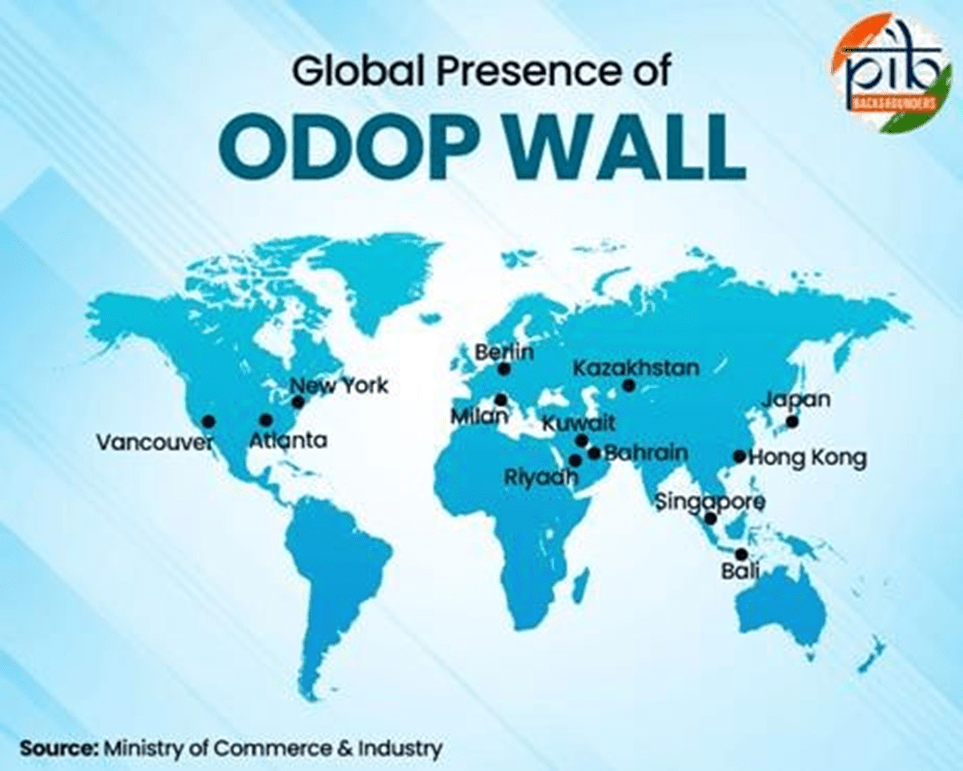
- 80+ Indian Missions promoted ODOP products abroad.
- ODOP products used in G20 diplomatic gifting.
- International retail presence:
- 2 stores in Singapore
- 1 store in Kuwait
ODOP Wall Initiative
- Curated district product displays at:
- SARAS Aajeevika Stores
- Enhances visibility for:
- Rural artisans
- Women SHGs
- Strengthens cultural diplomacy + economic diplomacy.
Social, Cultural & Ethical Dimensions
- Preserves intangible cultural heritage.
- Restores dignity to artisanal labour.
- Encourages inter-generational skill transmission.
- Promotes inclusive growth without forced urban migration.
Challenges / Gaps / Criticisms
- Uneven capacity across districts for:
- Branding
- Quality control
- Export compliance.
- Risk of:
- Over-commercialisation of heritage.
- Product standardisation diluting uniqueness.
- Need stronger convergence with:
- Logistics
- Testing & certification labs
- Design & innovation support.
Way Forward
- District-level ODOP cells with design, export & digital experts.
- Stronger linkage with:
- GI Registry
- Skill India
- ONDC.
- Outcome-based funding tied to:
- Income rise
- Export growth
- Job creation.
- Global branding strategy similar to Japan’s OVOP model.
- Regular product rotation & innovation to avoid stagnation.
Prelims Pointers
- ODOP started in Uttar Pradesh (2018).
- National rollout covers 770+ districts.
- Nodal Department: DPIIT.
- PM Ekta Malls:
- ₹5,000 crore interest-free support
- 29 malls approved.
- ODOP products promoted via GeM–ODOP Bazaar.


