
Content
- Pinaka Long Range Guided Rocket
- INSV Kaundinya’s Maiden Voyage
Pinaka Long Range Guided Rocket
Why in News ?
- DRDO successfully conducted the maiden flight test of the Pinaka Long Range Guided Rocket (LRGR-120) on 29 December 2025 at the Integrated Test Range, Chandipur.
- The rocket achieved its maximum range of 120 km with high-precision target impact, validating guidance, control and in-flight manoeuvre capabilities.
- The system was launched from an in-service Pinaka launcher, proving compatibility across Pinaka variants and enhancing operational flexibility.
Relevance
GS-III | Defence Technology & Internal Security
- Indigenisation & Aatmanirbhar Bharat in Defence Manufacturing — indigenous R&D ecosystem (DRDO, ARDE, HEMRL, DRDL, RCI).
- Strategic Forces Modernisation — precision-guided long-range artillery bridging gap between guns and tactical missiles.
- Internal & External Security Preparedness — counter-battery fire, deep-strike support, battlefield deterrence.
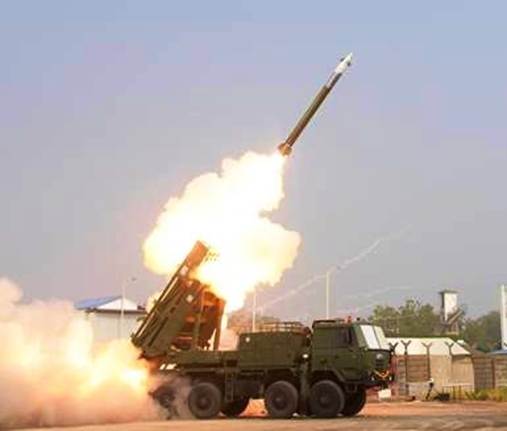
Understanding the Pinaka System
- Origin & Role
- Indigenous Multi-Barrel Rocket Launcher (MBRL) developed by DRDO in the 1990s; inducted post-Kargil for area saturation fire support.
- Variants (Evolution)
- Pinaka Mk-I — ~40 km range (unguided, battlefield support)
- Pinaka Mk-II / Guided Pinaka — ~70–90 km, improved accuracy with guidance kit
- Pinaka LRGR-120 (New) — 120 km, precision-guided long-range strike
- Platform
- Mounted on high-mobility launch vehicles; rapid shoot-and-scoot capability.
Technical Features of LRGR-120
- Range & Accuracy
- 120 km maximum range, precision impact (“textbook precision”).
- Guidance & Navigation
- Likely INS-GPS based guidance, mid-course corrections, terminal accuracy enhancements.
- Design & Development Ecosystem
- Developed by ARDE with support from HEMRL, DRDL, RCI.
- Trial coordinated by ITR & Proof & Experimental Establishment.
- Launcher Compatibility
- Fired from existing Pinaka launcher, enabling multi-range munitions from a single platform.
- Operational Advantages
- Higher standoff distance, survivability, quick deployment, reduced logistics footprint.
Strategic Significance for India’s Armed Forces
- Extended Battlefield Reach
- Bridges gap between tube artillery and tactical ballistic missiles.
- Precision-Strike over Long Range
- Enables counter-battery fire, interdiction of logistics hubs, and deep-area targeting.
- Indigenisation & Self-Reliance
- Strengthens Aatmanirbhar Bharat in defence munitions & rocket systems.
- Game-Changer Capability
- Enhances deterrence, joint-force firepower, and cost-effective long-range strike options.
Comparative Perspective
- Similar Global Systems
- Comparable class to HIMARS / MLRS (US), Lynx (Israel), Tornado-S (Russia).
- Differentiator
- Cost-effective, indigenous, modular launcher supporting multiple rocket ranges.
Implications for Future Capability Development
- Pathway to Larger Ecosystem
- Integration with network-centric warfare, ISR-targeting chains, UAV-based cueing.
- Potential Enhancements
- Higher-range variants, improved seekers, swarming salvo doctrines.
- Export Potential
- Strong candidate for friendly foreign militaries under defence diplomacy.
INSV Kaundinya’s Maiden Voyage
Why in News ?
- INSV Kaundinya, an indigenously built traditional stitched sailing vessel of the Indian Navy, embarked on its maiden overseas voyage from Porbandar to Muscat on 29 December 2025.
- The expedition aims to revive and celebrate India–Oman maritime heritage, retracing ancient trade and cultural routes across the Arabian Sea.
- The voyage underscores maritime diplomacy, cultural connect, and heritage preservation as strategic pillars of India’s naval outreach.
Relevance
GS-I | Culture & Heritage
- Maritime Heritage & Civilisational Exchanges — revival of stitched-boat traditions, ancient India–Oman trade links.
GS-III | Maritime Security & Indian Ocean Region
- Naval Outreach & Maritime Presence — symbolic assertion of India’s maritime identity.
- Indian Ocean Geopolitics — cultural diplomacy complementing security cooperation.
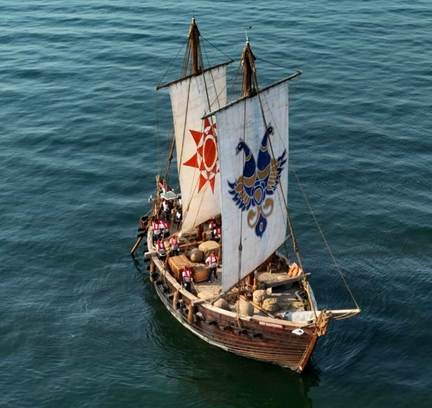
From Basics — Understanding INSV Kaundinya & Stitched Vessels
- What is a stitched vessel?
- Traditional shipbuilding method where planks are stitched together with natural fibre cords, not metal fasteners.
- Historically used along India’s western coast — Gujarat, Konkan, Kerala — for long-distance Indian Ocean navigation.
- Civilisational Context
- Reflects India’s role in pre-modern maritime trade networks — spices, horses, dates, textiles, pearls.
- Echoes accounts from Arab chroniclers, Sangam texts, and maritime archaeology (Lothal, Sohar links).
Voyage Highlights (Expedition)
- Route: Porbandar (Gujarat) → Muscat (Oman)
- Purpose: Re-enact ancient sea routes connecting western India with Oman.
- Crew: 4 officers + 13 sailors;
Design & Heritage Features
- Indigenously constructed using traditional stitched shipbuilding techniques and natural materials.
- Based on historical and iconographic evidence — recreating indigenous seamanship, navigational practices, and hull design traditions.
- Acts as a “living laboratory” of maritime history, linking craft traditions with contemporary naval heritage initiatives.
Strategic & Diplomatic Significance
- Maritime Diplomacy
- Reinforces India–Oman strategic partnership through heritage-led engagement.
- Deepens people-to-people ties, cultural memory, and shared oceanic identity.
- Indian Ocean Civilisational Continuity
- Reaffirms India’s historic seafaring ethos and coastal trade networks.
- Soft Power & Narrative Building
- Positions India as a culturally rooted, responsible maritime nation in the IOR.
- Regional Geopolitical Context
- Complements SAGAR vision, Indian Navy outreach, Western Indian Ocean engagement.
India–Oman Maritime Linkages
- Historical
- Gujarat–Oman ties via Kutch, Mandvi, Porbandar trading communities.
- Shared maritime routes across Gulf of Oman & Arabian Sea for centuries.
- Contemporary
- Strategic partnership, defence cooperation, access arrangements, energy & diaspora linkages.
- Oman hosts one of the largest Indian expatriate communities in West Asia.


