
Content
- 2025 Economic Reforms
- PathGennie – “Fast-Tracks” drug discovery
2025 Economic Reforms
Why in News ?
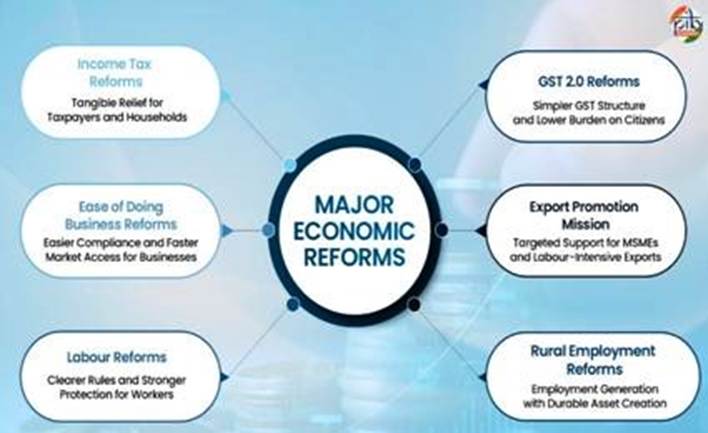
- The Government rolled out a consolidated package of economic reforms in 2025 focused on:
- outcome-driven governance
- simplification of systems
- inclusive and employment-centric growth
- Reforms spanned taxation, GST, labour, MSMEs, exports, rural employment and ease-of-doing-business.
Relevance
GS-III | Economy, Growth & Inclusive Development
- Growth-oriented reforms — tax rationalisation, GST 2.0, MSME expansion, export promotion
- Formalisation + productivity gains via labour codes & digital compliance
- Rural livelihoods + asset-creation through VB-GRAM (125-day guarantee)
- Fiscal stability — wider tax base, predictable revenues, ease of doing business
- MSME-led employment, startup competitiveness, credit enablement
Big Picture — Reform Philosophy
- Shift from rule-heavy regulation → outcome-based governance.
- Emphasis on:
- simplification, predictability, digitalisation, compliance reduction
- trust-based administration and fiscal stability
- enabling youth, women, MSMEs, gig workers, rural households
Key Reform Pillars — Facts & Data
1) Direct Tax & New Income Tax Act, 2025
- Income up to ₹12 lakh exempt in new regime
- Effective exemption ₹12.75 lakh for salaried (incl. standard deduction).
- Comprehensive rewrite of 1961 Act with:
- textual simplification, removal of obsolete clauses
- continuity in tax policy & rates
- Unified “Tax Year” replaces AY/PY — reduces ambiguity.
- Digital-first enforcement, faceless administration, unified TDS framework.
Likely Outcomes
- Higher disposable income → consumption multiplier
- Reduced litigation, clarity for taxpayers
- Improved compliance through digital systems
2) Labour Reforms — Four Labour Codes
- 29 laws consolidated into 4 Codes
(Wages, IR, Social Security, OSH & Working Conditions) - Coverage extended to:
- gig & platform workers (~1 crore+ beneficiaries)
- women workers — improved leave, maternity & safety
- Uniform wage definition, simplification of dispute settlement.
Structural Impact
- Single framework for 50+ crore workers
- Moves labour regulation towards flexibility + protection
- Supports formalisation & workforce security
3) Rural Employment Reforms — VB-GRAM Act, 2025
- Replaces MGNREGA with integrated livelihood framework.
- Guarantee: 125 days paid work/household/year
- Timely wage payment: weekly / ≤15 days
- Asset creation focus — water, climate-resilient works, rural infra, livelihoods
- Decentralised planning via VGPPs + digital convergence (PM Gati Shakti)
- Admin expenditure ceiling raised to 9% to strengthen delivery.
Development Logic
- Aligns rural employment with productive capital formation
- Balances farm labour availability + worker security
- Enhances local planning capacity
4) Ease of Doing Business & MSME Support
- MSME-friendly QCO roll-out (phased, exemptions, legacy stock clearance).
- Credit & liquidity measures:
- MCGS cover up to ₹100 crore
- collateral-free loans up to ₹10 lakh
- working capital: ≥20% of projected turnover (≤₹5 crore limits)
- MSME definition revised:
- Micro: ₹2.5 cr / ₹10 cr
- Small: ₹25 cr / ₹100 cr
- Medium: ₹125 cr / ₹500 cr
- Credit-guarantee limit doubled ₹5 cr → ₹10 cr
Expected Gains
- Scale expansion, formal credit penetration
- Export & startup competitiveness
- Employment generation in manufacturing & services
5) GST 2.0 — Next-Generation GST
- Two-slab regime: 5% & 18%
- Rate rationalisation lowers cost of essentials & services.
- Faster refunds, simpler registration, MSME-friendly compliance.
- Taxpayer base expanded to 1.5 crore+
- Gross GST collections FY 2024-25: ₹22.08 lakh crore
Macroeconomic Effects
- Reduced classification disputes & compliance burden
- Boost to consumption and business confidence
- Improved revenue predictability + fiscal stability
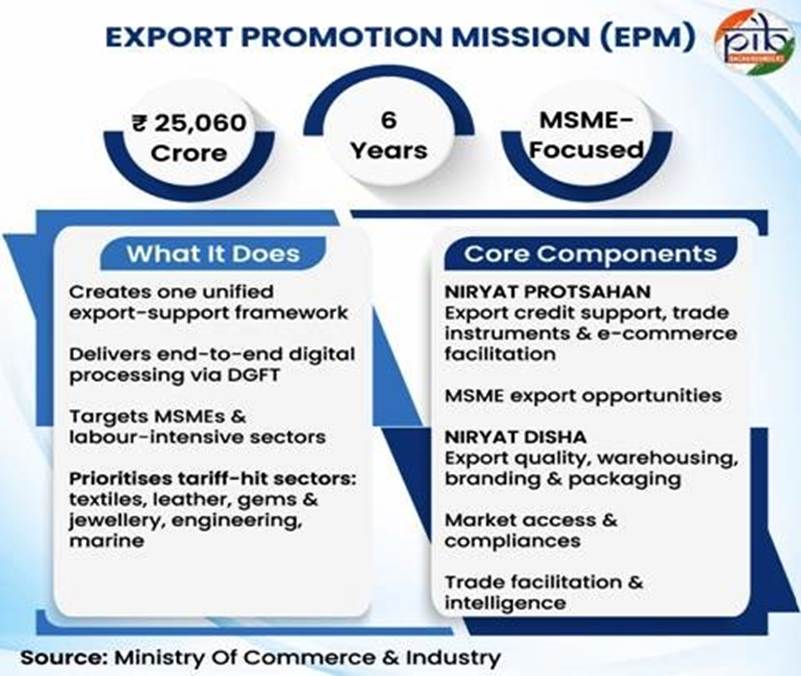
6) Export Promotion Mission (EPM) — ₹25,060 crore (2025-31)
- Unified architecture replacing fragmented schemes.
- Two pillars:
- Niryat Protsahan — finance, credit enhancement
- Niryat Disha — compliance, branding, logistics, market access
- Focus on:
- MSMEs, first-time exporters, non-traditional districts
- jobs in manufacturing & logistics
Strategic Objective
- Build district-export ecosystems
- Position India for competitive, inclusive export growth toward 2047
7) Other Trade & Process Reforms
- Digital trade stack — National Single Window, ICEGATE, Trade Connect
- D-BRAP 2025 — decentralised approvals & inspections
- GeM & MSME-SAMBANDH — deeper MSME procurement linkages
- ₹58,000 crore disbursed under RoDTEP (till March 2025)
Strengths & Risks
Strengths
- Coherent reform sequencing (tax → labour → MSME → exports)
- Administrative simplification → lower transaction costs
- Inclusion of gig workers, women, rural households
- Outcome-orientation → assets, productivity, formalisation
Risks
- Labour code rollout dependent on state rules & capacity
- GST two-rate system still needs fitment clarity in edge sectors
- Rural employment redesign must avoid under-funding or delays
- MSME expansion needs market access + productivity upgrading, not just credit
Takeaways
- Income-tax exemption (new regime): up to ₹12 lakh (₹12.75 lakh salaried)
- GST taxpayer base: 1.5 crore+ | FY25 GST: ₹22.08 lakh crore
- Rural guarantee: 125 days work | admin cap 6% → 9%
- Labour coverage: 50+ crore workers | gig workers ~1 crore+
- EPM outlay: ₹25,060 crore (2025-31)
- MSME thresholds: Micro ₹2.5cr/₹10cr | Small ₹25cr/₹100cr | Medium ₹125cr/₹500cr
PathGennie – “Fast-Tracks” drug discovery
Why in News ?
- Scientists at S. N. Bose National Centre for Basic Sciences, Kolkata (DST institute) developed PathGennie, a novel open-source computational framework.
- It accelerates simulation of rare molecular events and enables accurate prediction of drug–protein unbinding pathways without distorting physics.
- Published in Journal of Chemical Theory and Computation—relevant to drug discovery, molecular simulations, AI-integrated chemistry and biotech innovation.
Relevance
GS-III | Science & Technology, Biotechnology & Innovation
- Frontier research in computational chemistry & molecular simulation
- Strengthens Computer-Aided Drug Discovery (CADD) capabilities
- Direction-Guided Adaptive Sampling — rare-event modelling breakthrough
- Reduces cost, time, distortion in drug–protein unbinding predictions
GS-III | Health, Pharma R&D & Indigenous Tech Capacity
- Improves drug design pipelines, residence-time analysis, resistance-pathway mapping
- Supports domestic pharma innovation, precision therapeutics, R&D localisation
- Aligns with Make in India (Pharma) & Deep-Tech missions
Scientific Context — The Problem
- In drug discovery, residence time (how long a drug stays bound) is often more important than binding affinity.
- Unbinding events are rare — occur over milliseconds to seconds.
- Classical Molecular Dynamics (MD) cannot simulate these time-scales even on supercomputers.
- Existing methods force events using:
- bias forces
- high temperature
- artificial steering
- These distort true kinetic pathways → unreliable predictions.
What PathGennie Does ? — Core Idea
- Introduces Direction-Guided Adaptive Sampling.
- Mimics natural selection at the molecular scale.
- Uses many ultrashort unbiased MD trajectories (few femtoseconds).
- Only those trajectories showing progress toward the target state are extended.
- Non-productive trajectories are discarded → “survival-of-the-fittest” simulations.
Result
- Captures true, undistorted transition pathways
- Achieves faster discovery of rare molecular events without biasing forces.
How It Works ? — Mechanism (Step-wise)
- Launch multiple micro-trajectories in molecular configuration space.
- Evaluate movement in chosen Collective Variables (CVs) — descriptors of progress.
- Exploration + Exploitation balance:
- extend promising paths
- prune unproductive ones
- Iteratively reconstruct complete transition pathways across high-energy barriers.
- Works even in high-dimensional / machine-learned CV spaces.
Evidence & Demonstrations (Proof-of-Concept)
- Team: Prof. Suman Chakrabarty, Dibyendu Maity, Shaheerah Shahid
- Validated on benchmark systems:
- Benzene–T4 lysozyme → mapped multiple ligand exit routes
- Imatinib (Gleevec)–Abl kinase → detected three dissociation pathways
- Recovered experimentally-known mechanisms
→ confirms accuracy without biasing forces.
Why It Matters ?— Impact on Drug Discovery
- Enables accurate residence-time modelling
- Reduces:
- computational cost
- simulation time
- pathway distortion
- Strengthens Computer-Aided Drug Discovery (CADD) pipelines.
- Helps identify:
- drug escape routes
- off-pathway binding / resistance pathways
- molecule stability under physiological motion
Broader Scientific Applications
- Rare-event simulations in:
- chemical reactions & catalysis
- phase transitions
- self-assembly processes
- biomolecular conformational changes
- Compatible with machine-learning–derived order parameters.
- Open-source → lowers adoption barrier for global research labs.
Strategic & National Significance
- Strengthens India’s computational chemistry & pharma innovation ecosystem.
- Supports:
- AI-enabled science
- drug design localization
- cost-efficient R&D
- Aligns with:
- Make in India – Pharmaceuticals
- Deep-tech & research translation missions
Facts & Data
- Institution: S. N. Bose National Centre for Basic Sciences, Kolkata (DST)
- Tool: PathGennie — open-source computational framework
- Domain: Rare-event molecular simulations / CADD
- Key innovation: Direction-Guided Adaptive Sampling
- Output: Unbinding pathways without external bias
- Validated on: T4 lysozyme–benzene, Imatinib–Abl kinase


