Why in News ?
- Union Budget 2026–27 proposes developing Rakhigarhi, a major Harappan civilisation site in Haryana, as a cultural-tourism hub, but local concerns over slow progress and land issues triggered public dissatisfaction.
Relevance
GS-1 – History & Culture
- Indus Valley civilisation
- Archaeology & heritage
- Art & culture
GS-2 – Governance / Culture
- Heritage conservation policy
- Role of ASI & legislation
Rakhigarhi – Basics
Location & Identity
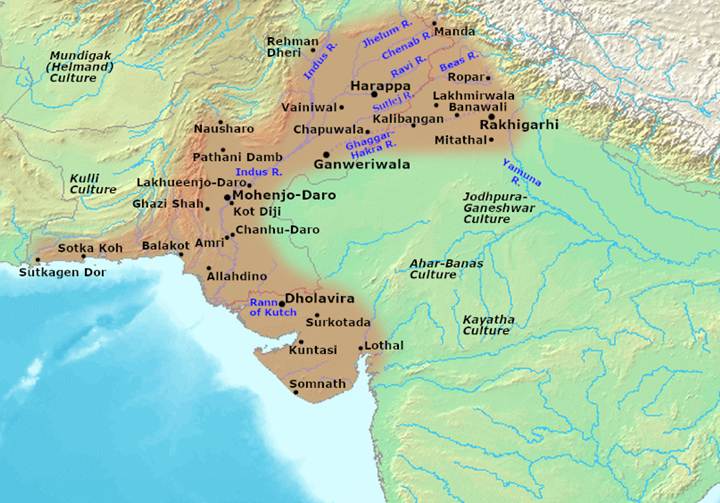
- Rakhigarhi, located in Hisar district, Haryana, is among the largest Harappan (Indus Valley) sites in the means subcontinent, often compared with Mohenjo-daro and Harappa in scale and complexity.
Chronology
- Site dates roughly to 2600–1900 BCE (Mature Harappan phase), with evidence of earlier and later cultural layers, helping reconstruct the evolution and decline of the Indus Valley Civilisation.
Archaeological Significance
- Excavations revealed planned streets, drainage systems, craft production areas, burials, and artefacts, indicating advanced urban planning, trade networks, and social organisation typical of Harappan culture.
Key Budget & Policy Announcement
Heritage Development Push
- Government proposes integrated site development, museum creation, and tourism infrastructure to convert Rakhigarhi into a global heritage destination, linking conservation with local economic opportunities.
Part of Wider Revamp
- Rakhigarhi included in plan to revamp multiple archaeological sites, reflecting policy shift toward heritage-led development and cultural tourism as soft-power and local-growth instruments.
Historical & Cultural Importance
Civilisational Value
- Rakhigarhi strengthens understanding that Harappan civilisation extended deep into present-day India, countering earlier Pakistan-centric geographic perception and enriching India’s civilisational narrative.
Knowledge Contributions
- Findings on diet, burial practices, pottery, metallurgy, and settlement patterns provide insights into Harappan lifestyle, trade, and social differentiation, valuable for archaeology and ancient history studies.
Constitutional / Legal Dimension
- Conservation aligns with Article 49 obligating State to protect monuments of national importance and with Ancient Monuments and Archaeological Sites and Remains Act, 1958 governing protected heritage sites.
Governance / Administrative Dimension
- Development requires coordination among ASI, State Government, Tourism Ministry, and local administration, balancing heritage protection, land acquisition, rehabilitation, and community participation.
Economic Dimension
- Heritage tourism can generate local employment, MSME growth, hospitality demand, and rural infrastructure, turning archaeological assets into sustainable economic multipliers for surrounding communities.
Social / Ethical Dimension
- Local resistance arises when communities perceive displacement risks, inadequate compensation, or exclusion from benefits, highlighting need for participatory and inclusive heritage-development models.
Cultural Diplomacy / Soft Power
- Showcasing Harappan heritage strengthens India’s civilisational diplomacy, global academic collaborations, and cultural branding, similar to how Egypt leverages ancient heritage for soft power.
Data & Evidence
- Rakhigarhi spreads across multiple mounds over large area, making it one of the most extensive Harappan sites; DNA and material studies from the site informed debates on Harappan origins.
Challenges / Gaps
- Slow excavation pace, funding constraints, and conservation delays reduce research potential and public trust in development promises.
- Encroachments and agricultural activity risk site degradation, threatening stratigraphic integrity and long-term archaeological value.
- Over-commercialisation may compromise authenticity and scientific conservation if tourism priorities overshadow archaeological protocols.
Way Forward
- Adopt community-based heritage management, ensuring locals gain from tourism via jobs, homestays, and services, building local stewardship for conservation.
- Increase archaeological funding, scientific excavation, and digital documentation using GIS, 3D mapping, and residue analysis for global-standard research.
- Develop site museums and interpretation centres for public education, linking Rakhigarhi with broader Harappan heritage circuits.
Data & Facts
- Rakhigarhi spans ~350 hectares+, making it among the largest Harappan sites.
- Indus Valley Civilisation covered ~1.3 million sq km, larger than Egypt & Mesopotamia combined.
- Harappans used standardised bricks (1:2:4 ratio) → advanced civil engineering.
- No monumental temples/palaces found → suggests relatively egalitarian urban planning.
- DNA studies show complex indigenous population history without simplistic invasion narratives.