The Hindu — UPSC Analysis
Tuesday, 17 November 2026
International Edition · Vol. 4, No. 271 · Curated for Prelims & Mains | GS I · II · III · IV
📋 Today's Topics
- Census portal briefly lists 287 'other' religionsGS2 · GS1
- A poverty line that falls shortGS3 · GS2
- Taxes, policy uncertainty and lost investor confidenceGS3
- Wholesale inflation at 12.3%; RBI eyes a cap on overseas remittancesGS3
- Outlook outage: who is accountable when the cloud fails?GS3
- Clear the path: India, Pakistan and the SCOGS2
- Trump, Xi and Putin to meet in ShenzhenGS2
- SC warns of contempt over Aadhaar access for the visually impairedGS2
- The Sachar report at 20GS2 · GS1
- The road to a disease-free world goes through waterGS2 · GS3
- Fewer Indian students head to the U.S.GS2
- How ISRO selected and trained Gaganyaan astronautsGS3
- Quick Prelims Revision (MCQ Bank)Prelims
- FAQsRevision
Census portal briefly lists 287 'other' religions
Context
The Census 2027 self-enumeration portal, live in four poll-bound States, showed a drop-down list of 287 options under "Others" for religion. It was removed the same day after The Hindu queried the Home Ministry.
Background & Key Facts
- The list: It included entries like ISKCON, Sanatan, Sarna, Shia, Sunni, Methodist and Pentecostal. Many of these were earlier treated as sects within major religions, and some had never been recorded before.
- Official explanation: The list was "predictive text" to avoid spelling errors, and respondents can still write any religion. The RG&CCI said it was "incorrect" to call these other religions.
- Categories: Six major religions (Hindu, Muslim, Christian, Sikh, Buddhist, Jain) plus "Others".
- Firsts: First digital Census, first caste enumeration (with an open column) and first self-enumeration. 40 questions have been notified, 13 of them new.
- Rollout: The portal went live for U.P., Uttarakhand, Goa and Punjab, and opens for the rest of India in January 2027. Adivasi groups have long sought a separate religion code.
Critical Analysis
Classification shapes data: Listing sects as separate religions could fragment counts and affect comparisons with past Censuses.
Process concern: Changes to how religion is recorded need public explanation and expert review, not ad hoc menus.
Sarna question: The issue renews the debate on a separate code for tribal faiths.
Way Forward
- Publish the coding scheme for religion and caste in advance.
- Test digital forms with experts and communities.
- Decide on the Sarna or tribal religion demand through consultation.
Exam Relevance
Discuss the challenges of recording religious and caste identity in the Census. How can data quality be ensured? (GS2, 10 marks, 150 words)
The demand for a separate "Sarna" religion code in the Census comes mainly from:
(a) Tribal communities of Jharkhand and neighbouring States (b) Sikh groups in Punjab (c) Buddhist groups in Ladakh (d) Parsi groups in Gujarat
A poverty line that falls short
Context
Saumitra Bhaduri (Madras School of Economics) argues that estimates of poverty in India range from about 5% to over 26% because there is no agreed official poverty line.
Background & Key Facts
- World Bank: At $3 a day (2021 PPP), 2.6% of Indians were poor in 2022-23. At $4.20, it rises to about 16.1%.
- Domestic estimates: SBI Research using the Tendulkar line gives 7.2% rural and 4.6% urban. Rangarajan and Dev give 10.8%, and Sethu et al. give 26.4%.
- History: Alagh (1979) used calories, Lakdawala used State lines, Tendulkar (2009) found 21.9% in 2011-12 and Rangarajan found 29.5%.
- Data gap: The 2017-18 consumption survey was never published, and the next full one came in 2022-23.
- Multidimensional poverty: NITI Aayog's MPI fell from 24.85% (2015-16) to 14.96% (2019-21). Its 11.28% for 2022-23 is a projection.
- Other findings: 80% of Indians lived below $8.3 a day in 2023, and 30% lack basic sanitation.
Critical Analysis
Line decides the number: Higher thresholds show more poverty, so the choice is partly normative.
Extreme vs broad poverty: A low extreme-poverty figure can hide widespread economic insecurity.
Policy cost: Without a credible benchmark, targeting welfare and measuring progress is hard.
Way Forward
- Set an official poverty line using HCES 2022-23.
- Publish consumption surveys regularly.
- Use consumption and multidimensional measures together.
Exam Relevance
"How poor is India? The answer depends on where the line is drawn." Discuss the issues in estimating poverty in India. (GS3, 15 marks, 250 words)
Which committee moved away from a direct calorie-based approach to a wider consumption basket including health and education?
(a) Alagh Task Force (b) Lakdawala Committee (c) Tendulkar Committee (d) Dandekar-Rath
Taxes, policy uncertainty and lost investor confidence
Context
Congress MP Shashi Tharoor argues that changing capital-gains taxes and policy uncertainty have hurt investor confidence, noting that the Nifty 50 returned minus 14% over two years while other markets gained.
Background & Key Facts
- Comparison: Over two years, the KOSPI rose 160%, the KSE-100 107%, the TAIEX 105% and the Nikkei 70%, while the Nifty 50 fell 14%.
- Tax history: In 2004, LTCG on listed shares was exempted and STT introduced in its place. In 2018, LTCG was reintroduced at 10% while STT stayed. In July 2024, LTCG rose to 12.5% and STCG to 20%. Budget 2026 raised STT on futures and options.
- Inflows: ₹15,000 crore came into Indian equities after the U.S. midterms.
- Retrospective concern: The tax dispute over the 2018 Flipkart-Walmart deal hurt perceptions of predictability.
Critical Analysis
Double burden: Taxing both gains and transactions raises the cost of participating in markets.
Other view: The government says taxes on capital gains improve fairness between capital and labour income. Market returns also reflect high valuations and global flows, not only tax.
Political author: The author is an Opposition MP, so his criticism is partly political, but the data points are verifiable.
Way Forward
- Review the combined burden of STT and capital gains taxes.
- Commit to stable, predictable tax rules.
- Focus on corporate earnings growth and ease of doing business.
Exam Relevance
"For global capital, predictability is as important as profitability." Discuss with reference to India's taxation of capital markets. (GS3, 10 marks, 150 words)
The Securities Transaction Tax (STT) was introduced in India in:
(a) 1999 (b) 2018 (c) 2010 (d) 2004
Wholesale inflation at 12.3%; RBI eyes a cap on overseas remittances
Context
Wholesale inflation rose to 12.3% in October, the second straight month in double digits. Separately, the RBI has reportedly proposed a ₹50-lakh sub-limit within the Liberalised Remittance Scheme to curb dollar outflows.
Background & Key Facts
- WPI drivers: Crude petroleum and natural gas inflation was over 70%, and manufactured goods rose 9.5%. The new WPI series goes back only to April 2024.
- Pass-through: Economists expect wholesale prices to feed into retail prices, after CPI crossed 6%.
- LRS: Introduced in 2004 under FEMA, it allows residents to remit up to $2,50,000 a year for travel, education, medical treatment and investment. RBI data shows lifestyle spending outweighs overseas investment.
- Jobs data: The PLFS for October shows overall LFPR at 55.7% and female LFPR at 35%.
Critical Analysis
Cost-push pressure: High WPI driven by energy suggests more retail inflation ahead.
Capital controls debate: A remittance cap may protect the rupee but signals a step back from liberalisation and could hurt confidence.
Targeted design: A sub-limit on discretionary items may avoid hurting education and medical remittances.
Way Forward
- Coordinate fuel tax policy and monetary policy to contain inflation.
- Keep any remittance curbs temporary and transparent.
- Build forex buffers and diversify energy imports.
Exam Relevance
Distinguish between WPI and CPI inflation. Why is a rise in wholesale inflation a concern for consumers? (GS3, 10 marks, 150 words)
The annual limit under the Liberalised Remittance Scheme for resident individuals is:
(a) $1,00,000 (b) $2,50,000 (c) $5,00,000 (d) $10,00,000
Outlook outage: who is accountable when the cloud fails?
Context
Microsoft blamed last week's global Microsoft 365 outage on a faulty network upgrade. The editorial "Outlook outage" warns about centralising the internet's architecture, and an explainer examines Indian rules on reporting such failures.
Background & Key Facts
- CERT-In: Its April 2022 directions require incidents to be reported within six hours, but they cover attacks, not technical faults. CERT-In can still seek information under Section 70B(6).
- RBI: Its outsourcing directions (November 2025) require banks to assess cloud dependence and keep exit plans.
- DPDP Act: It counts "loss of access" as a breach, with penalties up to ₹200 crore under Rules due in May 2027. It is unclear whether a temporary outage counts.
- Abroad: The EU's DORA named 19 tech vendors, including Microsoft and TCS. Under NIS2, a cloud outage of over 30 minutes is a "significant incident" to be reported within 24 hours.
Critical Analysis
Centralisation trade-off: Shared cloud services are cheap but create single points of failure.
Regulatory gap: Indian rules focus on cyberattacks and data breaches, not service availability.
Sovereignty lesson: The editorial argues that resilience matters more than simply replacing a foreign vendor with a domestic one.
Way Forward
- Set outage reporting rules for critical cloud providers.
- Require multi-vendor resilience for essential services.
- Clarify whether "loss of access" under the DPDP Act covers outages.
Exam Relevance
Examine the adequacy of India's legal framework in holding cloud service providers accountable for major outages. (GS3, 15 marks, 250 words)
Under the CERT-In directions of April 2022, cyber incidents must be reported within:
(a) 6 hours (b) 24 hours (c) 72 hours (d) 7 days
Clear the path: India, Pakistan and the SCO
Context
As Pakistan's Climate Minister Musadik Masood Malik prepares to attend the SCO Civilisational Dialogue Forum in New Delhi, the editorial "Clear the path" urges India to use multilateral platforms to advance cooperation with Pakistan, while staying firm on terrorism.
Background & Key Facts
- India's stance: Since the Pahalgam attack, India says terrorism and talks cannot coexist, a condition later extended to trade and water.
- Regional trade: Intra-regional trade in South Asia is only about 5%.
- Water: India stopped sharing Indus hydrological data and approved the Chenab-Beas link tunnel. China restricts Brahmaputra data, and India has protested Bangladesh's proposed Padma Barrage.
- SCO: Pakistan chairs the SCO, and its summit is in Islamabad in August 2027.
Critical Analysis
Editorial's view: Suspending all ties does not reduce terrorist capability and weakens India's regional leadership.
Counter-view: The government argues that engaging without action on terrorism rewards hostility.
Upstream-downstream: India is upstream of Pakistan and Bangladesh but downstream of China, so consistent water norms serve its interests.
Way Forward
- Keep cultural, climate and humanitarian channels open.
- Pursue issue-based cooperation through the SCO.
- Seek hydrological data-sharing norms with all neighbours.
Exam Relevance
Should India engage Pakistan on non-security issues despite cross-border terrorism? Critically examine. (GS2, 15 marks, 250 words)
The Farakka Barrage, mentioned in the context of water disputes, is built on the:
(a) Brahmaputra (b) Teesta (c) Ganga (d) Padma
Trump, Xi and Putin to meet in Shenzhen
Context
China said the November 19 meeting of Xi Jinping, Donald Trump and Vladimir Putin in Shenzhen, on the sidelines of APEC, would be of "groundbreaking significance". It is the first such three-way face-to-face meeting.
Background & Key Facts
- Agenda: The Ukraine war, West Asia including energy supplies, and nuclear arms control.
- China's framing: China officially rejects a "G2" or "G3", but state media hails the meeting as recognition of its standing.
- Expectations: Chinese experts expect symbolism over substance. Russia was "most enthusiastic".
- West Asia: A third U.S. aircraft carrier has arrived in the region amid tensions with Iran.
Critical Analysis
Great-power management: Direct talks may reduce risks, but rivalries remain deep.
India's interests: A U.S.-China-Russia understanding could reduce India's leverage as a swing partner.
Arms control: With major treaties lapsed, any nuclear dialogue would be significant.
Way Forward (for India)
- Engage each power bilaterally to protect India's interests.
- Strengthen multilateral platforms where India has a voice.
- Watch outcomes on energy and the Ukraine settlement.
Exam Relevance
How might closer coordination among the U.S., China and Russia affect India's strategic autonomy? (GS2, 10 marks, 150 words)
The New START treaty was a nuclear arms control agreement between:
(a) U.S. and China (b) U.S. and Russia (c) Russia and China (d) U.S., U.K. and France
SC warns of contempt over Aadhaar access for the visually impaired
Context
The Supreme Court warned of contempt action if the Centre and regulators did not respond to a plea that blind and low-vision persons still cannot complete Aadhaar face authentication on their own.
Background & Key Facts
- Problem: The new Aadhaar app's face authentication needs the eyes to look into the frame, which blocks e-KYC for many visually impaired users.
- Petitioner: Advocate Amar Jain cited his own e-KYC rejection by a private bank in October 2026.
- Earlier judgment: In Pragya Prasun (2025), the Court gave detailed directions on digital accessibility.
- Gaps: No grievance mechanism, accessibility audits or human review of rejected KYC applications.
- Separate challenge: Mandatory biometric Aadhaar authentication for subsidised LPG refills from October 1, 2026.
Critical Analysis
Digital exclusion: Technology meant to ease access can shut out disabled people without inclusive design.
Implementation lag: Court directions need active monitoring across regulators.
Rights-based duty: The RPwD Act, 2016 requires accessible services.
Way Forward
- Provide alternative KYC methods and human review of rejections.
- Mandate accessibility audits for apps and websites.
- Appoint nodal officers for accessibility complaints.
Exam Relevance
"Digital public infrastructure must be accessible by design." Discuss with reference to persons with disabilities. (GS2, 10 marks, 150 words)
The Rights of Persons with Disabilities Act, 2016 recognises how many specified disabilities?
(a) 7 (b) 12 (c) 21 (d) 25
The Sachar report at 20
Context
Twenty years after the Sachar Committee submitted its report on November 17, 2006, IPS officer and author Abdur Rahman argues it remains largely unimplemented. The piece is strongly critical of the present government, and its political claims are the author's own.
Background & Key Facts
- Mandate: A Prime Minister's High-Level Committee chaired by Justice Rajinder Sachar studied the socio-economic status of Muslims.
- Findings: The community was educationally backward, economically weak and under-represented in government jobs and banking.
- General recommendations: A National Data Bank, an Equal Opportunity Commission and a Diversity Index. The author says these were ignored.
- Implemented: Pre- and post-matric scholarships and the Multi-Sectoral Development Programme.
Critical Analysis
Data value: The report remains a key evidence base on minority development.
Contested claims: The author alleges systematic marginalisation since 2014. The government says its schemes are for all citizens without appeasement, under "Sabka Saath, Sabka Vikas".
Wider relevance: Tools like a diversity index could benefit all deprived groups.
Way Forward
- Create a National Data Bank on deprivation across all groups.
- Consider an Equal Opportunity Commission.
- Track minority outcomes in education, jobs and credit.
Exam Relevance
Evaluate the impact of the Sachar Committee report on policies for minority development in India. (GS2, 10 marks, 150 words)
The Sachar Committee report was submitted in:
(a) 2004 (b) 2009 (c) 2006 (d) 2011
The road to a disease-free world goes through water
Context
UAE Assistant Minister Abdulla Balalaa argues that water and sanitation infrastructure must be treated as preventive health infrastructure to finish eradicating polio, ahead of the 2026 UN Water Conference in Abu Dhabi.
Background & Key Facts
- Polio: Wild poliovirus cases have fallen by over 99% since 1988.
- Gaps: In 2024, 2.1 billion people lacked safe drinking water and 3.4 billion lacked safe sanitation (WHO/UNICEF). Poor WASH contributed to at least 1.4 million deaths in 2019.
- Surveillance: Wastewater testing can detect poliovirus even without paralysis cases. The EU launched a Wastewater Surveillance Dashboard in 2025.
- Funding: The UAE and the Gates Foundation's Reaching the Last Mile Fund.
Critical Analysis
Prevention pays: Water and sanitation reduce many diseases, not just polio.
India's experience: India was certified polio-free in 2014 and uses sewage surveillance.
Integration needed: Health and water policies are often planned separately.
Way Forward
- Expand wastewater surveillance under public health programmes.
- Link Jal Jeevan Mission and Swachh Bharat with health goals.
- Finance water infrastructure as health investment.
Exam Relevance
"Water infrastructure is preventive health infrastructure." Discuss. (GS2, 10 marks, 150 words)
India was certified polio-free by the WHO in:
(a) 2011 (b) 2014 (c) 2012 (d) 2016
Fewer Indian students head to the U.S.
Context
The Open Doors 2026 Report shows Indian enrolment in U.S. universities fell to 3,39,435 in 2025-26 from 3,63,019, as the U.S. tightened immigration rules. An OECD report shows international student inflows declined for a second year.
Background & Key Facts
- Decline: Indian enrolment fell about 6.5%, with graduate students down 34%. India is still the largest source of international students in the U.S.
- Reasons cited: Visa processes (88% of institutions), travel restrictions (70%), choice of other countries (60%) and cost (45%).
- OECD trend: Inflows peaked at 2.1 million in 2023. Canada and the U.S. fell over 30% in a year, while Germany, Italy and Austria gained.
- Policy causes: Canada capped study permits in 2024, and Australia introduced a Genuine Student test.
Critical Analysis
Shifting destinations: Students are moving to Europe as Anglophone countries tighten rules.
Underemployment: Even highly educated migrants often work in low- to medium-skilled jobs.
Opportunity at home: Fewer students leaving could help Indian higher education if quality improves.
Way Forward
- Strengthen Indian universities and foreign campuses in India under NEP 2020.
- Negotiate mobility pacts with European countries.
- Protect students from fraudulent agents.
Exam Relevance
Discuss the implications of changing global student mobility for India's higher education and economy. (GS2, 10 marks, 150 words)
The Open Doors Report on international students in the U.S. is published by:
(a) OECD (b) UNESCO (c) U.S. Department of Homeland Security (d) Institute of International Education
How ISRO selected and trained Gaganyaan astronauts
Context
An explainer describes how ISRO selected and trained crew for Gaganyaan, India's first human spaceflight mission, and how this builds capacity in bioastronautics.
Background & Key Facts
- Karman line: An imaginary line 100 km above sea level, widely treated as the boundary of space.
- Test pilots first: Space agencies have historically chosen military test pilots for their ability to handle high acceleration and emergencies.
- Criteria: Age, health, BMI, psychological stability, education and skills, which vary by agency.
- Records: The youngest spacefarer was 18 (Oliver Daemen, 2021) and the oldest 90 (Ed Dwight, 2024), both on suborbital flights.
Critical Analysis
Indigenous capacity: Training at home reduces dependence on foreign partners.
Bioastronautics: Studying human health in space supports future missions such as Bharatiya Antariksh Station.
Safety first: Crew safety and escape systems must be fully tested.
Way Forward
- Build aerospace medicine institutions.
- Widen selection to scientists and engineers in later missions.
- Cooperate internationally on crew training.
Exam Relevance
Discuss the significance of the Gaganyaan mission for India's space programme and scientific capabilities. (GS3, 10 marks, 150 words)
The Karman line, widely regarded as the boundary of space, lies at about:
(a) 100 km (b) 50 km (c) 400 km (d) 36,000 km
Quick Prelims Revision (MCQ Bank)
Q1. India's first open foetal repair of myelomeningocele was performed at AIIMS Delhi free of cost under which scheme?
(a) Ayushman Bharat PM-JAY (b) Janani Shishu Suraksha Karyakram
(c) Rashtriya Bal Swasthya Karyakram (d) PM Matru Vandana Yojana
Answer: (b) — The surgery for the severe form of spina bifida, at 25 weeks of gestation, was free under JSSK.
Q2. Which of the following is NOT among the five proposed greenfield shipbuilding clusters?
(a) Dugarajapatnam (b) Kendrapada
(c) Thoothukudi (d) Kochi
Answer: (d) — The five clusters are Dugarajapatnam (A.P.), Kuchhadi (Gujarat), Dighi (Maharashtra), Kendrapada (Odisha) and Thoothukudi (T.N.).
Q3. "Audit Divas" recently marked how many years of the CAG institution?
(a) 75 (b) 100
(c) 166 (d) 150
Answer: (c) — The CAG's Audit Divas marked 166 years of the institution.
Q4. Which is NOT one of the five Earthshot Prize categories?
(a) Clean our Air (b) Revive our Oceans
(c) Build a Waste-Free World (d) End World Hunger
Answer: (d) — The categories are Clean our Air, Fix our Climate, Revive our Oceans, Build a Waste-Free World, and Protect and Restore Nature.
Q5. According to PLFS data for October 2026, the overall female labour force participation rate was:
(a) 35% (b) 25.9%
(c) 39.5% (d) 55.7%
Answer: (a) — Overall female LFPR was 35%. Rural female LFPR was 39.5%, urban 25.9%, and overall LFPR 55.7%.
Q6. Which EU law covers cyber resilience obligations for cloud companies across all sectors?
(a) GDPR (b) NIS2
(c) Digital Markets Act (d) AI Act
Answer: (b) — NIS2 covers cloud providers across sectors, while DORA covers vendors to financial firms.
Q7. The Supreme Court asked the Centre to halt shifting which 135-year-old institution under the Central Vista project?
(a) National Archives (b) National Museum
(c) Nehru Memorial Library (d) Central Secretariat Library
Answer: (d) — The Court criticised the "ad-hoc approach" to moving the library from Shastri Bhavan to Kartavya Bhavan-4.
Q8. India has protested a proposed Padma Barrage in which country?
(a) Bangladesh (b) Nepal
(c) Bhutan (d) Myanmar
Answer: (a) — India has protested Bangladesh's proposed Padma Barrage, much as East Pakistan once objected to Farakka.
Frequently Asked Questions
Why did the Census religion drop-down cause concern?
It listed 287 options under "Others", including sects of major religions and entries never recorded before. This could change how religious data is counted. Officials said it was only predictive text, and removed it after queries.
Why do poverty estimates for India differ so widely?
They depend on the poverty line and method used. The World Bank's $3 line gives 2.6%, while higher domestic lines give up to 26.4%. India has had no official line since the Rangarajan Committee, and a consumption survey gap lasted over a decade.
What is the Liberalised Remittance Scheme?
Introduced in 2004 under FEMA, it allows residents to send up to $2,50,000 a year abroad for travel, education, medical treatment and investment. The RBI has reportedly proposed a ₹50 lakh sub-limit to reduce dollar outflows.
Does Indian law require reporting of cloud service outages?
Not clearly. CERT-In rules cover cyberattacks, not technical faults. RBI rules apply only to banks, and it is unclear whether the DPDP Act treats a temporary outage as a breach. The EU, by contrast, requires reporting of major outages.
Why are fewer Indian students going to the U.S.?
Institutions cite visa processes, travel restrictions, rising costs and students choosing other countries. Canada and Australia have also tightened rules, while European countries are attracting more students.
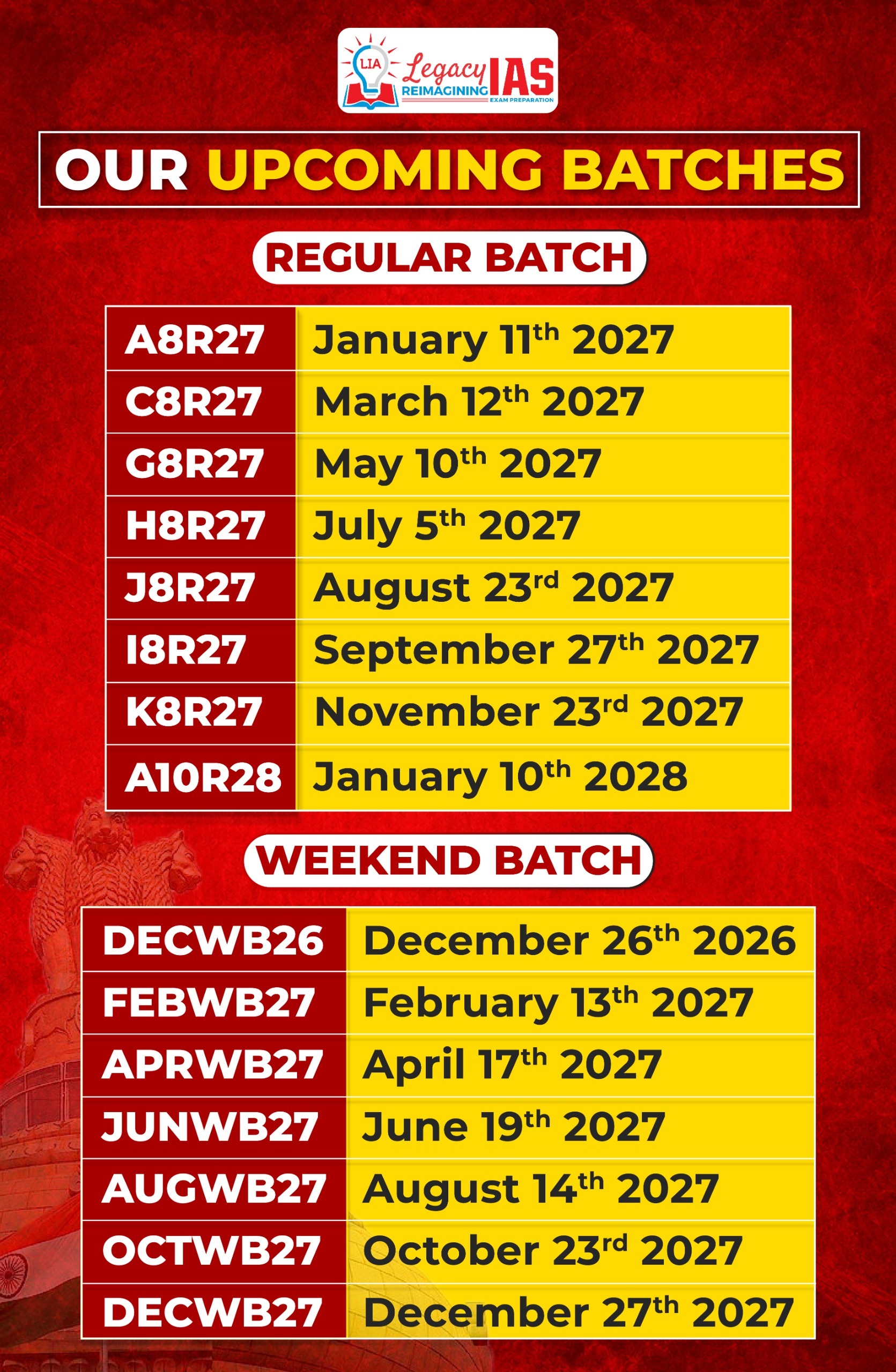
Serious about cracking UPSC CSE?
Join Legacy IAS Academy's structured Prelims + Mains programs, or get personalised mentorship from experienced faculty and toppers.
Legacy IAS Academy — Bengaluru
#1, 2nd Floor, KHB Colony, 5th Block, Koramangala, Bengaluru, Karnataka
Source: The Hindu, International Edition, 17 November 2026. Static background and frameworks have been added for exam preparation. Original article text has been paraphrased, not reproduced; this analysis is prepared independently for UPSC Civil Services exam preparation.