The Hindu — UPSC Analysis
Wednesday, 18 November 2026
Delhi City Edition · Vol. 16, No. 272 · Curated for Prelims & Mains | GS I · II · III · IV
📋 Today's Topics
- Quad, ASEAN and East Asia summits: PM calls for peace and predictabilityGS2
- U.S. blocks remote access to AI chips; China objectsGS3 · GS2
- Transgender rights after the 2026 amendmentGS2
- All-too fallible: the case against the death penaltyGS2 · GS4
- Elusive peace: Kulgam operations and the Statehood questionGS2 · GS3
- Nearly 75 lakh names added in draft SSR rollsGS2
- India needs a comprehensive doctrine on space securityGS3
- Fearmongering around fake drugsGS2
- The battle for responsible microfinanceGS3
- AI estimates vs ground evidence in official statisticsGS3 · GS2
- Voyager 1 reaches one light-day from EarthGS3
- Quick Prelims Revision (MCQ Bank)Prelims
- FAQsRevision
Quad, ASEAN and East Asia summits: PM calls for peace and predictability
Context
PM Narendra Modi attended three back-to-back summits in Manila: the ASEAN-India Summit, the East Asia Summit and the Quad Leaders' Summit. He called for "peace, stability, and predictability" and made proposals on maritime security, critical minerals and trade.
Background & Key Facts
- Quad: It was held in a non-member country for the first time, hosted by President Trump with Australia's Anthony Albanese and Japan's Sanae Takaichi. The joint statement opposed economic and maritime "coercion".
- Announcement: India will host the first Quad Business Forum in Mumbai in 2027.
- ASEAN-India: India and ASEAN make up nearly one-fourth of the world's population. India promised free e-visas for ASEAN tourists. Myanmar's junta leader was not invited.
- East Asia Summit: PM Modi proposed a seafarers' safety initiative, and said India supports peace efforts in Ukraine and West Asia.
- Japan: The India-Japan 2+2 Ministerial Dialogue is in Tokyo on November 18-19, after the JAIMEX 2026 naval exercise.
Critical Analysis
Quad revival: The summit ends a long gap and shows the grouping has survived strategic turbulence.
Balancing act: India works with the Quad while engaging Russia and China at the East Asia Summit.
Delivery matters: Business forums and safety initiatives must produce concrete outcomes.
Way Forward
- Build critical mineral supply chains with Quad partners.
- Conclude the AITIGA review with ASEAN.
- Operationalise maritime and seafarer safety cooperation.
Exam Relevance
Discuss the significance of India's participation in the Quad and East Asia Summit for its Indo-Pacific strategy. (GS2, 15 marks, 250 words)
JAIMEX is a bilateral maritime exercise between India and:
(a) Jamaica (b) Japan (c) Jordan (d) Indonesia
U.S. blocks remote access to AI chips; China objects
Context
The U.S. Commerce Department issued a rule to stop Chinese firms from accessing advanced AI chips remotely through data centres in third countries. China accused the U.S. of "abusing export control measures".
Background & Key Facts
- Rule: The Bureau of Industry and Security issued an interim final rule requiring licences to export advanced chips to Indonesia, Malaysia, Singapore, Thailand and Brazil, which it calls "higher-than-normal risk of diversion" countries.
- Loophole: Barred from buying top chips directly, Chinese firms used data centres in countries such as Malaysia.
- Nvidia link: Questions have arisen over chips supplied to a Singapore-based data-centre firm, amid the scandal over Jensen Huang's exit.
- Timing: The rule came days before President Trump's trip to Shenzhen for APEC.
Critical Analysis
Tech denial: Export controls are now a central tool in U.S.-China rivalry.
Third-country effect: Southeast Asian data-centre growth may slow under licensing.
Opportunity for India: India is not on the list, which may help it attract AI infrastructure if it meets security standards.
Way Forward (for India)
- Ensure strong compliance and export-control systems for data centres.
- Use the iCET and TRUST framework with the U.S. to secure chip access.
- Accelerate domestic semiconductor capacity.
Exam Relevance
How are export controls on advanced semiconductors reshaping global technology supply chains? What are the implications for India? (GS3, 10 marks, 150 words)
Which of the following countries was NOT named in the new U.S. rule on remote access to AI chips?
(a) Malaysia (b) Brazil (c) India (d) Thailand
Transgender rights after the 2026 amendment
Context
The Transgender Persons (Protection of Rights) Amendment Act, 2026 replaces self-identification with medical and administrative certification. An op-ed by physicians and public health workers argues this harms rights and health, and a Data Point shows a sharp fall in transgender voters during the SIR.
Background & Key Facts
- What changed: Recognition now needs a medical board's recommendation, selection from prescribed categories and certification by a District Magistrate. Trans men, trans women and genderqueer persons are removed from the statutory definition.
- Precedent: NALSA (2014) recognised the right to self-perceived gender identity under Article 21.
- Concerns: There is no appeal mechanism, and the definition departs from WHO ICD-11 and WPATH Standards of Care 8. Providers are delaying gender-affirming care.
- Voters: Transgender electors fell 31.4%, from 45,610 to 31,300, in the States analysed. In Delhi, the draft rolls cut about 64%.
- Certificates: 48,707 persons have registered for certificates, little over 10% of the 4.8 lakh counted in Census 2011. Over 9,000 applications are pending.
Critical Analysis
Autonomy vs verification: The authors say medical gatekeeping conflicts with NALSA. The government's view is that certification helps target welfare to genuine beneficiaries, and the authors accept the Act adds some protections.
Health risks: Uncertainty may push people towards unregulated hormones and unsafe procedures.
Exclusion from rights: Documentation barriers affect voting, insurance and welfare.
Way Forward
- Create an independent appeal mechanism for certification decisions.
- Train medical staff in transgender health, as the Madras HC's Sushma (2021) verdict mandates.
- Run targeted enrolment drives for transgender voters.
Exam Relevance
"Should the state protect a marginalised group through certification or by maximising autonomy?" Discuss with reference to transgender rights in India. (GS2, 15 marks, 250 words)
The Supreme Court recognised transgender persons as a "third gender" with the right to self-identify in:
(a) Navtej Singh Johar (2018) (b) Puttaswamy (2017) (c) Suresh Kumar Koushal (2013) (d) NALSA (2014)
All-too fallible: the case against the death penalty
Context
After India voted against the UN moratorium on executions, the editorial "All-too fallible" argues that the death penalty requires an infallible justice system that India does not have.
Background & Key Facts
- Death row: 574 people were on death row on December 31, 2025, the highest since 2016.
- Releases: The Supreme Court released 38 people from death row in 2016-2025 after an average of eight years there (Project 39A).
- Law Commission: Its 2015 report under Justice A.P. Shah recommended abolition for all crimes except terrorism and waging war.
- Expansion: The BNS added capital offences. India's last executions were in 2020.
- Government's position: Retention is a sovereign choice protected by safeguards such as "rarest of rare" and High Court confirmation.
Critical Analysis
Deterrence unproven: Research finds no added deterrence over life imprisonment.
Penal populism: Harsh penalties respond to public anger without fixing poor policing.
Unintended effect: Death for non-fatal crimes may lead offenders to kill witnesses.
Other view: Supporters argue it is a just response to the gravest crimes and reflects public sentiment.
Way Forward
- Suspend executions pending a review, as the editorial suggests.
- Remove the death penalty for crimes not involving intentional killing.
- Improve investigation, prosecution and legal aid.
Exam Relevance
"The death penalty requires a near-infallible criminal justice system." Critically examine this statement in the Indian context. (GS4, 10 marks, 150 words)
The 2015 Law Commission report recommending abolition of the death penalty, except for terrorism and waging war, was headed by:
(a) Justice A.P. Shah (b) Justice B.S. Chauhan (c) Justice Ritu Raj Awasthi (d) Justice J.S. Verma
Elusive peace: Kulgam operations and the Statehood question
Context
A week-long anti-terror operation in civilian areas of Kulgam followed the November 11 attack on a CRPF checkpoint. The editorial "Elusive peace" says restoring Statehood is essential for lasting peace in J&K.
Background & Key Facts
- Operation: Officials identified the man killed as Umar Nisar Dar, a baker not on any terrorist list, suspected of joining LeT operative Lateef Bhat. His family had filed a missing person report.
- Criticism: The NC, the PDP and CPI(M) leaders objected to prolonged restrictions on villages. Mehbooba Mufti called it "collective punishment".
- Other incident: Two SPOs were found dead in Kishtwar, with conflicting accounts.
- Security gains: Police say local recruitment is now in single digits.
- Governance: The elected government has no control over police, since J&K has been a UT since 2019.
Critical Analysis
Security vs alienation: Strict operations have reduced violence, but harsh measures on civilians risk resentment.
Accountability gap: Without Statehood, elected leaders cannot respond to public concerns about policing.
Government's view: Security agencies argue that thorough searches are needed to find attackers hiding in residential areas.
Way Forward
- Set a timeline for restoring Statehood, as promised.
- Follow SOPs that limit hardship to civilians during operations.
- Pair security with political outreach to all stakeholders.
Exam Relevance
"The absence of violence is not the same as peace." Discuss in the context of Jammu and Kashmir. (GS3, 15 marks, 250 words)
Jammu and Kashmir became a Union Territory with a legislature under the J&K Reorganisation Act passed in:
(a) 2014 (b) 2019 (c) 2021 (d) 2024
Nearly 75 lakh names added in draft SSR rolls
Context
Draft rolls published under the Special Summary Revision in 13 States and UTs added nearly 75 lakh names, months after the Special Intensive Revision shrank electorates.
Background & Key Facts
- Numbers: The electorate in these States was 49.61 crore before the SIR, 45.22 crore after it, and 45.96 crore in the draft SSR, a 1.64% rise.
- States: U.P. added 18.84 lakh, the most in absolute terms, while Goa had the highest rate at 3.01%.
- Delay: The SSR was on hold after the SIR began, which Election Commissioners S.S. Sandhu and Vivek Joshi recently highlighted.
- Expansion: It now covers more States, including Karnataka and Meghalaya.
Critical Analysis
Corrective effect: Additions recover some names lost in the SIR and enrol new voters.
Net loss remains: Electorates are still well below pre-SIR levels.
Vulnerable groups: Data on transgender electors shows deletions fall heavily on marginalised groups.
Way Forward
- Hold the SSR annually without gaps.
- Run special drives for first-time, migrant and marginalised voters.
- Publish reasons for deletions at booth level.
Exam Relevance
Examine the role of annual roll revisions in ensuring universal adult franchise. (GS2, 10 marks, 150 words)
Under the four qualifying dates for voter enrolment, which of the following is NOT one?
(a) January 1 (b) April 1 (c) October 1 (d) December 1
India needs a comprehensive doctrine on space security
Context
Brigadier (retd.) Advitya Madan argues that space has become critical infrastructure, and that India needs a doctrine covering disruption, attribution and recovery.
Background & Key Facts
- Changing threats: The concern has shifted from destroying satellites to disrupting services through jamming, spoofing, cyber interference and electronic warfare.
- Hard questions: What counts as an attack, how to attribute it, and how to tell accidental interference from a deliberate one.
- Existing framework: The Indian Space Policy 2023 and ISRO's ISSAR-2025 report on space situational awareness.
- Private players: Commercial operators now run much of the space ecosystem.
Critical Analysis
Resilience first: Redundancy and quick recovery matter more than building weapons.
Escalation risk: Unclear thresholds could cause misjudged responses in a crisis.
Peaceful use: The author stresses that a doctrine need not mean weaponisation.
Way Forward
- Define thresholds and response principles for space disruption.
- Expand space domain awareness.
- Build government-industry information sharing.
Exam Relevance
"In space, the shift is from destruction to disruption." Discuss the need for a space security doctrine for India. (GS3, 15 marks, 250 words)
India's anti-satellite missile test, Mission Shakti, was conducted in:
(a) 2017 (b) 2021 (c) 2019 (d) 2023
Fearmongering around fake drugs
Context
After reports of fake cancer drugs seized in Karnataka, Dinesh S. Thakur and Prashant Reddy T. argue that the government has not confirmed the seizure and that fears about counterfeit drugs are often exaggerated.
Background & Key Facts
- Doubt: A list circulated on social media contained only antibiotics, not cancer drugs. The authors urge the State Health Department to clarify.
- Data: The 2017 National Drug Survey found counterfeit drugs at only 0.0245%. The "25%" figure often attributed to the WHO is a myth.
- Why low: Drug trade requires records under Section 19(3) of the Drugs and Cosmetics Act, 1940.
- Real gaps: There is no licensing for drug transporters, and WHO Good Distribution Practices have been pending for over a decade.
Critical Analysis
Proportionate response: Expensive anti-counterfeit technologies could raise drug prices.
Lobbying concern: The authors warn of industry pressure, including through PILs.
Quality is the bigger issue: Substandard drugs, distinct from counterfeits, may be a larger problem.
Way Forward
- Communicate clearly and quickly after drug seizures.
- License transporters and adopt Good Distribution Practices.
- Base anti-counterfeiting policy on evidence.
Exam Relevance
Distinguish between substandard and spurious drugs. What reforms are needed in India's drug distribution system? (GS2, 10 marks, 150 words)
The 2017 National Drug Survey found the share of counterfeit (spurious) drugs in the Indian market to be about:
(a) 25% (b) 0.0245% (c) 3% (d) 10%
The battle for responsible microfinance
Context
The RBI has taken a firm line that financial inclusion cannot come at the cost of over-indebted households, as the microfinance sector recovers from two years of stress.
Background & Key Facts
- Recovery: Early-stage delinquency fell to 1.9% in June 2026 from 6.1%, but loans overdue by more than 180 days are at 17.4%.
- Size: The portfolio fell 12% to ₹2.69 lakh crore (SIDBI-Equifax), with 7.15 crore active accounts. April-June disbursements rose 17%.
- Industry demands: Raise the ₹3 lakh household income threshold (set in 2022) and review the 50% fixed-obligation-to-income ratio (FOIR).
- RBI stance: Lenders must give a Key Facts Statement and obtain the borrower's acknowledgement, and the RBI warns against "pseudo-consent".
Critical Analysis
Inclusion vs prudence: Strict rules protect borrowers but may push them to moneylenders.
Outdated threshold: The income limit has not kept up with inflation.
Multiple lending: Over-borrowing from several lenders caused the past crisis.
Way Forward
- Index the income threshold periodically.
- Strengthen credit bureau checks across lenders.
- Promote financial literacy among borrowers.
Exam Relevance
"Financial inclusion cannot come at the cost of household over-indebtedness." Discuss with reference to the regulation of microfinance in India. (GS3, 10 marks, 150 words)
Under the RBI's microfinance framework, the annual household income limit for a microfinance loan is:
(a) ₹1.25 lakh (b) ₹2 lakh (c) ₹3 lakh (d) ₹5 lakh
AI estimates vs ground evidence in official statistics
Context
A Text & Context piece warns that AI and synthetic data can make statistics faster, but cannot replace ground-level surveys. Poor use could misallocate public resources.
Background & Key Facts
- Synthetic data: Models such as GANs can create artificial records that resemble real data.
- Risk: Models trained on urban data may miss informal workers, migrants and women's unpaid work.
- VISTAR: It proposes raising major surveys from 43 to 59 during the 16th Finance Commission cycle.
- Informal economy: ASUSE 2025 covered over 6.7 lakh establishments.
Critical Analysis
Inherited bias: Synthetic data repeats the gaps in its training data.
Policy impact: Errors could distort funding for welfare schemes.
Trust: Undisclosed AI use may weaken confidence in official data.
Way Forward
- Use AI only to supplement primary data, with full disclosure.
- Validate model estimates against field surveys.
- Set governance standards for AI in statistics.
Exam Relevance
Examine the opportunities and risks of using AI and machine learning in India's official statistical system. (GS3, 10 marks, 150 words)
The Annual Survey of Unincorporated Sector Enterprises (ASUSE) covers:
(a) Non-farm informal enterprises (b) Listed companies only (c) Agricultural households (d) Public sector units
Voyager 1 reaches one light-day from Earth
Context
Voyager 1 is now one light-day, or almost 26 billion km, from Earth. A signal takes a full day to travel each way.
Background & Key Facts
- Records: It has been the farthest human-made object since February 17, 1998, and travels at 61,000 km/h.
- Ageing craft: Its cameras were switched off in 1990, and by 2026 only two of 10 instruments remain online.
- Unplanned science: Its ultraviolet spectrometer's "noise" turned out to be galactic cosmic rays, as reported in 2014.
- Einstein test: Data from its Saturn flyby later gave independent support for a prediction of general relativity.
Critical Analysis
Value of old data: Archived measurements can find new uses with new theories.
Long missions: Durable design and careful power management extend scientific returns.
Lesson for India: Long-term data archiving should be built into ISRO missions.
Way Forward
- Preserve and open mission data for researchers.
- Invest in deep-space communication networks.
- Plan for India's own outer planetary missions.
Exam Relevance
Discuss the scientific contributions of long-duration space missions such as Voyager 1. (GS3, 10 marks, 150 words)
The boundary where the solar wind is stopped by interstellar medium, which Voyager 1 crossed in 2012, is called the:
(a) Heliopause (b) Kuiper Belt (c) Oort Cloud (d) Van Allen belt
Quick Prelims Revision (MCQ Bank)
Q1. Which country won a 2026 Earthshot Prize at the ceremony in Mumbai?
(a) Nepal (b) Bhutan
(c) Sri Lanka (d) Maldives
Answer: (b) — Bhutan and Mahindra Last Mile Mobility were among the five winners. It was the first time the prize was held in India.
Q2. The black-necked crane, whose population in Ladakh rose to 108 in 2026, is classified by the IUCN as:
(a) Endangered (b) Critically Endangered
(c) Near Threatened (d) Least Concern
Answer: (c) — It is "Near Threatened" and is Ladakh's State bird. Its numbers rose about 25% from 87 last year.
Q3. Which countries lost their measles-elimination status, according to recent reports?
(a) U.S., Mexico and Bolivia (b) India and Pakistan
(c) U.K. and France (d) Brazil and Argentina
Answer: (a) — The spread, largely among unvaccinated people, is at its highest in over 30 years.
Q4. MSF-led studies in Bihar contributed to updated WHO guidance on treating HIV co-infection with which disease?
(a) Tuberculosis (b) Malaria
(c) Dengue (d) Visceral Leishmaniasis (Kala-azar)
Answer: (d) — The studies, with DNDi research in Ethiopia, found combination therapy worked better than a single drug.
Q5. According to the Agriculture Ministry, wheat sowing so far this rabi season is down by about:
(a) 5% (b) 10%
(c) 25% (d) 15%
Answer: (d) — Wheat has been sown on 50.07 lakh hectares, down 15.27% from 59.10 lakh hectares a year ago.
Q6. Which country recently sanctioned eight Israeli companies involved in West Bank settlement construction?
(a) France (b) United Kingdom
(c) Germany (d) Canada
Answer: (b) — The U.K. imposed sanctions to halt new construction that threatens the two-state solution.
Q7. Reliance plans to set up about 100 of which type of plant by 2030?
(a) Compressed biogas (b) Green hydrogen
(c) Small modular reactors (d) Lithium refineries
Answer: (a) — It plans about 100 compressed biogas plants using agricultural residue, costing about ₹150 billion.
Q8. According to the "State of state finance 2026-27" report, States are estimated to spend about what share of GDP on cash transfer schemes in 2026-27?
(a) 0.3% (b) 1%
(c) 3% (d) 5%
Answer: (b) — About 1% of GDP (around ₹4 lakh crore), up from 0.6% in 2022-23.
Frequently Asked Questions
What were the key outcomes of the Manila summits for India?
The Quad joint statement opposed economic and maritime coercion, and India will host the first Quad Business Forum in 2027. India offered free e-visas to ASEAN tourists and proposed a seafarers' safety initiative at the East Asia Summit.
What does the 2026 transgender amendment change?
It replaces self-identification with a medical board recommendation, prescribed categories and District Magistrate certification. Critics say this conflicts with the NALSA judgment and lacks an appeal process. The government says it aims to better target protections.
Why does the editorial call for suspending executions?
It points to 574 people on death row, the Supreme Court releasing 38 from death row over a decade, no evidence of added deterrence and unequal legal representation. It argues that the system cannot guarantee against error.
Why is the U.S. restricting AI chip access through third countries?
Chinese firms barred from buying advanced chips were using data centres in countries such as Malaysia. The new rule requires licences for exports to five higher-risk countries to close this route.
Is counterfeit medicine a widespread problem in India?
According to the 2017 National Drug Survey, counterfeits made up only 0.0245% of samples. The authors argue the bigger gaps are unlicensed transport and the absence of Good Distribution Practices.
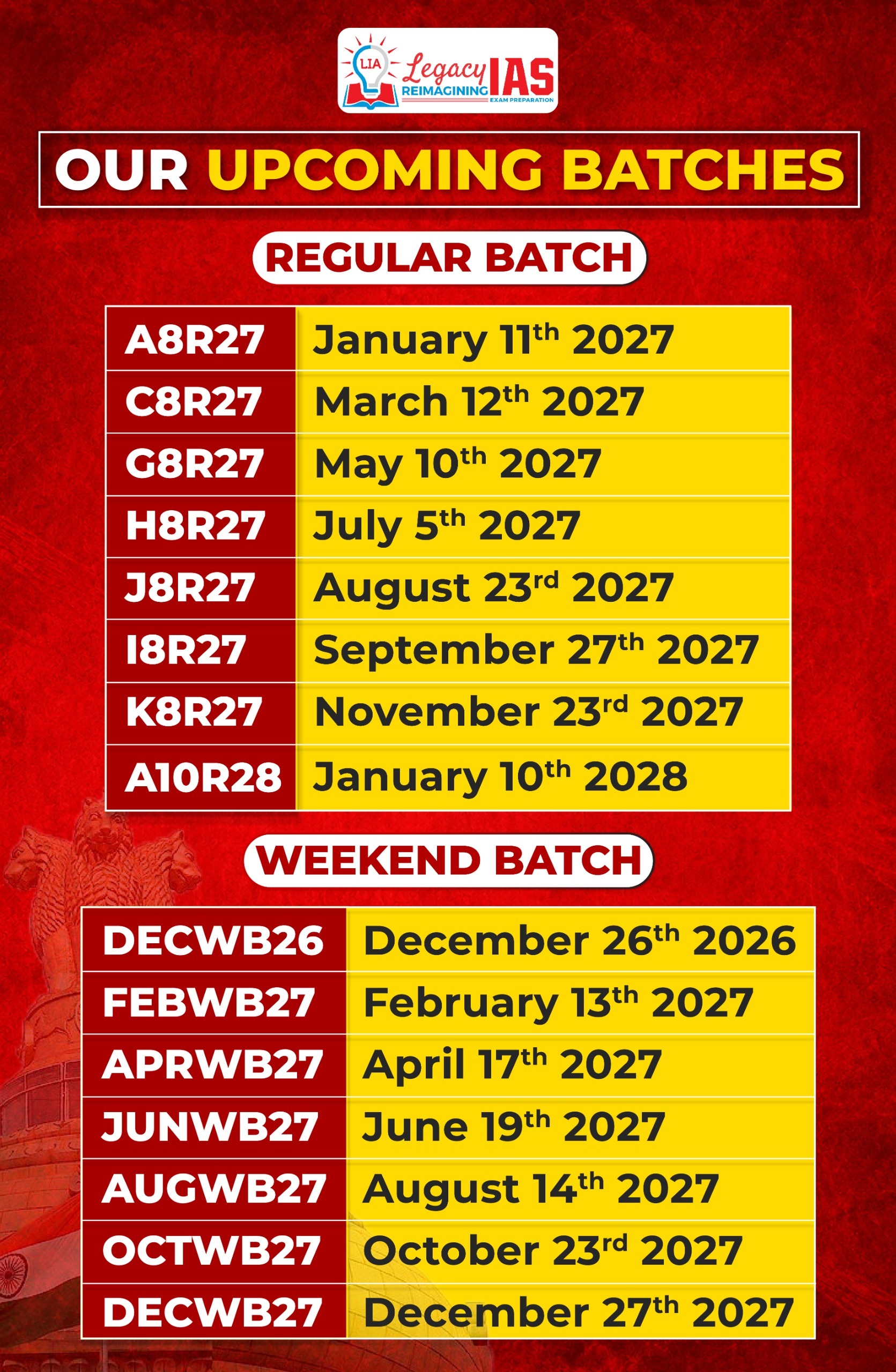
Serious about cracking UPSC CSE?
Join Legacy IAS Academy's structured Prelims + Mains programs, or get personalised mentorship from experienced faculty and toppers.
Legacy IAS Academy — Bengaluru
#1, 2nd Floor, KHB Colony, 5th Block, Koramangala, Bengaluru, Karnataka
Source: The Hindu, Delhi City Edition, 18 November 2026. Static background and frameworks have been added for exam preparation. Original article text has been paraphrased, not reproduced; this analysis is prepared independently for UPSC Civil Services exam preparation.