
Why in News?
Renewed U.S. Assertiveness in the Arctic
- Days after a U.S. military strike on Venezuela and capture of President Nicolás Maduro, Donald Trump intensified calls to acquire Greenland, calling it an “absolute necessity” for U.S. national security, triggering global debate on NATO’s future.
Relevance
- GS Paper 1: Arctic geography, strategic significance of polar regions, impact of climate change on geopolitical spaces.
- GS Paper 2: International relations, NATO, collective security, U.S. foreign policy shifts, alliance politics, India’s strategic autonomy lessons.
Greenland Proposal and NATO’s Core Contradiction
Challenge to NATO’s Foundational Principle
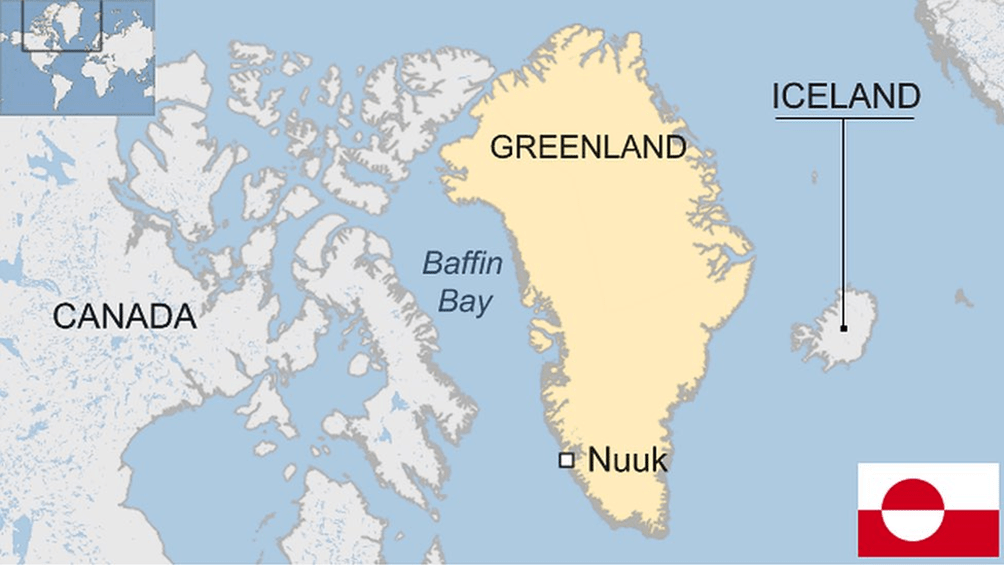
- Greenland is an autonomous territory of Denmark, a member of North Atlantic Treaty Organization, whose Article 5 treats an attack on one member as an attack on all.
Unilateralism vs Alliance Commitments
- Trump’s proposal signals a shift from alliance-based security to unconstrained unilateralism, undermining the credibility of NATO’s collective defence pledge.
Strategic Drivers Behind U.S. Interest in Greenland
Security and Strategic Geography
- Greenland’s location offers dominance over Arctic air and maritime approaches, critical for missile defence, early-warning systems, and control of emerging polar sea lanes.
Shipping Routes and Arctic Sea Lanes
- Two key routes define Arctic geopolitics:
- Northern Sea Route (NSR) along Russia’s Siberian coast
- Northwest Passage through the Canadian Arctic Archipelago
- Control over Greenland does not directly govern the Northwest Passage, raising questions about the strategic logic of sovereignty acquisition.
Resource Competition
- Greenland is rich in rare earth elements, hydrocarbons, and minerals, intensifying interest amid global energy transition and resource nationalism.
Arctic Governance and Existing Institutional Order
Established Arctic Frameworks
- The Arctic is already governed by well-developed political and institutional arrangements, involving Arctic states such as Russia, Denmark, Canada, and Norway.
Limited U.S. Long-Term Investment
- Unlike Russia, which operates extensive Arctic ports and nuclear-powered icebreaker fleets, the U.S. has invested minimally in Arctic infrastructure and energy development.
Russia’s Strategic Calculus
Russia as the Dominant Arctic Power
- Russia is the most entrenched Arctic actor, with centuries of presence, logistics networks, and military capabilities across the Arctic Sea.
The Russian Dilemma
- A weakened NATO suits Moscow strategically, but a stronger U.S. Arctic presence via Greenland would intensify long-term U.S.–Russia competition in the polar region.
Linkages with Ukraine Negotiations
- Arctic cooperation is reportedly part of broader U.S.–Russia discussions on Ukraine, making Greenland a bargaining chip in wider geopolitical negotiations.
Implications for NATO and European Security
Erosion of Trust in U.S. Security Guarantees
- Trump’s willingness to threaten a NATO member’s sovereignty sends a destabilising signal to smaller NATO states already wary of Russian assertiveness.
Europe’s Defence Dependency
- Europe has underinvested in defence for decades, relying heavily on U.S. military power; even with increased defence spending, capability gaps will persist in the medium term.
MAGA Worldview and Alliance Fatigue
- Trump’s second term reflects the rise of MAGA ideology, which views alliances as burdens and rejects the U.S. role as global security guarantor.
Greenland and the Western Hemisphere Doctrine
Strategic Consolidation of U.S. Influence
- Trump’s Greenland push aligns with a broader worldview that U.S. interests lie primarily in securing the Western Hemisphere, rather than sustaining global alliance networks.
Sovereignty, Not Influence
- Unlike traditional U.S. security partnerships, Trump seeks outright sovereign control, marking a departure from post-World War II norms.
Resource Coercion and Foreign Policy Style
From Venezuela to Greenland
- U.S. actions—from oil politics in Venezuela to rare earth interests in Greenland—suggest a pattern of coercive bargaining linked to resource access.
Deal-Making over Occupation
- Trump prefers quick, transactional deals and avoids prolonged military occupation, reflecting a cost-minimisation approach rather than imperial overstretch.
Can NATO Survive a Second Trump Term?
Protector Turning Tormentor
- European leaders increasingly view Trump’s posture as one where their traditional protector becomes a source of strategic uncertainty.
Likely European Response
- Europe may seek accommodation—pressuring Denmark to offer face-saving arrangements—to keep the U.S. within NATO and avoid alliance collapse.
Structural Vulnerability of NATO
- NATO’s survival rests not only on military capacity but on U.S. political commitment; erosion of this commitment risks deepening European divisions and weakening collective security.
Core Takeaways
Arctic as the New Geopolitical Frontier
- The Arctic is emerging as a zone of strategic rivalry driven by climate change, resource access, and new shipping routes.
End of Assumed U.S. Benevolence
- Trump’s Greenland proposal signals a potential end to the assumption that the U.S. will always act as a benign guarantor of allied security.
NATO at an Inflection Point
- The episode is a wake-up call for Europe: without strategic autonomy and defence self-reliance, NATO’s future remains hostage to domestic politics in Washington.


