
Why in news ?
- New research (Nature, 2025) has demonstrated progress toward a broad-spectrum, next-generation antivenom using camelid-derived nanobodies — a potential shift away from India’s six-decade-old horse-serum–based antivenom model.
- Parallel Indian work (NRC on Camel, Bikaner) shows camel-antivenom efficacy against Sochurek’s saw-scaled viper, signalling scope for region-specific, modern antivenom platforms.
- The issue is critical because snakebite remains a major public-health burden in rural India, despite medical advances.
Relevance
- GS-II (Health, Governance of Public Health Systems)
- Neglected tropical diseases, rural health inequity, service delivery gaps
- GS-III (Science & Technology, Biotechnology & Public Health Innovation)
- Nanobody-based antivenom, translational research, Make-in-India biologics
Scale of the problem
- India records ~58,000 snakebite deaths annually (Lancet estimates), with highest mortality in Uttar Pradesh, Bihar, Jharkhand, Madhya Pradesh, Rajasthan.
- Deaths primarily affect farm workers, paddy cultivators, and rural households — a classic neglected tropical disease (NTD) (WHO classification).
- Case-fatality worsens due to late referral, inadequate antivenom availability, poor transport, lack of trained rural health staff, and regional venom variation.
Basics — venom, species and clinical effects
- Three major toxic effects of venoms
- Haemotoxic → bleeding, clotting failure (common in vipers)
- Neurotoxic → respiratory / muscle paralysis (typical in cobras & kraits)
- Cytotoxic → local tissue necrosis, disability/amputations
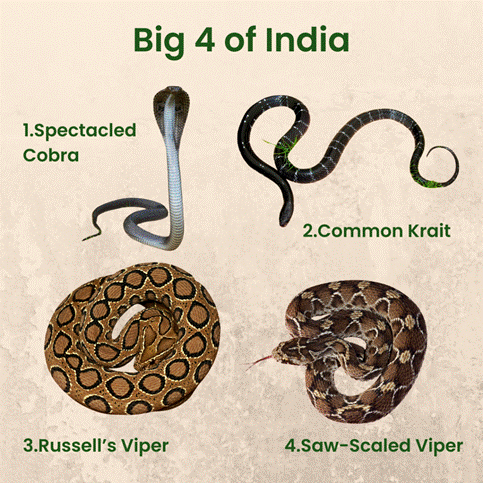
- India’s medically important species (“Big Four”)
- Spectacled cobra, common krait, Russell’s viper, saw-scaled viper
- Problem: India has >60 venomous species and strong geographical venom variation → current antivenom often mismatched.
Conventional antivenom — process & limitations
- Venom from the Big Four is injected into horses → repeated immunisation → antibodies harvested from plasma → purified, freeze-dried, supplied in vials.
- Limitations
- Designed for Big Four only; poor coverage for other species / regional variants
- Batch variability, high cost, cold-chain dependence
- Adverse reactions (serum sickness, anaphylaxis) due to heterologous horse proteins
- Requires multiple vials and ICU support → increases mortality in peripheral settings.
Twenty-first-century approach — nanobody / recombinant technology
- Camelid family (camels, llamas, alpacas) produce unique single-domain antibodies (“nanobodies”)
- Small, stable, heat-tolerant, highly specific, easier to mass-produce in bacteria
- Research workflow (Danish–international collaboration, Africa focus)
- Venoms of 18 medically important species collected
- Injected into alpaca & llama → strong immune response
- B-cells isolated → nanobody genes cloned into bacteriophage vectors
- High-affinity binders selected → recombinant nanobodies manufactured
- Animal trials showed protection against 17 of 18 venoms tested
- Indian progress
- NRC-Camel (Bikaner) demonstrated camel-derived antivenom neutralisation for Sochurek’s saw-scaled viper (Rajasthan region) → pathway for region-specific platforms.
Why this matters for India ?— policy & health relevance
- Potential for broad-spectrum, pan-regional antivenom reducing:
- Mortality & amputations
- Dose requirements & adverse reactions
- Cost and dependence on horse-serum collection
- Supports WHO’s Snakebite Envenoming Roadmap (2030) — targets 50% reduction in deaths and disabilities.
- Aligns with India’s priorities: rural health equity, indigenous biotech, Make-in-India biologics, cold-chain-light therapeutics.
Challenges going forward
- Translational gap — moving from lab success to clinical trials, regulatory approval, GMP manufacturing.
- Need species-wise & geography-wise validation for India’s venom diversity.
- Supply-chain planning (district hospitals, PHCs), training for early administration, and public awareness against harmful first-aid practices.
- Sustained investment in surveillance, toxinomics databases, and regional venom banks.
Way ahead — actionable priorities
- Expand Indian nanobody platforms beyond pilot species; build national venom biobank + genomic / proteomic mapping.
- Develop region-calibrated antivenom portfolios (Deccan, Indo-Gangetic, Western Ghats, Arid zones).
- Integrate rapid diagnostics, ambulance referral networks, and standardised treatment protocols in rural health systems.
- Public-health messaging on boots, torches, field safety, and immediate hospitalisation.


