
WHY IS IT IN NEWS?
- The western tragopan, one of India’s rarest pheasants and the State bird of Himachal Pradesh, has shown successful captive breeding at the Sarahan Pheasantry, with 46 individuals currently maintained.
- However, experts warn that the species’ long-term survival remains uncertain because:
- Only 3,000–9,500 mature individuals survive in the wild.
- All belong to one subpopulation, increasing genetic vulnerability.
- Habitat fragmentation, climate change, and human disturbance continue to threaten wild populations.
- Reintroduction trials (2020–21) showed early signs of viability, but funding gaps and need for more research have stalled further releases since 2023.
Relevance
GS-III – Environment & Ecology
- Species conservation (IUCN Vulnerable)
- Ex-situ vs in-situ conservation
- Habitat loss, fragmentation, climate change effects
- Reintroduction protocols; genetic diversity management
- Human–wildlife interface in Himalayan ecosystems
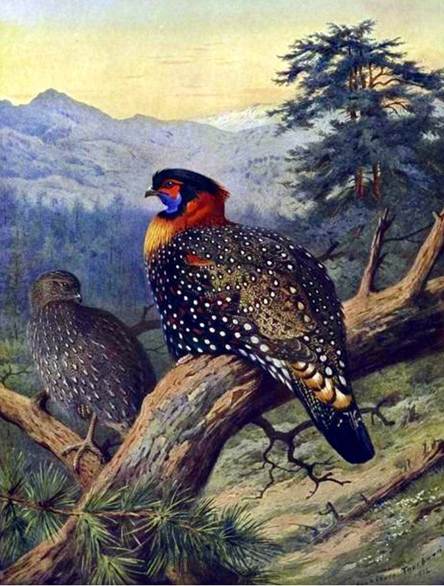
WHAT IS THE WESTERN TRAGOPAN?
a) Taxonomy
- Scientific name: Tragopan melanocephalus
- Family: Phasianidae (pheasants & partridges)
- Distribution: Historically Jammu & Kashmir, Himachal Pradesh, Uttarakhand; now restricted to fragmented Himalayan pockets.
b) IUCN Status
- Vulnerable (but with rapidly declining numbers; conservationists consider it closer to “Endangered”).
c) Habitat
- Prefers dense temperate broadleaf and conifer forests, usually between 2,000–3,600 m elevation.
d) Ecological role
- Indicator species for high-altitude forest health, sensitive to disturbance & climate variability.
POPULATION STATUS & FRAGMENTATION
a) Wild population
- 3,000–9,500 mature individuals
- All part of a single subpopulation → high extinction risk
- Distributed across western Himalayas & parts of northern Pakistan
b) Key threats
- Habitat fragmentation
- Encroachment & grazing pressure
- Climate variability disrupting breeding cycles
- Declining insect availability for chicks
- Human disturbance in breeding zones
THE MISSING LINK: IN-SITU CONSERVATION
Experts repeatedly emphasise that ex-situ breeding cannot substitute for habitat protection.
Key issues:
- Habitat loss continues → forests crucial for wild survival remain threatened.
- Breeding failures linked to climate variability:
- Warming at lower altitudes
- Unsynchronised timing between chick hatch and insect peak
- Dependence on community support:
- Locals in Pakistan voluntarily protect breeding zones
- Similar models could be explored in India
- Conservation benefits remain stagnant despite crores spent because:
- Birds were produced
- But wild habitats were not strengthened simultaneously
COMMUNITY-BASED CONSERVATION: A PROMISING MODEL
- Birdwatchers and local guides report stronger sightings in areas where villagers minimise disturbance.
- Community-based tourism provides alternative income → reduces pressure on forests.
- Examples: Rakhundi, Shilt regions
- Positive local stewardship reshapes conservation outcomes


