
WHY IS IT IN NEWS?
- The World Inequality Report 2026, led by economists Lucas Chancel, Ricardo Gómez-Carrero, Ravaida Mushrif, and Thomas Piketty, reveals that India’s income inequality is among the highest in the world.
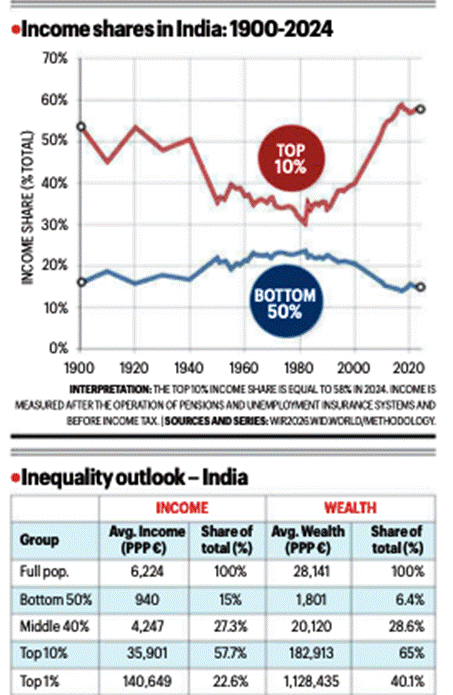
- The top 10% of earners capture 58% of national income, while the bottom 50% receive only 15%.
- Wealth inequality is even sharper: the top 1% owns 40% of total wealth, and the bottom 50% owns just 6%.
- The findings mark a continued rise in inequality despite earlier improvements post-liberalisation.
Relevance
GS-III – Economy
- Income & wealth inequality trends
- Structural drivers: informality, labour markets, capital concentration
- Impact on growth quality, consumption demand, productivity
- Policy responses: taxation, social security, universal services
GS-II – Welfare & Governance
- Public service delivery gaps
- Social protection mechanisms for bottom 50%
- Fiscal policy design (wealth tax, inheritance tax debates)
WHAT IS THE WORLD INEQUALITY REPORT?
a) What is it?
- An annual global study by the World Inequality Lab, analysing distribution of income, wealth, gender inequality, and public vs private assets.
b) Why it matters?
- Provides country-wise comparable data.
- Influences global debates on taxation, welfare, job creation, and inequality.
- Uses multiple data sources: national accounts, tax data, household surveys.
KEY FINDINGS FOR INDIA (INCOME INEQUALITY)
a) Income Shares in 2024
- Top 10%: 58% of national income
- Middle 40%: 27%
- Bottom 50%: 15%
b) Historical trend
- Inequality fell after Independence → lowest in 1980s
- Rose sharply after 1991 liberalisation
- Since 2000s, India among world’s most unequal economies
c) Comparison with 2023
- Top 10% share: rose from 57% → 58%
- Bottom 50% share: marginal improvement from 13% → 15%
WHY INEQUALITY IS WORSENING
A) Structural economic factors
- High informality in labour markets → low wages
- Unequal access to education & health
- Skill-biased growth favouring tech-intensive sectors
- Concentration of corporate power and private capital
- Regional disparities (South & West more developed than North-Central regions)
B) Wealth concentration mechanisms
- Rising property prices
- High returns on capital vs wages
- Growth of billionaire wealth → tripled in 10 years
- Limited inheritance taxation or wealth taxes
C) Labour market outcomes
- Women earn only 64% of what men earn for equal work
- Unpaid labour and care burden remain high
- Agricultural wages remain stagnant despite growth in service economy
GLOBAL CONTEXT
- Inequality reduced in Asia, Europe, North America during 20th century, but:
- Since 1980, 40% of global wealth growth captured by the top 1%
- India mirrors global trend but with more extreme concentration
Geography of inequality (report highlights)
- High inequality regions:
- Middle East & North Africa
- Latin America
- India
- Sub-Saharan Africa
- Low inequality regions:
- Europe
- East Asia (Japan, South Korea)
SOCIAL & ECONOMIC CONSEQUENCES FOR INDIA
A) Economic growth quality
- High inequality → reduces consumption demand
- Limits human capital formation
- Weakens long-term growth sustainability
B) Social impacts
- Reduced social mobility
- Intergenerational inequality
- Increased risk of social tension
- Gender disparity persists
C) Policy impacts
- Public investments (health, education, skilling) face pressure
- Widening gap between urban digital economy and rural informal economy
POLICY DEBATES RAISED BY THE REPORT
Possible interventions (as per global best practices):
- Progressive taxation
- Wealth tax or inheritance tax
- Stronger taxation on capital gains & high-income groups
- Universal basic services
- Health, education, childcare reforms
- Social security for informal workers
- Labour market reforms
- Higher minimum wages
- Strengthening collective bargaining
- Gender-focused interventions
- Reducing unpaid labour burden
- Ensuring equal pay structures
- Regional balancing
- Targeted investment in backward districts
- Rural infrastructure & skilling


