Fiscal Federal Context
- 16th Finance Commission (FC) report tabled in Lok Sabha sets tax devolution and local body grants framework, signalling stronger fiscal recognition of urbanisation, municipal finance needs, and decentralised service delivery.
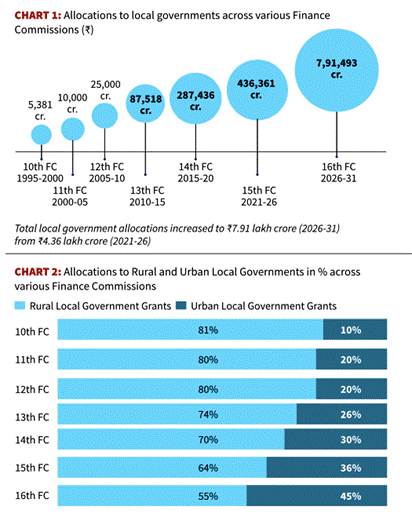
- Commission recommended ₹3.5 lakh crore for Urban Local Governments (ULGs) over five years, reflecting unprecedented scale-up in urban fiscal support amid rapid urbanisation and infrastructure stress.
Relevance
GS II — Polity & Governance
- Finance Commission (Article 280), fiscal federalism, Centre–State–ULB relations.
- Urban governance, decentralisation, and municipal finance reforms.
GS III — Economy
- Urban infrastructure financing, municipal bonds, property tax reforms.
- Public expenditure quality and local fiscal capacity.
Background — Finance Commission & Urbanisation
Role of Finance Commission
- Finance Commission, under Article 280, recommends vertical and horizontal devolution, including grants to local bodies to strengthen fiscal capacity and cooperative federalism.
- Urban grants aim to improve first-mile infrastructure, service delivery, and municipal governance in water, sanitation, mobility, and local public goods.
Urbanisation Context
- India’s urban population projected near 40% by 2036, increasing pressure on urban infrastructure, housing, and services, necessitating stronger municipal finances.
Key Recommendations — 16th FC
Quantum of Allocation
- Recommended ₹3.5 lakh crore to ULGs for five years, roughly matching Centre’s share in centrally sponsored urban schemes over previous 13 years combined (Janaagraha analysis).
- Marks 230% increase over 15th FC allocation of ₹1.5 lakh crore (2021–26), signalling major fiscal shift toward urban governance.
Share in Local Body Grants
- ULGs’ share in total local government grants raised to 45% from 36% earlier, indicating prioritisation of urban governance alongside Panchayati Raj Institutions.
Urbanisation Premium Grant
- Introduced ₹10,000 crore urbanisation premium grant to incentivise planned rural–urban transition, supporting emerging towns facing demographic and economic transformation pressures.
Grant Design & Structure
Basic vs Tied Grants
- Over 60% grants categorised as basic grants; tied components target core services like water supply and sanitation, ensuring minimum service standards.
- Untied grants allow location-specific spending flexibility, excluding salary and establishment costs, promoting local prioritisation and accountability.
State-wise Trends
Distribution Patterns
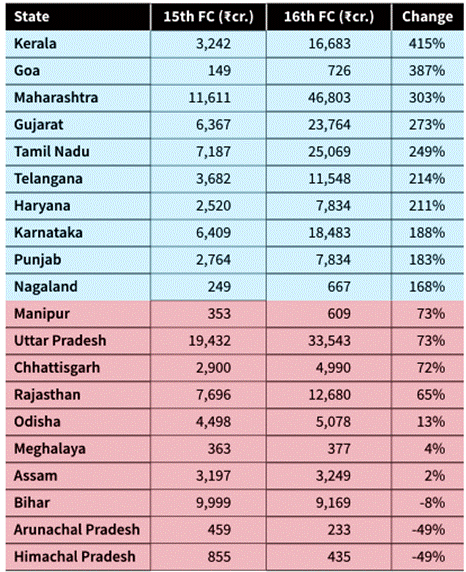
- Kerala recorded >400% increase in allocation, reflecting demographic and urban governance indicators; suggests performance-sensitive distribution.
- Himachal Pradesh saw ~50% decline, possibly linked to lower urbanisation levels or revised formula weights.
Economic & Governance Significance
Strengthening Municipal Capacity
- Enhanced grants can reduce ULG dependence on State transfers, enabling better own-source revenue leverage, creditworthiness, and municipal bond potential.
- Supports decentralised delivery of public goods, improving urban productivity, livability, and economic competitiveness.
Urban Transition Support
- Urbanisation premium recognises migration-driven town growth, helping finance infrastructure in peri-urban and census towns lacking formal governance capacity.
Data & Evidence
Key Figures
- ₹3.5 lakh crore recommended for ULGs.
- 230% rise from previous cycle.
- 45% share of local body grants to ULGs.
- ₹10,000 crore urbanisation premium.
- >60% basic grants structure.
Challenges & Concerns
Implementation Risks
- Weak municipal capacity, staffing gaps, and planning deficits may limit effective utilisation of larger grants.
- Persistent low property tax collection efficiency constrains fiscal sustainability despite higher transfers.
- Risk of grant dependency without parallel reforms in revenue mobilisation and governance.
Way Forward
Reform Priorities
- Link grants with municipal finance reforms, digital property tax systems, and user-charge rationalisation.
- Strengthen urban planning, GIS-based asset mapping, and participatory budgeting.
- Encourage municipal bonds and credit ratings for large cities.