
Content
- Food Irradiation
- India’s Commitment to Disability Rights
Food Irradiation
Why is it in News?
- Government announced major push for multi-product food irradiation units under ICCVAI, PMKSY.
- ₹1,000 crore outlay (July 2025) exclusively earmarked for 50 new irradiation units.
- As of Aug 2025: 16 proposals approved, 9 operational.
- As of June 2025: 395 cold chain projects approved, 291 operational, 25.52 LMT preservation capacity created.
- Objective: reduce post-harvest losses, improve food safety, boost export competitiveness.
Relevance:
GS-III: Indian Economy — Agriculture, Food Processing
- Modernisation of food value chains under PMKSY and ICCVAI.
- Reducing post-harvest losses (20–40%) → direct link to farmers’ income and agri-efficiency.
- Expansion of cold chain + irradiation → critical for doubling agri-exports.
- Enhances competitiveness via compliance with global SPS standards (Codex, FAO/WHO).
GS-III: Science & Technology — Applications of Radiation
- Use of gamma, X-ray, and e-beam technologies in food safety.
- Demonstrates peaceful applications of atomic energy (BRIT, DAE role).
- Supports safe, non-chemical alternatives to fumigation (methyl bromide phase-out).
What are Processed Foods?
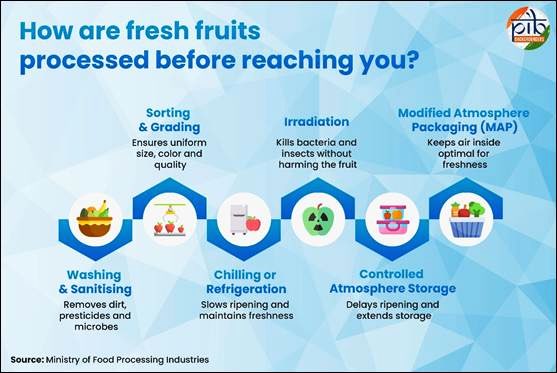
- Any food altered from natural state using techniques like heating, canning, drying, freezing, irradiation.
- Objectives: safety, extended shelf life, nutritional enhancement, marketability, waste reduction.
Why Food Processing Matters?
- Reduces spoilage & microbial hazards (Pasteurisation, sterilisation, irradiation).
- Extends shelf life → stabilises markets for perishables.
- Leads to value addition, higher farmer income, stronger agri-food chains.
- Supports nutritional interventions (fortification, germination, fermentation).
What is Food Irradiation?
- Application of controlled ionising radiation to food to:
- Kill bacteria, viruses, moulds
- Destroy insects & pests
- Delay ripening & sprouting
- Extend shelf life
- Does not make food radioactive.
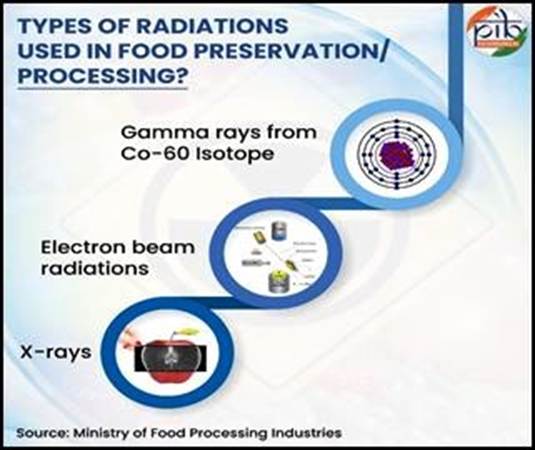
Radiation Sources Used
- Gamma Rays (Cobalt-60)
- Supplied by BRIT (DAE); MoU with BRIT mandatory.
- X-rays
- High-energy photons generated via electron beam–metal target.
- Electron Beam (e-beam)
- Fast electrons, rapid processing, shallow penetration.
Applications in India
- Potatoes, onions
- Spices
- Mangoes
- Cereals, pulses, oilseeds
- Export quarantine treatment (especially mangoes)
International Scientific Endorsement
- Approved by Codex Alimentarius, FAO/WHO, IAEA.
- Supported by American Medical Association, American Dietetic Association, Institute of Food Technologists.
- Studies show no toxicological or nutritional risks.
Benefits of Food Irradiation
- Prevents sprouting of tubers.
- Extends shelf life of fruits & vegetables.
- Eliminates insect infestation → boosts export quality.
- Reduces microbial load → prevents food-borne diseases.
- Complements cold chain infrastructure.
- Reduces post-harvest losses (India loses 30–40% fruits & veggies annually).
- Supports agri-exports (e.g., mangoes to US/EU).
Consumer Information & Labelling
- FSSAI licence number.
- Logos: Organic, Fortification (F+), HACCP, ISO22000, FSSC, BIS, AGMARK, Vegan.
- Irradiation symbol (Radura).
- Examine nutrition labels: calories, sodium, added sugar, saturated fats.
- Avoid misleading claims: “natural”, “low fat”, “home-made” etc.
Government Support – ICCVAI under PMKSY
ICCVAI (Integrated Cold Chain & Value Addition Infrastructure)
- Component of PMKSY (Pradhan Mantri Kisan Sampada Yojana).
- Objective: end-to-end cold chain from farm gate → retail.
- Addresses post-harvest losses, farmer distress sales, supply chain inefficiencies.
Key Functions
- Scientific storage
- Value addition (processing, packaging)
- Refrigerated transport
- Irradiation units for perishables
Funding Pattern
- General areas: 35% of eligible project cost (max ₹10 cr).
- Difficult Areas / SC–ST / FPOs / SHGs: 50% (max ₹10 cr).
- Difficult Areas include NE states, J&K, Ladakh, Islands, ITDP regions.
Eligibility
- Individuals, FPOs, FPCs, SHGs, NGOs, Firms, Companies, PSUs.
- Land requirement: Minimum 1 acre for standalone/integrated irradiation units.
- Proposals online: sampada-mofpi.gov.in.
Strategic Objectives of ICCVAI
- Reduce post-harvest losses (currently 20–25% fruits/vegetables).
- Increase farmer income via storage & value addition.
- Improve quality & safety of perishables.
- Stabilise market prices.
- Ensure year-round availability.
- Boost export competitiveness via global-standard safety.
Major Components of ICCVAI
- Farm Level Infrastructure (FLI).
- Distribution Hub (DH).
- Pack Houses, Ripening Chambers.
- CA/Cold Stores.
- Refrigerated/Insulated Transport.
- Radiological processing units.
Funding requires FLI + linkage to DH/transport.
Progress & Achievements
Cold Chain Infrastructure (as of June 2025)
- 395 approved, 291 operational since 2008.
- Preservation capacity: 25.52 LMT/year.
- Processing capacity: 114.66 LMT/year.
- Jobs created: 1.74 lakh.
Financial Milestones
- 2016–17 onwards:
- Grants approved: ₹2,066.33 crore
- Released: ₹1,535.63 crore
- Projects operationalised: 169
Food Irradiation Units (as of Aug 2025)
- 16 proposals approved
- 9 operational, 7 under implementation
- Total Grants-in-aid approved: ₹112.99 crore
- Released: ₹68.38 crore
Expanded Outlay (July 2025)
- Additional PMKSY allocation: ₹1,920 crore
- Total PMKSY allocation: ₹6,520 crore (till March 2026)
- Includes:
- 50 irradiation units (20–30 LMT additional capacity)
- 100 NABL-accredited FTLs
Significance for India
Economic
- Reduces wastage → raises farm incomes.
- Enhances competitiveness of Indian exports.
- Boosts food processing sector (contributes ~12% of manufacturing GVA).
Food Security
- Stabilises supply of perishables.
- Enhances safety & reduces food-borne illness burden.
Environmental
- Reduces food waste → lower climate footprint (FAO: food waste emits 4.4 Gt CO₂-eq globally).
- Efficient utilisation of harvest surpluses.
Strategic
- Supports Atmanirbhar Bharat in agri-value chain.
- Strengthens India’s compliance with global SPS norms.
- Reduces dependence on chemical fumigation (e.g. methyl bromide).
Challenges
- High initial CAPEX for irradiation units.
- Limited awareness among farmers & consumers.
- Misconceptions about “radiation” & food safety.
- Need for trained radiation safety personnel.
- Logistics integration with wider cold chain still uneven.
- Rural connectivity gaps affect collection & distribution efficiency.
Way Forward
- Strengthen farmer awareness through Krishi Vigyan Kendras & FPO networks.
- Incentivise private investment through expanded subsidies.
- Integrate irradiation with digital traceability (blockchain, QR-based tracking).
- Promote irradiation for export-oriented clusters (mango, spices, onions).
- Facilitate BRIT capacity enhancement for Cobalt-60 production & supply.
- Strengthen last-mile refrigerated transport networks.
Conclusion
- Food irradiation is emerging as a scientifically robust, economically efficient, and export-enabling technology within India’s modernising food ecosystem.
- With strong government push under ICCVAI/PMKSY, India is creating a resilient, integrated cold chain that minimises losses, enhances safety, increases farm incomes, and ensures reliable availability of high-quality food.
- The scaling of irradiation units, alongside testing labs and cold chain expansion, marks a critical transition towards a future-ready, low-waste, high-value food system.
India’s Commitment to Disability Rights
Why Is This in News?
- Government highlighted major achievements in disability inclusion ahead of International Day of Persons with Disabilities (3 December).
- Launch of revamped Sugamya Bharat App, expanded ISL Digital Repository (3,189 e-content videos), and updates on national schemes (ADIP, SIPDA, UDID, PM-DAKSH).
- Recent large-scale events (Divya Kala Mela, Purple Fest 2025) showcased government efforts on accessibility, skilling, and digital inclusion.
Relevance:
GS-II: Welfare Schemes for Vulnerable Sections
- Disability inclusion aligned with RPwD Act, SIPDA, UDID, ADIP, NDFDC.
- Government interventions for assistive devices, livelihood, education, rehabilitation.
- National institutes, CRCs, PM-DAKSH enabling skilling and job linkage.
GS-II: Social Justice, Equality, Rights
- Enforcement of Articles 14, 15, 16, 41, 46 for equitable access.
- Rights-based approach replacing charity model → core constitutional values.
- Reservation in jobs and education; anti-discrimination mandates.
GS-II: Governance & Administration
- Digital public infrastructure: UDID, Sugamya Bharat App, ISL e-library.
- Standardisation of disability certification and service delivery.
- Regulation of rehabilitation professionals (RCI Act).
Disability Rights — Constitutional & International Context
- Constitutional grounding:
- Equality before law (Article 14), non-discrimination (Articles 15–16).
- Social justice and empowerment under Directive Principles (Articles 41, 46).
- UNCRPD:
- India is a signatory (2007), driving accessibility-centric laws and programmes.
- Census 2011:
- PwDs: 2.68 crore (2.21% of population).
- Male: 1.50 crore, Female: 1.18 crore.
Legal and Policy Framework
1. Rights of Persons with Disabilities (RPwD) Act, 2016
- Replaced 1995 Act; effective from 19 April 2017.
- Expanded disability categories from 7 to 21.
- Mandates:
- 4% reservation in government jobs, 5% in higher education.
- Barrier-free access in public buildings, transport, ICT.
- Inclusive education and community-based living.
- Centralised disability certification (UDID integration).
2. National Trust Act (1999)
- Welfare for persons with Autism, Cerebral Palsy, Intellectual Disability & Multiple Disabilities.
- Runs group homes, respite care, and guardian systems.
3. Rehabilitation Council of India (RCI) Act, 1992
- Regulates training and certification of rehabilitation professionals; maintains national register.
4. SIPDA (Scheme for Implementation of RPwD Act)
- Umbrella programme supporting Ministries/States in accessibility, awareness, skill development, and inclusion.
Key Government Schemes & Initiatives
1. Accessible India Campaign (Sugamya Bharat Abhiyan), 2015
- Aims for universal accessibility in:
- Built environment
- Transport systems
- ICT services
- Revamped Sugamya Bharat App (2025):
- Accessibility mapping/rating of public spaces.
- Digital directory of schemes, jobs, scholarships.
- Grievance redressal for accessibility complaints.
- Supports assistive tech, voice navigation, multi-language UI.
2. ADIP Scheme (1981)
- Provides assistive aids/devices + corrective surgeries.
- Covers hearing aids, wheelchairs, prosthetics, cochlear implants.
- Case Highlight: Cochlear implant success story of Kritika (Nagpur).
3. Deendayal Divyangjan Rehabilitation Scheme (DDRS)
- Financial assistance to NGOs for special education, training, and rehabilitation services.
4. National Divyangjan Finance & Development Corporation (NDFDC)
- Concessional loans for entrepreneurship.
- DSY: Loans for self-employment.
- VMY: Microfinance via SHGs/JLGs.
5. Artificial Limbs Manufacturing Corporation of India (ALIMCO)
- Only Indian PSU manufacturing a full range of assistive devices.
- Setting up Pradhanmantri Divyasha Kendras (PMDKs) across national institutes.
6. Unique Disability ID (UDID)
- Centralised national database.
- Single ID ensures uniformity, transparency, and targeted delivery.
- Includes online applications, renewals, MIS tracking, future scalability.
7. PM-DAKSH-DEPwD Portal
- One-stop platform for skill development and employment:
- Divyangjan Kaushal Vikas: 250+ skill courses, UDID-based enrolment.
- Rozgar Setu: 3,000+ geo-tagged job listings; MoUs with private companies.
8. National Institutes & CRCs
- 9 National Institutes + 30 CRCs providing rehabilitation, training, R&D, and outreach.
Purple Fest 2025 (Goa)
- India’s largest inclusion festival.
- Key launches:
- Revamped Sugamya Bharat App.
- IELTS Handbook for PwDs.
- RPL Certification for ISL interpreters/SODA/CODA.
- Training programmes in ASL/BSL for ISL professionals.
Promotion of Indian Sign Language (ISL)
ISLRTC (Nodal Body)
- Established 2015 under DEPwD.
- Key achievements:
- World’s largest ISL Digital Repository (3,189 videos; 2,200+ glossary videos).
- ISL Dictionary > 10,000 terms.
- Channel 31 under PM e-Vidya dedicated to ISL training.
- ISL translation of NCERT textbooks (Classes 1–12) to be completed by 2026.
- PRASHAST App: screened 92 lakh+ students for early disability detection.
Strengths
- Strong rights-based legislative framework aligned with UNCRPD.
- Digital-first inclusion strategy (UDID, Sugamya Bharat App, PM-DAKSH).
- Rapid expansion of ISL ecosystem — repository, dictionary, training channels.
- Economic empowerment through NDFDC, skill programmes, Divya Kala Melas.
Challenges
- Physical accessibility in public spaces remains uneven across States.
- Delayed disability certification; rural areas lack trained assessors.
- Assistive devices market still dependent on imports despite ALIMCO.
- Learning materials in ISL need faster translation cycles.
- Employment for PwDs remains below 1% in many sectors.
Way Forward
- Seamless integration of disability inclusion in Smart Cities and urban design.
- Strengthening local-level rehabilitation services via Panchayati Raj institutions.
- Incentivising private sector hiring via tax benefits and accessibility ratings.
- Expanding ISL interpreter workforce and formalising ISL as a recognised language.
Conclusion
- India’s disability rights movement has shifted from a welfare approach to a rights-based, accessibility-driven model.
- The combination of strong legislation, digital inclusion tools, targeted financial schemes, assistive technology expansion, and large-scale awareness festivals reflects a maturing, institutionalised framework.
- These initiatives collectively aim to build a society where persons with disabilities participate fully and independently, with dignity and equal opportunity.


