
Why is this in news?
- New scholarship foregrounds Mahad as the birthplace of one of India’s earliest human rights movements, led by Dr. B. R. Ambedkar in 1927.
- Highlights how Mahad shaped:
- India’s constitutional ethics
- Discourse on water democracy, caste annihilation, and gender equality
- December 25 (Manusmriti Dahan) is increasingly viewed as Indian Women’s Liberation Day.
Relevance
GS-1 (Society & Social Movements)
- Caste system, untouchability, Bhakti–Dalit reform movements.
- Social justice movements and their historical roots.
- Intersection of caste and gender.
GS-2 (Polity & Constitution)
- Evolution of constitutional morality.
- Foundations of Article 17, equality, dignity, and Fundamental Rights.
- Human rights discourse and Ambedkarian constitutional philosophy.
Basic understanding
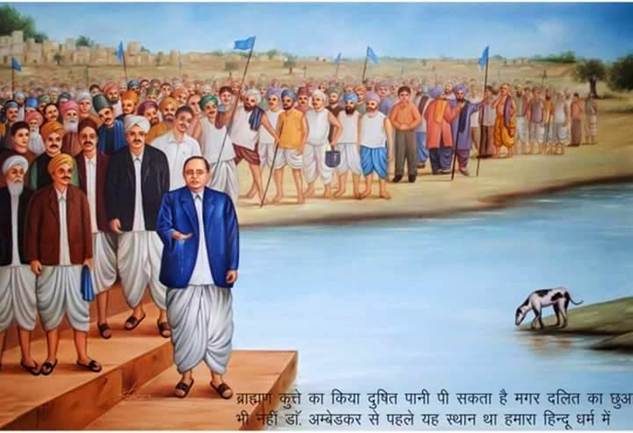
- Mahad Satyagraha was launched by Ambedkar in 1927 at Chavadar Tank (Mahad) to assert Dalit right to access public water.
- It operationalised the 1923 S. K. Bole Resolution permitting untouchables to use public tanks.
- It marked the shift from reformist charity to rights-based mobilisation.
Social and regional background
- Mahad, in the Bombay Presidency, had rigid caste norms and denial of public water to Dalits.
- Region had a reformist legacy: Gopalbaba Walangkar, N. M. Joshi, Sambhaji Gaikwad, and later R. B. More.
- Local incidents at Goregaon and Dasgaon showed early resistance by untouchables.
The Bole Resolution (1923)
- Recommended allowing untouchable communities to use all public water bodies funded or maintained by public authorities.
- Directly challenged Brahmanical control over public resources.
- Gave Ambedkar a legal and legislative foundation for Mahad.
Mahad 1.0 (March 19–20, 1927)
- Thousands followed Ambedkar to assert water rights.
- Local caste groups denied access despite the 1923 resolution.
- Dalits had to purchase water for ₹40, illustrating extreme exclusion.
- Upper castes carried out purification rituals after Dalits touched the tank.
Significance
- First mass assertion of dignity, equality, and human rights by Dalits.
- Ambedkar compared it to the French Revolution for its transformative ethos.
The phase between Mahad 1.0 and 2.0
- Court issued a stay claiming the tank was privately owned → blocked Dalit access legally.
- Ambedkar launched Bahishkrut Bharat, articulating democratic and human rights ideals.
- Violent reprisals in the region → creation of Ambedkar Seva Dal.
- Ambedkar engaged in the Ambabai Temple Satyagraha.
Mahad 2.0 (December 25–26, 1927)
- Ambedkar avoided direct satyagraha due to ongoing court case.
- The gathering became a philosophical and political intervention.
- The Manusmriti was burned, symbolising a break with Brahmanical patriarchy and graded inequality.
- Ambedkar addressed women explicitly, foregrounding gender as central to human rights.
Ambedkar’s gendered imagination of the nation
- Ambedkar’s 1916 paper theorised caste as a system sustained through control of women.
- At Mahad 2.0, women and men gathered as equal participants—an embryonic National Assembly of the oppressed.
- Contrasted with the French Revolution, which excluded women; Mahad corrected this gap.
- Rights were framed through Buddhist ethics of maitri, manuski, liberty, equality, fraternity.
Intellectual significance
- Mahad redefined political struggle as a human rights movement, not a reformist appeal.
- Key ideas that emerged:
- Dignity as a non-negotiable right
- Equality independent of religious sanction
- Fraternity as a social ethic, not sentiment
- repudiation of scriptures that legitimised hierarchy
- Formed the ethical foundation of:
- Article 17
- Constitutional morality
- Fundamental Rights framework
Why Mahad marks a turning point ?
- First organised movement asserting human rights in modern India.
- Introduced the idea of water as a democratic right.
- Brought women into the rights discourse, preceding global constitutional feminism.
- Transformed anti-caste struggle into a constitutional ethic.
- Provided Ambedkar the philosophical base for a republic rooted in dignity, equality, and fraternity.


