
Wondering how to start UPSC preparation during graduation? You’re not alone. Many students have the same question. The reality is that you don’t have to wait for your degree to be completed.
Your college years are the best time to begin your UPSC journey. To put it simply, UPSC CSE preparation requires years of preparation and consistency. In your graduation phase, you have curiosity, sufficient time, and minimal responsibility. The best part? Small daily efforts can help you progress over time- All this is possible without rushing.
When you start UPSC preparation during graduation, you learn concepts early. Daily reading, note-making, and answer-writing practice becomes your habit. This can help you in the long run and master topics efficiently. You have sufficient time to choose and prepare well for optional subjects.
When your graduation is completed, you already have a strong foundation. This helps you stay ahead of the competition. In this article, we have a step-by-step guide on how to start UPSC preparation during graduation and how Legacy IAS Academy helps beginners start strongly.
Why Graduation is the ideal time to begin UPSC Preparation?
Many aspirants ask, “Why graduation is the ideal time to begin UPSC preparation?” The reasons are quite straightforward. You have enough time, flexibility, and fewer responsibilities. You can grasp concepts and try different resources without any time constraint or worrying about your full-time job.
Here are the key reasons why graduation is the ideal time to begin your UPSC preparation:
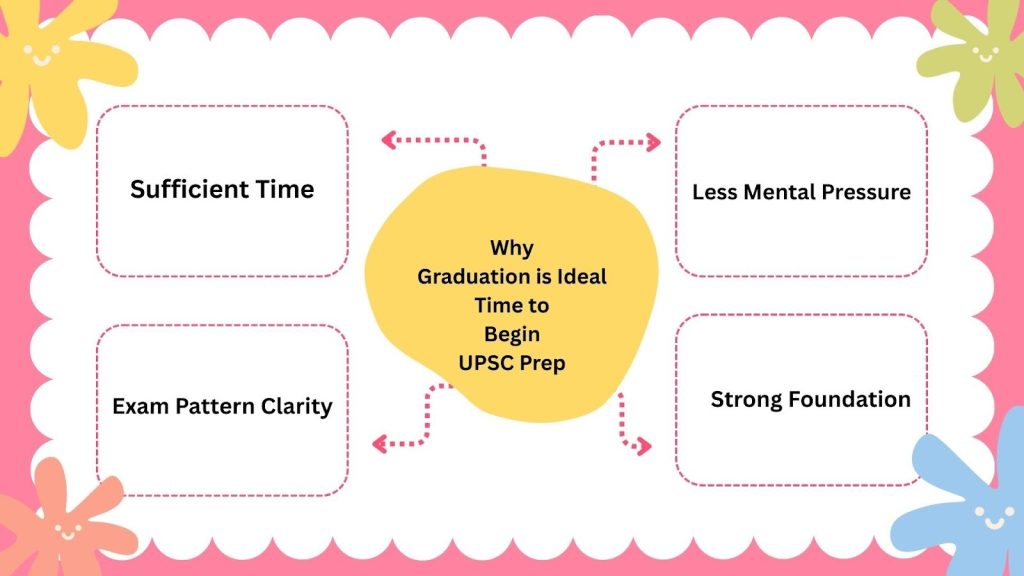
Sufficient Time & Less Pressure
After finishing your degree, you may get busy with your full-time job. Many aspirants do not take a career break to prepare for the UPSC exam. It’s not very easy to balance a full-time job and UPSC prep.
Your full-time job may leave you exhausted at the end of the day. While you don’t need long study hours in college. Just 1-2 hours daily is sufficient. These small efforts can help you build strong habits.
Understand the UPSC Pattern Early
Starting early gives you the time to slowly understand UPSC exam requirements. This includes question format, weightage, marking scheme, and more. This keeps you on the right track and enhances your preparation.
Develop a Strong Base
UPSC tests your conceptual clarity and understanding. It is not about rote memorisation. When you start early, you have sufficient time to master the NCERTs and build a reading habit. These solid fundamentals can simplify your UPSC preparation. Are you looking for guidance during graduation?
This is where Legacy IAS Academy steps in. Courses like the Legacy IAS Foundation Course or the Legacy IAS Academy Weekend Coaching help you balance college studies and preparation.
Role of NCERT books in Concept Building
Every UPSC topper has shared how NCERTs have helped them build a stronger base. NCERTs are simple and easy to understand. So, you must refer them to gain conceptual clarity. When you begin NCERTs during graduation, you cover nearly 40-50% of the syllabus.
But you should know how to make the most of the NCERT books. Here are a few tips on how to build strong concepts with NCERT books:
- Begin by reading the NCERTs of Class 6-8. This helps you build concepts from scratch for many subjects. They are history, geography, polity, economy, etc.
- After this, start reading Class 11-12 NCERTs. The content in those books matches the UPSC GS syllabus. They are more detailed and can help you advance your concepts.
- Maintain a notebook to write key facts clearly. This can be helpful in quick revision. You will not have to go through the entire chapter every time.
- Many questions in UPSC are asked from the NCERTs. So, you should seriously study the NCERTs to maximise your chances of success.
Importance of developing a daily newspaper-reading habit
You must build a habit of reading the newspaper daily. It plays an important role in your UPSC preparation. And the perfect time to build this habit is your college days.
- Reading newspapers daily will keep you informed about all the latest happenings.
- It improves your analytical thinking and writing ability.
- This helps you connect daily events with the topics in the UPSC syllabus. This can solidify your preparation.
When you read the newspaper, try to emphasise more on the Government policies, economic updates, International relations, etc. Still, many students find it difficult to maintain this habit regularly. They can join Legacy IAS Online Coaching for current affairs compilation, editorial analysis, and PIB summaries.
Early note-making techniques for GS subjects
Note-making strategy can help you recall key information. It allows you to revise the entire syllabus quickly. You can start maintaining notes during your graduation. Here are a few note-taking techniques for GS subjects:
- Maintain a separate notebook for every subject. This helps you avoid conceptual clashes or confusion.
- Use simple sentences and bullet points for clarity.
- You can integrate flowcharts and mind maps for quick revision.
- Regularly updates your notes with the latest information.
When and how to choose your optional subject during college?
An optional subject plays an important role in your UPSC exam performance. That’s why you should choose the UPSC optional subject carefully. When you start UPSC preparation during graduation, you get sufficient time to understand the optional subject.
This can help you make an informed decision. Here are tips on how to choose your optional subject during college:
- Pick the subject you are really interested in. It helps you build long-term consistency.
- Analyse the syllabus and PYQs of the optional subjects. It helps you understand the exact requirements and decide accordingly.
- Check whether your graduation subject matches the UPSC syllabus. Subjects like history or geography offer a strong overlap.
- Talk to the experts for proper guidance. Mentors at Legacy IAS help students focus on optional subjects as part of their UPSC Foundation Course. You can check out the Legacy IAS Foundation Course. It helps students build concepts from scratch with or without prior knowledge in the subject.
Benefits of Practicing Answer Writing from 1st and 2nd year
Answer writing is the backbone of the UPSC Mains Exam. You can build a confident mindset when you start this in your college studies. Some benefits of practising answer writing from 1st and 2nd year are:
- It improves your analytical and critical thinking ability.
- It enhances your ability to structure your answers.
- It improves your speed of writing answers.
- You learn question scanning and expressing ideas clearly.
So, you can start by writing 2-3 answers every week. Your answers should have proper formatting. Include a clear intro, body, and short conclusion. Use bullet points and simple language. This can make your answers look clear and well-organised. You can also create diagrams to explain certain points wherever applicable.
How Legacy IAS Foundation Courses Help Beginners Start Correctly?
Feeling confused about how to start UPSC preparation as a beginner? All you need is the right books, a structured course, and a study schedule to start strongly. This is where the Legacy IAS Foundation Course steps in. Some of its benefits are:
- It can be accessed in three modes: Offline Physical Classroom, Online Sessions, and Recorded Classes.
- Experienced Faculty who have strong knowledge of the UPSC Civil Services Exam.
- Special Guest Lectures and Motivation Session with Alumni.
- Updated Resources for Static Subjects and Current Affairs.
- Class Tests on Weekend, Surprise Tests, and Daily Mains Answer Writing Practice.
- Preparation of Optional Subjects, etc.
Starting your UPSC preparation during graduation is one of the smartest moves. You get sufficient time, strong basics, and minimal pressure. It helps you develop a newspaper habit, master the NCERTs, and explore optionals at an early stage. And the expert guidance from Legacy IAS Academy can help you start your UPSC journey in the right direction.
Frequently Asked Questions
Q) How to study for UPSC along with graduation?
A) You can start with NCERTs and a newspaper reading to build strong basics. Spend 2-3 hours daily to cover at least 50% of the syllabus during your graduation.
Q) How to balance college and UPSC preparation?
A) You can build a smart strategy to efficiently balance your college and UPSC preparation. Use weekends and vacations to revise and practice answer-writing.


