
Why is this in News?
- The Union Government is set to introduce the VB-GRAM Bill in the Lok Sabha to replace MGNREGA, 2005.
- The Bill proposes a structural shift:
- From demand-driven employment guarantee → supply-driven, budget-capped framework.
- Strong Opposition objections on:
- Dilution of legal right to work.
- Increased State financial burden.
- Removal of Mahatma Gandhi’s name.
- Centralisation of power via area notification by the Union.
Relevance
- GS II:
- Welfare schemes, rights-based vs executive-driven governance
- Federalism, Centre–State fiscal relations
- Decentralisation, role of Panchayati Raj Institutions
- GS III:
- Inclusive growth, rural employment, poverty alleviation
- Public finance, fiscal discipline vs social protection
MGNREGA (2005): Core Basics
- Legal right to employment under Article 21 (Right to livelihood – judicial interpretation).
- Guarantees:
- 100 days of unskilled manual work per rural household per year.
- Work on demand within 15 days, failing which unemployment allowance is payable.
- Cost sharing:
- Centre: ~90% (wages + material).
- States: ~10% (mainly unemployment allowance).
- Decentralised:
- Gram Panchayat as principal planning and implementing authority.
- Key objectives:
- Livelihood security.
- Creation of durable rural assets.
- Strengthening grassroots democracy.
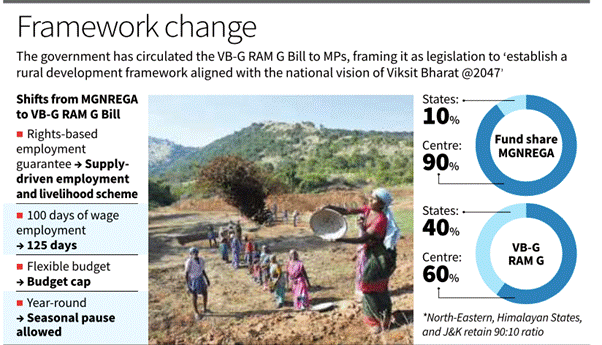
What is VB-GRAM Bill?
- Replaces MGNREGA with a new employment and livelihood mission.
- Key shifts:
- Supply-driven scheme (no statutory demand guarantee).
- Fixed annual budget cap decided by Union Government.
- Employment only in Centre-notified rural areas.
- Guaranteed workdays increased from 100 → 125 days.
- State contribution raised to 40% of total expenditure.
Demand-Driven vs Supply-Driven: Conceptual Difference
Demand-Driven (MGNREGA)
- Employment is a right, not discretion.
- Fiscal outlay expands automatically with demand.
- Strong shock absorber during:
- Droughts.
- Pandemic-like crises.
- Agrarian distress.
Supply-Driven (VB-GRAM)
- Employment limited by budget ceilings.
- Government decides:
- Where work is provided.
- How much work is available.
- Converts entitlement into welfare discretion.
Key Changes at a Glance
| Aspect | MGNREGA | VB-GRAM Bill |
| Nature | Legal right | Welfare scheme |
| Workdays | 100 | 125 |
| Trigger | Worker demand | Govt allocation |
| Budget | Demand-responsive | Fixed, capped |
| Area coverage | All rural India | Centre-notified areas |
| State share | ~10% | ~40% |
| Federal tilt | Decentralised | Centralised |
Constitutional & Federalism Concerns
- Article 246 + Seventh Schedule:
- Rural employment, agriculture, land → State List/Concurrent List orientation.
- Increased State share:
- Unfunded mandate.
- Violates spirit of cooperative federalism.
- Central notification of eligible areas:
- Weakens Gram Sabha autonomy (Article 243).
Socio-Economic Implications
Positive Arguments (Government’s Likely Rationale)
- Fiscal predictability and expenditure control.
- Better targeting of backward regions.
- Alignment with Viksit Bharat 2047 productivity narrative.
- Shift from relief-oriented work to “livelihood mission”.
Negative Implications
- Exclusion risk for distress-hit but non-notified areas.
- Loss of automatic safety net during economic shocks.
- Higher State burden may lead to:
- Delays in wage payments.
- Reduced work provision.
- Weakens women’s participation (MGNREGA had ~55–60% women workers).
- Potential rollback of poverty reduction gains:
- MGNREGA contributed significantly to fall in rural poverty and distress migration.
Political Economy Dimension
- Removal of Mahatma Gandhi’s name:
- Symbolic break from rights-based welfare architecture.
- Shift reflects broader trend:
- From rights-based legislations (RTI, MGNREGA, NFSA)
- To executive-driven missions.
- Raises question: Welfare state → Developmental state with fiscal discipline?
Governance & Accountability Issues
- No clarity on:
- “Parameters” for budget allocation.
- Criteria for area notification.
- Reduced legal enforceability:
- No unemployment allowance guarantee.
- Potential erosion of social audit effectiveness.
Way Forward
- Retain statutory demand-based core, even with budget rationalisation.
- Transparent, rule-based criteria for area notification.
- Restore balanced Centre-State cost sharing.
- Strong social audit and grievance redress mechanisms.
- Parliamentary scrutiny via Standing Committee.


