
Why is this in News?
- ACLED (Armed Conflict Location and Event Data) released its 2025 global conflict assessment.
- Key headline:
- 831 million people exposed to conflict in 2025.
- Roughly one in six people globally.
- Reveals:
- Sharp rise in violent events.
- Increasing state involvement in violence, including against civilians.
- Changing nature of warfare, especially use of commercial drones by non-state actors.
Relevance
- GS II:
- International relations, global conflict trends
- Role of UN, multilateralism, peacekeeping
- GS III:
- Internal security: non-state actors, emerging technologies in warfare
What is ACLED?
- An independent, globally recognised conflict data collection and analysis organisation.
- Tracks:
- Political violence.
- Armed conflict.
- Protest events.
- Used by:
- UN agencies.
- Governments.
- Researchers and humanitarian organisations.
Key Global Findings (2025)
Scale of Conflict
- ~200,000 violent events recorded globally.
- Nearly double compared to four years ago.
- 10% of global population exposed to conflict environments.
Nature of Contemporary Conflicts
1. Increased Violence, Reduced Restraint
- Armed actors show:
- Higher willingness to use force.
- Disregard for civilian harm.
- Reflects erosion of:
- International Humanitarian Law (IHL).
- Norms protecting non-combatants.
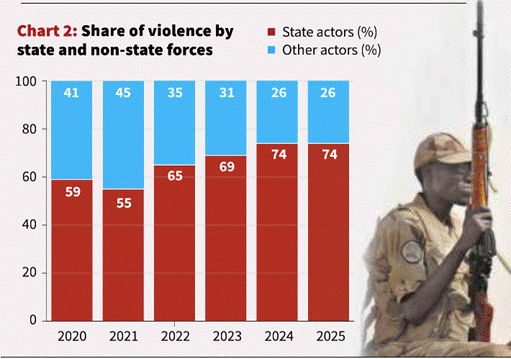
2. Rising Role of State Forces
- 74% of violent events involved state forces in 2025.
- State-led violence against civilians:
- Increased from 20% (2020) → 35% (2025).
- Indicates:
- Militarisation of internal conflicts.
- Shrinking space for civilian protection.
Civilians at the Centre of Violence
- 56,000+ incidents of violence directed at civilians.
- Highest in the last five years.
- Two critical patterns:
- States increasingly targeting civilians.
- Non-state groups causing the majority of fatalities.
Region-wise Trends
Europe
- Largest increase in violence globally.
- Driven overwhelmingly by:
- Russia–Ukraine war.
- Highest number of people affected since 2022 invasion.
West Asia
- 48% decline in violent events compared to 2024.
- Key reasons:
- End of Syria’s civil war.
- Ceasefires in Gaza and Lebanon.
- Reduced Israeli and Turkish air campaigns:
- Led to 17% global drop in aerial warfare.
Africa
- Continues to bear:
- High civilian fatalities.
- Complex multi-actor conflicts.
- Sudan, DRC, Myanmar remain major hotspots.
State vs Non-State Actors: A Nuanced Picture
State Actors
- Israel and Russia:
- Responsible for ~90% of cross-border state violence targeting civilians.
- Myanmar military:
- Accounted for ~33% of state violence against its own civilians.
Non-State Armed Groups
- Responsible for ~60% of civilian fatalities.
- Major perpetrators:
- Rapid Support Forces (RSF), Sudan:
- 4,200 civilians killed.
- ~11% of all non-state group fatalities globally.
- Allied Democratic Forces (ADF):
- ≥1,370 civilian deaths.
- M23 movement (DRC):
- 1,100 civilian deaths.
- Rapid Support Forces (RSF), Sudan:
- Numbers likely undercounted due to reporting gaps.
Technological Shift in Warfare
Weaponisation of Commercial Drones
- 469 non-state armed groups have used drones at least once in last five years.
- 14% increase over the previous year.
- Significance:
- Democratisation of military technology.
- Low-cost, high-impact tools bypass traditional state monopoly on force.
- Raises challenges for:
- Airspace control.
- Counter-terrorism.
- Civilian safety.
Broader Implications
International Humanitarian Law (IHL)
- Rising civilian targeting signals:
- Weak enforcement of Geneva Conventions.
- Normalisation of civilian harm.
Global Security
- Conflicts are:
- More frequent.
- More lethal.
- More fragmented.
- Multi-actor conflicts harder to resolve diplomatically.
Humanitarian Impact
- Increased displacement.
- Food insecurity.
- Collapse of health and education systems in conflict zones.
India and Global Governance Lens
- Reinforces need for:
- Stronger multilateral conflict prevention.
- UN Security Council reform.
- Regulation of emerging military technologies (drones, AI).
- Relevant for India’s role in:
- UN peacekeeping.
- Global South diplomacy.
- Norm-building on warfare ethics.


