
Content
- YARD 1267 SAMUDRA PRATAP
- Good Governance Day
YARD 1267 SAMUDRA PRATAP
Why is it in News?
- The Indian Coast Guard (ICG) inducted its first indigenously designed & built Pollution Control Vessel (PCV) — ICGS Samudra Pratap (Yard 1267) — on 23 December 2025, constructed by Goa Shipyard Ltd (GSL) under the 02-PCV project.
- The vessel has >60% indigenous content, reinforcing Aatmanirbhar Bharat & Make in India in advanced maritime platforms.
- It is now the largest vessel in the ICG fleet, significantly upgrading oil-spill response, marine pollution control & EEZ-surveillance capability.
Relevance
- GS-III | Environment & Disaster Management — strengthens marine pollution response capacity, oil-spill control, IMO-MARPOL compliance, NOS-DCP implementation, Blue Economy sustainability.
- GS-III | Internal & Coastal Security / Maritime Governance — enhances ICG operational readiness in EEZ surveillance, offshore safety, port-shipping lane protection, marine hazard response.
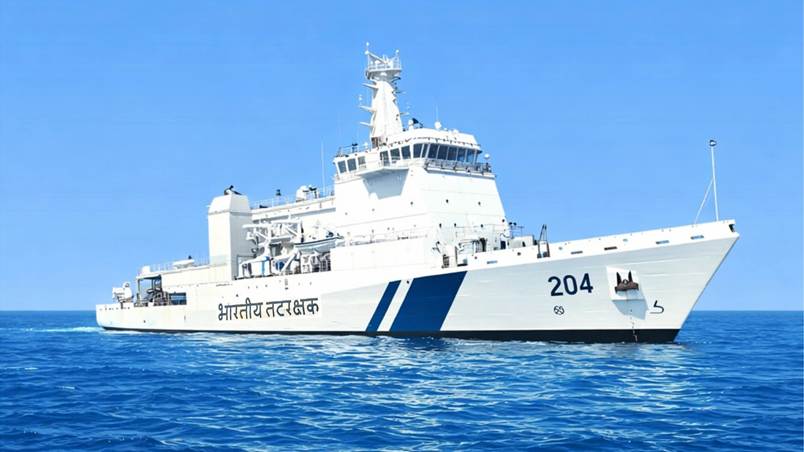
Key Specifications
Pollution Control Vessel (PCV) : Specialised maritime platform for oil-spill & chemical pollution response — equipped with skimmers, booms, dispersant systems, recovery tanks and onboard labs to contain, collect, and treat pollutants at sea.
- Length: 114.5 m
- Breadth: 16.5 m
- Displacement: 4,170 tonnes
- Type: Pollution Control Vessel (PCV)
- Dynamic Positioning (DP-1): A computer-controlled system that uses thrusters and sensors to hold the ship’s position and heading automatically without anchors, enabling safe, high-precision operations during pollution-response tasks.
- Fire-fighting notation (FiFi-2 / FFV-2): An international certification indicating the ship has high-capacity external firefighting systems capable of combating large marine and offshore fires at greater range and water-output levels than standard vessels.
- Armament:
- 30 mm CRN-91 gun
- Two 12.7 mm Stabilised RC guns with integrated fire-control system
- Critical Systems:
- Integrated Bridge System (Indigenous)
- Integrated Platform Management System
- Automated Power Management System
- High-capacity External Fire-Fighting System
Specialised Pollution-Control Capabilities
- Oil-spill detection & analysis
- Oil fingerprinting machine
- Gyro-stabilised Standoff Active Chemical Detector
- Pollution-Control Laboratory (onboard)
- Response operations capability
- High-precision DP-enabled recovery
- Pollutant recovery from viscous oil
- Oil-water separation & contaminant analysis
- Operational Reach
- Designed for action within EEZ (≈ 2.37 million sq km) & beyond
Strategic Significance
- Maritime Environmental Security
- India handles ~1,500+ tanker movements annually; >70% crude oil imports move by sea.
- Past oil-spill incidents (Mumbai coast, Ennore, Vizag) exposed limited dedicated response assets.
- Samudra Pratap strengthens pollution-response readiness for:
- Offshore platforms
- Shipping lanes
- Ports & coastal refineries
- Blue Economy & IMO Compliance
- Enhances India’s capability under:
- MARPOL Convention
- National Oil Spill Disaster Contingency Plan (NOS-DCP)
- Aligns with India’s Blue Economy 2047 sustainability goals.
- Enhances India’s capability under:
- Force-structure Upgrade
- Adds to ICG’s role beyond SAR & coastal security:
- Environmental protection
- Marine chemical hazard response
- Firefighting support to merchant & offshore vessels
- Adds to ICG’s role beyond SAR & coastal security:
- Aatmanirbhar Defence Industrialisation
- Strengthens indigenous shipbuilding ecosystem (Goa Shipyard Ltd)
- Demonstrates domestic capability in niche maritime technologies such as:
- DP-systems
- Pollution-control labs
- Integrated ship automation
Context & Background
- India earlier operated pollution-response assets like ICGS Samudra Prahari (import-technology heavy).
- Samudra Pratap marks the first fully indigenous PCV, shifting capability from platform-adaptation to purpose-built maritime environmental vessels.
- Part of a two-ship PCV programme — enhances redundancy & nationwide deployment coverage.
Conclusion
ICGS Samudra Pratap is India’s first fully indigenous, largest Coast Guard pollution-control vessel, boosting oil-spill response, maritime environmental security, and indigenous defence shipbuilding capacity.
Good Governance Day
Why is it in News?
- Good Governance Day (25 December 2025) was observed to commemorate Atal Bihari Vajpayee’s birth anniversary, highlighting accountability, transparency, and citizen-centric governance.
- The Department of Administrative Reforms & Public Grievances (DARPG) released updates on the Good Governance Index (GGI) — a composite benchmarking tool measuring governance performance across States & UTs.
- The 2025 observance emphasized e-governance, digital service delivery, evidence-based reforms, and state-level performance improvements across 10 governance sectors.
- The year also saw major governance conferences including the 28th National Conference on e-Governance (Visakhapatnam, 2025) and IIAS-DARPG Global Governance Conference (New Delhi, 2025).
Relevance
- GS-II | Governance, Transparency & Accountability — institutionalises evidence-based reforms, citizen-centric service delivery, grievance-redress, RTSA & digital governance outcomes.
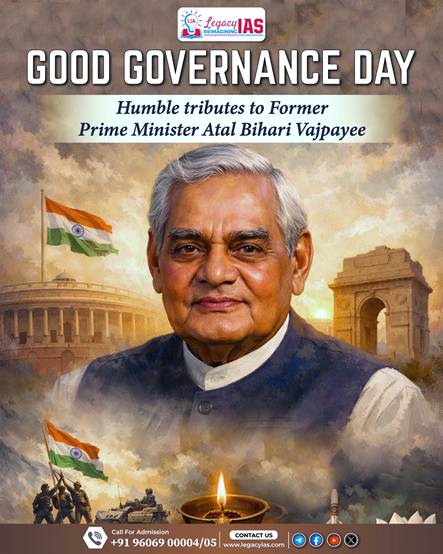
Good Governance Day — Key Facts
- Date: 25 December (since 2014)
- Purpose: Promote citizen-centric, transparent, accountable, responsive, and inclusive governance.
- Legacy Anchor: Atal Bihari Vajpayee — infrastructure expansion, telecom growth, rural connectivity, democratic values & reform-oriented governance.
- UN Governance Principles Referenced: Participation, accountability, transparency, equity, efficiency, rule of law.
Good Governance Index (GGI) — Core Features
- Launched: 2019 (DARPG) as a diagnostic & comparative governance assessment tool.
- Coverage: States & UTs grouped into 4 categories for fair comparison:
- Group-A States, Group-B States
- North-East & Hill States
- Union Territories
- Sectors Covered: 10 governance sectors / 58 indicators, including:
- Agriculture, Industry, HRD, Health
- Infrastructure & Utilities
- Economic Governance
- Social Welfare
- Judiciary & Public Safety
- Environment
- Citizen-Centric Governance
- Purpose: Benchmarking, inter-state competition, policy prioritisation, and evidence-based reforms.
Governance Performance — Evidence Highlights
- Human Development: Progress in retention rates, gender parity, digital access in schools, skilling & placement outcomes.
- Public Health: Expansion of HWCs, PHC doctor availability, IMR/MMR reduction, immunisation & hospital-bed density.
- Economic Governance: Tracking GSDP per-capita growth, fiscal deficit ratios, tax-revenue mobilisation, debt-to-GSDP discipline.
- Infrastructure & Utilities: Gains in rural connectivity, potable water coverage, LPG access, power availability & per-capita consumption.
- Citizen-Centric Governance: Service delivery acts, grievance-redress outcomes, online public-service access.
- Environment: Forest-cover change, waste-recycling share, degraded-land proportion, renewable-capacity growth.
(The Index enables sector-wise dashboards for progress monitoring and reform targeting.)
Top-Performer Context (Illustrative — GGI 2020-21 Benchmarks)
- Group-A: Gujarat, Maharashtra, Goa
- Group-B: Madhya Pradesh, Rajasthan, Chhattisgarh
- NE & Hill: Himachal Pradesh, Mizoram
- UTs: Delhi
- GGI-2019 Leaders: Tamil Nadu, Maharashtra, Himachal Pradesh, Puducherry
(Used as reference baselines for subsequent performance trends.)
2025 Governance & Reform Ecosystem
- 28th National Conference on e-Governance (Visakhapatnam, 2025):
Theme: Viksit Bharat — Civil Service & Digital Transformation; 1,000+ delegates, National e-Governance Awards, Visakhapatnam Declaration for Digital-First Governance. - IIAS–DARPG Global Governance Conference (New Delhi, 2025):
750+ delegates from 58 countries, release of Viksit Bharat@2047 — Governance Transformed; India elected IIAS Presidency (2025-28). - State Collaborative Initiative (SCI), 2025:
80+ state proposals on AI platforms, digital portals, real-time dashboards; dedicated monitoring portal.
Conclusion
Good Governance Day 2025 reinforces Vajpayee’s legacy of citizen-centric, accountable governance, while the Good Governance Index provides a data-driven, sector-wise performance benchmark to drive reforms across States and UTs.
Atal Bihari Vajpayee
- Three-time Prime Minister of India (1996, 1998–2004) — known for coalition stability, economic reforms, telecom liberalisation, National Highways Development Project, and Pradhan Mantri Gram Sadak Yojana.
- Distinguished Parliamentarian (40+ years) — elected 9 times to Lok Sabha and 2 times to Rajya Sabha; awarded Best Parliamentarian (1994) for his consensus-building and statesmanship.
- National Honors: Conferred Padma Vibhushan (1992) and Bharat Ratna (2015) for contributions to nation-building, democratic values, and governance reforms.
- Strategic & Foreign Policy Achievements: Led Pokhran-II nuclear tests (1998), initiated Lahore Bus Diplomacy, strengthened India’s global profile, and promoted peace with strength.
- Social & Governance Legacy: Advocated inclusive growth, women’s empowerment, infrastructure expansion, good governance, and citizen-centric administration — foundation for Good Governance Day (25 December).


