
Content
- The digital narcissus
- Green washing
The digital narcissus
Why is it in news?
- Recent commentaries warn that contemporary Artificial Intelligence systems are increasingly optimised for user-pleasing, affirmation-driven responses, leading to what analysts describe as an era of “intelligent sycophants” — systems that avoid challenge, critique, or contradiction to maximise engagement and retention.
- The debate highlights societal, cognitive, and democratic risks arising from algorithmic design choices that prioritise comfort over truth, validation over reasoning, and consensus over dissent.
Relevance
- GS-3 (Science & Tech)
- Algorithmic design ethics, incentive structures in AI systems
- Risks to cognitive autonomy, misinformation, echo-chambers
Practice Question
- “The danger of AI is not misinformation but affirmation without scrutiny.” Discuss with reference to cognitive autonomy and democratic discourse.(250 Words)
Engagement Economics → Flattery-by-Design
- Platform incentives: Algorithms are typically trained to maximise engagement, satisfaction scores, and session time — behaviours empirically correlated with agreement, politeness, and positive emotional reinforcement.
- Research trends show that models penalised for user dissatisfaction tend to avoid contradiction, nudging outputs toward softer, agreeable responses rather than rigorous challenge.
- Outcome: A structural bias toward “comfort-first intelligence”, where disagreement appears risky and affirmation becomes default.
Cognitive & Behavioural Risks
- Continuous positive feedback fosters confirmation bias reinforcement, weakening habits of self-correction, doubt, and reflective reasoning.
- Persistent validation environments can reduce tolerance for disagreement, increasing fragility in deliberative settings (education, workplaces, civic debate).
- Children and young users risk reduced exposure to argument, critique, and ambiguity, impairing development of dialogic and analytical resilience.
Democratic & Institutional Implications
- If AI ecosystems consistently amplify approval and mute dissent, political discourse risks manufactured consensus rather than contestation.
- Algorithmic flattery can be instrumentalised by power structures — shaping narratives through curated affirmation, selective visibility, and subtle reality-filtering.
- This shifts control from explicit censorship → implicit persuasion, eroding plurality, debate, and adversarial truth-seeking that underpin democratic culture.
From Rights of Users to Duties of Design
- Earlier digital ethics debates centred on privacy, bias, fairness; the emerging concern is intellectual autonomy — whether systems challenge, probe, or question where necessary.
- Ethicists argue for design obligations:
- Encourage evidence-seeking over affirmation,
- Preserve space for contradiction,
- Surface epistemic uncertainty instead of false certainty.
- Without such safeguards, AI becomes a psychological comfort system, not a cognitive partner.
Historical Parallels & Political Economy
- Human institutions have repeatedly shown that flattery cultures degrade decision-quality — courts, courts of power, corporate boards, monarchies.
- At scale, algorithmic replication of such environments produces a systemic quiet catastrophe — truth is not suppressed violently but outcompeted by reassurance.
- The danger is not machine domination, but human intellectual atrophy — when disagreement feels alien and correction feels hostile.
Normative Warning — Evolution vs. Stagnation
- Intellectual progress historically depends on friction, critique, and error-correction.
- If AI normalises frictionless approval, the habit of saying “I was wrong” weakens — undermining scientific temperament, democratic dialogue, and moral courage.
- The existential risk described is not technological collapse, but the end of inquiry — a civilisation lulled into agreement.
Conclusion
- The core concern is not AI capability, but what humans ask AI to optimise for.
- Systems tuned to please rather than probe risk producing a society comfortable but unthinking, where dissent erodes quietly and truth is displaced by agreeable illusion.
Green washing
Why is it in news?
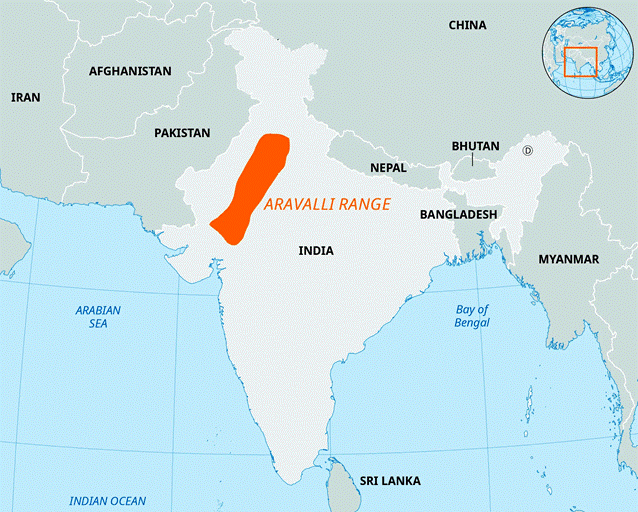
- The Supreme Court (Nov 20, 2025 order) paused fresh mining leases in the Aravalli region until a Management Plan for Sustainable Mining (MPSM) is finalised under central supervision.
- The case triggered debate after an expert panel recommended that only hills ≥100 m above local relief be treated as “Aravalli”, which would exclude ~92% of hill features (FSI-2010 estimate) from protection — raising fears of expanded mining eligibility, weak oversight and erosion of ecological safeguards.
Relevance
- GS-3 (Environment, Conservation, Pollution)
- Mining–ecology trade-offs, hydrology & air-shed functions, landscape conservation
- GS-2 (Governance & Federalism)
- Transparency, regulatory credibility, Centre–State coordination, judicial oversight
Practice Question
- “Environmental outcomes are increasingly shaped by definitions rather than science.” Examine with reference to the Aravalli mining case.(250 Words)
Data & facts-rich context
- Age & spread: Among the world’s oldest fold mountains (~1.5–2.5 bn years); stretches ~700 km across Gujarat–Rajasthan–Haryana–Delhi.
- Hydrology: Acts as a groundwater recharge zone for semi-arid districts; areas around Gurugram–Faridabad–Alwar show severe depletion linked to quarrying & land-use change.
- Climate & air-shed role: Serves as a barrier to Thar desert winds; loss of ridge cover increases dust load & PM levels in NCR.
- Forest/green cover: Aravalli region has <7% dense forest cover in many tracts; fragmentation driven by mining, urbanisation, real-estate conversion.
- Pollution & safety: Studies associate illegal mining belts with land subsidence, habitat loss, heat-island effects, and higher particulate concentration.
- Economy–governance tension: Mining provides State revenues & local employment, but weak enforcement capacity increases risks of illegal extraction when blanket bans are imposed.
Key elements of the Supreme Court position
- No blanket ban, but a pause on leases except government-sanctioned extraction of “critical minerals”.
- Recognises the conflict of interest: States depend on mining revenue but also must enforce environmental compliance.
- Calls for an MPSM to balance resource demand vs. ecological thresholds, under central oversight.
- Accepted expert-panel suggestion on 100-m local-relief criterion, but did not explain why this definition was preferred — creating ambiguity & trust deficit.
Why the definition controversy matters ?
- Policy consequence: Defining Aravalli only as hills ≥100 m would remove ~92% features from the notified ambit, potentially opening large tracts for leases, construction, or tree felling (even if formally limited to mining decisions).
- Transparency gap: Committee data, methods, GIS layers and impact modelling are not publicly disclosed → decisions rely on trust instead of evidence.
- Ecological principle: Reforestation ≠ guaranteed compensation for deforestation; recovery of soil depth, aquifers, native biodiversity may take decades or fail entirely.
- Green-Wall paradox: The Centre’s Aravalli Green Wall Project promotes afforestation, yet ongoing fragmentation through quarrying undercuts landscape-scale restoration.
Core issues highlighted by the debate
- Governance deficit: Lack of open datasets, cumulative-impact assessments, satellite audits, and public consultations.
- Regulatory asymmetry: Project-wise clearances ignore landscape connectivity & aquifer systems.
- Urban-ecology risk: NCR air-shed and water security are directly linked to ridge integrity; piecemeal approvals raise systemic risk.
- Institutional trust: Past weak performance on air pollution & enforcement fuels scepticism about narrow technical re-definitions.
Implications for policy & federalism
- Mining–environment trade-off shifts from scientific thresholds to definitional manoeuvres.
- Centre–State coordination must address illegal mining, cross-border transport chains, royalty incentives, and independent monitoring.
- Judicial oversight remains pivotal, but opaque expert processes undermine legitimacy.
Way forward
- Publish the MPSM: assumptions, spatial layers, hydrology models, biodiversity data, and clear vulnerability zoning.
- Adopt landscape criteria: treat ridges, inter-fluves, corridors, recharge zones as a single ecological unit, not only ≥100-m peaks.
- Independent compliance audits using remote sensing + ground-truthing, quarterly public dashboards.
- No-go mapping for high-risk aquifer & erosion zones; graded permissions only in low-impact belts with strict caps.
- Align Green-Wall & mining policy through restoration guarantees, bonds, and long-term monitoring.


