
Why is it in news?
- A new study by researchers from the Physical Research Laboratory (PRL), Ahmedabad and the Tamil Nadu Department of Archaeology has used Optically Stimulated Luminescence (OSL) dating to determine when flood sediments buried parts of the Keezhadi settlement along the Vaigai river.
- The findings suggest that portions of the site were covered by flood-borne sediments roughly ~1,000 years ago, helping distinguish when people lived there from when nature buried the remains.
- The study was published in Current Science (October 25) and strengthens efforts to build a scientific timeline for the Keezhadi cultural landscape beyond literary references from the Sangam corpus.
Relevance
- GS-I: Indian Culture / Archaeology
- Urban settlement archaeology, Sangam-era material culture
- GS-I & GS-III: Geography–Environment Interface
- River dynamics, floods, settlement relocation, late-Holocene climate context
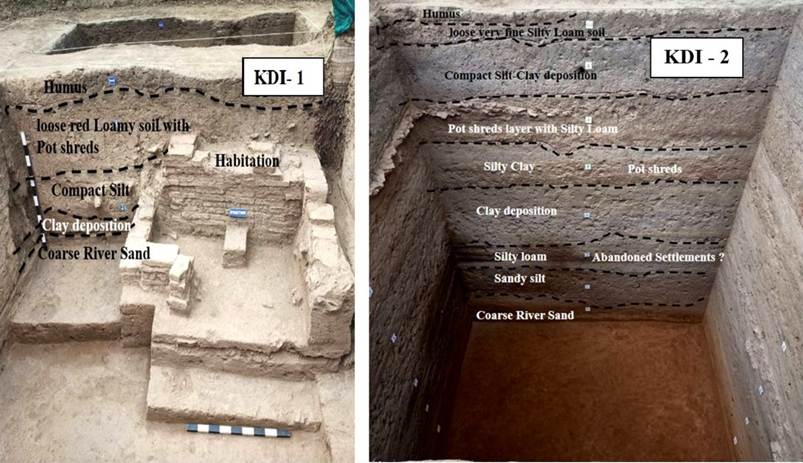
Facts & Data — Keezhadi Excavation Context
- Location: Keezhadi, Sivaganga district, Tamil Nadu — on the Vaigai floodplain.
- Excavations have revealed:
- Brick walls, channel-like drains, fine clay floors, pottery fragments
- Settlement layout suggesting urban planning, craft activity, and trade linkages
- Key research challenge:
- Sangam poems mention towns & trade, but lack precise chronology → archaeology + geoscience used to build timelines.
What did the new study examine?
- Focus: Sediment layers covering the archaeological structures, not the bricks themselves.
- Hypothesis: Flooding events of the Vaigai deposited sand–silt–clay layers that buried the settlement remains.
- Goal: Date when burial occurred → infer damage/abandonment phases of the settlement.
Method: Optically Stimulated Luminescence (OSL)
- Quartz grains accumulate energy from natural radiation while buried.
- Sunlight resets this clock when grains are exposed at the surface.
- In the lab, grains are stimulated with light → measured luminescence = time since last exposure → approximates time of burial.
- Study details:
- Four sediment samples from two pits (KDI-1, KDI-2)
- Samples extracted using light-tight metal tubes to prevent exposure.
Result: OSL dates indicate flood-deposit burial ~1,000 years ago (late Holocene phase).
Climate & River Dynamics
- The late Holocene climate in South India shows wet–dry fluctuations and river course shifts.
- The Vaigai today flows a few kilometres away from the mound → supports long-term channel migration.
- Implication: Floods + course shifts may have
- damaged infrastructure
- disrupted water access
- triggered abandonment or relocation of settlements.
Why the finding matters (Archaeological Significance)?
- Differentiates two timelines:
- Period of habitation vs. period of environmental burial
- Provides a process-based narrative: settlements respond to hydrological hazards, not only political decline.
- Guides future excavations: variable sediment thickness across pits suggests differential preservation of older layers.
Limits & Scope of Interpretation
- OSL dates the burial sediments, not the construction age of structures.
- Does not prove modern-type climate change → indicates long-term fluvial processes.
- Requires integration with ceramic typology, carbon dates, cultural layers, and stratigraphy.


