
Context and Core Development
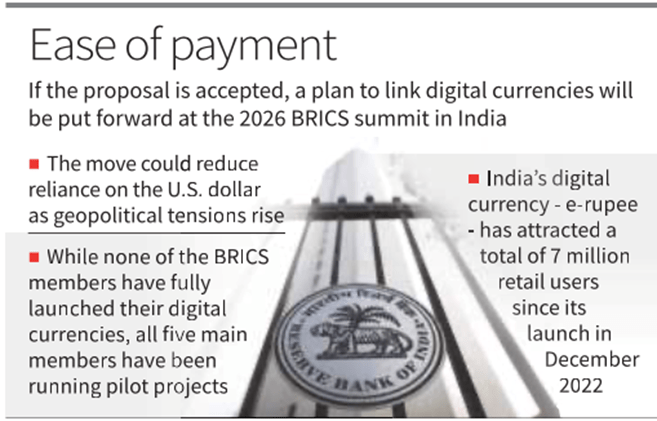
- The Reserve Bank of India has recommended that interlinking central bank digital currencies (CBDCs) of BRICS countries be placed on the agenda of the 2026 BRICS Summit, to be hosted by India.
- The proposal aims to facilitate faster, cheaper, and more efficient cross-border payments among BRICS members by enabling interoperability between sovereign digital currencies issued by their respective central banks.
Relevance
- GS II – BRICS, India’s foreign policy, strategic autonomy, multilateral and minilateral diplomacy
- GS III – Digital currency, RBI, fintech, cross-border payments, global financial architecture, de-risking
Strategic Rationale Behind the RBI’s Proposal
- Cross-border payments today remain costly, slow, and opaque, with average transaction costs globally still around 6–7 percent, disproportionately affecting developing economies.
- Interlinked CBDCs could significantly reduce settlement time, transaction costs, and correspondent banking dependence, improving trade and remittance efficiency among BRICS economies.
Building on BRICS 2025 Declaration
- The RBI proposal builds upon the 2025 BRICS Summit Declaration in Brazil, which called for interoperability between national payment systems to enhance cross-border transaction efficiency.
- This reflects an incremental approach, moving from payment system interoperability toward sovereign digital currency connectivity, rather than abrupt systemic disruption.
Current Status of CBDCs in BRICS Countries
- None of the BRICS members have fully launched retail CBDCs, but all five core members are running pilot programmes, reflecting convergent experimentation without formal adoption.
- India’s e₹ (Digital Rupee) pilot, launched in 2022, has crossed 1.3 million users and over 400,000 merchants as of 2024, making it one of the most advanced pilots globally.
India’s Digital Rupee as a Technological Anchor
- The RBI has publicly expressed interest in linking the digital rupee with other countries’ CBDCs, positioning India as a technology and standards leader in sovereign digital finance.
- India’s strong digital public infrastructure, including UPI, Aadhaar, and India Stack, provides a scalable foundation for cross-border CBDC experimentation.
Implications for Trade and Payments within BRICS
- Interoperable CBDCs could enable direct settlement of trade invoices in local digital currencies, reducing reliance on intermediary currencies and lowering foreign exchange conversion costs.
- This is particularly relevant as intra-BRICS trade exceeded USD 450 billion, yet remains heavily dollar-denominated despite growing local currency trade efforts.
Dollar Dependence and De-risking, Not De-dollarisation
- Although CBDC linkage could reduce reliance on the U.S. dollar for settlements, the RBI has clarified that India’s intent is not ideological de-dollarisation, but pragmatic payment efficiency.
- This distinction is crucial to preserve India’s access to Western capital markets, technology flows, and financial credibility.
Geopolitical Sensitivities and U.S. Response
- The proposal risks irritating the United States, which has repeatedly warned against initiatives perceived as bypassing the dollar-dominated global financial system.
- U.S. President Donald Trump has previously labelled BRICS as “anti-American” and threatened tariffs on members, raising geopolitical costs of misaligned signalling.
India’s Balancing Act within BRICS
- India must carefully balance its role in BRICS by supporting functional financial innovation without allowing the grouping to drift into overt anti-West or currency-bloc narratives.
- This aligns with India’s broader strategy of strategic autonomy and multi-alignment, engaging diverse power centres without rigid bloc politics.
Financial Sovereignty and Payment Resilience
- CBDC interoperability enhances financial sovereignty by reducing exposure to sanctions risks, payment disruptions, and chokepoints in traditional correspondent banking networks.
- This is particularly relevant after recent global experiences of financial sanctions and weaponisation of payment systems.
Technical and Regulatory Challenges
- Linking CBDCs requires robust solutions for interoperability standards, cybersecurity, data localisation, privacy protection, and settlement finality across jurisdictions.
- Divergent regulatory frameworks and capital control regimes among BRICS members could complicate harmonisation and slow operationalisation.
Monetary Policy and Financial Stability Concerns
- Cross-border CBDC use raises concerns regarding currency substitution, capital flow volatility, and potential spillovers into domestic monetary policy transmission.
- Central banks will need safeguards to ensure CBDC linkages do not undermine capital controls or domestic financial stability.
Institutional Architecture and Governance
- Any BRICS CBDC linkage would require a multilateral governance framework, potentially involving a shared settlement platform or coordinated clearing mechanisms.
- Lessons may be drawn from BIS-led projects such as mBridge, which explores multi-CBDC cross-border payment systems.
BRICS as a Laboratory for Digital Finance
- BRICS provides a relatively safe experimental space for South–South financial innovation, given shared concerns over payment efficiency and development finance constraints.
- Successful CBDC linkage could later be scaled to other emerging economies, enhancing BRICS’ relevance beyond rhetoric.
Implications for Global Financial Architecture
- While not replacing existing systems like SWIFT, interoperable CBDCs could introduce parallel settlement channels, increasing redundancy and resilience in global finance.
- Over time, this may gradually reshape norms around cross-border payments, settlement transparency, and sovereign control.
India’s Opportunity as BRICS Host in 2026
- As host of the 2026 BRICS Summit, India has agenda-setting power to frame CBDC linkage as a technical, development-oriented initiative rather than a geopolitical statement.
- India can emphasise efficiency, inclusion, and resilience, aligning the proposal with Global South development priorities.
Way Forward: Calibrated and Incremental Approach
- India should advocate pilot-based, sandbox-driven implementation, starting with limited corridors and trade-linked transactions to test operational feasibility.
- Parallel diplomatic engagement with Western partners can mitigate misperceptions and reassure stakeholders about India’s non-confrontational intent.


